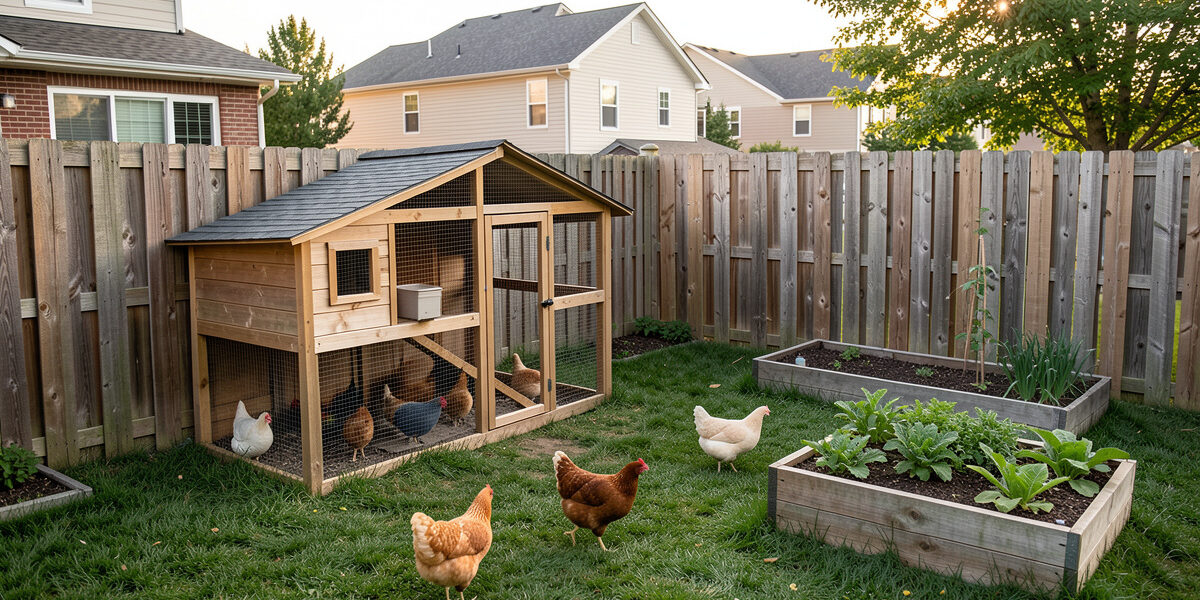
You can keep urban chickens legally in most U.S. towns and a great many suburbs, but the path runs through three gates: a permissive local ordinance, a flock sized to your lot, and neighbors who never have a reason to call. Get those right and a town coop is quieter and less work than a dog.
I keep a cold-hardy flock in Sweden in a coop I built and automated end to end, but the questions I get most often are not about welding run frames or wiring sensors — they are about the politics of keeping birds within earshot of three other households. The town flock is its own discipline. The biology is the same chicken, but the constraints are legal, spatial, and social, and ignoring any one of them is how people lose their birds. This guide is the map: what to check before you buy a single pullet, how big a flock your yard can really carry, and how to build a coop that the planning office, your nose, and the neighbor over the fence all leave alone.
Start With the Law, Not the Catalog
Before you price a coop, read your municipal code — hens are allowed in the large majority of U.S. cities, but the conditions vary wildly, and a single setback line can make your only viable yard spot illegal. The catalog coop you fell for is irrelevant until you know what your jurisdiction permits.
There is no national rule. Permission lives in the municipal code, the zoning ordinance, and — the one people forget — the private covenant. A city can welcome hens while your HOA bans them outright, and the HOA wins. The four levers almost every ordinance pulls are: a flock cap (commonly four to six hens), a rooster ban, a coop setback from property lines and dwellings (often 10 to 25 feet), and sometimes a permit or annual fee. Read the actual text rather than a forum summary; codes get amended, and a 2019 thread is not your 2026 code. I walk through how to find and read yours in the guide on urban chicken laws and how they vary by neighborhood, and the coop-specific clauses in the city chicken coop ordinance breakdown.
How Many Birds Your Lot Can Actually Hold
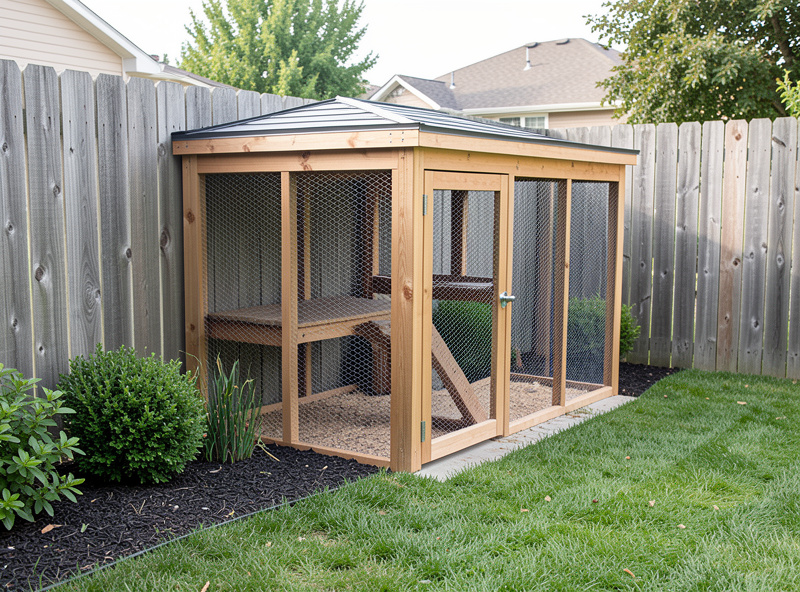
Most urban ordinances cap a flock at four to six hens, and that number usually matches what a small lot can carry anyway: plan on 4 square feet of coop floor and 8 to 10 square feet of run per bird, and a quarter-acre yard handles six hens comfortably without turning to mud.
The legal cap and the spatial reality usually agree, which is convenient. Where people get into trouble is “chicken math” — the coop you build for six ends up holding ten, because chicks are cheap and a friend has spare pullets. In town, over-crowding is not just an animal-welfare problem; it is the fastest route to odor and noise complaints, which is the fastest route to losing the whole flock. Stay at or below your legal number and build the run a size up from your bird count, not down. Two related questions deserve their own pages: the legal side in how many chickens are allowed in urban areas, and the pure space math in keeping chickens in a small backyard. For the square-footage detail behind the per-bird figures, the coop size guide has the full breakdown.
Roosters, Noise, and the Neighbor Math
You do not need a rooster for eggs, and in residential zones you almost certainly cannot keep one — roosters are banned in the overwhelming majority of urban codes, specifically because a crow carries 80 to 90 decibels across several lots at 4 a.m. Hens, by contrast, top out around the volume of human conversation.
This is the single biggest misconception new keepers carry: that chickens are loud. A laying hen’s “egg song” is a brief, intermittent cackle in the 60 to 70 decibel range, comparable to two people talking, and it stops. A rooster crows on his own schedule, repeatedly, at a volume that genuinely travels — which is exactly why he is the one bird almost every urban ordinance singles out. If you want fertile eggs or you are romantic about the farmyard sound, the suburbs-with-acreage rule is different from the in-town rule; I cover where the line actually falls in are roosters allowed in residential areas. For hens, the noise question is really a management question — covered in the rooster-free rooster management guide and the noise-and-neighbors playbook.
Designing a Coop That Fits a Town Lot
An urban coop is a small-footprint engineering problem: it has to give each hen 4 square feet inside and roughly 10 in the run, ventilate enough to dump moisture, and disappear visually — all on a footprint that often can’t exceed a garden shed. Vertical space and a covered run do most of the heavy lifting.
The town coop trades sprawl for cleverness. Hens use vertical space — a roost bar 18 inches up doubles the usable volume of a small box — and a covered, walk-in-height run lets you keep birds enclosed full-time without it feeling like a cage, which matters because free-ranging is rarely an option three feet from a property line. The non-negotiables do not shrink with the lot: ridge-and-soffit ventilation sized to exhaust the moisture birds exhale (moisture, not cold, is what frostbites a comb — see the ventilation versus draft breakdown), a roost positioned away from drafts, and nesting boxes at one per three to four hens. A combined coop-and-run unit is usually the right call on a tight lot; the full run sizing guide covers materials. The detailed small-yard layout lives in keeping chickens in a small backyard.

Predator Pressure Is Different in Town
City predators are not the ones beginners expect: raccoons, off-leash dogs, hawks, and rats do far more urban coop damage than foxes, and every one of them is defeated by the same thing — half-inch hardware cloth on every opening, never chicken wire. Chicken wire keeps chickens in; it does not keep predators out.
Suburban raccoons are dexterous, bold, and numerous, and they will reach through one-inch poultry netting and through chain-link to pull a bird apart in pieces. The fix is 19-gauge half-inch hardware cloth screwed and washered (not stapled) over every window, vent, and gap, a buried or aproned dig barrier to stop digging predators, and latches a raccoon’s hands can’t operate — a simple slide bolt is not enough. Hawks are a daytime threat that a covered run solves outright. The complete defensive system is in the predator-proof coop guide, the mesh decision is in hardware cloth versus chicken wire, and the dig-defense detail is in the underground barrier designs. In a dense neighborhood, a PoE camera on the run earns its place fast — it tells you what actually came calling instead of leaving you guessing at a pile of feathers.
Keeping the Coop Invisible and Odor-Free
A well-run urban coop has almost no smell and barely registers as a coop — odor comes from wet litter, not from chickens, and the visual objection vanishes when the structure reads as a garden feature. The deep-litter method plus a coop painted and planted to blend is what keeps the peace.
The two complaints that actually reach a city inspector are smell and sightline, and both are design problems with clean fixes. A properly ventilated coop running the deep-litter method — carbon bedding building a composting floor — stays dry and earthy-smelling rather than ammoniac; a coop that stinks is a coop that is too wet or too crowded. The sightline objection dissolves when the coop is sized down, painted to match the fence or house trim, screened with a trellis or raised bed, and kept tidy. I go deep on the camouflage tactics — from cottage-garden screening to coops that double as planters — in disguising a chicken coop in the backyard. The coop your neighbor never notices is the coop nobody complains about.
Automating the Urban Coop
Automation is what makes a town flock fit a normal life: an automatic pop door on a sunrise-offset schedule, a heated waterer on a freeze-watch, and a camera on the run turn the coop from a twice-daily chore into a system that mostly runs itself and texts you when something is wrong.
This is the part of keeping I came in through. The single highest-value upgrade is an automatic coop door — it lets hens out at first light and locks them in at dusk whether or not you are home, which both keeps a regular schedule (good for neighbors) and closes the most common predator entry point at exactly the right moment. I run mine on an astronomical sunrise/sunset offset rather than a dumb clock, wired through Home Assistant alongside the rest of the house; the logic is the same as the smart door scheduling I use everywhere. Add a thermostatic waterer so a town flock isn’t dependent on you breaking ice at 7 a.m., and an automatic feeder sized for rodent exclusion — rats are an urban coop’s quiet pest, drawn to spilled feed. A door that fails open, though, is worse than no door at all, so buy the reliability, not the gadget.
Urban Coop Setups Compared
There is no single right coop for a town lot — the choice tracks your space, budget, and how hands-off you want to be. The table below compares the four setups I see work in urban yards, with the trade-off that actually decides it.
| Setup | Best Lot Size | Flock | Visual Footprint | The Real Trade-off |
|---|---|---|---|---|
| Compact A-frame + covered run | Small (under 1/8 acre) | 3–4 hens | Low, blends easily | Cheapest and most discreet; tight on space, hard to stand up in to clean |
| Walk-in shed coop + attached run | Medium (1/8–1/4 acre) | 5–6 hens | Medium, needs screening | Easiest to service and ventilate; biggest sightline to disguise |
| Mobile tractor (movable) | Any lawn | 3–4 hens | Low, but always visible | Spreads manure and fresh grass; weaker against digging predators overnight |
| Coop-as-garden-feature (planter roof) | Small to medium | 4–5 hens | Reads as landscaping | Best neighbor camouflage; costs more and takes design effort to build |
Whichever you pick, the per-bird square footage and predator hardening are the same. The coop body is a preference; the floor space and the hardware cloth are not.
Choosing the Right Breed for a Town Flock
The best urban hens are quiet, cold- or heat-tolerant for your climate, calm in confinement, and good layers — temperament matters more in a small yard than in a pasture. Breeds in the Australorp, Orpington, Wyandotte, and Easter Egger class hit that balance and tolerate being enclosed without going stir-crazy.
A flighty, loud, or flock-aggressive breed amplifies every problem a small lot already has. For a town flock I steer people toward calm dual-purpose and reliable-layer breeds: they handle confinement, they are quiet, and they are friendly enough that the neighbor’s kids become allies rather than complainants. The full selection logic is in best chicken breeds for backyards, the friendliest breeds for households with kids, and — for anyone north of me — the cold-hardy picks. If eggs are the whole point, cross-reference the top laying breeds, and remember that even your best layers will slow down in winter as daylight drops.
What It Actually Costs to Start a Town Flock
A predator-tight urban coop for four to six hens runs roughly $400 to $1,200 built or bought, plus around $20 to $30 a month in feed and bedding once the birds are laying — the coop is the real cost, and under-spending on it is where people pay twice. Cheap coops fail the predator test, not the looks test.
Here is the honest breakdown. The coop and run are the big line: a flat-pack model that genuinely holds its rated bird count and takes half-inch hardware cloth lands around $400 to $1,200, and a self-built one can be less if you already own tools. The mistake is buying the $200 listing rated “for 6 hens” — those are rated for 6 birds you don’t mind losing, with chicken-wire panels and staple-gun closures a raccoon opens in a night. Budget separately for the hardening you will add regardless: a roll of 19-gauge half-inch hardware cloth to re-screen every opening, predator-proof latches, and a buried dig apron. Pullets run $15 to $40 each depending on breed; feed and pine-shavings bedding settle around $20 to $30 a month for a small flock. An automatic door, a heated waterer, and a camera are optional at first but each pays for itself in saved chores and saved birds. As an Amazon Associate I earn from qualifying purchases.
Climate-Proofing a Small Coop
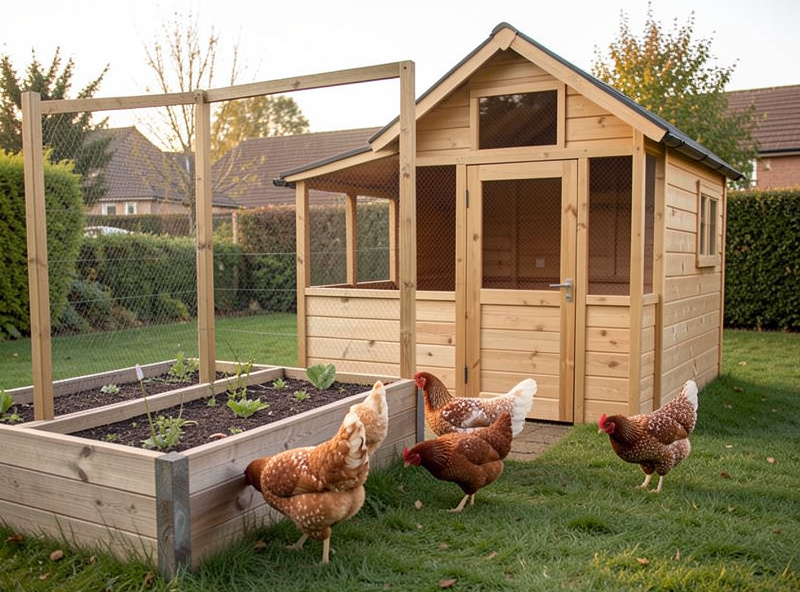
A small coop swings to extremes faster than a big one, so climate control matters more in town, not less: in cold the enemy is moisture, not temperature, and in heat the enemy is poor airflow in a tight box. Ventilation solves both, and a thermostatic waterer solves the freeze.
I keep birds through Swedish winters, and the lesson that surprises people is that hens handle cold far better than damp. A sealed-up coop traps the moisture they exhale, and that moisture — condensing on a comb overnight — is what causes frostbite, not the thermometer reading. The fix is counterintuitive: ventilate more in winter, high up and away from the roost, so humidity escapes without drafting the birds. A small footprint also overheats fast in summer sun, so site the coop in afternoon shade and keep cross-ventilation open. The one piece of cold-climate gear that is not optional is a heated or thermostatic waterer; a small waterer freezes solid by early morning, and a flock without water does not lay. None of this is exotic — it is the same ventilation logic in the coop ventilation guide, sized down for a town lot.
A Realistic Path to Your First Urban Flock
The order of operations matters: confirm legality, design to the limit, build predator-tight, then add birds — never the reverse. The keepers who lose their flocks almost always built or bought first and read the ordinance second.
Here is the sequence I’d give a neighbor starting out. First, pull your municipal code and your HOA covenant and confirm the flock cap, rooster rule, and coop setback in writing. Second, lay out the yard to the legal limit — coop, covered run, and a screening plan — before buying anything. Third, build or buy a coop hardened with half-inch hardware cloth and a dig barrier from day one, because retrofitting predator-proofing after a kill is a miserable way to learn. Fourth, choose four to six calm, climate-appropriate hens — point-of-lay pullets, not chicks, if you want eggs this season. Fifth, tell your immediate neighbors before the birds arrive and offer them eggs; a neighbor with a carton of your eggs in the fridge does not call the city. Each of those steps has its own deep guide below.
Related Guides in This Series
- Urban Chicken Laws and How They Vary by Neighborhood
- How Many Chickens Are Allowed in Urban Areas
- Keeping Chickens in a Small Backyard
- Handling Neighbor Complaints About Chickens
- City Chicken Coop Ordinances Explained
- Are Roosters Allowed in Residential Areas?
- Disguising a Chicken Coop in the Backyard
Frequently Asked Questions
Are backyard chickens legal in most cities?
Yes. Hens are legal in the large majority of U.S. cities and most suburbs, though almost always with conditions: a flock cap (often 4 to 6), a rooster ban, and a coop setback from property lines. Always confirm both your municipal code and any HOA covenant before buying birds.
Do I need a rooster for my hens to lay eggs?
No. Hens lay eggs with no rooster present; a rooster is only required to fertilize eggs for hatching. Since roosters are banned in most residential zones for their crowing, an egg flock should be all hens.
How many chickens can I keep in a small urban backyard?
Most urban ordinances allow 4 to 6 hens, which also matches what a small lot can carry: plan for 4 square feet of coop and 8 to 10 square feet of run per bird. A quarter-acre yard handles six hens comfortably.
Do backyard chickens smell bad?
A well-managed coop has almost no odor. Smell comes from wet, crowded litter, not from the birds. Good ventilation plus the deep-litter method keeps a coop dry and earthy-smelling rather than ammoniac. A coop that stinks is too wet or overcrowded.
What is the most important thing to get right before getting urban chickens?
Legality, in writing. Confirm your municipal code and HOA covenant for the flock cap, rooster rule, and coop setback before you build or buy anything. Most keepers who lose their flocks built first and read the ordinance second.
Are chickens loud enough to bother neighbors?
Hens are not. A laying hen’s egg song is brief and around 60 to 70 decibels, similar to conversation. Roosters are the loud ones, crowing at 80 to 90 decibels at all hours, which is exactly why they are banned in most urban areas.
Related Guides

Handling Neighbor Complaints About Chickens
The best way to handle a neighbor complaint about your chickens is to prevent it: keep the coop odor-free, the…
Keeping Chickens in a Small Backyard
You can keep a happy flock of three to six hens in a backyard as small as a few hundred…
Urban Chicken Laws and How They Vary by Neighborhood
Urban chicken laws are set locally, not nationally, which is why they can change from one side of a city…