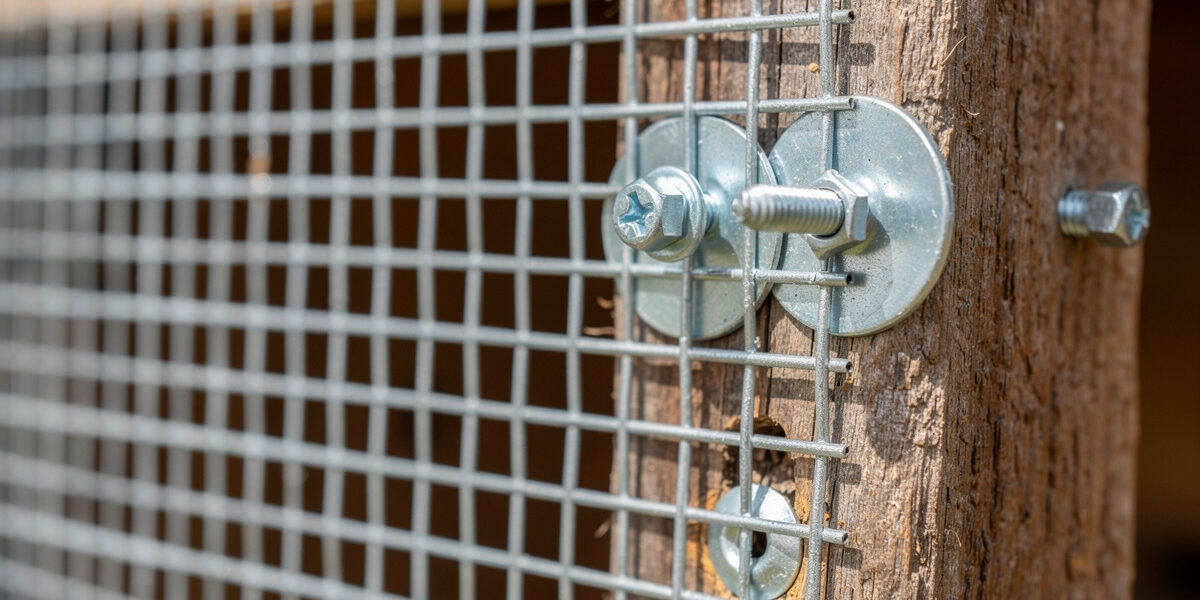
Chicken wire keeps chickens IN. Hardware cloth keeps predators OUT. 1/2-inch galvanized hardware cloth is the only mesh that reliably stops raccoons, weasels, rats, snakes, and minks. Chicken wire fails against all of them — raccoons reach through it and pull birds apart, weasels squeeze through 1-inch openings, snakes slither through the gaps. Everything predator-facing on my own welded run is 19-gauge half-inch hardware cloth screwed down with washers — it is the one material I will not cut a corner on. This guide covers why hardware cloth is non-negotiable, the specifications that matter, and where every backyard coop needs it.
Hardware cloth is the foundation of Layer 1 (coop hardening) and Layer 2 (run reinforcement) in our Predator-Proof Chicken Coop Defense Guide.
As an Amazon Associate I earn from qualifying purchases.
Hardware Cloth vs Chicken Wire: The Non-Negotiable Difference
| Property | Chicken Wire | Hardware Cloth |
|---|---|---|
| Mesh size (typical) | 1" hexagonal | 1/2" or 1/4" square |
| Wire gauge | 20–22 ga (thin) | 16–19 ga (thick) |
| Weight (per sq ft) | 0.05 lb | 0.18 lb |
| Stops raccoons reaching through | NO | YES |
| Stops weasels and minks | NO | YES (with 1/2" mesh) |
| Stops rats | NO | YES |
| Stops snakes | NO | YES (with 1/4" mesh) |
| Lifespan outdoors | 5–10 yrs | 15–25 yrs (galvanized) |
| Cost (per sq ft) | $0.30–$0.50 | $0.80–$1.50 |
| Right use | Internal flock-only barriers | All predator-facing surfaces |
The cost difference — about 3x per square foot — is real, but the per-coop math is small. An 8-bird run with 100 sq ft of mesh face costs $30–$50 in chicken wire vs $80–$150 in hardware cloth. Compared to losing $200 of birds to a single predator breach, the hardware-cloth premium pays back in one prevented incident.
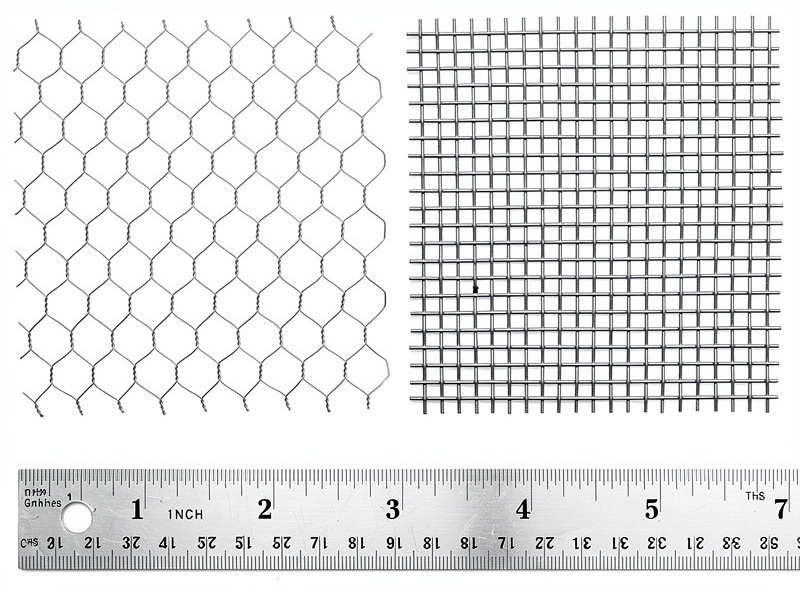
Why Chicken Wire Fails Against Predators
Chicken wire was designed in the 1840s as a lightweight, cheap fence for keeping poultry inside an enclosed area. It is excellent at that. It is not predator-proof, and it never was.
The three failure modes:
Reach-through. Raccoons grab through 1-inch hexagonal openings, hook a chicken pressed against the wire, and tear the bird apart on the spot. Most chicken wire predator deaths happen this way — birds are not extracted from the run, they are killed inside it.
Pull-apart. 22-gauge chicken wire is thin enough that determined raccoons or foxes can pull strands apart, creating an opening within 30 minutes. The wire bends and breaks under repeated pressure.
Squeeze-through. Weasels (3/4" body diameter) and minks (1" body diameter) squeeze through 1-inch hex openings without modification. Weasels are known for surplus killing — a single animal can take a dozen or more birds in one breach, far more than it eats (see Backyard Poultry’s rundown of weasel surplus-killing behavior).
Chicken wire stops chickens. It does not stop predators. Use it for internal partitions (separating chicks from older birds, dividing run sections) and never as the predator-facing barrier.
Hardware Cloth Specifications That Matter
Mesh size: 1/2" for most uses, 1/4" for snake country. 1/2" mesh stops raccoons, weasels, rats, and the smaller hawks; 1/4" adds snake-proofing at higher cost. 1" hardware cloth still lets some weasels through; only use 1" on top netting where weasel-proofing is not the primary concern.
Wire gauge: 19 ga minimum, 16 ga ideal. 23-gauge hardware cloth (sold cheaply on Amazon) is barely better than chicken wire. Look for "19 gauge" or "heavy duty" designation. 16-gauge welded mesh is the gold standard for outer perimeter.
Coating: galvanized after welding (GAW). Cheap hardware cloth is galvanized BEFORE welding — the welding process cracks the coating right at the joints, leaving the welds themselves bare and the first place rust starts. GAW mesh costs more but the whole sheet gets dipped in zinc after welding, so there’s no bare joint to fail; industrial suppliers put GAW’s real-world service life at several times longer than GBW (see Riverdale Mills’ GAW technical explainer). Verify on the spec sheet — "galvanized after weld" or "hot-dipped galvanized after weld" is what you want.
Roll size: 36"-wide rolls are most common; 48" rolls cover taller surfaces with one piece. Buy 36" for vents and openings, 48" for run walls.
Where Every Coop Needs Hardware Cloth
The full hardware-cloth coverage stack:
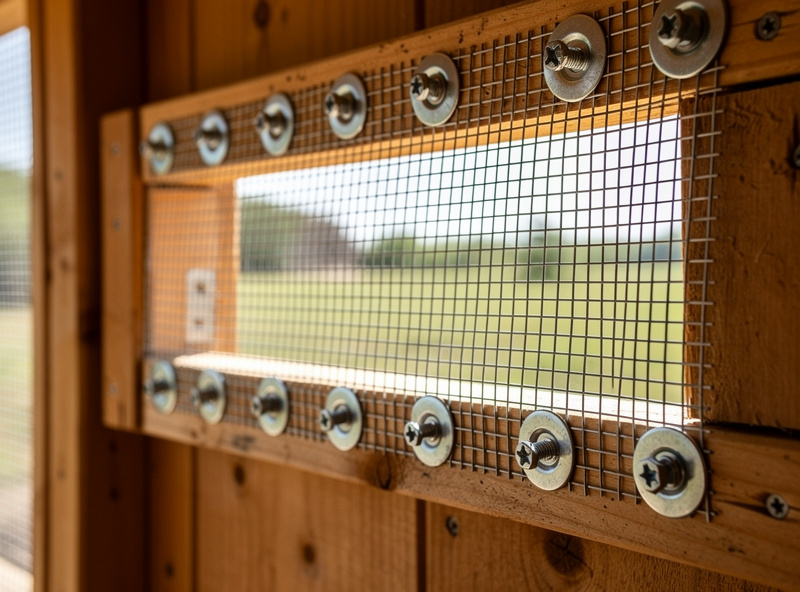
Coop vents (every one). Even small ventilation openings are predator entry points without mesh. Cut 1/2" hardware cloth slightly larger than each vent, screw to the inside of the coop wall with washers.
Pop door (the gap when closed). Modern automatic pop doors close to within 1/4" of the threshold; older models leave 1" gaps. If your gap is over 1/2", cover with a hardware cloth flap on the inside.
Coop windows. Glass windows that open need hardware cloth on the inside frame so the window can stay open in summer without being a predator entry.
Roof-to-wall joints. Inspect every gap; cover from the inside with strips of hardware cloth + silicone caulk.
Run wall (lower 4 feet at minimum). The height a raccoon or fox can reach. Above 4 feet, 1" mesh or chicken wire is acceptable for most threats.
Run roof or top netting. If overhead protection is required (every backyard with hawks), use 1" hardware cloth or agricultural netting. Solid roof is preferable for snow load areas.
Buried apron skirt. 12" outward, 4" deep around the run perimeter — the only stop for foxes and coyotes digging under. See Underground Predator Barriers.
Installation Best Practices
Hardware cloth fails most often at the attachment point, not in the mesh itself. Install it right:
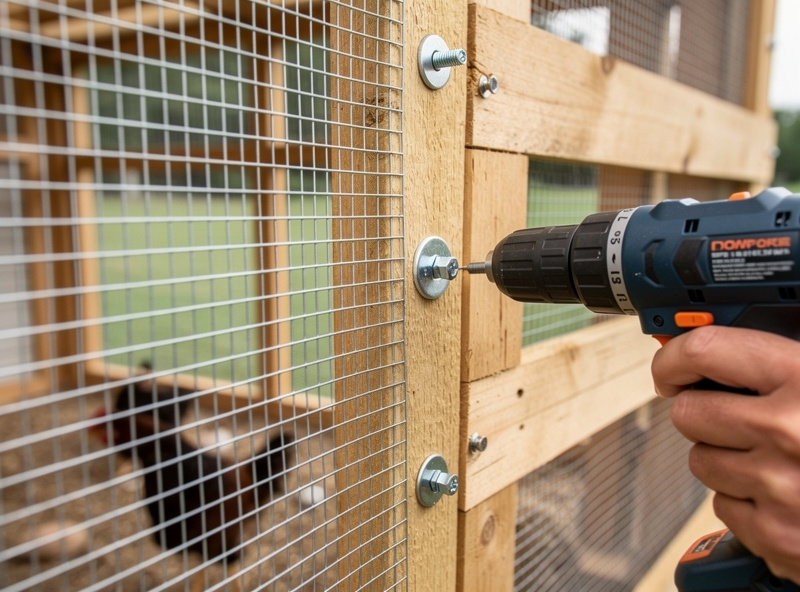
Use washers with every screw. A bare screw head pulls through hardware cloth under predator force. A 1/2"-3/4" fender washer distributes load and prevents pull-through. I have watched a raccoon peel a washerless panel back like a sardine tin; with washers it simply does not happen. Cost: $0.05 per washer; a typical install uses 30–50.
Screw spacing: every 6 inches at edges, every 12 inches at middle. Closer spacing at edges is where predator force concentrates. Use exterior-grade deck screws (1.5" minimum length).
Overlap seams 2". Where two pieces of hardware cloth meet, overlap the second piece 2" over the first and screw through both. Butt joints fail at the seam.
Mount inside or outside? For coop walls, mount hardware cloth on the OUTSIDE — this prevents predators from pulling against the wood and bypassing the mesh. For interior partitions, mount on either side. For vents, mount inside.
Leather work gloves and tin snips. Hardware cloth cuts skin. Use leather gloves, decent tin snips ($25–$40), and clean up trimmings — sharp ends are dangerous to chickens and humans.
When Other Mesh Is Acceptable
Hardware cloth is mandatory at predator-facing surfaces. Other mesh types are acceptable for specific non-predator uses:
Chicken wire: internal flock partitions (chick separation, broody-hen segregation), garden fencing inside a fenced run, cosmetic covers over hardware cloth (some keepers add chicken wire for color/aesthetic over the structural hardware cloth).
Welded wire (2" × 4" or 1" × 1"): upper-run walls (above 4 feet, where reach-through is not an issue), garden fencing for vegetable areas, chicken-tractor sides where the tractor is moved daily.
Agricultural netting (1" mesh): top netting for run aerial defense (alternative to hardware cloth on top), temporary chick brooders, hawk-defense overhead cover for free-range areas.
Plastic poultry netting: not predator-rated. Use for visual barriers, garden protection, or as a temporary chicken containment only. Do not rely on it for any predator threat.
Cost Math for an 8-Bird Coop
Full hardware cloth coverage for a typical 8-bird coop with 8'×8' run:
- Coop vents (4 vents × 1 sq ft each): 4 sq ft × $1 = $4
- Run lower 4 feet (32 linear ft × 4 ft tall): 128 sq ft × $1 = $128
- Run top (8'×8' = 64 sq ft): 64 sq ft × $1 = $64 (or skip if using cheaper agricultural netting at $0.20/sq ft = $13)
- Buried apron (32 linear ft × 1 ft wide): 32 sq ft × $1 = $32
- Hardware (washers, screws, tin snips): $25
Total: $253–$304 for full hardware cloth coverage. Comparable to one budget chicken coop's purchase price, and the single most predator-leverage you can buy. Skip nothing in this list. Physical exclusion also stops wild birds — a key disease vector. For the full keeper protocol covering quarantine, footwear hygiene, and new-bird intake, see the chicken biosecurity guide.
Frequently Asked Questions
What is the difference between chicken wire and hardware cloth?
Chicken wire is 1-inch hexagonal mesh in 20-22 gauge thin wire — it stops chickens but not predators. Hardware cloth is 1/2-inch or 1/4-inch square welded mesh in 16-19 gauge thick wire — it stops raccoons reaching through, weasels squeezing through, and rats and snakes. Chicken wire is cheap; hardware cloth is necessary.
What size hardware cloth do I need for a chicken coop?
1/2-inch mesh is the standard for most uses — stops raccoons, weasels, rats, and minks. Use 1/4-inch mesh in snake country (Southwest US, parts of Florida) for snake-proofing. 1-inch mesh is acceptable for top netting only, not predator-facing walls.
How much hardware cloth do I need for a chicken coop?
For a typical 8-bird coop with 8×8 ft run, full coverage is about 220-230 sq ft costing roughly $250-300 in materials and hardware. Coverage includes coop vents, lower 4 feet of run walls, run top, and buried apron skirt around the perimeter.
Will hawks grab chickens through hardware cloth?
No — hawks cannot grab through 1/2-inch or 1/4-inch hardware cloth. They can grab through chicken wire (1-inch hex) when birds press against it. Use hardware cloth on the lower 4 feet of any run wall and on overhead netting if hawks are a concern.
Where do I install hardware cloth on a chicken coop?
Every coop vent, every window opening, the gap under closed pop doors, all roof-to-wall joints, the lower 4 feet of every run wall, and the run perimeter as a buried apron skirt 12 inches outward and 4 inches deep. Skip nothing — partial coverage means partial protection.
How do I attach hardware cloth so predators cannot pull it loose?
Use 1/2 to 3/4-inch fender washers with every screw (about 0.05 dollars each), screw every 6 inches at edges and 12 inches at the middle, use 1.5-inch exterior deck screws minimum. The most common failure mode is bare screw heads pulling through the mesh — washers fix this completely.
Related Articles
- Predator-Proof Chicken Coop Defense Guide
- Underground Predator Barriers
- Raccoon-Proof Coop Latches
- Hawk Protection for Backyard Chickens
- Chicken Run Guide
Related Guides
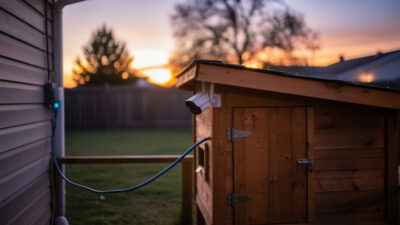
Smart Coop Cameras: Network Setup for Reliable Predator Alerts
A reliable smart coop camera setup needs three things your default home Wi-Fi rarely provides: stable signal at the coop…
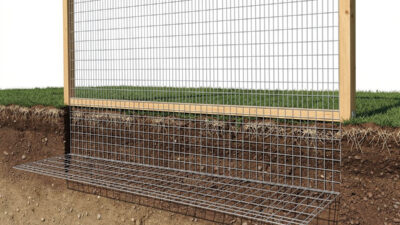
Underground Predator Barriers: Apron & Footer Designs
Foxes and coyotes can dig under an unprotected chicken run wall in well under an hour once they commit to…
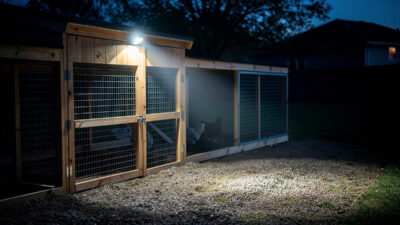
Motion-Sensor Coop Lights for Predator Deterrence
A 200+ lumen motion-activated light mounted at the chicken run perimeter is a genuine short-term deterrent for raccoons, foxes, and…