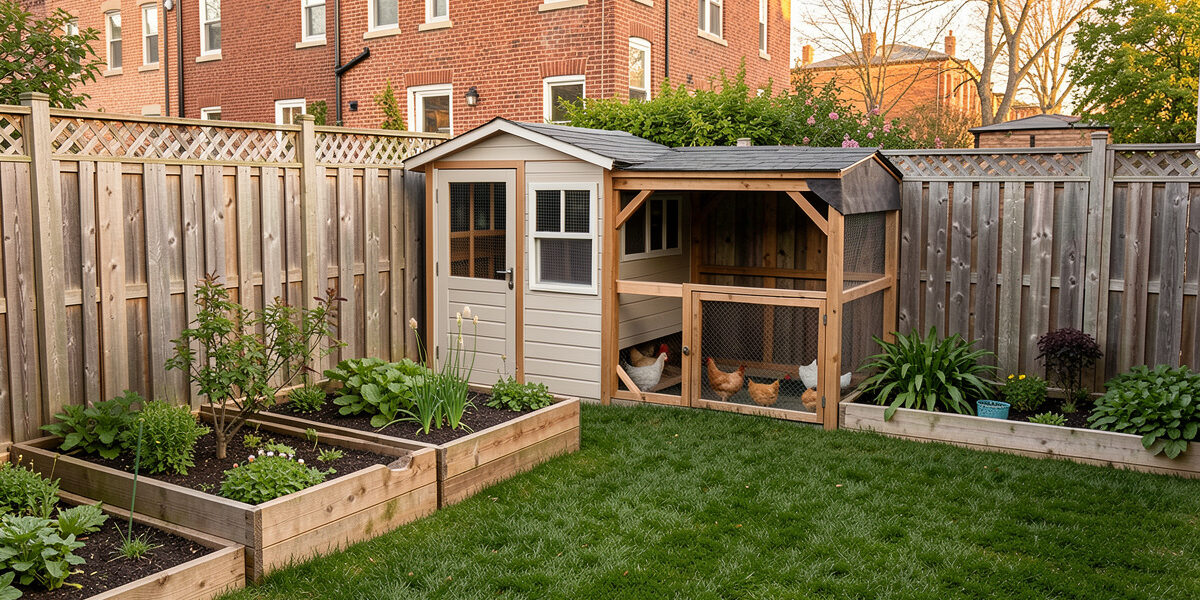
You can keep a happy flock of three to six hens in a backyard as small as a few hundred square feet, as long as you give each bird about 4 square feet of coop and 8 to 10 square feet of run, build upward to save floor space, and cover the run so the birds can be out in any weather. Small-space keeping is a design problem, not an impossibility.
My own coop is a walk-in build with a welded run, but most of what makes it work scales straight down to a city lot — the per-bird math is the same whether you have an acre or a postage stamp. The difference is that on a small lot you cannot waste an inch, and every mistake in layout shows up fast as mud, boredom, or smell. This guide is the small-yard playbook: how much space you actually need, how to lay it out, and how to keep a tight run from turning into a problem. It expands the space section of the urban chicken keeping guide.
How Much Space a Small Flock Really Needs
The working minimum is 4 square feet of coop floor and 8 to 10 square feet of run per hen, which means four hens need roughly 16 square feet of coop and 40 of run — a footprint that fits in a corner of almost any backyard. Going below those numbers is the single biggest cause of pecking, mess, and odor in small setups.
These figures are not arbitrary; they are the density below which hens start to feel crowded and behave badly. Crowding causes feather-picking and bullying, concentrates manure faster than bedding can absorb it, and turns a run to bare mud. The table shows the space to plan for by flock size — build to the run figure or above, never below.
| Flock Size | Coop Floor (min) | Run (min) | Total Footprint |
|---|---|---|---|
| 3 hens | 12 sq ft | 24–30 sq ft | ~36–42 sq ft |
| 4 hens | 16 sq ft | 32–40 sq ft | ~48–56 sq ft |
| 5 hens | 20 sq ft | 40–50 sq ft | ~60–70 sq ft |
| 6 hens | 24 sq ft | 48–60 sq ft | ~72–84 sq ft |
The full reasoning behind these numbers, including how breed size shifts them, is in the chicken coop size guide.
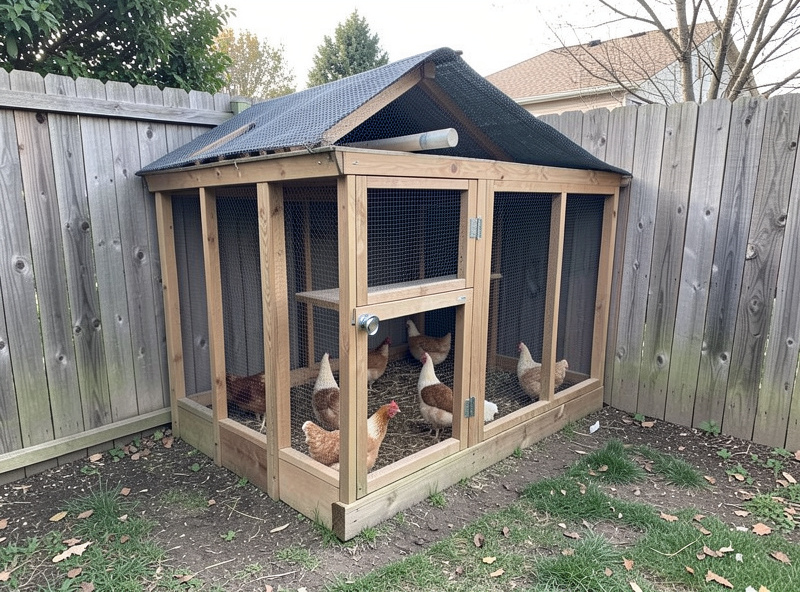
Build Upward to Save Floor
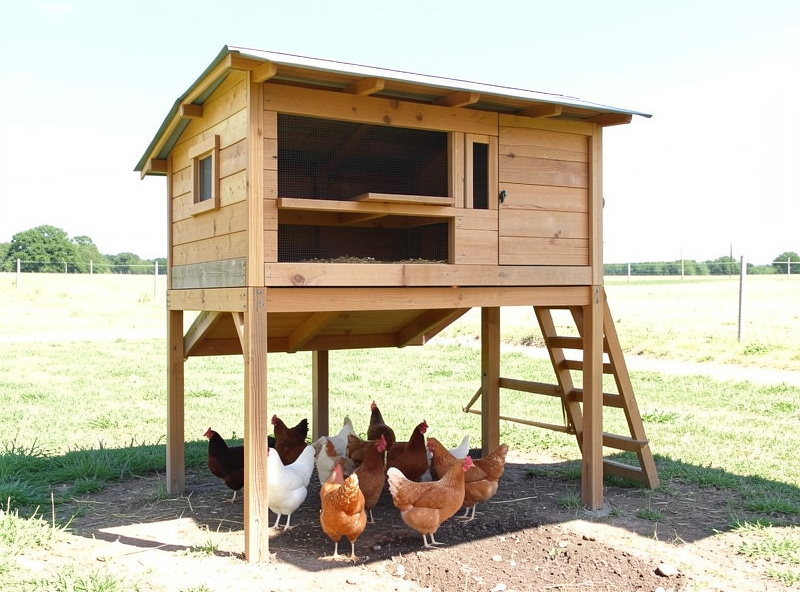
The trick to a small footprint is using vertical space hens naturally want: a raised coop with the run underneath, roost bars stacked above floor level, and wall-mounted feeders and waterers can nearly double the usable area without enlarging the footprint. Chickens live in three dimensions; a flat layout wastes the cheapest space you have.
Raising the coop on legs gives you sheltered, dry run space underneath — instantly doubling the ground a small yard offers. Inside, a roost bar 18 inches up adds resting capacity without floor area, and hanging the feeder and waterer keeps the floor clear and the feed cleaner. A combined coop-and-run unit is usually the most space-efficient buy for a tight lot, because it integrates the vertical stacking for you. Whatever you build, harden it properly from the start — small urban yards still face raccoons and rats, and the predator-proofing does not shrink with the lot.
Keeping a Tight Run From Turning to Mud
The number-one failure in a small backyard is a run that becomes a muddy, smelly patch, and it has one root cause — too many birds on too little ground with nowhere for moisture to go. A covered run, deep litter, and good drainage keep a compact space clean year-round.
A small run takes a beating because the same square footage gets scratched bare and rained on repeatedly. The first winter I left part of my run uncovered, it was ankle-deep sludge by January, and I ended up roofing the whole thing the following spring. Cover it — a roof or even a tarp over part of it keeps rain out and lets you use the space in any weather, which also solves hawk pressure. On the ground, run the deep-litter method with deep wood chips or coarse organic bedding that absorbs droppings and composts in place rather than turning to sludge; top it up rather than letting it pack down. Site the run where water drains away from it, not into it. Done right, a covered, deep-littered run on a small lot stays dry and nearly odorless — and the resulting compost feeds the garden, closing a tidy loop.
Keeping Small-Space Hens From Getting Bored
Confined hens with nothing to do invent bad habits — feather-picking, egg-eating, escape attempts — so a small run needs enrichment that a free-ranging flock gets for free. A few cheap additions keep penned birds calm and occupied, which directly protects your peace with the neighbors.
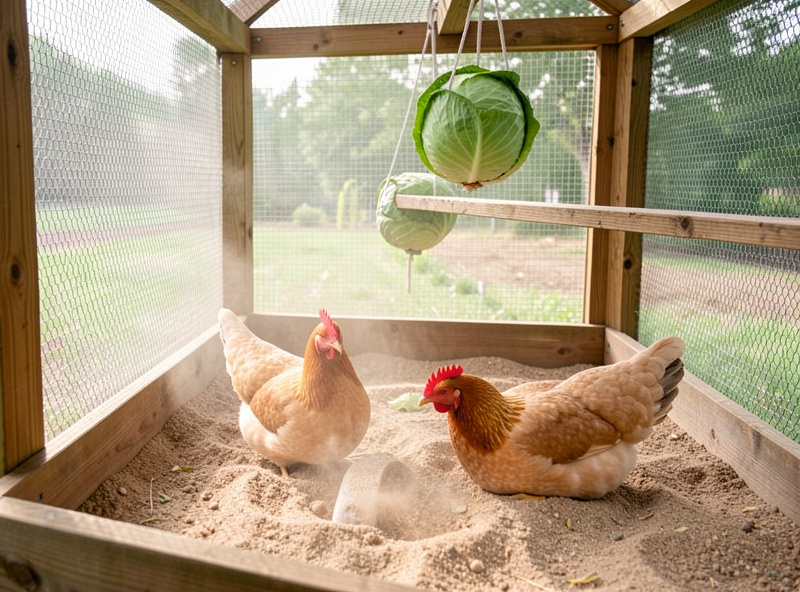
Boredom is the hidden cost of small-space keeping, and it shows up as the exact behaviors that generate noise and damage. The fixes are simple: a dust-bathing box of dry sand and wood ash, a hanging cabbage or seed block to peck, a low perch or two to jump between, and a handful of scratch scattered to make them forage. A second roost height and a sheltered corner give lower-ranking birds somewhere to escape bullying. Calm, occupied hens are quiet hens — which is half the battle in a yard surrounded by neighbors, as I cover in handling neighbor complaints about chickens. And on a small lot, screening the setup well does double duty; the camouflage tactics are in disguising a chicken coop in the backyard.
Further Reading
- The Complete Urban Chicken Keeping Guide
- Chicken Coop Size Guide
- How Many Chickens Are Allowed in Urban Areas
- Disguising a Chicken Coop in the Backyard
- The Deep Litter Method Explained
Frequently Asked Questions
What is the smallest backyard you can keep chickens in?
A flock of three to four hens can do well in a backyard with as little as 40 to 60 square feet set aside for them, provided each bird gets about 4 square feet of coop and 8 to 10 of run. Building vertically and covering the run makes a small space work.
How much space does each chicken need?
Plan for a minimum of 4 square feet of coop floor and 8 to 10 square feet of run per hen. Larger or heavier breeds want the upper end. Going below these densities causes feather-picking, mud, and odor in small setups.
Can chickens be kept in a run all the time without free-ranging?
Yes, as long as the run meets the per-bird space minimums, is covered, and has enrichment like a dust bath, perches, and things to peck. Many urban flocks never free-range because of property lines, and they do fine in a well-designed run.
How do I stop my small chicken run from getting muddy?
Cover the run to keep rain out, use the deep-litter method with wood chips or coarse bedding that absorbs moisture and composts in place, and site it where water drains away. Mud is caused by too many birds, too little drainage, and an open roof.
Do chickens get bored in a small space?
They can, and bored hens develop feather-picking and other bad habits. Add a dust bath, a hanging vegetable, scattered scratch, and a couple of perches at different heights. Occupied hens are calmer and quieter, which matters in a yard near neighbors.
Is a raised coop better for a small yard?
Yes. Raising the coop on legs gives you dry, sheltered run space underneath, effectively doubling the ground a small lot offers. It also keeps the coop drier and makes the underside harder for ground predators to exploit when properly screened.
Related Guides

Handling Neighbor Complaints About Chickens
The best way to handle a neighbor complaint about your chickens is to prevent it: keep the coop odor-free, the…
Urban Chicken Laws and How They Vary by Neighborhood
Urban chicken laws are set locally, not nationally, which is why they can change from one side of a city…

Disguising a Chicken Coop in the Backyard
The best way to disguise a chicken coop is to stop it from reading as a coop at all: paint…