Choose the right automatic chicken door for your coop — pop hole sizing, sensor types, power sources, safety features, predator resistance, and climate considerations.
The best automatic chicken door for a backyard keeper in Florida is wrong for a homesteader in Minnesota. Your flock size, coop design, local predators, climate, and daily routine all shape which door features actually matter. This decision guide walks through every variable so you buy once and buy right — and where a variable is the same one that shaped my own choices running doors through a Swedish winter, I’ll say so.
Start with Your Coop: Dimensions and Mounting
Before comparing features and brands, measure your coop. Physical constraints eliminate options immediately and save you from ordering a door you cannot install.
Pop Hole Dimensions
The pop hole (chicken entrance) determines which doors fit. Standard automatic doors accommodate openings between 25-30 cm wide and 30-35 cm tall (roughly 10-12 inches × 12-14 inches). If your pop hole falls outside this range, your options narrow significantly.
Oversized openings (wider than 35 cm) require adapter frames — flat panels with a cut-out that reduce the opening to standard size. Most manufacturers sell these separately for $10-20. Undersized openings (smaller than 25 cm wide) work with most doors but may restrict larger breed chickens. Standard breeds like Rhode Island Reds, Plymouth Rocks, and Orpingtons need at least 25 cm of clear width to pass comfortably.
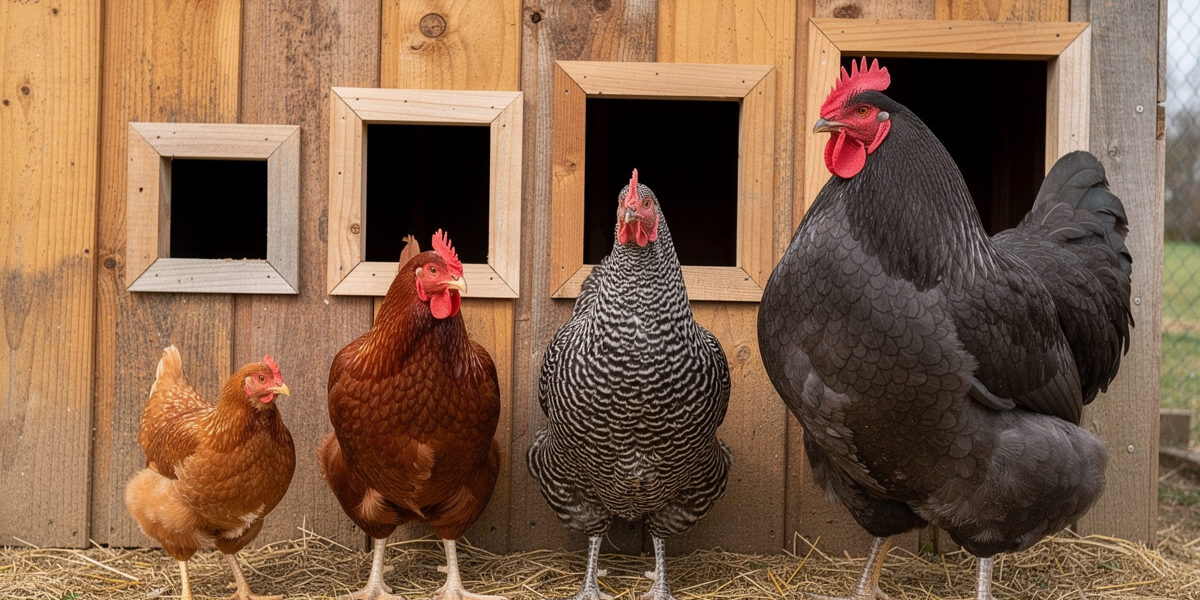
| Breed Size | Minimum Pop Hole Width | Minimum Pop Hole Height | Examples |
|---|---|---|---|
| Bantam | 20 cm (8″) | 25 cm (10″) | Silkies, Sebrights, Dutch |
| Standard | 25 cm (10″) | 30 cm (12″) | Leghorns, Australorps, Sussex |
| Large | 30 cm (12″) | 35 cm (14″) | Orpingtons, Brahmas, Jersey Giants |
| Extra Large | 35 cm (14″) | 40 cm (16″) | Cochins, Marans roosters |
Vertical Clearance Above the Pop Hole
Most automatic doors slide vertically — the panel lifts up into a track above the opening. This requires clearance equal to the door panel height above the pop hole. A standard 30 cm tall door panel needs 30 cm of unobstructed wall above the opening, plus 5-10 cm for the motor housing. Total: roughly 40 cm of clear wall above the pop hole top edge.
If your coop has a low roofline, window, or nesting box blocking this space, you have two alternatives: mount the door on the exterior wall (most common solution), or choose a horizontal-sliding door like the Omlet Autodoor that needs lateral clearance instead of vertical.
Wall Material and Thickness
Standard mounting hardware works with wood walls 15-40 mm thick. Thicker walls (log cabin style, insulated panels) need longer screws or through-bolts. Metal-sided coops require self-tapping screws or rivets. Plastic coops (Omlet Eglu, similar) need brand-specific mounting kits — generic doors may not attach securely to curved or textured plastic surfaces.
Match the Sensor to Your Environment
The sensor system determines when your door opens and closes. Choosing wrong here causes daily frustration — doors closing too early, opening too late, or behaving erratically.
Light Sensors: When They Work and When They Fail
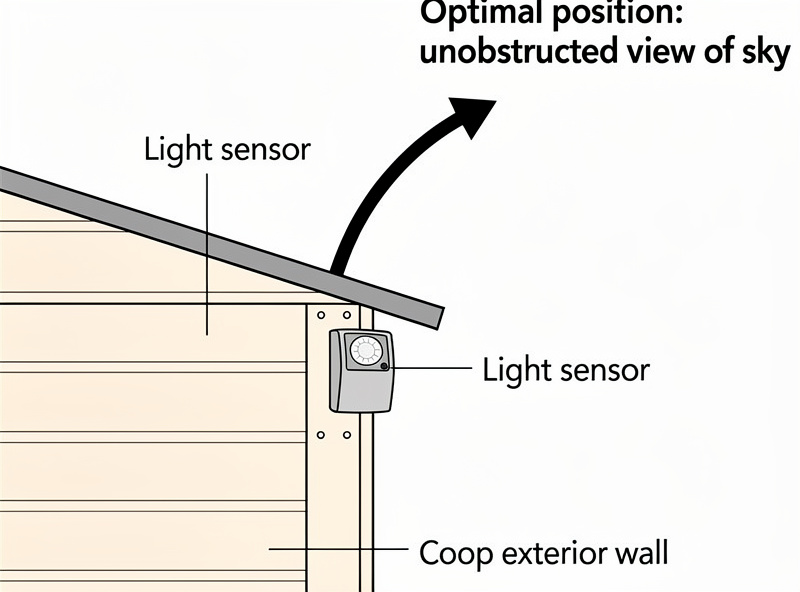
Light sensors are the default choice and work perfectly in the majority of situations. They track natural daylight, opening at dawn and closing at dusk — exactly matching your chickens’ instinctive roosting behavior. Most models include sensitivity adjustment so you can fine-tune the trigger point.
Light sensors fail predictably in three scenarios:
- Artificial light: Street lights, security lights, or neighboring buildings illuminating your coop at night prevent the sensor from detecting darkness. The door stays open all night. Solution: position the sensor facing away from artificial light, or switch to timer mode.
- Heavy overcast: Unusually dark daytime conditions can trick the sensor into closing mid-afternoon. Chickens get locked out. This is rare with modern sensors that use rolling averages rather than instant readings, but older or budget sensors remain vulnerable.
- Snow reflection: Fresh snow amplifies ambient light dramatically. The sensor reads “still daylight” well after sunset because snow bounces enough light to exceed the threshold. Common in northern climates during winter — I’ve watched it happen on my own coop after a fresh snowfall, which is exactly why I run a timer as backup rather than trusting the light sensor alone through a Swedish winter.
If any of these scenarios apply to your coop location, choose a dual-mode door (light sensor + timer backup) or a smart door with astronomical timing that calculates sunrise/sunset from GPS coordinates.
Timer Mode: Predictable but High-Maintenance
Timer doors operate on fixed schedules you program. They ignore ambient light entirely, making them immune to artificial light and weather interference. The downside is significant: you must manually adjust open/close times every 4-6 weeks as seasons shift. A door set to close at 8:00 PM in July will close two hours after sunset in October — two hours of open-door predator exposure every night until you reprogram.
Keepers who choose timer mode need calendar reminders for seasonal adjustment. Set your close time to 30 minutes after local sunset and your open time to local sunrise. Update both monthly for safety.
Astronomical Timing: Set It and Truly Forget It
Available on premium smart doors (ChickenGuard ASTi and similar), astronomical timing calculates exact sunrise and sunset for your GPS coordinates and adjusts daily. You program it once — enter your location — and the door tracks seasonal daylight shifts automatically for years. No sensors to clean, no timers to reprogram, no false triggers from artificial light.
The trade-off is cost. Astronomical timing exists only in Wi-Fi-connected smart doors priced $180+. If your budget allows, this is the most reliable triggering method available.
Power Source: Match to Your Coop Location
Power determines reliability during the conditions that matter most — freezing nights, extended power outages, and storms when predators are most active. Predation remains the leading cause of death in backyard flocks (eXtension Poultry), so a door that dies with the batteries on the wrong night is a real cost, not a hypothetical one.
Decision Matrix for Power Source
| Your Situation | Best Power Source | Why |
|---|---|---|
| Coop within 15m of house outlet | Mains (AC adapter) + battery backup | Unlimited power, battery backup for outages |
| Coop 15-50m from outlet | Solar + lithium battery | No cable to run, self-sustaining |
| Coop 50m+ from any power, good sun exposure | Solar + lithium battery | Only viable option that does not need battery changes |
| Coop in heavy shade or dense forest | Battery (lithium in cold climates) | Solar panels need 3-4 hours of direct sun daily |
| Extreme cold (-20°C and below) | Mains power or lithium batteries | Alkaline batteries lose 50%+ capacity below -10°C |
| Budget-limited setup | 4×AA alkaline batteries | Lowest upfront cost, replace every 3-6 months |
Safety Features: Non-Negotiable vs Nice-to-Have
Safety features protect your flock from the door itself. Their importance depends on your specific flock composition.
Anti-Crush Detection — When It Is Essential
Anti-crush detection reverses the door when it encounters resistance during closing. It prevents injury to chickens caught in the doorway. This feature is non-negotiable if you keep:
- Bantam breeds: Smaller birds are more vulnerable to crushing force and slower to move through the door.
- Young pullets: Inexperienced birds may not retreat quickly when the door starts closing.
- Mixed-age flocks: Younger birds often roost later than established hens, increasing the chance of being caught in a closing door.
- Large flocks (15+ birds): More birds means more traffic through a single door, increasing the probability of a bird being in the doorway during closing.
If your flock consists entirely of standard-size adult hens with established roosting habits and a flock of under 10 birds, anti-crush is less critical but still recommended. The cost premium for anti-crush ($10-30 extra) is trivial compared to replacing a $30-50 hen.
Manual Override — Always Required
Every automatic door must have a manual override. When batteries die, controllers malfunction, or an emergency requires immediate access, you need to physically open or close the door. Verify this mechanism exists and works before you need it.
Predator Resistance
The door panel itself is a security barrier. Consider your local predator pressure:
| Predator | Attack Method | Door Panel Requirement |
|---|---|---|
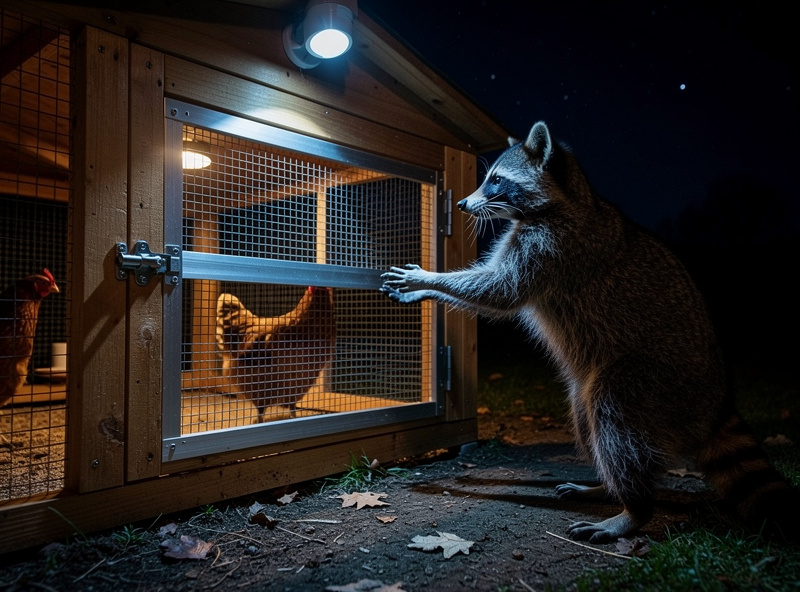
| Raccoons | Prying, lifting, pulling | Bottom-locking mechanism, 2mm+ aluminum |
| Foxes / Coyotes | Pushing, digging | Secure bottom seal, frame flush to wall |
| Weasels / Mink | Squeezing through gaps | Tight track tolerances, brush seal |
| Rats / Snakes | Squeezing under/around door | Bottom seal flush to ground |
| Hawks / Owls | N/A (enter from above) | Door not relevant — covered run needed |
Magnetic bottom-locking (found on Run Chicken T50 and others) adds significant raccoon resistance. A raccoon cannot lift a magnetically locked panel from outside. This is the single most effective predator-resistance feature beyond the door simply being closed.
Smart Features: Worth the Premium?
Smart doors with Wi-Fi connectivity cost $50-150 more than equivalent non-smart models. Evaluate whether the premium justifies itself for your situation:
When Smart Features Are Worth It
- You travel frequently: Remote monitoring confirms door status when you are away. Push notifications alert you to failures.
- Your coop is far from the house: You cannot easily glance at the door from a window. Remote status checks replace physical walks to the coop.
- You want data: Smart doors log open/close times, battery levels, and sensor readings. Over time, this data helps optimize your flock management.
- Home automation integration: If you already run Home Assistant, Alexa, or Google Home, a smart door integrates into your existing system with automated routines.
When Smart Features Are Overkill
- Your coop is visible from the house: A quick look from the window confirms door position. Remote monitoring adds no value.
- You rarely travel: If you are home every evening, manual checks suffice.
- Your coop has poor Wi-Fi: A smart door without connectivity is just an expensive non-smart door. Test signal strength at the coop before buying.
- Budget is tight: The $50-150 premium buys a lot of AA batteries. A reliable non-smart door with anti-crush serves most keepers better than a smart door without safety features.
Climate Considerations
Your local weather directly impacts which components survive and which fail.
| Climate Challenge | Feature to Prioritize | Feature to Avoid |
|---|---|---|
| Extreme cold (-20°C and below) | Rack-and-pinion drive, lithium batteries, mains power | String-lift (strings freeze), alkaline batteries |
| Heavy rain / humidity | IP65+ weather sealing, stainless steel hardware | Exposed controller boards, unsealed motor housings |
| Hot summers (40°C+) | UV-resistant housing, ventilated motor enclosure | Dark-colored plastic housings (heat absorption) |
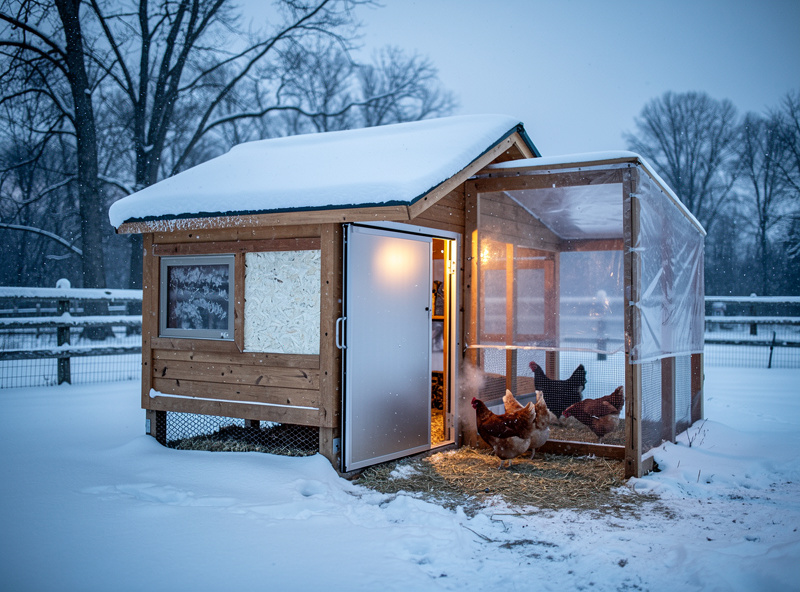
| Heavy snowfall | Timer or astronomical trigger (not light sensor), covered door area | Light sensors (snow reflection false triggers) |
| High winds | Bottom-locking mechanism, sturdy mounting | Lightweight doors that rattle or blow open |
Budget Planning: What to Spend
Automatic chicken coop doors range from $25 to $300. Here is where the money goes and where you can safely economize:
| Budget Tier | Price Range | What You Get | What You Give Up |
|---|---|---|---|
| Entry | $25-50 | Working automatic door, basic light/timer sensor | Anti-crush, weather sealing, build quality |
| Mid-Range | $60-120 | Reliable mechanism, anti-crush option, better build | Smart features, solar power |
| Premium | $120-200 | Rack-and-pinion or smart features, good weather sealing | Solar integration, camera, full smart ecosystem |
| Top-End | $200-300 | Solar + smart + anti-crush + premium build, everything | Nothing — full feature set |
The sweet spot for most keepers is the $60-120 mid-range. You get reliable operation and safety features without paying for smart connectivity you may not need. Invest the savings in a quality coop lock and predator-proof hardware cloth instead.
Frequently Asked Questions
What size automatic door do I need for my chickens?
Standard breeds (Leghorns, Australorps, Sussex) need a pop hole at least 25 cm wide × 30 cm tall. Large breeds (Orpingtons, Brahmas, Jersey Giants) need 30 cm × 35 cm minimum. Bantams can use smaller openings (20 cm × 25 cm). Measure your largest bird at full height while walking — the pop hole should clear comfortably without crouching. Most automatic doors fit standard 25-30 cm × 30-35 cm openings.
Should I get a light sensor or timer automatic coop door?
Choose a light sensor if your coop is in a rural area without artificial lighting nearby. Choose timer mode if your coop is near streetlights, security lights, or reflective surfaces. The best option is a dual-mode door that uses both — the light sensor handles daily operation while the timer provides a backup failsafe. If budget allows, astronomical timing (available on smart doors) eliminates all sensor issues.
Is a string-lift or rack-and-pinion coop door better?
Rack-and-pinion doors are mechanically superior — stronger, more reliable, and maintenance-free. String-lift doors are cheaper and simpler but require annual string replacement. In cold climates, rack-and-pinion is strongly preferred because strings can freeze or absorb moisture and stiffen. If budget allows, always choose rack-and-pinion for long-term reliability.
How do I predator-proof my automatic chicken coop door?
Choose a door with magnetic bottom-locking to prevent raccoons from prying it open. Ensure the panel sits flush in its track with minimal gaps — weasels can squeeze through openings as small as 25 mm. Add brush seals around the door frame to block drafts and small predator entry. Most importantly, the door must close reliably every night — even the most predator-resistant panel is useless if it stays open.
Do automatic chicken doors work with all coop designs?
Most automatic doors retrofit onto any coop with a standard pop hole and sufficient mounting space. You need 30+ cm of flat wall above the opening for vertical slide doors, or equivalent lateral space for horizontal models. Wood, plywood, and OSB coops accept direct screw mounting. Metal-sided or plastic coops may need adapter plates or brand-specific mounting kits. Measure your coop before ordering.
Related Articles
- How Automatic Chicken Coop Doors Work: Sensors, Motors, and Safety — deep dive into the technology
- Best Automatic Chicken Coop Doors: 7 Models Compared — specific model reviews and side-by-side comparison
- Automatic Chicken Coop Doors: Complete Buyer’s Guide 2026 — comprehensive buyer’s guide
- How to Build a Smart Chicken Coop — integrate automatic doors into a full smart coop
- Best Smart Chicken Coop Devices & Automation Tools 2026 — the complete smart coop ecosystem
Related Guides
Smart Coop Door Brand Compatibility & Failure Modes
Not every coop door brand actually plays nice with a smart-home schedule, and that’s the gap this guide fills. A…
Automatic Coop Door Problems: Troubleshooting and Maintenance Guide
Fix every automatic coop door problem — dead batteries, stuck panels, sensor failures, grinding motors, and seasonal issues. Complete troubleshooting…
Automatic Chicken Door Openers: Installation and Setup Guide
Step-by-step guide to installing an automatic chicken door opener — tools, pop hole prep, mounting, sensor setup, testing, and troubleshooting…