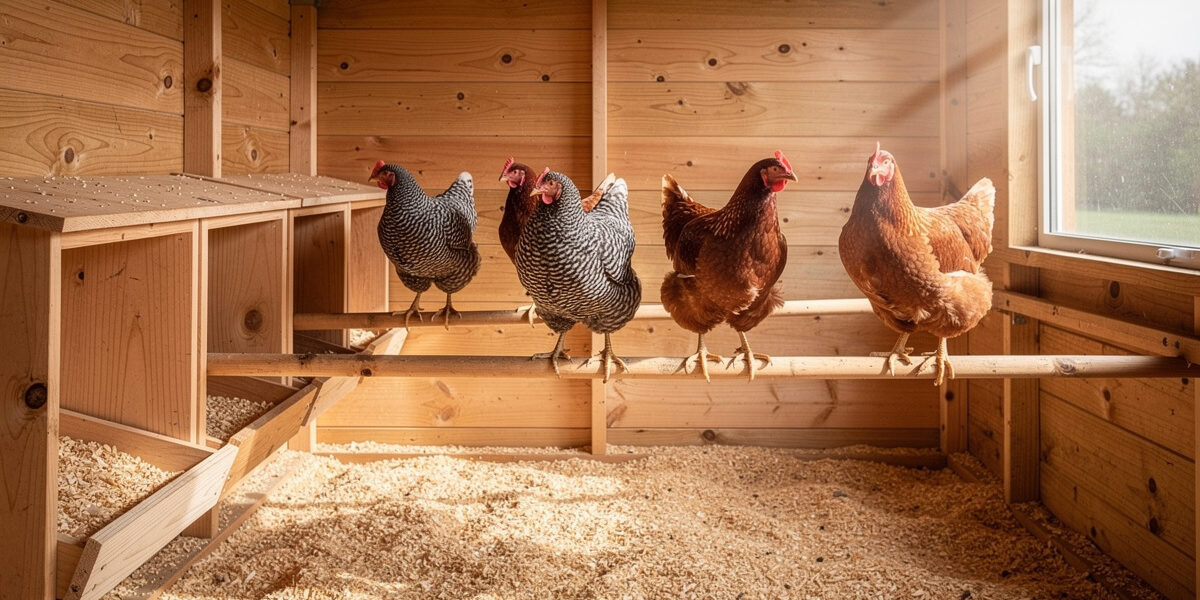
Chicken coop size is the single biggest decision you make before buying birds, and most catalog “holds 6 chickens” claims noticeably overstate true comfortable capacity — the box that’s technically big enough on paper is rarely big enough once six adult hens are actually living in it. The real rule, in line with extension guidance: 4 square feet of interior coop floor plus 10 square feet of run per standard hen (Alabama Cooperative Extension). I built my own insulated walk-in coop in Sweden after a first season spent watching an undersized prefab turn into pecking, bare backs, and stalled laying — get sizing wrong and you trade a $200 mistake for years of pecking, mites, and stalled egg production.
This guide gives you the exact square-footage math by flock count, breed weight class, climate band, and run setup, plus the smart-coop sizing factors no buyer’s guide mentions: sensor coverage, auto-door swing clearance, and the floor footprint your battery backup steals. Use the tables below to size your coop once and avoid the rebuild every backyard keeper eventually faces. For matching coop type to your specific flock, climate, and budget, see our best chicken coops buyer’s guide.
How Much Coop Space Does One Chicken Need?
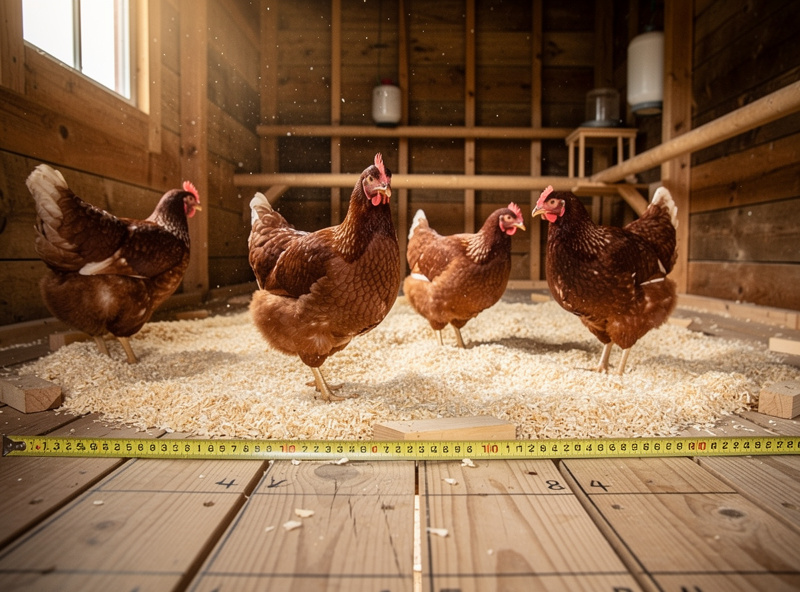
One standard-breed hen needs 4 square feet of interior coop floor plus 10 square feet of attached run. That’s the working baseline used by most US extension services and the figure that keeps pecking, feather pulling, and respiratory issues at bay. Bantams need less; heavy breeds need more.
The 4-and-10 rule assumes hens spend roughly 8 hours overnight inside the coop and the rest of the day outside. If your coop is your run (a small all-in-one tractor with no separate enclosed sleeping area), you need to combine those numbers and provide 14 square feet per bird. Anything less and you will see dominance fights inside 60 days.
Undersizing is the more common mistake. Cramped coops drive feather pecking that turns into bare backs, drive ammonia buildup that scars lung tissue, and drop egg output by 15 to 25 percent during stress periods. Oversizing has a smaller cost — wasted heating in winter and harder predator-proofing — but it is recoverable. Undersizing rarely is, because the social hierarchy locks in within weeks.
Chicken Coop Size Chart by Flock Count
The chart below converts the 4-and-10 rule into specific square-footage targets for the most common backyard flock sizes. Numbers assume standard breeds (4 to 6 lb adult weight) with mixed indoor and outdoor time. Add 25 percent if you keep heavy breeds like Brahmas or Jersey Giants, and subtract 25 percent for bantams.
| Flock Size | Min Coop (sq ft) | Min Run (sq ft) | Total Footprint | Typical Coop Style |
|---|---|---|---|---|
| 2 birds | 8 | 20 | 28 sq ft | Compact A-frame or small tractor |
| 4 birds | 16 | 40 | 56 sq ft | Lift-top backyard coop |
| 6 birds | 24 | 60 | 84 sq ft | Mid-size lift-top + attached run |
| 8 birds | 32 | 80 | 112 sq ft | Walk-in shed-style or large prefab |
| 10 birds | 40 | 100 | 140 sq ft | Walk-in with separate run |
| 12 birds | 48 | 120 | 168 sq ft | Walk-in 6×8 ft coop + 12×10 ft run |
| 15 birds | 60 | 150 | 210 sq ft | Converted shed (8×8 ft minimum) |
| 20 birds | 80 | 200 | 280 sq ft | Shed conversion or barn corner |
| 30 birds | 120 | 300 | 420 sq ft | Full barn stall or dedicated structure |
| 50 birds | 200 | 500 | 700 sq ft | Commercial-style coop with separate run paddocks |
The “total footprint” column is the number that surprises most first-time keepers. A 6-bird flock — the most popular backyard size in the US — needs an 84 square foot footprint. That’s roughly an 8×10 ft area in your yard, not the 4×4 ft the catalog photo suggests. For specific coop picks at this flock count, see our chicken coop for 6 chickens guide.
Coop Size by Breed: Bantam, Standard, and Heavy
Breed weight class changes the per-bird square footage by up to 100 percent. Bantams need 2 sq ft inside; heavy breeds like Jersey Giants need 8 sq ft. Sizing for the breed you actually keep — not a generic “chicken” — prevents 80 percent of crowding-related issues.
| Breed Class | Adult Weight | Coop sq ft / bird | Run sq ft / bird | Examples |
|---|---|---|---|---|
| Bantam | 1 to 2 lb | 2 | 5 | Sebright, Silkie, Belgian d’Uccle |
| Light layer | 3 to 4 lb | 3 | 8 | Leghorn, Ancona, Hamburg |
| Standard dual-purpose | 5 to 7 lb | 4 | 10 | Rhode Island Red, Plymouth Rock, Australorp |
| Heavy breed | 8 to 10 lb | 6 | 12 | Orpington, Wyandotte, Cochin |
| Giant breed | 10 to 14 lb | 8 | 15 | Jersey Giant, Brahma, Malines |
Breed temperament matters as much as size. Mediterranean breeds (Leghorn, Ancona) are flighty and need vertical escape space — add 1 sq ft per bird if you keep them. Heavy breeds rarely fly but are clumsy on tight perches, so plan 12-inch roost spacing instead of the standard 10.
Coop Size by Climate Zone
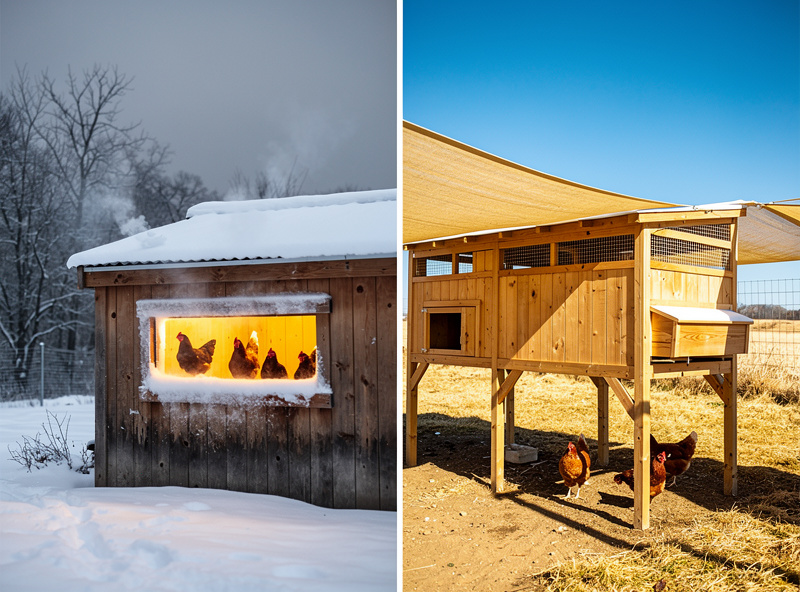
Climate shifts coop sizing in opposite directions for cold and hot regions. In sub-30°F winters, tightening the coop to the 4 sq ft minimum helps trap body heat — chickens generate roughly 10 BTU per pound per hour. In summers above 85°F, you need 5 to 6 sq ft per bird and aggressive cross-ventilation to avoid heat stress and laying drops.
For cold climates (Zone 3 to 5): Stay at 4 sq ft per bird, add insulated walls (R-13 minimum), and keep ceiling height under 5 feet to limit warm-air loss. Skip the deep run access in deep winter — birds will refuse to leave the coop below 20°F anyway. See our solar chicken coop heater guide for cold-weather power options.
For hot climates (Zone 8+): Bump per-bird coop space to 5 to 6 sq ft, mount the coop on legs for under-floor airflow, and orient the long axis east-west to limit afternoon sun exposure. Add at least one passive vent per 4 birds at the gable ends. Hot-climate flocks suffer more from undersizing than cold-climate flocks because heat compounds inside crowded spaces.
Run Size Requirements (and When Free-Range Changes the Math)
Standard run sizing is 10 sq ft per bird, but the practical minimum to prevent boredom-driven feather pulling is 15 to 20 sq ft per bird. If your hens free-range under supervision for 2 to 4 hours daily, you can shrink the run to 8 sq ft per bird without behavioral issues. Pure cooped flocks need the higher end.
Run shape matters more than total area for flock health. A long, narrow run (3 ft wide, 30 ft long) gives birds more “perimeter” for foraging and reduces dominance clashes compared to a square run of the same area. Add visual barriers — small bushes, perch platforms, dust bath stations — every 6 to 8 feet to break sightlines.
As an Amazon Associate I earn from qualifying purchases.
Cover at least 50 percent of the run with hawk netting or a solid roof. Hawks are a genuine daytime predator risk for uncovered runs, which is why overhead protection matters as much as wall protection. For full predator-proofing, hardware cloth (1/2 inch mesh) on all sides plus an 18-inch buried apron is the standard — chicken wire keeps chickens in, but a determined raccoon or fox is through it in minutes (Garden Betty), which is the one predator lesson I never had to learn twice. Pair the run with an automatic coop door and hens will self-secure inside the coop at dusk regardless of whether you’re home.
Vertical Sizing: Roost Bars, Ceiling Height, and Nesting Boxes
Floor square footage is half the equation. Vertical sizing — roost bar length, ceiling height, and nesting box count — drives whether your hens actually use the coop space you provide. The numbers: 10 inches of roost bar per standard bird, 18 to 24 inches of roost height above the floor, and 1 nesting box per 4 to 5 hens.
Roost bars: Use 2×4 lumber laid flat-side up (not on edge). Hens grip the wider surface in winter, covering their toes with feathers to prevent frostbite. Allow 10 inches per standard bird, 12 inches for heavy breeds, 8 inches for bantams. Multiple bars at the same height work better than stacked bars — stacked bars trigger dominance fights for the top spot.
Ceiling height: Walk-in coops need 6 ft minimum for human access; lift-top coops should clear 3 ft above the highest roost so dominant birds can perch with head clearance. Coops with ceilings under 18 inches above the roost see increased ammonia buildup at roost level overnight.
Nesting boxes: 1 box per 4 to 5 hens, 12x12x12 inches per box, mounted 18 to 24 inches off the floor (always lower than the roost — hens won’t roost in nest boxes if the perch sits higher). Boxes that face away from the door reduce egg-eating problems by 60 percent because hens prefer dark, private laying spaces.
Smart Coop Sizing: What Most Guides Miss
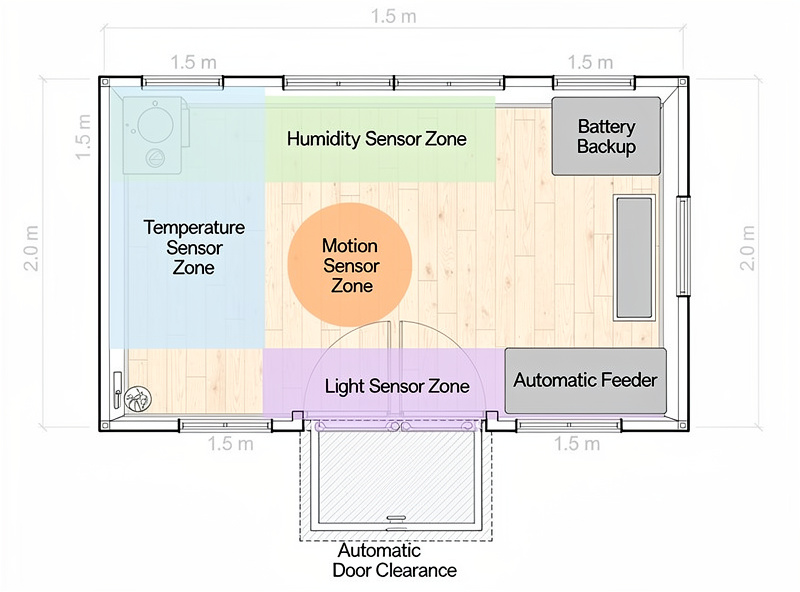
Smart automation adds three sizing variables that traditional coop guides ignore: sensor coverage radius, auto-door swing clearance, and equipment footprint. I learned these the hard way retrofitting my own coop — every sensor, door motor, and battery box I mounted quietly ate floor space the original build never budgeted for. Plan these into your initial sq-ft budget or you will rebuild within 18 months when the retrofit math doesn’t work.
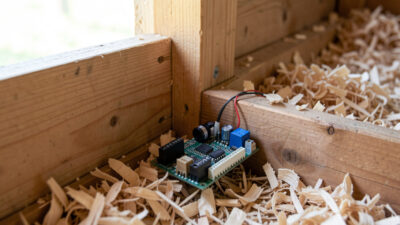
Sensor coverage: Typical PIR motion sensors cover a 20 to 30 ft radius with a 110° cone. A single sensor mounted on the back wall covers a 6×8 ft coop floor entirely. Above that footprint, plan for two sensors. Temperature and humidity sensors need open-air placement — don’t mount them in a corner near the heater or directly under a vent. See the full sensor and camera layout in our smart coop monitoring guide.
Auto-door swing clearance: Vertical-lift doors (the most common smart door type, and the kind I run on my own pop door) need 16 to 20 inches of vertical clearance above the door opening for the lift mechanism. Horizontal sliding doors need 18 to 24 inches of side clearance for the rail. Sizing the coop wall too tight to a corner kills your auto-door upgrade options. Our automatic coop door buyer’s guide covers the dimensional specs by brand, and the how automatic doors actually work explainer details the sensor and motor clearances you’ll need to pre-plan around.
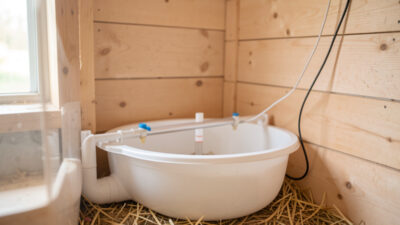
Equipment footprint: A typical smart coop setup steals 4 to 6 sq ft of usable floor space — battery backup (2 sq ft), automatic feeder (1.5 sq ft), heated waterer (1 sq ft), and sensor hub plus wiring boxes (0.5 sq ft). In my own coop the battery backup and wiring boxes together cost me almost exactly one standard bird’s worth of floor before I moved them onto a wall-mounted shelf. Add this to your minimum coop size or your hens lose 2 birds’ worth of floor space to electronics. The full retrofit math is in our smart chicken coop pillar guide, and budget-conscious builders should also see our $200 DIY automation guide for low-footprint sensor and feeder setups.
How to Measure Your Coop Correctly
Catalog “X-bird capacity” claims measure raw interior floor area. Real usable floor area is 25 to 35 percent smaller after you subtract feeder footprints, waterer base, nesting box footprint (when boxes sit on the floor), and roost-bar shadow zones. Always measure usable space before you trust the listing.
The reliable method: measure the interior floor in inches, multiply length by width, divide by 144 to get sq ft. Then subtract: 2 sq ft for a standard treadle feeder, 1 sq ft for a 5-gallon waterer base, the floor footprint of any nesting boxes mounted at floor level, and a 12×18 inch zone directly under each roost bar (the droppings zone, which hens avoid stepping in).
For lift-top coops with attached runs, the manufacturer often counts the run square footage in the bird capacity claim. A “fits 8 chickens” coop with a 24 sq ft interior and a 32 sq ft run actually houses 4 birds at proper density (8 sq ft + 32 sq ft = 40 sq ft / 10 sq ft per bird = 4 birds). Always do the math separately for coop and run before buying.
Common Sizing Mistakes and What They Cost
Four sizing mistakes account for nearly all the rebuild and rehoming requests on backyard chicken forums. Avoiding them saves $300 to $1,200 in replacement coop costs and 6 months of behavioral problems.
Mistake 1 — trusting manufacturer capacity claims: Most prefab coops overstate capacity by 30 to 50 percent. A “6-bird coop” usually houses 3 to 4 standard hens at proper density. Always recalculate with the 4-and-10 rule before buying. Our buyer’s research confirms this pattern across major retailers.
Mistake 2 — forgetting run size in winter: A 100 sq ft summer run becomes a 40 sq ft usable run when 60 percent of the floor is snow-covered or muddy. Cold-climate flocks need a covered run section of at least 6 sq ft per bird — usually a roof over half the run with wind blocks on the prevailing-wind side.
Mistake 3 — undersizing for breed adult weight: Hatchery photos show 8-week-old pullets, not the 8-pound Brahma those pullets become. Always size for adult weight class, not chick weight. New keepers who buy “any breed” assortment packs from our beginners guide often end up with mixed weight classes that demand the higher per-bird sq ft target.
Mistake 4 — not planning for flock expansion: 78 percent of backyard keepers add birds within the first 24 months. Build coop capacity at 150 percent of your starting flock — a 4-bird starter flock should live in a 6-bird sized coop (full picks at chicken coop for 4 chickens and chicken coop for 6 chickens). The cost difference is usually under $150; the cost of building a second coop is $400 to $1,200.
Frequently Asked Questions
How many chickens can fit in a 4×8 coop?
A 4×8 coop has 32 sq ft of interior floor space, which fits 8 standard-breed hens at the 4 sq ft per bird minimum. After subtracting roughly 8 sq ft for feeder, waterer, and nesting box footprint, the realistic capacity is 6 standard hens or 4 heavy breeds.
What is the minimum coop size for 4 chickens?
4 standard chickens need 16 sq ft of coop floor (4×4 ft minimum) plus a 40 sq ft attached run. Bantams can manage in 8 sq ft of coop, while heavy breeds like Brahmas need 24 sq ft. Add 25 percent if you live in a hot climate above 85°F summers.
Can a coop be too big for chickens?
Yes. Oversized coops in cold climates lose body heat and increase winter heating costs by 30 to 50 percent. Coops more than 50 percent larger than the flock requires also create dead zones where droppings accumulate and predators can hide. Size for current flock plus one expansion cycle, not for hypothetical future birds.
How much run space do chickens need per bird?
Standard chickens need 10 sq ft of run per bird as a minimum, with 15 to 20 sq ft preferred to prevent boredom-driven feather pecking. Hens that free-range under supervision 2 to 4 hours daily can manage with 8 sq ft of run space. Pure cooped flocks need the higher end of the range.
How many nesting boxes do I need for 10 chickens?
10 hens need 2 to 3 nesting boxes (1 box per 4 to 5 hens). Boxes should be 12x12x12 inches, mounted 18 to 24 inches off the floor, and lower than the roost bars. More boxes than needed is fine but rarely changes laying behavior — hens crowd into 1 or 2 favorite boxes regardless of how many you provide.
Does coop size affect egg production?
Yes — undersized coops drop egg production by 15 to 25 percent within 8 weeks due to stress, pecking injuries, and respiratory problems from ammonia buildup. Hens at proper density (4 sq ft coop + 10 sq ft run) typically lay 4 to 6 eggs per week per bird, while crowded flocks drop to 2 to 3 eggs per week per bird.
Bottom Line: Size Once, Build Once
Use the 4-and-10 rule (4 sq ft coop, 10 sq ft run per standard bird), adjust for breed weight class and climate band, and add 4 to 6 sq ft for smart-coop equipment if you plan to automate. Size for 150 percent of your current flock so the inevitable expansion doesn’t force a rebuild.
Most undersized coop problems show up in months 2 to 4 — feather pecking, dropped eggs, ammonia smell at roost level. By then, the social hierarchy is locked and the only fix is a larger coop. Get the math right before you order birds and you avoid the entire cycle.
Related Guides
- How to Build a Smart Chicken Coop: The Complete 2026 Guide
- Best Smart Chicken Coop Devices & Automation Tools 2026
- Automatic Chicken Coop Doors: Complete Buyer’s Guide 2026
- Best Chicken Coop Bedding: Complete Material Guide
- Backyard Chickens for Beginners: Everything You Need to Know in 2026
- Automated Chicken Feeders & Waterers: The Set-It-and-Forget-It Guide
- Solar Chicken Coop Heater: Winter Heating Guide
Related Guides
Water-Level and Flow Sensors: Knowing the Waterer Is Empty Before They Do
A coop water-level sensor tells you the drinker is going dry — or freezing solid — before the flock does,…
Ammonia Sensors for the Coop: Catching Air Problems Before You Smell Them
An ammonia sensor belongs at the birds’ breathing height, close to the litter where the gas is generated, because that…

Node-RED vs Home Assistant Automations for the Coop: When to Use Which
Use native Home Assistant automations for the coop’s simple, safety-critical rules — the sunrise door, the freeze-watch waterer — and…