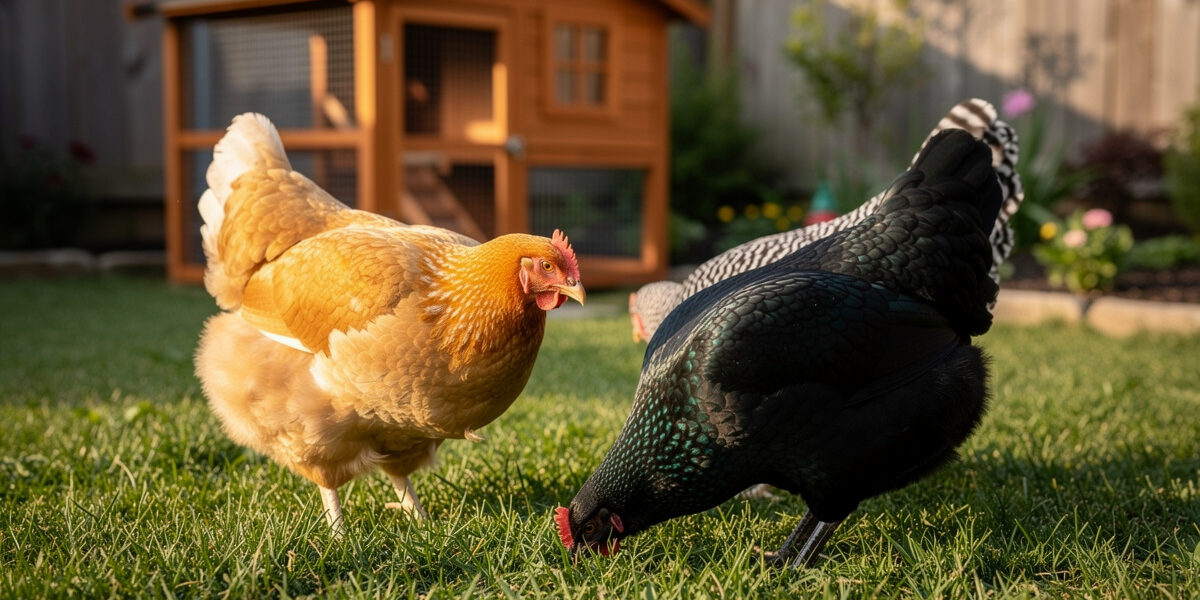
The 12 most popular chicken breeds in US backyards in 2026 produce 200 to 350 eggs per year, tolerate handling by children, fit standard 4 to 8 sqft per bird coops, and are stocked by every major hatchery. This guide ranks the 12 best backyard chicken breeds by overall package — egg production plus temperament plus climate flexibility plus availability — with picks for first-time keepers, families, egg-focused households, and dual-purpose hobbyists. My own flock in Sweden leans hard on the cold-hardy end of this list — small-comb, heavy-bodied, winter-laying types — because a breed that can’t handle a Nordic January is a breed I’m not keeping.
Quick Picks: Best 12 Backyard Chicken Breeds
- Buff Orpington — Best family breed
- Black Australorp — Best egg layer with friendly temperament
- Plymouth Rock (Barred) — Best dual-purpose
- Rhode Island Red — Most productive hardy layer
- Wyandotte — Best for cold climates
- Easter Egger — Best for colored egg variety
- Sussex (Speckled) — Best forager
- Australorp — Best heritage egg layer
- Brahma — Best gentle giant
- Faverolles — Best alternative gentle breed
- Silkie — Best pet/kid breed and broody mom
- ISA Brown — Best maximum egg production (short lifespan tradeoff)
Best for First-Time Keepers
If this is your first flock, start with these three breeds. They tolerate beginner mistakes (inconsistent watering, forgotten chores, overcrowded weeks), produce consistently, and integrate well into mixed flocks.
Buff Orpington
Heavy bird, calm temperament, 200-280 brown eggs/year. Tolerates cold and moderate heat. Fluffy buff feathers make them visually appealing and they handle children well. The “golden retriever” of chicken breeds.
Plymouth Rock (Barred)
Black and white striped feathers, 200-280 brown eggs/year, dual-purpose body weight. Friendly without being clingy. Heritage American breed available everywhere.
Black Australorp
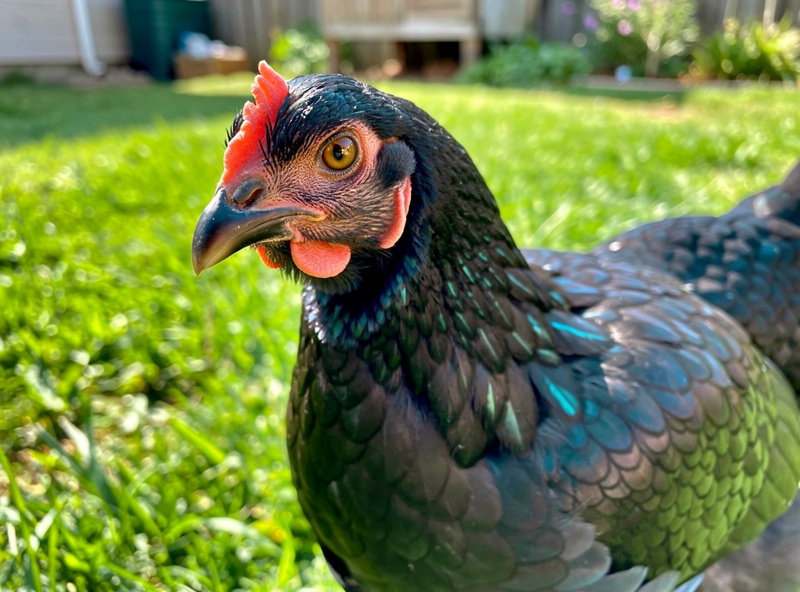
Glossy black feathers, 250-300 brown eggs/year, calm temperament. Heritage breed that set the world record for eggs in a single year — 364 in 365 days, from a 1922-23 Australian laying trial that’s still cited as the benchmark for the breed today (Livestock Conservancy). Most reliable layer in the friendly category.
For broader breed comparison, see our Complete Chicken Breeds Comparison Guide.
Best for Families with Young Kids
Children-friendly breeds tolerate handling, don’t peck reflexively, and are forgiving of inconsistent food/water schedules.
Silkie
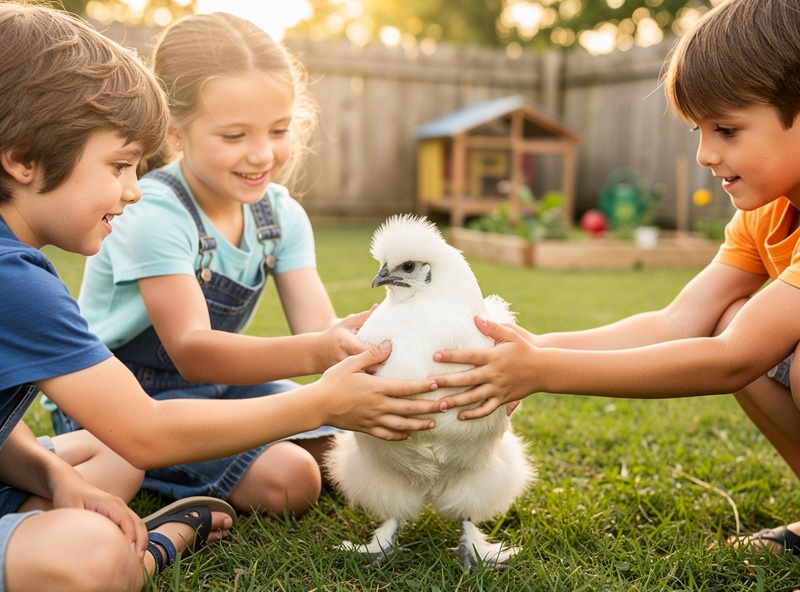
Small (3-4 lb), exceptionally fluffy, sweet temperament. Lay only 100-150 cream eggs/year — egg production is a tradeoff for pet quality. Often go broody, making them natural mothers if you want to hatch eggs. Many backyard kids learn to handle chickens with Silkies.
Faverolles
French breed with feathered cheeks, salmon-colored body, calm temperament. Lay 180-240 cream eggs/year. Heavy enough to handle cold winters in the Midwest and Northeast.
Buff Orpington
(Repeated from above — the family standard pick.) Children can carry full-grown Buff Orpingtons easily without being scratched.
Brahma
9-12 lb gentle giants. Despite the size, slow movements and unflappable temperament. Lay 150-200 brown eggs/year. Best for kids who want a “big chicken” they can carry around like a stuffed animal.
Best for Maximum Eggs
If your goal is replacing supermarket eggs, these breeds deliver:
ISA Brown
Hybrid layer (not heritage). 300-350 eggs/year peak. Friendly disposition. Catch: 2-3 year productive lifespan vs heritage breeds’ 4-7 years. Best if you accept rapid replacement and can source new chicks annually.
Leghorn (White)
280-320 white eggs/year. Heritage breed. Active, flighty, less cuddly. Mediterranean origin makes them excellent in heat and poor in cold. The supermarket egg comes from this breed.
Black Australorp
Heritage breed alternative to ISA Brown. 250-300 brown eggs/year. Friendly. Lifespan 4-7 years. Best long-term layer if you want one breed for everything.
Rhode Island Red
Heritage breed, 250-300 brown eggs/year. Hardy, productive. Sometimes aggressive — RIR roosters specifically have a reputation for being assertive.
Best for Cold Climates
For US zones 3-5 (sustained winter under 20°F), these breeds tolerate cold reliably. This is the section I write from lived experience, not a spec sheet — my own coop runs a mixed flock built from exactly this list, and the comb size is the detail that matters more than most guides let on: small or rose combs stay flatter against the skull with less exposed surface area, while large single combs and wattles are what actually freeze (Poultry Extension). Feathering and body mass matter too, but comb shape is the first thing I check before adding a new breed to a Nordic-winter flock.
| Breed | Cold Tolerance | Eggs/Year | Notes |
|---|---|---|---|
| Wyandotte | Excellent | 200-240 | Rose comb (frostbite-resistant) |
| Buff Orpington | Excellent | 200-280 | Heavy feathering, mild egg drop in winter |
| Brahma | Outstanding | 150-200 | Feathered legs, large body mass |
| Plymouth Rock | Very good | 200-280 | Hardy in most US climates |
| Australorp | Very good | 250-300 | Heavy body, dark feathers absorb heat |
| Faverolles | Very good | 180-240 | French heritage, beard around face |
Avoid in cold climates: Mediterranean breeds (Leghorn, Andalusian, Hamburg) — large combs frostbite easily. ISA Brown — specifically bred for moderate climates, struggle below 25°F.
For winter coop setup, see our Solar Chicken Coop Heater guide.
Best for Hot Climates
For US zones 9-10 (sustained summer above 90°F), prioritize Mediterranean origins and large combs for heat dissipation:
- Leghorn: Mediterranean, very heat-tolerant, 280-320 white eggs/year
- Andalusian: Spanish origin, active, 150-180 white eggs/year
- Egyptian Fayoumi: Egyptian heritage, exceptional heat tolerance, 150-200 small eggs/year
- Easter Egger (some lines): Mixed breeds with Mediterranean ancestry, moderate heat tolerance
Heavy heritage breeds (Brahma, Buff Orpington, Wyandotte) struggle above 95°F sustained. They survive but reduce egg production and become heat-stressed.
Best Dual-Purpose Breeds (Eggs + Meat)
Heritage dual-purpose breeds reach 4-7 lb processing weight at 16-20 weeks while still laying 200+ eggs/year as hens.
- Plymouth Rock: 200-280 eggs, 7 lb dressed, beginner-friendly
- Wyandotte: 200-240 eggs, 6 lb dressed, cold-hardy
- Sussex (Speckled): 200-250 eggs, 6-7 lb dressed, excellent foragers
- Buff Orpington: 200-280 eggs, 8 lb dressed, gentle
- Black Jersey Giant: 150-200 eggs, 13 lb dressed (largest American breed)
For pure meat production, Cornish Cross or Rangers are more efficient — but they’re broiler hybrids, not layers.
Avoid as a Beginner
Mediterranean breeds in cold climates. Leghorn freezes in Minnesota.
Game breeds. Old English Game, Modern Game — bred for combat, aggressive temperaments.
Crested breeds (Polish, Houdan). Vision-blocking head feathers cause bullying and predator vulnerability.
Pure broody breeds. Cochins and some Silkie lines go broody constantly. Egg production drops to zero during 3-5 week broody cycles.
Bantams as your only flock. Bantam (miniature) chickens are 1/3 to 1/2 the size of standard breeds. Eggs are smaller, capacity is lower, vulnerability to predators is higher. Fine as part of a mixed flock; problematic as the only flock.
For predator-protection considerations across breeds, see our Predator-Proof Chicken Coop guide.
Mixing Breeds in One Flock
3-5 different breeds works well for variety. Best mix strategies:
- For maximum eggs of varied colors: 2 Australorp (brown) + 2 Easter Egger (blue/green) + 1 Marans (dark brown) = 5-bird flock with rainbow eggs.
- For family-friendliness: 2 Buff Orpington + 1 Silkie + 2 Plymouth Rock = gentle 5-bird flock for kids.
- For dual-purpose: 2 Plymouth Rock + 2 Wyandotte + 2 Sussex = 6-bird flock for eggs and seasonal meat.
- For cold climate: 2 Wyandotte + 2 Brahma + 2 Buff Orpington = 6-bird flock for zones 3-5.
Avoid mixing very small breeds (Silkies, Bantams) with very large breeds (Brahmas, Jersey Giants). Size disparity creates bullying.
Where to Buy Each Breed
The major US hatcheries stock most breeds in this guide:
- Murray McMurray Hatchery: Iowa-based, broadest selection, 100+ breeds.
- Meyer Hatchery: Ohio-based, smaller minimum orders (3 chicks), good rare breed selection.
- Ideal Poultry: Texas-based, wholesale pricing, 50+ breeds.
- Tractor Supply (Spring Chick Days): Limited 4-8 popular breeds, March-May only.
- Local breeders: Quality varies; see breeding stock before purchasing.
Most hatcheries require minimum orders of 3-6 chicks (for warmth during shipping). Check the live-arrival guarantee — most include 1-2 percent expected mortality on shipped chicks. For sourcing strategy, see our Chicken Coops Near Me guide.
Breed Traits That Actually Matter for an Automated Coop
Every breed guide talks eggs and temperament. Almost none of them mention how breed choice interacts with the door, cameras, and sensors once the coop is automated — and that’s the gap I keep running into when people ask me to help plan a build.
Pop-door sizing for big-bodied breeds
Brahmas and Jersey Giants are wide-bodied birds, and the auto-doors I’ve mounted and run for a full year — Run-Chicken, ChickenGuard, Omlet — all ship a standard opening in roughly the 10-13 inch range. That’s fine for a Leghorn or an Easter Egger moving through single file, but a heavy dual-purpose bird in a hurry (spooked by a hawk shadow, say) needs the full width and a clean threshold with no lip to catch a wing. If your list leans toward the gentle giants, check the door’s rated opening before you buy, not after.
Broody breeds and nest-box sensors
Silkies and some Cochin lines go broody hard and often, which matters if you’re running occupancy sensors or camera motion zones on the nesting boxes — a broody hen parked on a nest for three weeks reads very differently than a hen using the box normally, and it’s worth tuning your automation’s expectations (or your own check-ins) around that instead of assuming every extended nest-box occupancy is an egg-eating problem.
Camera identification and flock size
A 4-6 bird flock of one or two breeds is easy to keep track of by eye on a camera feed. Once you’re mixing 3-5 breeds the way this guide recommends for variety, distinct plumage patterns — barred Plymouth Rock versus solid Australorp versus laced Wyandotte — actually make it easier to spot an individual bird acting off on the PoE camera footage, which is a small but real argument for a visually varied flock over an all-one-breed setup.
Cold-hardy breeds and heated waterers
Pairing a cold-hardy breed list with a thermostatic heated waterer is the combination that actually gets a flock through a Nordic winter — the breed survives the cold, the waterer keeps them hydrated through it. Skip the heated waterer with a cold-hardy breed and you’ve solved half the problem; a frozen-solid founts by 7 a.m. doesn’t care how good the bird’s rose comb is.
Frequently Asked Questions
What are the best backyard chicken breeds for beginners?
Buff Orpington, Plymouth Rock, and Black Australorp are the three best beginner breeds. All three are friendly, productive (200-300 brown eggs/year), hardy in most US climates, and tolerant of beginner mistakes. Available at every major hatchery and Tractor Supply during spring chick days.
What chicken breed lays the most eggs?
ISA Brown hybrid lays 300-350 eggs per year — the highest of any production breed. Heritage breeds: Leghorn 280-320 white eggs, Black Australorp 250-300 brown eggs, Rhode Island Red 250-300 brown. The Australorp set a world record of 364 eggs in 365 days in 1922.
What chickens are best for cold winters?
Wyandotte, Buff Orpington, Brahma, Plymouth Rock, Australorp, and Faverolles tolerate winters below 20°F reliably. Look for small or rose combs (frostbite-resistant), heavy feathering, and body weight 7+ lbs. Avoid Mediterranean breeds (Leghorn, Andalusian) in cold climates.
How many chickens should I start with?
Most experts recommend starting with 4-6 hens. Smaller flocks of 2-3 hens stress easily when one is sick or broody. Larger flocks of 8+ overwhelm beginners. 4-6 birds in 3-5 different breeds gives variety, mutual flock support, and 18-30 eggs per week at peak production.
Are some chicken breeds better with kids?
Yes. Buff Orpington, Silkie, Faverolles, Brahma, and Australorp are documented child-friendly. They tolerate handling, rarely peck or scratch, and adapt to confined spaces well. Avoid game breeds (Old English Game, Modern Game) and Mediterranean breeds (Leghorn) with young children.
What chickens lay the most colorful eggs?
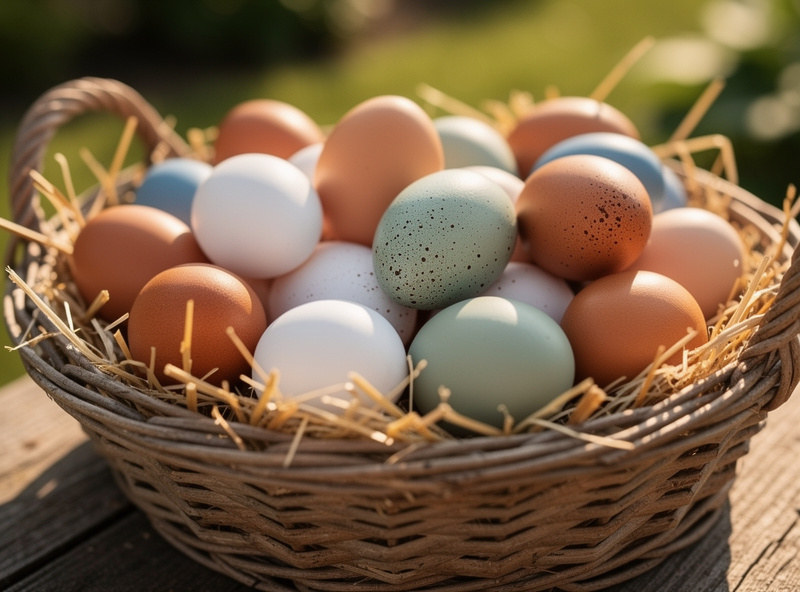
Easter Eggers lay blue, green, or olive eggs depending on individual hen. Ameraucana lays consistent true blue eggs. Marans lays dark chocolate-brown eggs. Olive Eggers (Marans x Ameraucana cross) lay olive green. A mixed flock with these four breeds plus a brown layer produces 4-5 different egg colors.
Related Articles
- Chicken Breeds: Complete Comparison Guide
- Chicken Coop Size Guide
- Best Chicken Coops 2026 Buyers Guide
- Predator-Proof Chicken Coop Guide
- Chicken Coops Near Me: Local Sourcing
Related Guides

How to Choose Chicken Breeds: A Keeper Decision Guide
Learning how to choose chicken breeds is really a requirements exercise, not a beauty contest. Before you look at a…
Heritage Chicken Breeds Compared: A Keeper Guide
A heritage chicken breeds comparison comes down to three things most lists never separate: a true heritage breed mates naturally,…
Bantam Chickens for Small Spaces: Best Small Breeds
Bantam chickens for small spaces are the answer when you want a real flock but have a courtyard instead of…