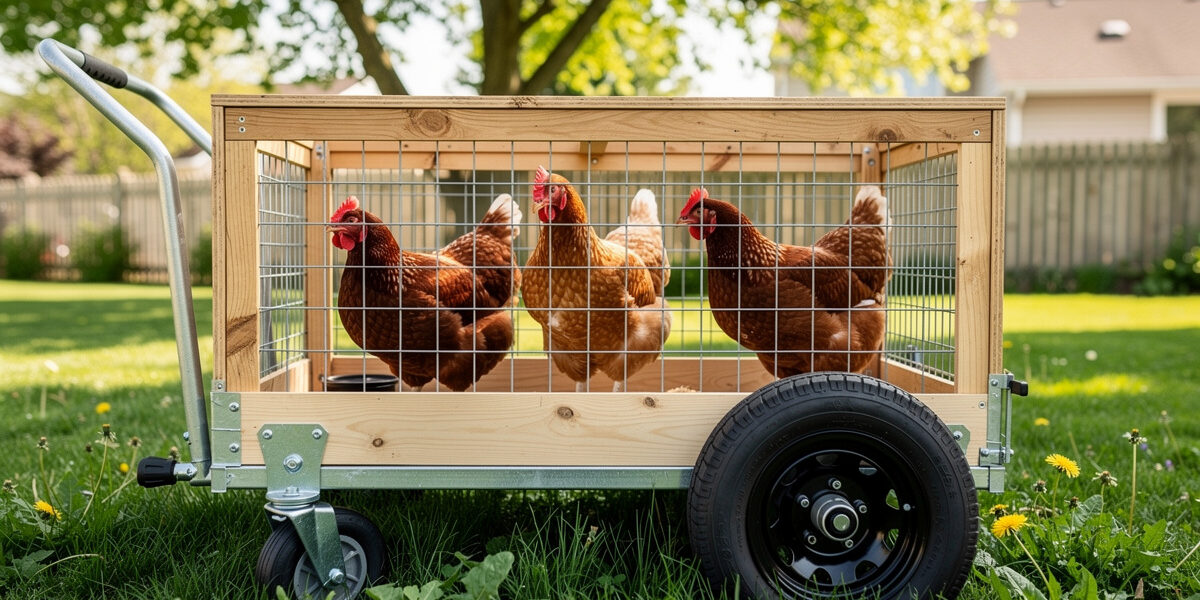
A portable chicken coop is any coop designed to be moved around your yard, pasture, or property — typically every 1 to 7 days. The category covers A-frame tractors, wheeled coops, light skidded structures, and PVC hoop builds. Done right, portable coops give 4 to 8 hens fresh foraging grass daily, meaningfully cut feed costs during growing season since foraged greens and bugs genuinely offset commercial feed, and eliminate the parasite buildup that traps static-coop flocks. I run a cattle-panel hoop and an A-frame on my own rotation, and the gap between a season I moved them religiously and one I did not showed up directly on the feed bill.
This guide covers what counts as a portable coop, the four formats that actually work in real backyards, the daily-rotation math that determines whether you save time or burn it, the smart-automation patterns that adapt to mobile coops, and the four mistakes that turn a $400 portable coop into firewood by year two. For specific picks by flock count, see our chicken coop size guide.
As an Amazon Associate I earn from qualifying purchases.
What Counts as a Portable Chicken Coop?
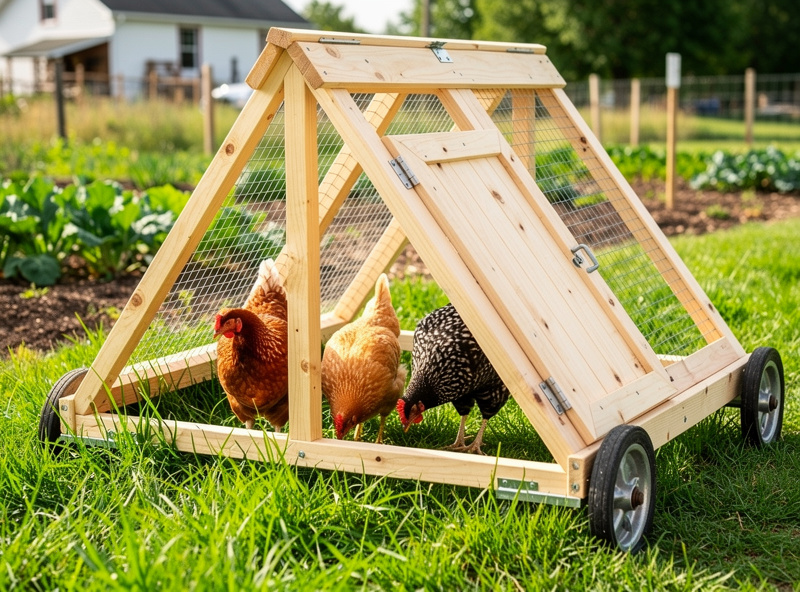
A portable chicken coop is any structure designed for repeated relocation by one or two people without disassembly. The defining features: weight under 250 pounds for one-person moves (or 400 pounds for two-person moves with handles), ground-level floor (no fixed foundation), integrated run or movable run that follows the coop, and design that tolerates rough handling without structural failure.
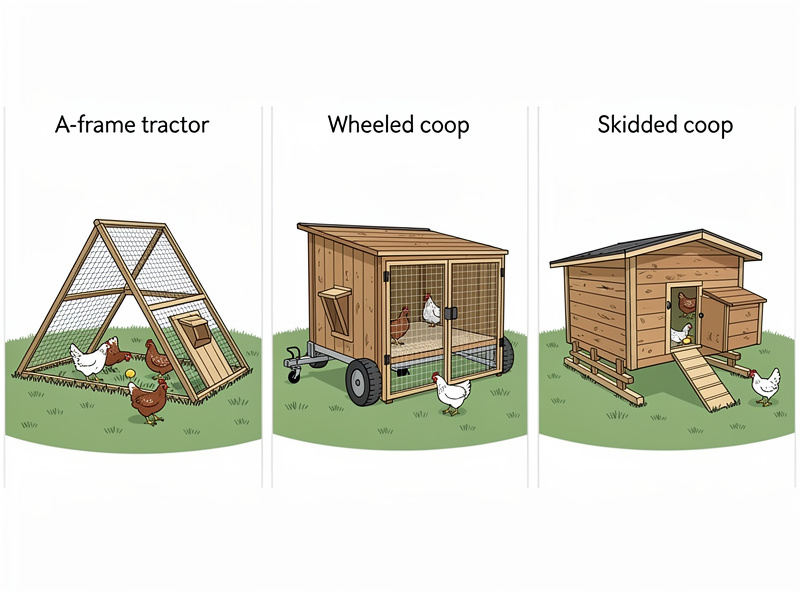
The category splits into four formats with very different use cases. A-frame tractors (sloped roof, triangular cross-section) are the lightest and most maneuverable. Wheeled coops (rectangular box with two large rear wheels and lift handles) handle rough ground best. Skidded coops (rectangular box on heavy runners) need to be dragged but tolerate the most weight. PVC hoop coops (lightweight pipe frame with tarp cover) are the cheapest DIY option but the shortest-lived.
What does NOT count as portable: coops above 6×10 ft, anything with a permanent floor, prefab “movable” coops that require 4 adults to lift, and any coop built on a foundation or skids buried in the ground. If you can’t move it solo by yourself in under 5 minutes, it’s a static coop with rolling pretensions.
Portable Chicken Coop Formats Compared
The table below compares the four portable coop formats that actually work for backyard and small-pasture flocks. Choose based on terrain, flock size, and how often you plan to move.
| Format | Typical Size | Bird Capacity | Move Frequency | Best Terrain | Approx. Cost |
|---|---|---|---|---|---|
| A-frame tractor | 4×6 to 4×10 ft | 2-6 standard hens | Daily | Flat lawn, mild slope | $280-$700 |
| Wheeled coop | 4×8 to 5×10 ft | 4-8 standard hens | Every 3-7 days | Rough ground, slopes | $600-$1,500 |
| Skidded coop | 5×8 to 6×10 ft | 6-10 standard hens | Weekly to bi-weekly | Pasture, large yards | $500-$1,200 |
| PVC hoop coop | 4×8 to 6×10 ft | 4-8 bantams or 3-5 standard | Daily | Flat lawn only | $80-$250 (DIY) |
A-frame tractors dominate the entry-level portable category because they’re the cheapest option that genuinely works for daily rotation. Wheeled coops cost more but tolerate rough ground that defeats A-frames — gravel paths, tree roots, slight slopes. Skidded coops handle the largest flocks but require either a tractor or a strong adult to drag them; the heavier weight is the trade-off for more interior space. PVC hoop coops are the cheapest DIY entry point but rarely last more than 2 to 3 years before the tarp tears or the PVC fatigues.
Why Daily Rotation Changes the Coop Math
Static coops follow the 4-and-10 rule (4 sq ft of coop floor + 10 sq ft of run per standard bird). Portable coops follow different math because the entire coop footprint counts as both sleeping area and foraging area. A 4×8 ft tractor moved daily delivers 32 sq ft of fresh grass per day per move — equivalent to 224 sq ft of foraging weekly across 7 daily moves.
For 4 birds in a daily-moved A-frame tractor: 32 sq ft of footprint provides 8 sq ft per bird (less than the 4-and-10 rule’s 14 sq ft per bird total, per Alabama Cooperative Extension guidance) but the daily ground refresh delivers more nutrition and behavioral enrichment than a static 56 sq ft setup. Properly moved tractors keep birds healthier than over-sized static coops because fresh forage genuinely offsets a meaningful share of daily caloric needs during growing season, on top of the behavioral enrichment of new ground every day.
The math fails if you don’t actually move the coop. A 4×8 tractor sitting in one spot for a week becomes a 32 sq ft static coop housing 4 birds at 8 sq ft per bird — undersized, with worn-out grass that turns to bare dirt within 10 days. Portable coops are a maintenance commitment, not a hardware purchase. Skip 3 daily moves and you’re worse off than a properly-sized static setup.
Best Portable Coops by Flock Size
Match the format to the flock count and your daily-rotation reality.
2 to 4 birds: A 4×6 or 4×8 ft A-frame tractor is the right format. Light enough for one-person moves (under 100 lbs), small enough to fit in any backyard, and cheap enough ($280 to $500) that the cost-of-failure is low. See our small chicken coops guide and 4-chicken coop guide for static-vs-tractor decision criteria at this flock size.
4 to 6 birds: A 4×8 ft wheeled coop or a 5×8 ft A-frame tractor handles this size. The wheeled coop is the better long-term choice because it tolerates rougher ground; the larger A-frame works if you have a flat lawn. The 6-chicken coop guide compares mobile vs static for this flock count.
6 to 10 birds: A 5×10 wheeled coop or 6×10 skidded coop is the practical maximum. Above 8 birds, weight crosses the one-person-move threshold (250 lbs typically) and you need either two-person handling or wheeled construction with assist mechanisms. See our 8-chicken and 10-chicken guides for capacity-validated picks.
Above 10 birds: Portable coops stop being practical. A 12-bird tractor weighs 350 to 500 lbs even in lightweight construction, requires two adults for any move, and stresses the wheels or runners enough to fail within 18 months. For 12+ bird flocks, build a static coop with a rotational paddock system instead — see our 12-chicken coop guide for the static layouts that work at this scale.
Daily Rotation: How Far and How Often to Move
The standard rotation pattern moves the coop one full coop-length forward each day, so the back of the coop sits where the front sat 24 hours ago. For a 4×8 ft tractor that’s an 8-foot daily move. Birds get fresh grass every 24 hours and the previously-occupied area gets a 7- to 14-day rest cycle before the rotation returns.
Adjust the move distance based on flock density and grass health. Heavy flocks (6+ birds in a 4×8 tractor) need 1.5 coop-lengths daily because they strip the grass faster. Light flocks (2 to 3 birds) can manage half-coop moves and still maintain grass health. In late summer when grass growth slows, double the move distance regardless of flock size to give grass extra recovery time.
Plan the rotation pattern before you start. A typical 1/4-acre suburban lawn supports 8 to 12 weeks of unique daily positions before the rotation must return to previously-used ground. Map a back-and-forth grid pattern that covers your usable yard area, leaving 7 to 14 days between revisits. Without a planned route, most keepers default to the same 3 or 4 spots and recreate the static-coop overgrazing problem.
Smart Automation for Portable Coops
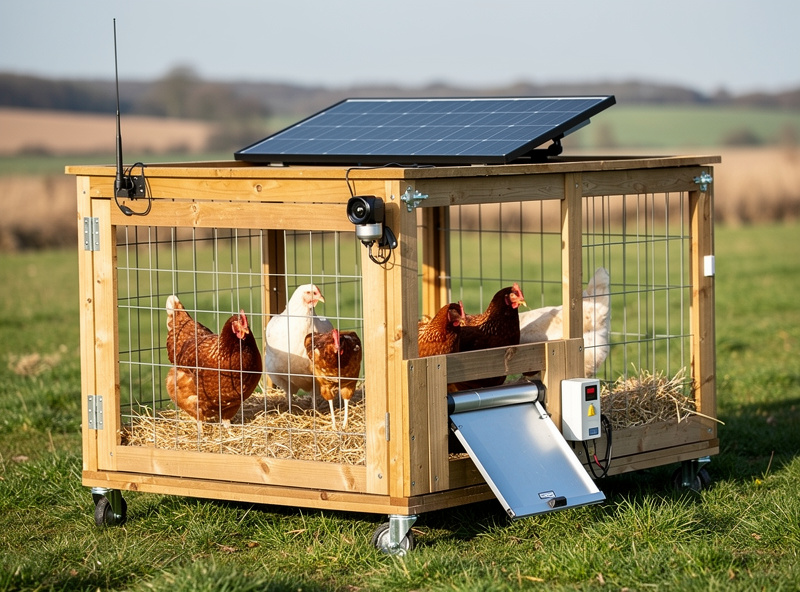
Smart-coop automation is harder in portable coops because the wiring, sensors, and equipment all have to move with the coop daily. The trade-off: lower complexity, lower hardware cost, and battery-only power instead of wired electrical. The smart features that work in portable coops are a focused subset of full smart-coop builds.
Battery-powered automatic door: The single most valuable smart upgrade for portable coops. A solar-rechargeable auto-door (typical cost $180 to $300) handles dawn and dusk transitions without daily intervention, which matters most when the coop is 50+ feet from the house. See our automatic coop door buyer’s guide for solar-friendly door picks.
Wireless temperature and humidity sensor: A battery-powered sensor with WiFi or Zigbee transmission gives you remote monitoring without running cables. Mount inside the coop near roost height. Battery life on a typical sensor is 12 to 18 months. The full sensor strategy is in our smart coop monitoring guide.
Solar-powered motion camera: A solar-trickle-charged outdoor security camera mounted to the coop frame gives predator detection and laying observation. Most portable coop applications can use the same outdoor cameras designed for property surveillance. Avoid cameras that require constant WiFi pings — the daily move can disrupt connection if you cross WiFi range boundaries.
Battery-friendly automatic feeder: A 3 to 5 lb capacity treadle or timer feeder needs no power but reduces feed waste and pest attraction. The full smart-coop layout — including the patterns that adapt to mobile coops — is in our smart chicken coop pillar guide, with budget-friendly automation in our $200 DIY automation guide.
Portable vs Static: Lifetime Cost Comparison
Sticker price favors portable coops, but the 5-year total cost of ownership shifts depending on flock size and rotation discipline. The numbers below assume 6 standard hens, zone 6 climate, and serious flock keepers (not first-timers who quit at month 18).
| 5-Year Cost Component | Portable (4×8 wheeled) | Static (4×6 lift-top + run) |
|---|---|---|
| Initial coop cost | $900-$1,200 | $650-$1,000 (coop + run materials) |
| Wear and replacement (5 yr) | $200-$400 (wheels, frame, tarp) | $150-$300 (run mesh, hinges) |
| Feed cost (growing season savings) | -$600 to -$1,200 (30-50% less feed during 6-month grazing) | $0 (no foraging savings) |
| Parasite/medication costs | $0-$80 (rotation prevents buildup) | $80-$300 (mites, worms) |
| Bedding cost (5 yr) | $50-$150 (less needed with rotation) | $200-$500 |
| 5-Year Total | $550-$1,650 | $1,080-$2,100 |
The portable coop wins on 5-year economics IF you actually move it daily during growing season. Skip the rotation discipline and the math flips — feed savings disappear, parasite costs reappear, and you’ve spent $300 to $400 more upfront for the same outcome as a static coop. The economic case for portable coops is entirely a labor case: trade 10 to 15 minutes of daily moves during 6-month growing season for $120 to $240 per year in feed and medication savings.
Smart-coop economics also tilt different ways. Static coops can amortize larger smart-automation investments ($600 to $900 for full sensor, camera, and door coverage) over a longer service life. Portable coops cap the smart investment at $300 to $400 because the equipment moves daily and gets replaced more often. Plan accordingly — overspending on smart hardware for a portable coop rarely pays back.
Common Mistakes With Portable Chicken Coops
Four mistakes account for nearly every “I’m switching back to static” post on backyard chicken forums.
Mistake 1 — buying a “portable” coop that isn’t: Many prefab coops marketed as “portable” weigh 200+ lbs empty (350+ lbs with bedding, feeder, and waterer in place) and require 2 adults to move. Test the actual weight before buying. If you can’t tilt one end off the ground unassisted, it’s not portable enough for daily rotation.
Mistake 2 — using a tractor as a winter coop: A-frame tractors and PVC hoop coops fail as winter coops in zones 3 to 5 because the ground-level floor offers no insulation and the light frame can’t hold heat. Use portable coops as 7-month-per-year solutions paired with a separate winter coop, or limit portable use to zones 7 and warmer.
Mistake 3 — skipping the rotation: The most common portable-coop failure is just not moving it. I have been guilty of it in a busy week — and a portable coop punishes you fast, with mud and bare ground inside ten days. After 2 weeks in one spot, a portable coop becomes a static coop with all the parasite, mud, and overgrazing problems static coops are designed to handle differently — regular movement to fresh ground is the actual mechanism behind lower parasite loads in pastured flocks, not the coop design itself (Rodale Institute). If you genuinely won’t move it daily, buy a static coop instead. Our beginners guide covers the static-vs-mobile decision in detail.
Mistake 4 — undersized coop with “fresh grass” excuse: Some portable-coop sellers justify undersized footprints (12 to 16 sq ft for 6 birds) by pointing to daily fresh grass. The math doesn’t fully work — birds still need adequate rest space at night and during weather that prevents daytime foraging. Stick to 6 to 8 sq ft of total tractor footprint per standard bird, even with daily rotation.
Frequently Asked Questions
What is the best portable chicken coop?
The best portable chicken coop format depends on flock size and terrain. A 4×6 or 4×8 ft A-frame tractor is best for 2 to 4 birds on flat lawn. A 4×8 ft wheeled coop is best for 4 to 6 birds on rough ground or slopes. Above 8 birds, switch to a 6×10 ft skidded coop or build a static coop with rotational paddocks instead.
How often do you move a portable chicken coop?
Standard rotation is daily, with the coop moving one full coop-length forward each day. Heavy flocks (6+ birds in a 4×8 tractor) need 1.5 coop-lengths daily. Light flocks (2 to 3 birds) can manage half-coop moves. In late summer when grass slows, double the move distance regardless of flock size.
Can a portable chicken coop be used in winter?
Generally no in cold climates. A-frame tractors and PVC hoop coops fail as winter coops in zones 3 to 5 because the ground-level floor offers no insulation. Use portable coops as 7-month-per-year solutions paired with a separate winter coop. Wheeled coops with insulated walls can extend into mild winters in zones 6 and warmer.
How heavy can a portable chicken coop be?
For one-person moves, keep total coop weight under 250 pounds (loaded with bedding, feeder, and waterer). For two-person moves with handles, 400 pounds is the practical maximum. Above 400 pounds, the coop is no longer portable enough for daily rotation regardless of marketing claims.
How many chickens fit in a portable coop?
Most portable coops are sized for 2 to 8 standard-breed hens. A 4×6 ft A-frame fits 2 to 3 birds, a 4×8 ft tractor fits 4 to 6 birds, and a 5×10 ft wheeled coop fits 6 to 8 birds. Above 8 birds, weight crosses the practical-portability threshold and a static coop with rotational paddocks works better.
Are chicken tractors better than static coops?
Neither is universally better – they solve different problems. Chicken tractors deliver fresh foraging daily, meaningfully cut feed costs during growing season, and prevent parasite buildup. Static coops handle larger flocks, work year-round in cold climates, and demand less daily labor. The right choice depends on flock size, climate, and how often you’ll actually move the coop.
Bottom Line: Portable Coops Are a Daily-Labor Commitment
A portable chicken coop only delivers its benefits — fresh grass, lower feed costs, no parasite buildup — if you actually move it daily. The hardware (A-frame, wheeled, skidded, or PVC hoop) matters less than the rotation discipline. If you’ll genuinely commit to daily moves through growing season, a $400 to $700 portable coop pays back in feed savings within 18 months and produces healthier birds. If you won’t, buy a static coop and put the rotation budget into a properly-sized run.
For specific portable-coop deep dives: chicken tractor design guide for A-frame plans, chicken tractor for sale for retailer comparisons, mobile chicken coops for grazing rotation, chicken coop on wheels for wheel system selection, movable chicken coops for daily rotation routines, portable chicken pens for daytime supervision, portable chicken houses for solid-walled options, and portable chicken runs for run-only setups. For sizing across formats, the chicken coop size guide covers the math.
Related Guides
- Chicken Coop Size Guide: How Many Chickens Per Square Foot
- Small Chicken Coops: Best Picks for 2-4 Birds
- Chicken Coop for 4 Chickens: Best Compact Picks
- Chicken Coop for 6 Chickens: Best Picks & Layout
- How to Build a Smart Chicken Coop: The Complete 2026 Guide
- Automatic Chicken Coop Doors: Complete Buyer’s Guide 2026
- Smart Chicken Coop on a Budget: DIY Automation Under $200
Related Guides
Water-Level and Flow Sensors: Knowing the Waterer Is Empty Before They Do
A coop water-level sensor tells you the drinker is going dry — or freezing solid — before the flock does,…
Ammonia Sensors for the Coop: Catching Air Problems Before You Smell Them
An ammonia sensor belongs at the birds’ breathing height, close to the litter where the gas is generated, because that…

Node-RED vs Home Assistant Automations for the Coop: When to Use Which
Use native Home Assistant automations for the coop’s simple, safety-critical rules — the sunrise door, the freeze-watch waterer — and…