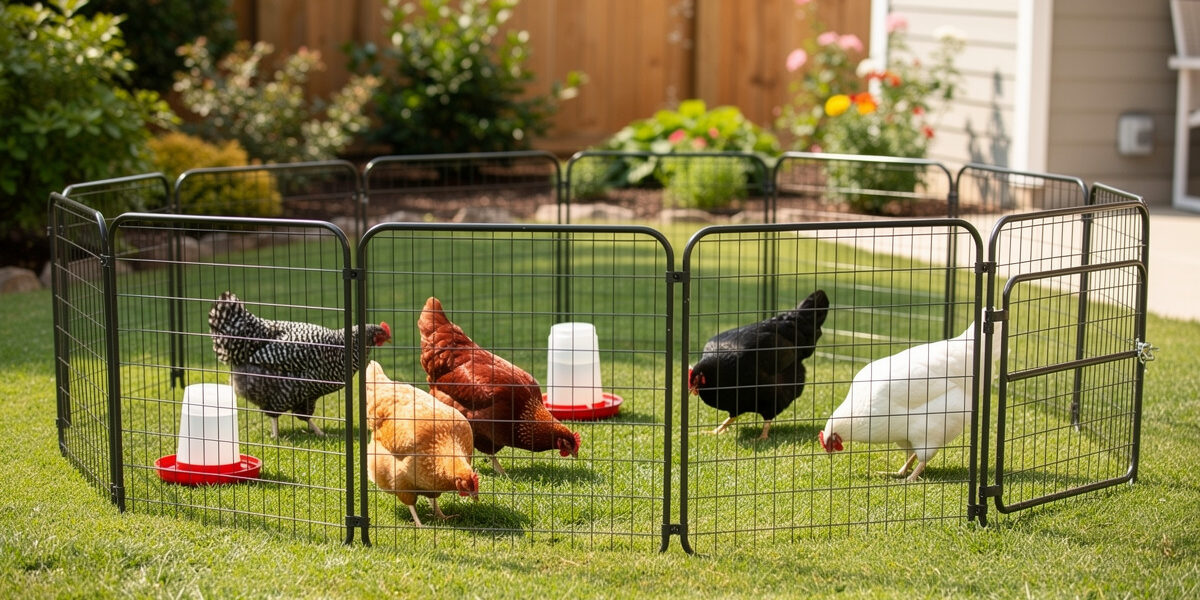
A portable chicken pen is a lightweight enclosed outdoor area that hens can use during daylight hours, distinct from a portable coop that includes sleeping quarters. Pens cost 60 to 70 percent less than full coops, weigh 15 to 40 lbs (one-person carry, no wheels needed), and solve different problems: daytime free-range supervision, chick brooder enclosures, day-pens that pair with a fixed main coop, or temporary enclosures during coop maintenance. I keep a light pen on hand for exactly two jobs on my own place — graduating brooder chicks to the outdoors and isolating a new or off-looking bird before it goes near the main flock.
This guide covers what separates a pen from a portable coop, the five pen formats that work for backyard chicken keepers, the use cases where a pen beats a full coop, the daily setup-and-take-down routine that defines pen ownership, and the four mistakes that turn a $80 pen into useless garage clutter. For full coop options, see our portable chicken coops hub.
As an Amazon Associate I earn from qualifying purchases.
Portable Pen vs Portable Coop: Key Differences
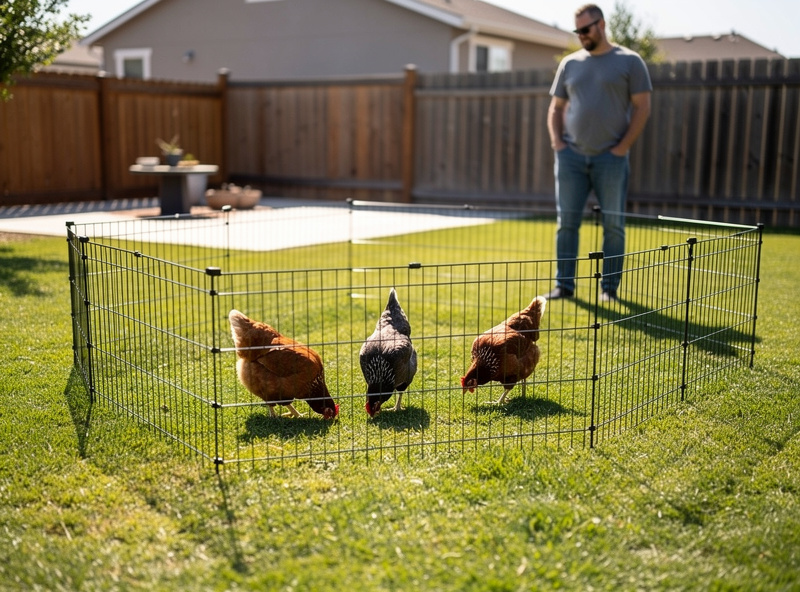
A portable chicken pen and a portable chicken coop solve overlapping but distinct problems. The pen is daytime-only outdoor space; the coop includes the enclosed sleeping area, nesting boxes, and roost bars. Buying the wrong category for your situation creates the most common pen-related disappointment.
Portable pens typically range from 8×4 ft to 16×8 ft in floor area, weigh 15 to 40 lbs (no wheels needed), and cost $40 to $250. They have no roof in some designs (open top with hawk netting required) or a light tarp/wire roof in covered designs. They don’t include sleeping or laying quarters — chickens go back to a separate primary coop at night. Setup and take-down typically takes 2 to 5 minutes by one adult.
Portable coops, by contrast, include the full enclosed sleeping area with nesting boxes and roost bars. They weigh 50 to 400+ lbs, often have wheels, and cost $200 to $1,500. Setup is typically permanent or semi-permanent — coops aren’t taken down nightly. The full feature comparison is in our portable chicken coops hub.
Five Portable Chicken Pen Formats
Five pen formats dominate the backyard market, each with distinct use cases.
| Format | Typical Size | Weight | Setup Time | Best Use |
|---|---|---|---|---|
| Pop-up wire pen | 10×4 ft | 12-20 lbs | 2 minutes | Daytime supervision, chicks 6+ weeks |
| Hexagonal play pen | 10 ft diameter | 15-25 lbs | 3 minutes | Free-range supervision, lawn rotation |
| Folding mesh panel pen | 16×8 ft (variable) | 25-40 lbs | 5 minutes | Larger flocks, day-pen pairing with coop |
| Brooder pen (chick-sized) | 4×2 ft to 6×3 ft | 5-15 lbs | 1-2 minutes | Chicks 1-6 weeks, indoor or outdoor |
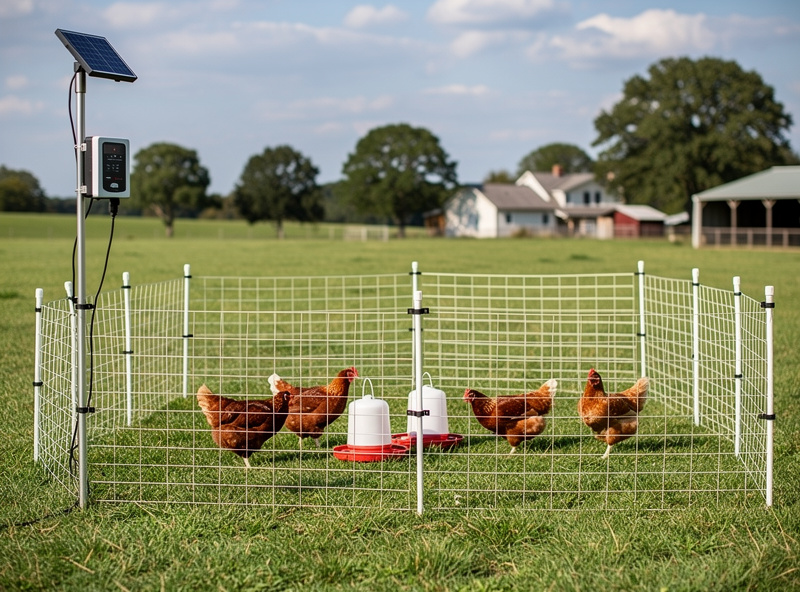
| Electric netting pen | 164 ft perimeter (typical) | 20-35 lbs | 15-20 minutes | Predator deterrent, larger free-range areas |
Pop-up wire pens are the entry-level pick at $40 to $90 and the format most buyers think of when they search for “portable chicken pen.” Hexagonal play pens (commonly sold for puppies but used widely for chickens) cost $60 to $140 and offer more usable area than pop-up rectangles. Folding mesh panel pens cost $120 to $250 and can be configured into different shapes. Brooder pens at $30 to $80 are the smallest format, designed for chicks under 6 weeks. Electric netting at $180 to $300 covers large areas with a portable solar charger and works as both a pen and a predator deterrent.
Best Use Cases for Portable Pens
A portable pen beats a full portable coop in five specific scenarios. If your situation matches one of these, the pen is the better buy.
Daytime free-range supervision: You let hens out of a fixed main coop for 1 to 4 hours of supervised free-ranging. A portable pen contains them in a defined safe area while letting them forage on fresh grass. Pop-up wire or hexagonal pens work best here.
Chick brooder graduation: Chicks aged 6 to 10 weeks are too large for indoor brooders but too small to integrate with adult flocks. A portable brooder pen lets them spend 4 to 8 hours daily outdoors getting acclimated to weather and ground conditions before joining the main flock — this is the pen job I lean on most, hardening off chicks the same patient way I harden off seedlings.
Day-pen rotation paired with fixed coop: Your main coop is fixed (large walk-in or shed conversion) but you want forage rotation benefits. Set up a portable pen in different spots daily for the hens to use during the day, returning them to the fixed coop at night. Best with folding mesh panel pens that can be reconfigured for the day’s location.
Temporary enclosure during coop maintenance: Cleaning the main coop, treating for mites, or doing repairs requires somewhere to put the flock for 2 to 4 hours. A portable pen handles this without forcing you to schedule maintenance around weather windows. See our chicken coop bedding guide for maintenance scheduling.
Sick bird quarantine: Isolating a sick or injured hen for observation or treatment requires separate enclosed space. A small portable pen kept clean and dedicated for quarantine use solves this without building a permanent quarantine coop. Critical at 10+ bird flocks where disease outbreaks can wipe out the whole flock — see our 12-chicken coop guide for quarantine planning at family-flock scale.
Daily Setup and Take-Down Routine
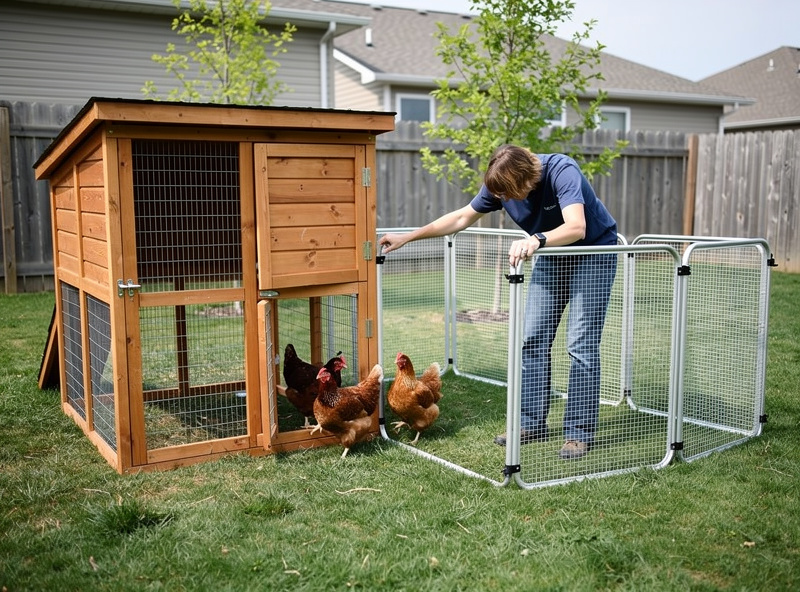
Portable pens differ from portable coops in that you typically set them up and take them down daily or near-daily. The routine matters: a pen that takes 10+ minutes to set up gets skipped within 30 days, while a 2-minute setup becomes a sustainable habit.
2-minute setup pens (pop-up wire, hexagonal): Pull from storage, unfold, stake corners, drop in feeder and waterer. These are the fastest-setup pens and the most-used in practice. Sustainable for daily use over years.
5-minute setup pens (folding mesh panels): Carry panels to setup location, link panels with provided clips, stake or weight corners, drop in feeder and waterer. Setup time is meaningful but still works for daily use if you keep all panels in one bag near the door.
15-20 minute setup pens (electric netting): Unroll netting, drive support posts at corners, attach netting to posts, set up solar charger and ground stake, test charge. Daily setup is impractical — these are typically deployed for 7 to 30 days at a time, then moved as a complete unit.
Storage matters as much as setup. A pen that lives in the garage takes 60 seconds longer to deploy than one stored 5 feet from the back door. Build a dedicated storage spot near the coop for daily-use pens. Brooder pens, electric netting, and quarantine pens can live in less-accessible storage since they’re used less frequently.
Pen Predator-Proofing
Portable pens are MORE vulnerable to predators than fixed coops because the lighter materials and ground-level construction don’t resist determined attacks. Daytime supervision is the assumed baseline — never leave hens in a portable pen overnight without dedicated predator measures.
Hawk protection: Open-top pens leave birds vulnerable to red-tail hawks, and the risk isn’t evenly spread — eXtension’s predator-management guidance notes hawks rarely take standard-sized adult chickens but will readily carry off a young or bantam bird, which matters here since brooder-graduation and quarantine are two of the most common jobs for a pen this size. Use covered pens (with wire or tarp top) for any unsupervised time over 30 minutes, even mid-day, especially with young or small-breed birds inside.
Ground predator protection: Standard pen mesh keeps chickens in but doesn’t deter raccoons, foxes, or coyotes. Add a 12-inch wire skirt around the pen perimeter laid flat on the ground (held with landscape stakes or rocks) to prevent dig-under attacks — the same 12-inch burial depth eXtension recommends for permanent run fencing. Electric netting pens combine the enclosure and the deterrent in one product.
Night protection: Never leave chickens in a portable pen overnight. Even predator-resistant pens with wire skirts and covered tops become death traps after dark. Always return birds to a properly-built coop with hardware cloth and a closing door at dusk. Pair with a battery-powered automatic coop door on the fixed main coop for reliable dusk closure.
Common Portable Chicken Pen Mistakes
Four mistakes account for most disappointed pen reviews on backyard chicken forums.
Mistake 1 — using a pen as overnight housing: Portable pens are daytime enclosures. Leaving birds in a pen overnight, even with covered tops, results in predator losses within weeks in most US locations. Always pair pens with a proper closing-door coop for nighttime housing.
Mistake 2 — buying too small: Pop-up wire pens at 6×3 ft fit chicks but are too small for 4 adult hens for any meaningful time. Match pen size to flock count using the same 10 sq ft per bird outdoor-space minimum eXtension recommends for laying hens that applies to runs. For exact sizing math, see our chicken coop size guide.
Mistake 3 — ignoring hawk protection: Open-top pens lose birds to hawks. Even a single hawk attack can wipe out a pen of 4 hens in under 30 seconds. Always use covered pens for unsupervised time, even brief mid-day periods.
Mistake 4 — buying a pen instead of a needed coop: Buyers searching for “portable chicken pen” often actually need a small coop because they don’t have a fixed main coop yet. Verify your situation: if you don’t have a main coop with sleeping/laying quarters, you need a coop, not a pen. New keepers from our beginners guide should start with a coop and add a pen later if needed.
Frequently Asked Questions
What is a portable chicken pen?
A portable chicken pen is a lightweight enclosed outdoor area for daytime use, distinct from a portable coop that includes sleeping quarters. Pens typically range from 8×4 ft to 16×8 ft, weigh 15 to 40 lbs, cost $40 to $250, and require 2 to 20 minutes of daily setup and take-down.
Can I use a portable chicken pen as a coop?
No. Portable pens are designed for daytime use only. They lack the sleeping quarters, nesting boxes, and predator-resistant construction that a proper coop provides. Always pair a pen with a proper coop for nighttime housing – leaving birds in a pen overnight results in predator losses within weeks.
How big should a portable chicken pen be?
Use the same 10 sq ft per bird minimum that applies to runs. A pen for 4 hens needs 40 sq ft minimum (8×5 ft or 4×10 ft). For 6 hens, 60 sq ft. Pop-up wire pens at 6×3 ft fit chicks but are too small for 4 adult hens for any meaningful time.
Are portable pens safe for chickens?
Only with proper supervision and predator measures. Open-top pens leave birds vulnerable to hawks – use covered pens for any unsupervised time over 30 minutes. Ground predators (raccoons, foxes, coyotes) defeat standard pen mesh easily – add a 12-inch wire skirt around the perimeter or use electric netting pens for unattended daytime use.
What is the difference between a chicken pen and a chicken run?
A chicken run is permanently attached to a fixed coop, providing the daily outdoor space that flock uses 8+ hours per day. A chicken pen is a portable temporary enclosure used for supervision, day-pen rotation, brooder graduation, or quarantine. Runs stay in one place; pens move daily or get taken down between uses.
How much does a portable chicken pen cost?
Pop-up wire pens cost $40 to $90. Hexagonal play pens (often sold as puppy pens but suitable for chickens) cost $60 to $140. Folding mesh panel pens cost $120 to $250. Brooder pens cost $30 to $80. Electric netting pens cost $180 to $300 including a solar charger.
Bottom Line: Pens Are Supplements, Not Replacements
A portable chicken pen is the right buy for daytime supervision, chick brooder graduation, day-pen rotation paired with a fixed coop, temporary maintenance enclosures, or sick-bird quarantine. It’s the wrong buy if you don’t already have a primary coop — pens never substitute for proper coop construction with sleeping quarters and predator-proof enclosures. Pop-up wire pens at $40 to $90 cover most backyard supplemental needs; folding mesh panel pens at $120 to $250 handle larger flocks and configurable setups.
For full coop options, see our portable chicken coops hub. For sizing your fixed primary coop, the chicken coop size guide covers the math by flock count.
Related Guides
- Portable Chicken Coops & Tractors: Complete 2026 Guide
- Mobile Chicken Coops: Rotational Grazing & Pasture Picks
- Chicken Coop Size Guide: How Many Chickens Per Square Foot
- Chicken Coop for 6 Chickens: Best Picks & Layout
- Backyard Chickens for Beginners: Everything You Need to Know in 2026
- Automatic Chicken Coop Doors: Complete Buyer’s Guide 2026
Related Guides
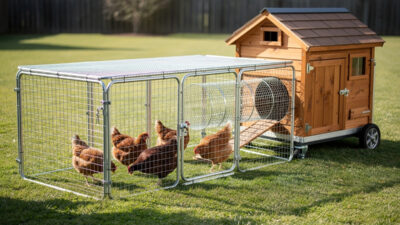
Portable Chicken Run: Modular Picks for Mobile Coops
A portable chicken run is a movable outdoor enclosure that connects to or follows a chicken coop, providing relocatable forage…
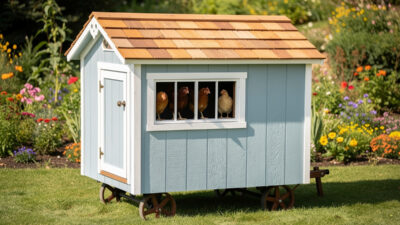
Portable Chicken House: Cottage, Plastic & Barn Picks
A portable chicken house is a movable enclosed structure focused on the housing/sleeping area, distinct from a portable chicken tractor…

Movable Chicken Coops: Daily Rotation Routine Guide
A movable chicken coop is one designed for occasional or daily relocation around a yard, distinct from “portable” coops built…