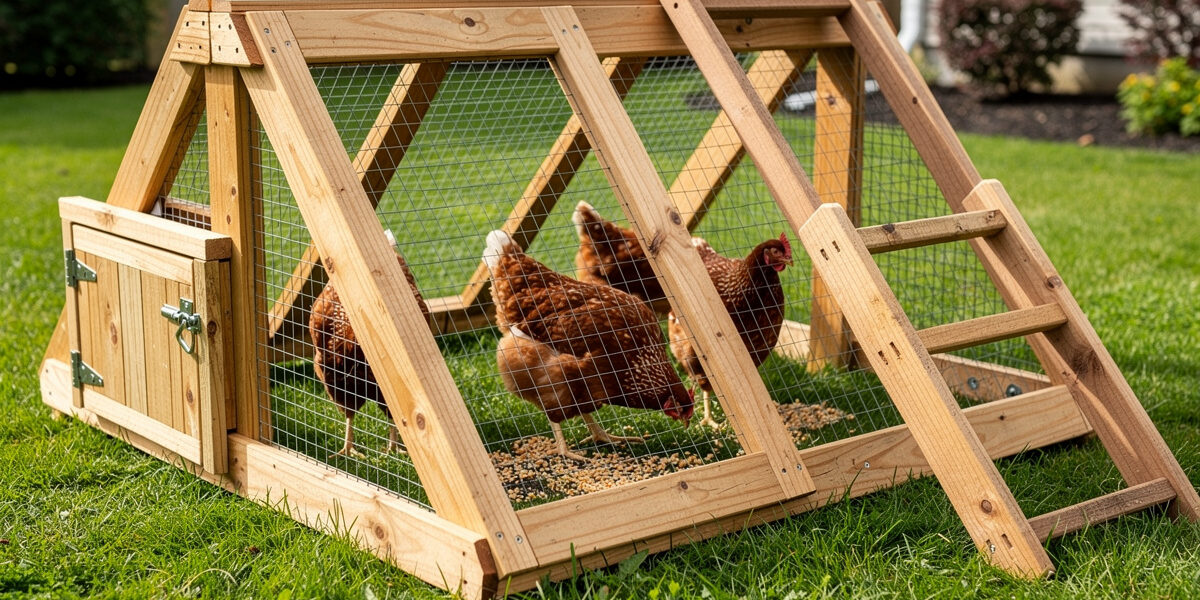
A chicken tractor is a bottomless mobile chicken coop, typically A-frame shaped, designed to be moved daily across grass or pasture so birds get fresh forage without ranging freely. The term itself comes from Andy Lee and Patricia Foreman’s book on the concept, and the daily-move rotation method was popularized for a wider audience through Joel Salatin’s pastured-poultry work at Polyface Farm starting in the early 1990s. Today it covers any 30 to 80 lb portable coop you can drag or wheel by yourself in under 5 minutes. I run a cattle-panel hoop and an A-frame across my own rotation, and that 5-minute rule is the one that actually matters: the moment a move takes longer, it quietly stops happening.
This guide covers what makes a true chicken tractor (vs. just a “small portable coop”), the seven standard A-frame designs that work for backyard and small-pasture use, the daily move math that determines whether you save feed money or burn time, and the four mistakes that ruin most first chicken tractors. For other portable formats, see our portable chicken coops and tractors hub, the portable chicken house guide for floored mobile coops, the portable chicken run guide for daytime-only enclosures, and the portable chicken pen guide for grow-out and quarantine setups. If you have already decided on the tractor format and want shopping channels, our chicken tractor for sale guide covers price ranges and where to buy.
As an Amazon Associate I earn from qualifying purchases.
What Makes a Chicken Tractor a Chicken Tractor?
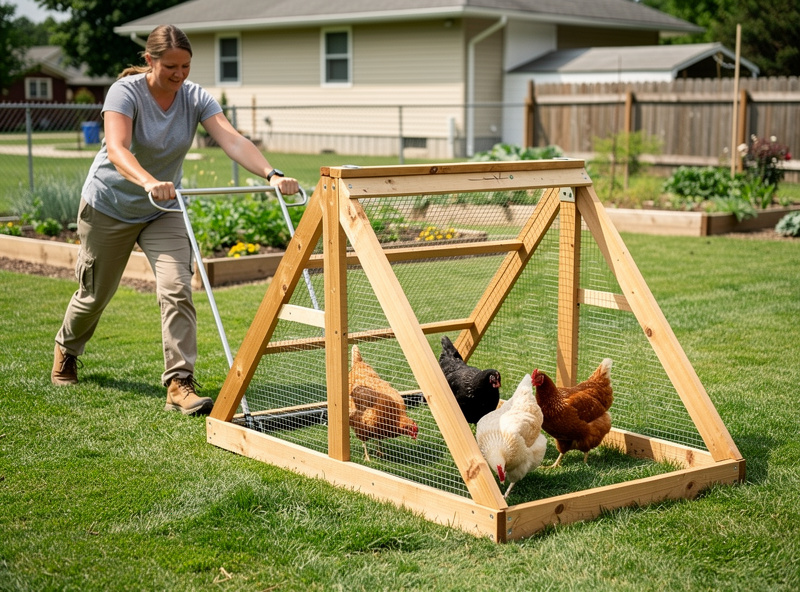
A chicken tractor has four defining features: bottomless construction (no floor, just the bare ground), light enough for one-person daily moves (typically 30 to 80 lbs empty), an integrated wire-enclosed run section that protects birds during the day, and a small enclosed sleeping/laying area at one end with nesting boxes and a roost bar. The traditional shape is A-frame, but rectangular and arched designs also qualify if they meet the four criteria above.
The bottomless design is the critical feature that separates tractors from other portable coops. Birds peck at fresh grass, scratch up bugs, and fertilize as they go — the entire ground footprint becomes both their living area and their foraging area. After 24 hours, the spot is grazed enough that you move forward and the area gets 7 to 14 days to recover. That’s the rotation cycle Salatin’s pasture systems are built on, scaled down for backyard use.
What does NOT count as a chicken tractor: any coop with a floor (those are portable coops, not tractors), anything heavier than 100 lbs unloaded (those need wheels and assist mechanisms, putting them in the wheeled-coop category), and anything that requires more than 5 minutes to move (those create rotation friction that kills the daily-move habit within weeks).
Seven Standard Chicken Tractor Designs
Most working chicken tractors fall into one of seven design patterns. Each fits a specific flock size and use case.
| Design | Typical Size | Bird Capacity | Empty Weight | Best Use |
|---|---|---|---|---|
| Compact A-frame | 3×6 ft | 2-3 standard | 30-50 lbs | Backyard rotation, urban lawns |
| Standard A-frame | 4×8 ft | 3-5 standard | 50-80 lbs | Suburban rotation, beginner builds |
| Joel Salatin pasture pen | 10×12 ft | 50-75 broilers | 100-150 lbs | Meat birds, small pasture |
| Hooped PVC tractor | 4×8 to 6×10 ft | 4-8 standard | 35-65 lbs | Cheapest DIY, mild climates |
| Cattle panel arch | 5×10 to 8×16 ft | 6-12 standard | 80-130 lbs | Larger rotational backyards |
| Wheeled rectangular tractor | 4×8 ft | 4-6 standard | 90-140 lbs | Rough ground, slopes |
| Mini tractor (2-bird starter) | 2×4 ft | 2 bantams or 1 standard | 20-35 lbs | Truly tiny yards, kids’ projects |
The standard 4×8 A-frame is the most-built backyard tractor and the design most DIY plans default to. Compact 3×6 A-frames work well in HOA-restricted yards. Salatin’s 10×12 pasture pen is the original meat-bird design and only practical on actual pasture. Hooped PVC tractors are the cheapest entry but rarely last more than 2 to 3 years before the tarp tears or the PVC fatigues. Cattle panel arches are the durable middle ground — heavier than hooped PVC but cheaper than full-frame wood A-frames.
Daily Move Math: Distance and Direction
Standard rotation moves the tractor one full coop-length forward each day. For a 4×8 ft tractor, that’s an 8-foot daily move, with the back of the tractor settling where the front sat 24 hours ago. Birds get fresh grass every morning and the previously-occupied area gets a 7- to 14-day rest cycle before the rotation grid returns.
Adjust the daily move distance based on flock density and grass health. Heavy flocks (5 birds in a 4×8 tractor) strip grass faster and need 1.5 coop-lengths daily. Light flocks (2 to 3 birds) can manage half-coop moves and still maintain grass cover. In late summer when grass growth slows, double the move distance to give grass extra recovery regardless of flock size.
Plan the rotation grid before you start moving. A 1/4-acre suburban lawn supports 8 to 12 weeks of unique daily positions before the grid must repeat. Map a back-and-forth pattern that covers your usable area, leaving 7 to 14 days between revisits — the actual rest period is what breaks the parasite cycle and lets grass recover, not the tractor design itself (Rodale Institute). Without a planned grid, most keepers default to the same 3 or 4 spots and recreate the static-coop overgrazing problem the tractor was supposed to solve. I did exactly this my first summer — drifted back to the same four spots near the gate and turned my so-called rotation into four bald, muddy patches by August. For exact sizing math by flock count, see our chicken coop size guide.
DIY Chicken Tractor Plans
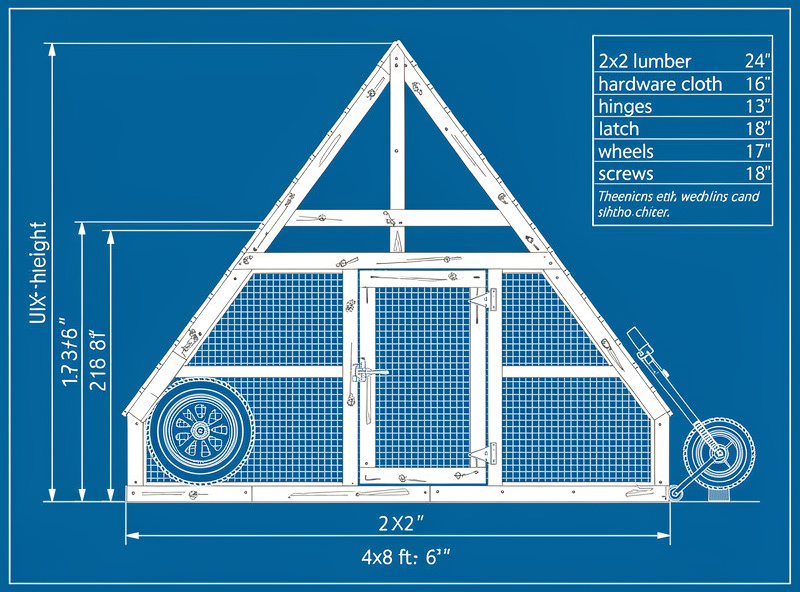
The standard DIY 4×8 ft A-frame chicken tractor takes 8 to 14 hours to build and costs $120 to $250 in materials. Plans available across YouTube, university extension sites, and homesteading forums all share the same core pattern: 2×2 lumber for the A-frame, 1/2 inch hardware cloth (never chicken wire) for predator-proof wire panels (Garden Betty), corrugated metal or treated plywood for the roof and rear sleeping section, and a hinged side door for human access.
Material list for a standard 4×8 A-frame:
- 4x 8-foot 2x4s (rip to 2×2 to save weight)
- 4x 4-foot 2x4s for cross braces and top ridge
- 2x 4×8 ft sheets of 1/2-inch hardware cloth
- 1x 4×4 ft sheet of corrugated metal or treated plywood
- 2x cabinet hinges for the access door
- Wire ties, deck screws, exterior wood glue
- Optional: 2 lawn-mower wheels with axle for the lift end
Total material cost depends on lumber prices in your region (typical 2024 to 2026 range: $150 to $220) and whether you have wood scrap on hand. Build time for a first-time builder runs 12 to 18 hours; experienced DIY builders complete the same plan in 6 to 8 hours. See our $200 DIY automation guide for adding battery-powered smart features to the build.
Best Commercial Chicken Tractors
Commercial pre-built chicken tractors fall into three price tiers, each with predictable trade-offs.
Entry-level ($280 to $450): 3×6 to 4×6 ft compact A-frames. Thin lumber (typically pine or fir 1×2), light hardware cloth, basic hinged access. Hold up for 2 to 3 years of daily use before structural failure starts. Best for first-time chicken keepers testing whether they want to commit to a flock long-term. Capacity: 2 to 3 standard hens.
Mid-range ($500 to $900): 4×8 ft standard A-frames or compact wheeled coops. Heavier 2×2 framing, full 1/2 inch hardware cloth, integrated nesting boxes (typically 1 to 2 boxes), often with lift-end wheels. 5 to 8 year service life with regular maintenance. The sweet spot for serious backyard rotation. Capacity: 3 to 5 standard hens.
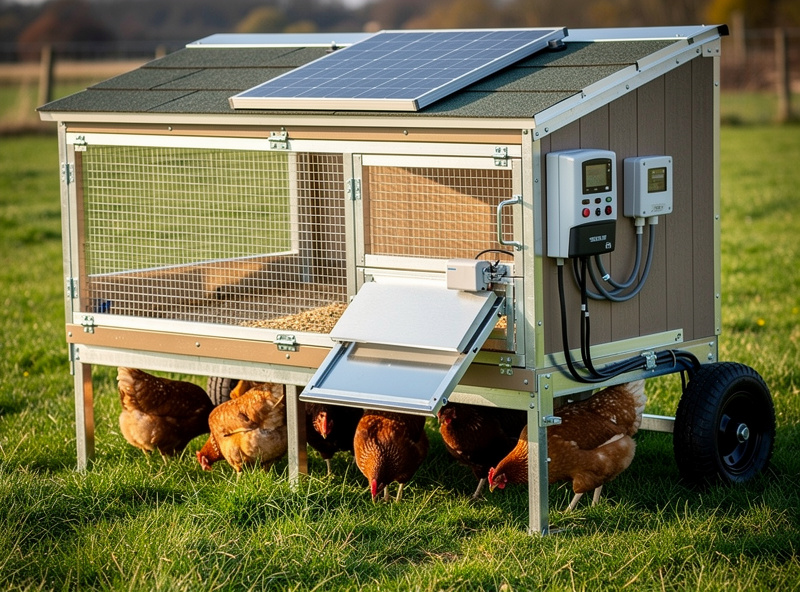
Premium ($1,000 to $1,800): 5×10 ft wheeled tractors or 4×10 ft heavy A-frames with metal roofing. Full 2×4 framing, multiple nesting boxes, sometimes integrated battery-door provisions. 10+ year service life. Best for committed long-term portable-coop keepers. Capacity: 5 to 8 standard hens.
Avoid sub-$280 “tractor” listings — they’re typically PVC hoop builds with thin tarp covers that fail within 12 months. Commercial tractors above $1,800 rarely justify the price premium over a comparable DIY build using the same materials.
Common Chicken Tractor Mistakes
Four mistakes account for nearly every “the chicken tractor failed” complaint on backyard chicken forums.
Mistake 1 — using a tractor as a winter coop: A-frame tractors fail as winter coops in zones 3 to 5 because the bottomless ground-level floor offers no insulation and the light frame can’t hold heat. Use tractors as 7-month-per-year solutions paired with a separate winter coop, or limit tractor use to zones 7 and warmer where freezing nights are rare.
Mistake 2 — not actually moving it: The most common tractor failure is just not moving it. The 80-lb commercial A-frame I tried first was heavy enough that I quietly stopped moving it after two weeks — weight is the silent killer of the daily habit. After 2 weeks in one spot, a tractor becomes a static coop with all the parasite, mud, and overgrazing problems static coops handle differently. If you genuinely won’t move it daily, a static coop with proper run sizing works better. Our backyard chickens beginners guide covers the static-vs-mobile decision in detail.
Mistake 3 — predator-prone construction: Many DIY and entry-level tractors use chicken wire instead of hardware cloth. Chicken wire is sized to keep chickens in, not predators out — a determined raccoon defeats it in under 60 seconds. Always use 1/2 inch galvanized hardware cloth for any wire panel that touches the ground or could be reached from outside. Pair with a battery-powered automatic coop door for the closed sleeping section if it has one.
Mistake 4 — overcrowding the tractor: Sellers often justify undersized tractors (12 to 18 sq ft for 6 birds) by pointing to daily fresh grass. The math doesn’t fully work — birds still need adequate rest space at night and during weather that prevents daytime foraging. Stick to 6 to 8 sq ft of total tractor footprint per standard bird, even with daily rotation. For exact picks by flock count, see our 4-chicken and 6-chicken coop guides.
Frequently Asked Questions
What is a chicken tractor?
A chicken tractor is a bottomless mobile chicken coop, typically A-frame shaped, designed to be moved daily across grass or pasture so hens get fresh forage. The daily-move rotation method was popularized for a wider audience by Joel Salatin’s pastured-poultry work, and the term now covers any 30 to 80 lb portable coop one person can move in under 5 minutes.
How big should a chicken tractor be?
Standard chicken tractors are 4×8 ft for 3 to 5 standard hens, 3×6 ft for 2 to 3 hens, or 10×12 ft for 50+ broiler chickens following the Joel Salatin pasture model. Allow 6 to 8 sq ft of total tractor footprint per standard bird, even with daily rotation.
How often do you move a chicken tractor?
Move a chicken tractor daily, one full coop-length forward each move. For a 4×8 ft tractor that is an 8-foot daily move. Heavy flocks (5+ birds in a 4×8) need 1.5 coop-lengths. Light flocks (2 to 3 birds) can manage half-coop moves. Skip the daily move and the tractor becomes a static coop with overgrazing problems.
Is a chicken tractor good for laying hens?
Yes, in growing season. Chicken tractors deliver fresh foraging that supports egg production and meaningfully cuts commercial feed use during peak grazing months. Tractors fail as winter coops in cold climates – pair with a separate winter coop in zones 5 and colder for year-round laying.
How much does a chicken tractor cost?
DIY 4×8 A-frame tractors cost $120 to $250 in materials and 8 to 14 hours of build time. Commercial entry-level tractors cost $280 to $450 for 3 to 6 ft A-frames. Mid-range commercial tractors run $500 to $900 for proper 4×8 ft builds with hardware cloth and integrated nesting boxes.
Can chicken tractors be predator proof?
Yes, with proper materials. Use 1/2 inch galvanized hardware cloth (not chicken wire) for all wire panels. Add a 12-inch wire skirt around the bottom edge to prevent dig-under attacks. Pair with a battery-powered automatic door if the tractor has an enclosed sleeping section. Avoid sub-$280 commercial tractors – they typically use chicken wire that any raccoon defeats quickly.
Bottom Line: A Chicken Tractor is a Daily Habit, Not a Hardware Purchase
The best chicken tractor is the one you’ll actually move every day. A $200 DIY 4×8 A-frame moved religiously beats an $800 commercial tractor that sits in one spot for two weeks. Pick the design that matches your terrain (A-frame for flat lawn, wheeled for slopes, hooped PVC for tightest budget), commit to the daily rotation grid, and pair with a separate winter coop in zones 5 and colder. The labor pays back in feed savings, healthier birds, and the parasite-prevention benefit static coops can’t match.
For other portable formats and the full rotation math, see our portable chicken coops and tractors hub. For sizing decisions across both portable and static formats, the chicken coop size guide covers the math.
Related Guides
- Portable Chicken Coops & Tractors: Complete 2026 Guide
- Chicken Coop Size Guide: How Many Chickens Per Square Foot
- Chicken Coop for 4 Chickens: Best Compact Picks
- Chicken Coop for 6 Chickens: Best Picks & Layout
- Small Chicken Coops: Best Picks for 2-4 Birds
- Automatic Chicken Coop Doors: Complete Buyer’s Guide 2026
Related Guides
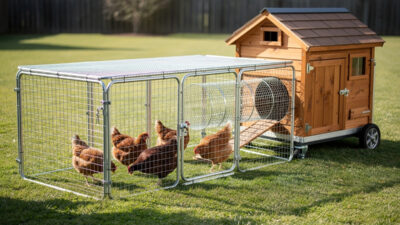
Portable Chicken Run: Modular Picks for Mobile Coops
A portable chicken run is a movable outdoor enclosure that connects to or follows a chicken coop, providing relocatable forage…
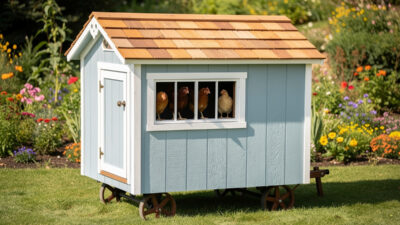
Portable Chicken House: Cottage, Plastic & Barn Picks
A portable chicken house is a movable enclosed structure focused on the housing/sleeping area, distinct from a portable chicken tractor…
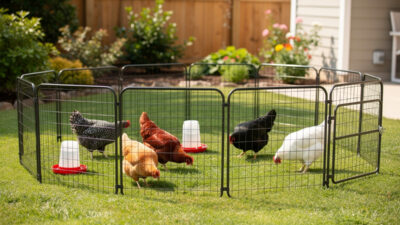
Portable Chicken Pen: 5 Best Picks for Daily Setup
A portable chicken pen is a lightweight enclosed outdoor area that hens can use during daylight hours, distinct from a…