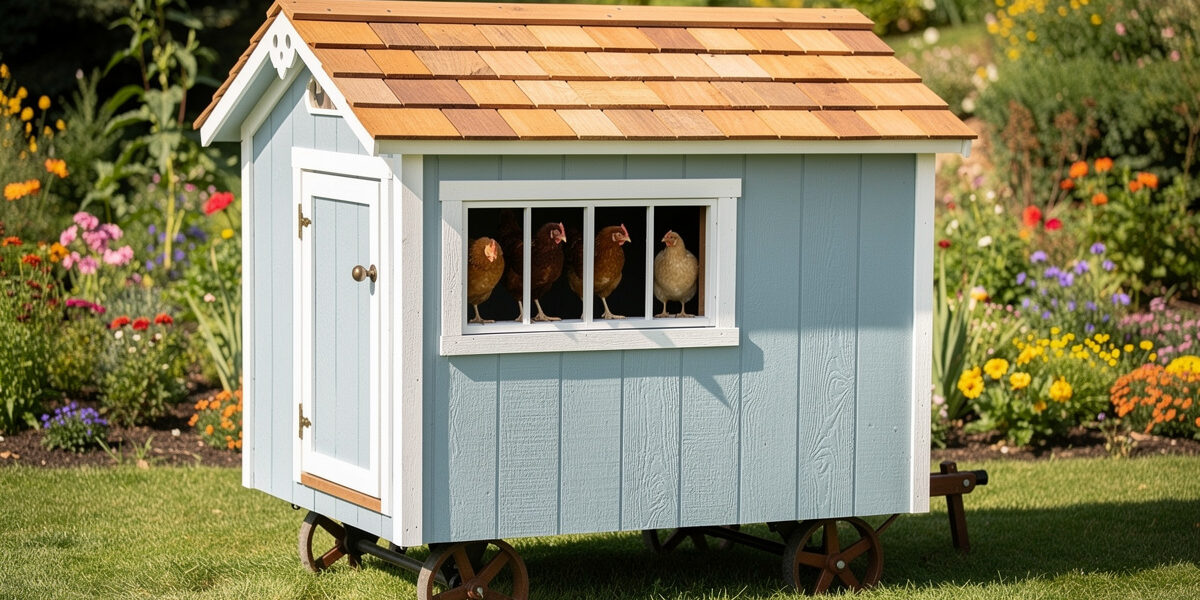
A portable chicken house is a movable enclosed structure focused on the housing/sleeping area, distinct from a portable chicken tractor (which combines housing and run in one mostly-wire structure). Houses prioritize solid walls, weather protection, and visual appearance over the open-wire grazing exposure that defines tractors. The right portable house works for keepers who want a movable coop that looks like a small backyard structure rather than a wire cage. My own coop is a fixed, insulated walk-in rather than any of these portable house styles, but the ventilation math, predator-proofing standards, and material choices below are the same ones I hold every coop to, portable or not.
This guide covers what separates a portable chicken house from a tractor or general portable coop, the four house formats that work for backyard flocks, when to pick a house over a tractor for your situation, the all-weather construction details that determine 5-year vs 15-year service life, and the four mistakes that make portable houses fail. For other portable formats, see our portable chicken coops hub.
Portable Chicken House vs Tractor: What’s the Difference?
The terminology overlap between portable chicken house, chicken tractor, and portable chicken coop confuses most buyers. Practical distinctions exist in construction style and use case, even though all three are technically “movable coops.”
A portable chicken HOUSE has solid walls (wood, plastic panels, or composite) on most sides with only specific ventilation openings. It includes a fully enclosed sleeping/laying area as the primary feature, with an attached run as a secondary or optional component. Visual aesthetic matters — houses are designed to look like small backyard buildings (cottage style, barn style, modern shed style) rather than cages.
A portable chicken TRACTOR has wire mesh on most sides for grazing exposure, with only a small enclosed end-section for sleeping. The whole footprint is functional grazing area. Aesthetic is utilitarian — tractors look like what they are (wire pens with a small box at one end). See our chicken tractor design guide for tractor specifics.
A portable chicken COOP is the broad category covering both houses and tractors plus everything in between. The portable chicken coops hub covers all formats together; this guide focuses specifically on the solid-walled, enclosed-house format.
Four Portable Chicken House Formats
Four house formats dominate the backyard portable-house market, each with distinct construction and use case patterns.
| Format | Typical Size | Bird Capacity | Materials | Approx. Cost |
|---|---|---|---|---|
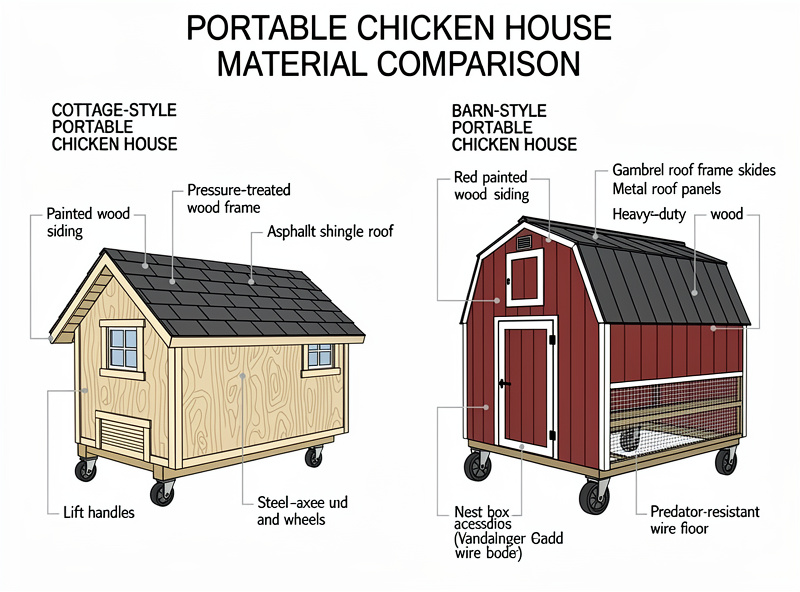
| Cottage-style portable house | 4×4 to 5×6 ft | 3-5 standard hens | Wood walls, asphalt or metal roof | $500-$1,200 |
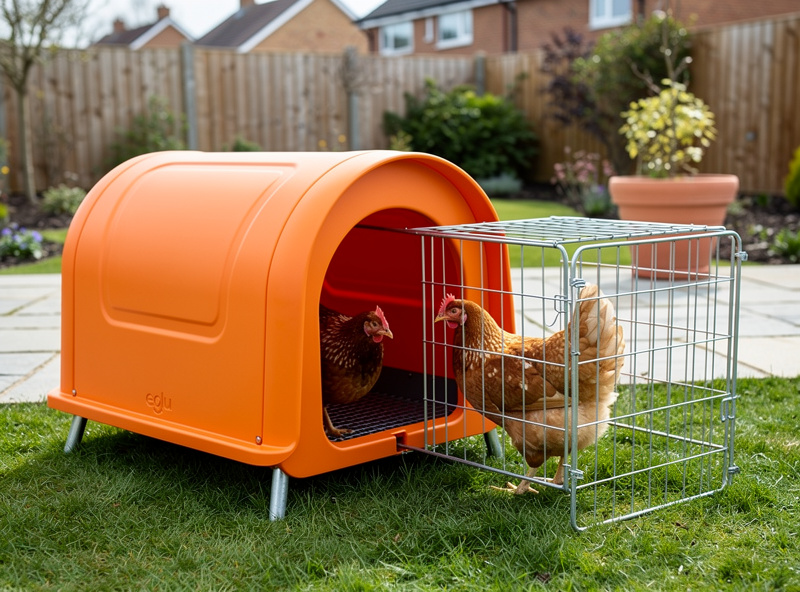
| Plastic Eglu-style modular | 3×4 to 4×5 ft | 2-4 standard hens | HDPE plastic panels | $650-$1,500 |
| Barn-style portable house | 5×7 to 6×8 ft | 4-7 standard hens | Wood walls, gambrel roof | $900-$2,000 |
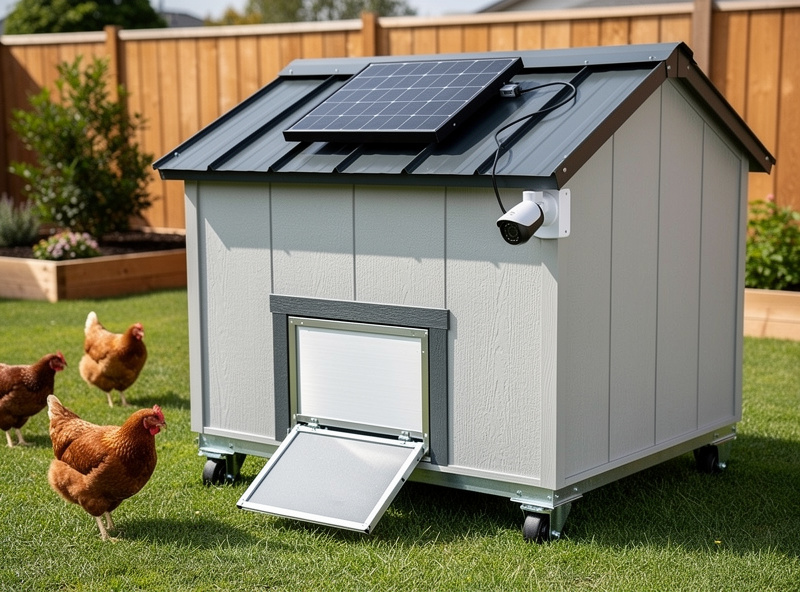
| Modern shed-style portable | 4×6 to 5×8 ft | 4-6 standard hens | Composite panels, metal roof | $700-$1,800 |
As an Amazon Associate I earn from qualifying purchases.
Cottage-style houses dominate the entry-to-mid market. Their visual design (often painted bright colors with decorative trim) appeals to buyers who treat the chicken house as a backyard feature rather than a utility structure. Plastic Eglu-style modulars offer the best long-term durability (HDPE plastic outlasts wood by 2x) and easiest cleaning (hose-down construction with no porous wood surfaces). Barn-style houses look more agricultural and typically include larger nesting box banks. Modern shed-style portables suit contemporary backyards and often integrate better with smart-coop hardware mounting because of flat-wall construction.
When to Pick a House Instead of a Tractor
Three buyer scenarios favor a portable house over a portable tractor.
HOA or neighbor-aesthetic concerns: If your neighborhood pushes back against utility-looking structures, a cottage or modern shed-style portable house draws less complaint mail than a wire tractor. Some HOAs explicitly disallow “agricultural-looking” structures but permit “garden buildings” — a portable chicken house often qualifies as the latter.
Cold climate weekly rotation (zones 4 to 6): Solid-walled houses retain heat better than wire-walled tractors in shoulder-season weather. A portable house with R-5 insulated walls handles 25°F to 50°F nighttime temps that tractors fail at. The enclosed walls also block wind, which matters more than absolute temperature for hen comfort — I’ve never lost a bird to cold on my own coop, but I’ve come close to losing one to a draft that was doing the same job as a fan in January. See our solar chicken coop heater guide for cold-weather portable-coop strategies.
Rotation paired with separate run/pen: Some keepers move the house weekly while leaving a separate detached run in place. The house provides sleeping/laying quarters; the detached run handles daytime grazing. This pattern works well in zones 4 to 6 where year-round portable use is impractical but the keeper still wants location flexibility for the housing structure.
All-Weather Construction Details
Portable house construction quality determines whether you replace it in 3 years or use it for 15. Six specific construction details make the difference.
Roof material: Galvanized corrugated metal lasts 15+ years. Asphalt shingles last 10 to 12 years before granule loss. Treated plywood lasts 5 to 8 years. Untreated plywood lasts 2 to 3 years before water damage. Match the roof material to your expected service life and budget.
Wall material and treatment: Cedar and redwood walls resist rot for 15+ years untreated. Pine walls need treatment (paint, stain, or oil) every 2 to 3 years to prevent rot. HDPE plastic walls don’t rot but can crack in extreme cold. Composite panels (Trex or similar) offer the longest service life at the highest material cost.
Ground-contact protection: Houses sit on the ground unless they have wheels or skids that lift them. Direct ground contact rots wood within 2 to 4 years even with treatment. Specify either skid runners (raise the house 4 to 6 inches off the ground) or wheels that maintain ground clearance during use.
Ventilation: Solid-walled houses need 1 sq ft of ventilation per 10 sq ft of floor space at minimum, located high on the walls (above hen height) — the same baseline extension poultry-housing guidance uses, which also notes birds face real respiratory risk once ammonia concentrations climb into the 20-25 ppm range (humans can already smell it at 20 ppm). This is the same moisture-management principle behind cold-climate coop design generally: it’s the trapped moisture and ammonia in a sealed box, not the cold itself, that does the damage — get the vent-to-floor ratio high on the wall and this stops being a problem in either a portable house or a fixed coop.
Door hardware: Cabinet-grade hinges (steel, not pot metal) and 2-point latches (not single-spring catches). Skip the “80 percent breach” statistics you’ll see floating around — nobody actually tracks that number — and go by raccoon anatomy instead: raccoons can work a button, hook, bolt, T-latch, lift latch, or push bar individually, and research on their paw dexterity shows they can even learn multiple latches of the same type. The only latch security that actually holds up is one that takes a genuinely different motion to release than a raccoon’s paws can find by feel — the same standard I use on my own run gates.
Floor construction (when present): Treated plywood floor with 1/4 inch drainage gaps at corners. Removable floor sections make weekly cleaning a 5-minute job instead of a 25-minute crawl-in operation. Some plastic Eglu-style houses use molded plastic floors that hose down completely.
Smart Features for Portable Houses
Solid-walled portable houses accommodate slightly more smart-coop hardware than open-wire tractors because the enclosed walls provide mounting surfaces and weather protection for sensors and equipment. The smart-coop stack still focuses on battery-powered or solar-charged hardware that tolerates relocation.
Wall-mounted automatic door: A solid wall section makes auto-door mounting straightforward. Most major brands install via 4 to 6 screws on a flat 18×14 inch wall area. A solar-trickle-charged version maintains battery indefinitely. See our automatic coop door buyer’s guide for solar-friendly picks and dimensional specs.
Interior wall-mounted sensors: Battery-powered Zigbee or LoRa sensors mount cleanly on solid interior walls. Mount the temperature and humidity sensor at roost height. Add an ammonia sensor at floor level near the droppings zone if you keep 5+ birds. The full sensor strategy is in our smart coop monitoring guide.
Weatherproof exterior camera: Solid walls provide flat exterior surfaces for camera mounting. Solar-trickle-charged outdoor cameras work well — most weekly-rotation portable houses can use the same outdoor cameras designed for property surveillance, since the move doesn’t disrupt connection patterns the way daily moves do.
Compact equipment placement: The enclosed structure of a portable house means equipment can be wall-mounted instead of hung from the ceiling, which makes automatic feeder and heated waterer placement easier than in tractors. The full smart-coop architecture, including patterns for portable houses, is in our smart chicken coop pillar guide.
Common Portable Chicken House Mistakes
Four mistakes account for nearly every “the portable house failed” complaint on backyard chicken forums.
Mistake 1 — picking a house when you needed a tractor: Houses don’t deliver the daily fresh-grass forage benefits that tractors do. If your primary goal is forage rotation and feed-cost reduction, a tractor or wheeled coop works better. Buy a house when aesthetic or weather-protection matters more than forage exposure.
Mistake 2 — undersized ventilation: Solid-walled houses need more deliberate ventilation than wire-walled tractors. Many entry-level portable houses ship with one tiny gable vent that’s inadequate for 4 to 6 birds. Verify 1 sq ft of vent area per 10 sq ft of floor minimum, and add additional vents if needed.
Mistake 3 — direct ground contact without skids: Houses without skids or wheels rot at the bottom within 2 to 4 years, regardless of wood treatment. Always pick a model with at least skid runners that lift the house 4 to 6 inches off the ground.
Mistake 4 — too heavy to actually move: Many “portable” houses ship at 200 to 400 lbs without wheels — heavy enough to require 2 to 3 people for any move. Verify the weight and either add a wheel system (see our chicken coop on wheels guide for retrofits) or accept that the house is essentially semi-permanent. New keepers from our beginners guide often skip this consideration and regret it.
Frequently Asked Questions
What is a portable chicken house?
A portable chicken house is a movable enclosed structure focused on the housing/sleeping area, distinct from a portable chicken tractor that combines housing and run in one mostly-wire structure. Houses have solid walls, weather protection, and visual appearance designed to look like small backyard buildings rather than wire cages.
What is the difference between a chicken house and a chicken tractor?
A chicken house has solid walls (wood, plastic, or composite) and prioritizes weather protection and aesthetics. A chicken tractor has mostly wire mesh walls and prioritizes fresh-grass forage exposure. Houses are better for cold-climate weekly rotation and HOA-aesthetic concerns; tractors are better for daily forage rotation and feed-cost reduction.
How big should a portable chicken house be?
Portable chicken houses range from 4×4 ft (3 hens) to 6×8 ft (7 hens). Use the standard 4 sq ft per standard bird minimum for the enclosed area. If the house attaches to a separate run, count only the enclosed area toward the 4 sq ft minimum and ensure the run provides 10 sq ft per bird.
Are plastic Eglu-style portable houses worth it?
Yes for long-term keepers. Plastic HDPE Eglu-style houses outlast wood by 2x (15+ years vs 7-8 years), clean with a hose, and resist mites better than wood construction. Trade-offs: higher upfront cost ($650 to $1,500 vs $500 to $1,200 for wood), can crack in extreme cold below -10°F, and limited customization options.
Can a portable chicken house be used in winter?
Solid-walled portable houses handle shoulder-season weather (zones 4 to 6) better than open-wire tractors because the walls retain heat and block wind. For deep winter (zones 3 to 4) below 0°F, even insulated portable houses need supplemental heat or a transition to a fixed insulated coop.
How much does a portable chicken house cost?
Cottage-style portable houses cost $500 to $1,200 for 3 to 5 hen capacity. Plastic Eglu-style modulars cost $650 to $1,500. Barn-style portable houses cost $900 to $2,000 for 4 to 7 hen capacity. Modern shed-style portable houses cost $700 to $1,800. DIY builds cost $200 to $500 in materials.
Bottom Line: Pick a House for Aesthetics and Weather, a Tractor for Forage
A portable chicken house works when aesthetic appearance, HOA acceptance, or shoulder-season weather protection matters more than daily forage rotation. Pick a cottage-style for visual appeal, a plastic Eglu-style for longevity and easy cleaning, a barn-style for larger flock capacity, or a modern shed-style for smart-coop integration. Verify ground-contact protection (skids or wheels), proper ventilation, and 5-year+ rated materials before committing to any portable house purchase.
For other portable formats and forage-focused tractor designs, see our portable chicken coops hub and chicken tractor design guide.
Related Guides
- Portable Chicken Coops & Tractors: Complete 2026 Guide
- Chicken Tractor: A-Frame Designs, Plans & Best Picks
- Chicken Coop on Wheels: Best Wheel Systems
- Movable Chicken Coops: Daily Rotation Routine Guide
- Chicken Coop Size Guide: How Many Chickens Per Square Foot
- Automatic Chicken Coop Doors: Complete Buyer’s Guide 2026
Related Guides
Portable Chicken Run: Modular Picks for Mobile Coops
A portable chicken run is a movable outdoor enclosure that connects to or follows a chicken coop, providing relocatable forage…
Portable Chicken Pen: 5 Best Picks for Daily Setup
A portable chicken pen is a lightweight enclosed outdoor area that hens can use during daylight hours, distinct from a…
Movable Chicken Coops: Daily Rotation Routine Guide
A movable chicken coop is one designed for occasional or daily relocation around a yard, distinct from “portable” coops built…