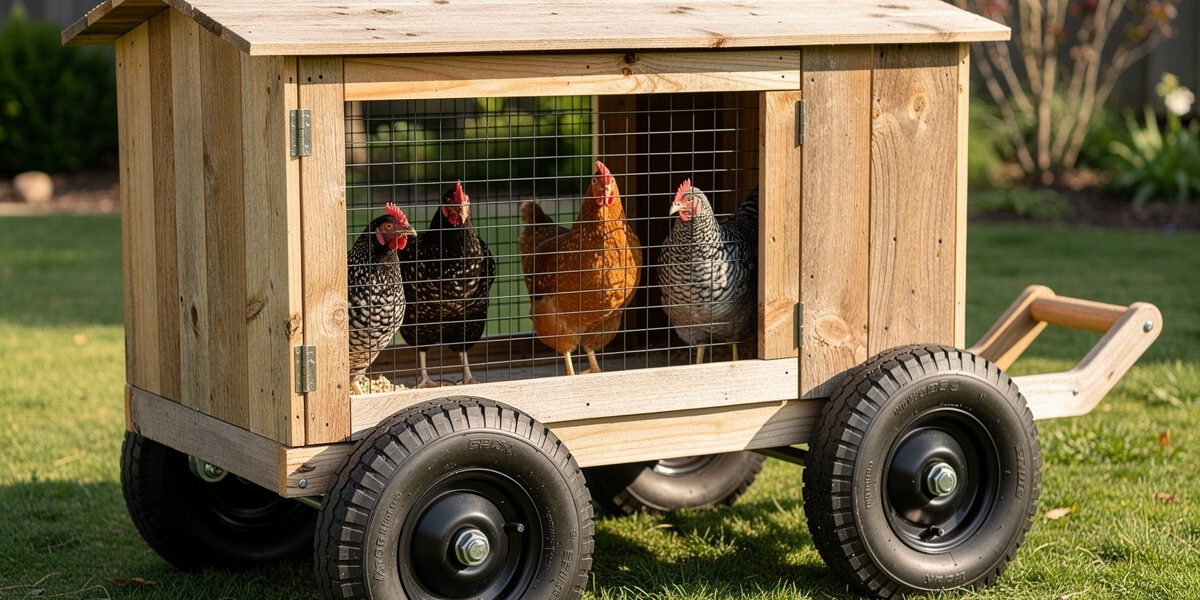
A chicken coop on wheels is a coop with permanently mounted wheels that lets one or two people roll it across a yard or pasture without lifting. The wheel system separates serious mobile coops from chicken tractors that you have to drag — a properly-wheeled coop moves 30 to 50 feet in 60 seconds, while an unwheeled coop of the same size takes 4 to 6 minutes of awkward dragging. The right wheel system depends on coop weight, ground type, and how often you actually move. I retrofitted wheels onto a heavy walk-in I was tired of dragging and it was night-and-day — but only after I scrapped the first set of cheap plastic wheels that folded in a single season.
This guide covers the four wheel systems that work on real coops, the diameter and material specs that determine whether wheels last 6 months or 10 years, the axle and hub configurations that handle real loads, and the four mistakes that turn a $700 wheeled coop into a stationary one. For the broader portable category, see our portable chicken coops hub.
As an Amazon Associate I earn from qualifying purchases.
Why Wheels Change the Mobile Coop Math
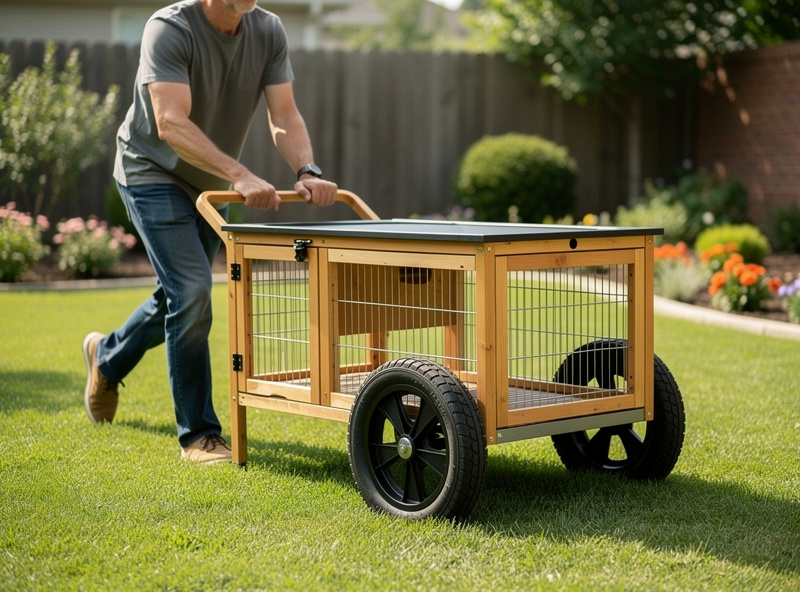
The defining problem with unwheeled mobile coops is the lift-and-drag friction. A 60-lb A-frame tractor takes 30 to 60 seconds of awkward dragging to move 8 feet — manageable but tiring. A 200-lb wheeled pasture pen moves the same 8 feet in under 10 seconds with one finger of effort. Multiply that across daily moves over a year, and the wheel-system difference is 30+ hours of saved labor per year.
The mechanical reason is rolling resistance. Rolling resistance coefficients run dramatically lower than sliding-friction coefficients across virtually every surface pairing — it’s the same principle that makes a loaded wheelbarrow trivial to push and a dragged sledge exhausting. On soft, deformable ground like grass or pasture, the gap narrows but doesn’t close: field-tested rolling resistance coefficients on grass and turf typically run roughly 5 to 20 percent depending on tire size and grass length, well under the sliding friction of a coop skid dragged across the same ground. For a 200-lb coop, that’s the difference between a two-person shove and one-finger effort — which is exactly the gap I felt the day I finally got wheels under the walk-in I’d been dragging.
Wheels also let you scale up coop size without scaling up the labor. An unwheeled mobile coop tops out around 80 lbs (the practical drag limit for one person). A wheeled coop with proper axle and hub design handles 400 to 600 lbs at the same one-person move difficulty. Mid-tier homestead operations (8 to 15 birds) only work with wheeled coops — see our 10-chicken coop guide for capacity-validated picks.
Four Wheel Systems for Mobile Coops
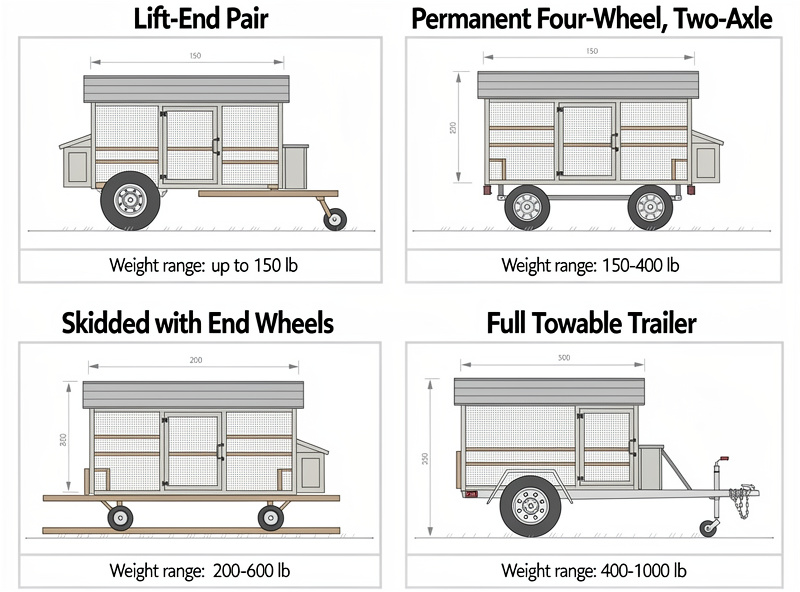
Mobile coop wheel systems break into four distinct configurations, each with predictable performance and failure modes.
| Wheel System | Coop Weight Range | Best Terrain | Service Life | Move Method |
|---|---|---|---|---|
| Lift-end pair (wheelbarrow style) | Up to 200 lb | Flat lawn, mild rough | 5-8 years | Lift one end, push or pull |
| Permanent two-axle (4 wheels) | 200-600 lb | Rough ground, slopes | 8-12 years | Push or pull at handle |
| Skidded with end wheels | 150-400 lb | Pasture, mowed fields | 10+ years | Lift end via crank or jack, drag |
| Full trailer (towable) | 500-2,000 lb | Any (with truck) | 15+ years | Tow with vehicle hitch |
Lift-end pair systems (two wheels at one end, two skid feet at the other) dominate the entry-level wheeled coop market. The trade-off is that you have to lift one end to engage the wheels, which limits practical coop weight to around 200 lbs. Permanent two-axle systems put 4 wheels on the coop with a fixed hub configuration, supporting heavier coops (200 to 600 lbs) but adding 30 to 50 lbs of dead weight from the extra wheels and structural support. Skidded coops with end wheels are the homestead workhorse — most weight rests on heavy skids, with end wheels engaged via a hand-crank or jack only during moves. Full trailers handle the largest scale (eggmobiles, professional pasture operations) but require a towing vehicle and trailer permits in some states.
Wheel Diameter and Material Specs
Wheel diameter and material determine whether your wheel system lasts 12 months or 10 years. Most failures trace to under-sized wheels with cheap materials.
Diameter: 10-inch minimum for any coop above 100 lbs. 12 to 14-inch wheels for coops above 250 lbs. Sub-8-inch wheels (common on entry-level wheeled coops) bog down in any rough ground and the small contact patch concentrates load on the bearing, killing the hub within 6 to 12 months of regular use.
Material — pneumatic tires: Air-filled tires offer the best ride quality across rough ground and protect the hub from shock loading. Trade-off is occasional inflation maintenance and puncture risk from sharp grass stalks or thorns. Best for 200+ lb coops on uneven ground. Service life: 5 to 8 years with proper inflation maintenance.
Material — solid rubber: Foam-filled or solid rubber tires never go flat and tolerate sharp objects without failing. Trade-off is harder ride and higher hub stress on rough ground. Best for lighter coops (under 200 lbs) on flat lawn. Service life: 7 to 10 years before rubber compound starts cracking.
Material — plastic: Hard plastic wheels are the cheapest option and the most common failure point. Suitable only for lightweight coops (under 100 lbs) on smooth ground. The plastic hub fatigues from repeated impact loading and typically fails within 12 to 18 months of regular use. Avoid for any coop you plan to move daily — the cheap plastic pair I started with cracked at the hub inside one season of weekly moves.
Axles and Hub Bearings
Axles and hubs handle the actual load. They’re invisible behind the wheels and the most-skipped inspection point on mobile coops.
Bushing hubs: Cheapest hub design — a sleeve bearing with grease pocket. Adequate for coops under 150 lbs and infrequent moves. Wears out within 200 to 400 moves under regular weekly use. Most entry-level wheeled coops ship with bushing hubs.
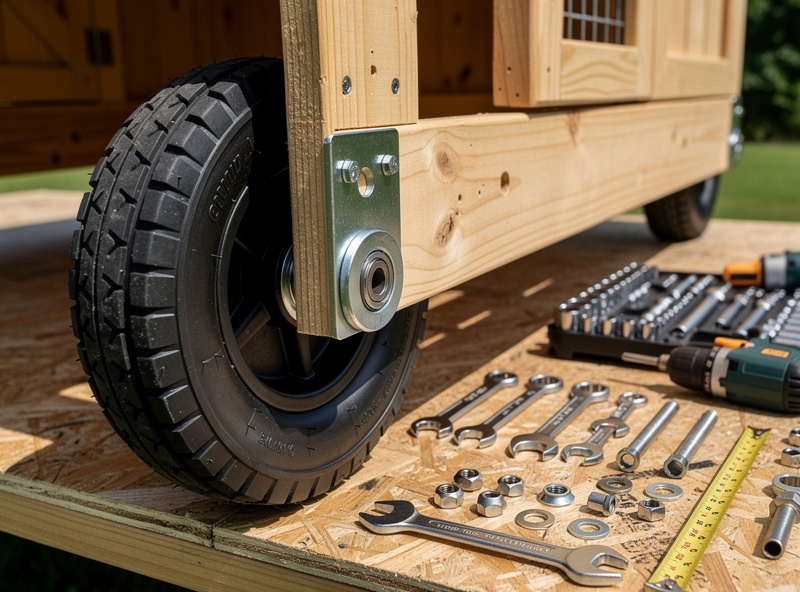
Sealed ball bearing hubs: Multiple-row ball bearing assemblies sealed against grass, dust, and water intrusion. The right choice for any coop above 200 lbs or any coop moved daily. Service life: 3,000 to 5,000+ moves. Worth the $20 to $40 upgrade per wheel — the bushing hubs on my first retrofit turned gritty within a season, and swapping to sealed bearings was the one upgrade I wish I’d started with instead of retrofitting later.
Axle diameter: 5/8 inch minimum for coops under 200 lbs, 3/4 inch for coops 200 to 400 lbs, 1 inch for coops above 400 lbs. Under-sized axles bend under shock loading and create a wobble that quickly destroys the hub bearings even on quality wheels.
Bolt-on vs welded: Bolt-on axles let you replace failing axles without rebuilding the coop. Welded axles are stronger and lighter but turn axle replacement into a 4-hour fabrication project. For DIY mobile coop builds, bolt-on axles are almost always the right choice.
DIY: Adding Wheels to an Existing Coop
Many static coops can be retrofitted with wheel systems, converting them from immovable to truly mobile. The cost runs $80 to $300 in parts plus 4 to 8 hours of labor.
Materials needed for a 4×8 ft coop retrofit:
- 2x 10-inch pneumatic wheels with bolt-on hubs
- 1x 5/8-inch x 36-inch steel axle
- 4x cotter pins or push nuts
- 2x 4-inch lag bolts for axle mounting
- 1x heavy-duty handle (45-degree lift handle pattern)
- Optional: 2x replacement skid feet for the non-wheel end
The standard retrofit attaches wheels at one end (the end opposite the door for easier access), with the wheel-end raised slightly off the ground so the wheels engage only when the opposite end is lifted via the handle. This wheelbarrow-style configuration lets a static coop become a wheeled coop without changing the daily living-area footprint.
Test the retrofit on a flat surface before committing to daily moves. If the coop tips backward when loaded with feeder, waterer, and bedding, add a second pair of wheels at the door end OR shift the original axle position 6 to 8 inches further from the door. Tipping risk increases with coop length — anything above 8 ft long usually needs a 4-wheel configuration. The full DIY mobile-coop pattern, including smart-feature additions, is in our $200 DIY automation guide.
Smart Features for Wheeled Coops
Wheels limit smart-coop options to battery-powered or solar-charged hardware. Wired electrical fails within a few moves regardless of how careful the routing. The smart-coop stack that works on wheeled coops focuses on door automation, wireless sensing, and battery-friendly cameras.
Solar-charged automatic door: The most valuable smart feature for any mobile coop. A 10W solar panel mounted on the coop roof maintains battery charge across daily moves. See our automatic coop door buyer’s guide for solar-friendly picks. Avoid AC-powered door models that require wall outlets.
Battery-only wireless sensors: Zigbee or LoRa sensors with 12+ month battery life work in any wheeled coop application. Mount inside the coop near roost height. Avoid WiFi-only sensors if the coop moves outside reliable router range. Our smart coop monitoring guide covers wireless sensor selection.
Cellular trail cameras: For wheeled coops that move into pasture beyond WiFi range, cellular-equipped trail cameras with solar trickle-charge send daily snapshots without WiFi. Higher cost ($300 to $500) but works at any distance from the house. See our smart chicken coop pillar guide for the full mobile-friendly automation pattern.
Common Wheel-System Mistakes
Four mistakes account for nearly every wheel-system failure on mobile chicken coops.
Mistake 1 — undersized wheels: Sub-8-inch wheels on any coop above 100 lbs bog down on rough ground and concentrate load on bearings, killing the hub within 12 months. Always use 10-inch minimum, 12 to 14-inch for heavier coops.
Mistake 2 — plastic hubs on heavy coops: Plastic wheels and plastic hubs are fine for 50-lb starter A-frames but fail under any meaningful weight. For coops above 100 lbs, use steel-rim wheels with sealed ball bearings.
Mistake 3 — fixed wheels with no lift mechanism: Permanent four-wheel coops without parking brakes or lift mechanisms can roll downhill on slight slopes, especially when full of birds. Always include either parking brakes (on heavier coops) or skid feet that engage when the coop is parked (on lift-end systems).
Mistake 4 — ignoring the handle ergonomics: A push handle at the wrong height destroys your back over hundreds of moves. Standard handle height is 38 to 42 inches at the grip — adjust for your own height. The lever advantage matters too: a longer handle (4 to 5 ft) reduces lift effort by 30 to 40 percent compared to a 2-ft handle. New keepers from our beginners guide often skip this consideration and regret it after the first month of moves.
Frequently Asked Questions
What is a chicken coop on wheels?
A chicken coop on wheels is a coop with permanently mounted wheels that lets one or two people roll it across a yard or pasture without lifting. Properly-wheeled coops move 30 to 50 feet in under 60 seconds, compared to 4 to 6 minutes of dragging for unwheeled coops of the same size.
What size wheels for a chicken coop?
Use 10-inch minimum wheels for any coop above 100 lbs. 12 to 14-inch wheels are correct for coops above 250 lbs. Sub-8-inch wheels bog down on any rough ground and the small contact patch concentrates load on the bearing, killing hubs within 6 to 12 months.
How many wheels does a chicken coop need?
Lift-end pair (2 wheels at one end, skid feet at the other) works for coops up to 200 lbs. Permanent four-wheel configuration is needed for coops above 200 lbs. Coops above 500 lbs require full trailer setup with proper axle, hub, and tongue weight balance.
Are pneumatic or solid wheels better for chicken coops?
Pneumatic (air-filled) tires offer better ride quality across rough ground and protect bearings from shock loading – best for 200+ lb coops on uneven ground. Solid rubber wheels never go flat – best for lighter coops on flat lawn. Avoid plastic wheels for any coop you plan to move regularly.
Can you add wheels to an existing chicken coop?
Yes, with $80 to $300 in parts and 4 to 8 hours of labor. The standard retrofit attaches 10-inch pneumatic wheels at one end of a 4×8 ft coop using a 5/8-inch steel axle, plus a heavy-duty handle on the opposite end. Test the retrofit on flat surface before committing to daily moves.
How much does a chicken coop on wheels cost?
Entry-level wheeled coops with lift-end pair systems cost $400 to $800 for 4 to 6 hen capacity. Mid-range wheeled coops with proper hubs and handles run $700 to $1,500. Heavy-duty four-wheel coops for 8 to 15 hens cost $1,200 to $2,500. DIY retrofits of existing static coops cost $80 to $300 in parts.
Bottom Line: Wheels Make Mobile Coops Sustainable
The right wheel system separates mobile coops you actually move from wheeled coops that turn static within 30 days. Match the wheel system to coop weight (lift-end pair under 200 lbs, four-wheel above), pick 10-inch minimum pneumatic wheels with sealed ball bearing hubs, and verify the handle ergonomics before committing to daily moves. The $40 to $100 upgrade from cheap plastic wheels to proper steel-rim pneumatic with sealed bearings is the single best investment you can make in any wheeled coop.
For broader mobile-coop strategy, see our mobile chicken coop guide. For the full portable category and rotation math, the portable chicken coops hub covers all formats.
Related Guides
- Portable Chicken Coops & Tractors: Complete 2026 Guide
- Mobile Chicken Coops: Rotational Grazing & Pasture Picks
- Chicken Tractor: A-Frame Designs, Plans & Best Picks
- Chicken Coop Size Guide: How Many Chickens Per Square Foot
- Chicken Coop for 10 Chickens: Best Walk-In Picks
- Smart Chicken Coop on a Budget: DIY Automation Under $200
Related Guides
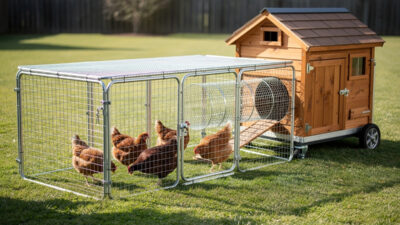
Portable Chicken Run: Modular Picks for Mobile Coops
A portable chicken run is a movable outdoor enclosure that connects to or follows a chicken coop, providing relocatable forage…
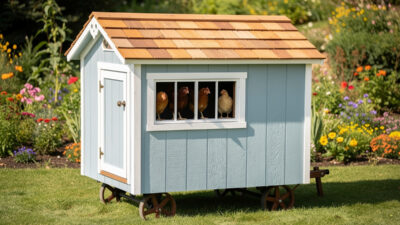
Portable Chicken House: Cottage, Plastic & Barn Picks
A portable chicken house is a movable enclosed structure focused on the housing/sleeping area, distinct from a portable chicken tractor…
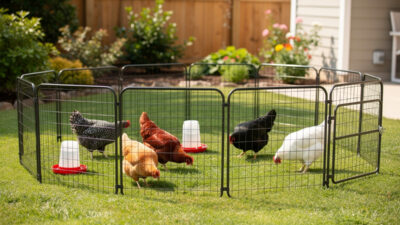
Portable Chicken Pen: 5 Best Picks for Daily Setup
A portable chicken pen is a lightweight enclosed outdoor area that hens can use during daylight hours, distinct from a…