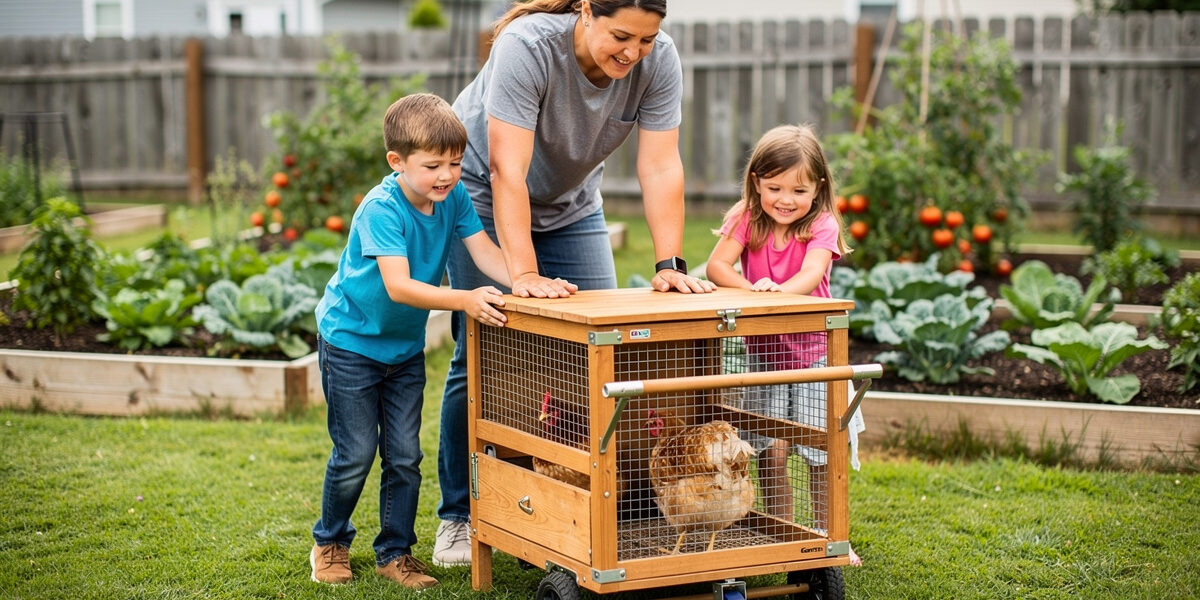
A movable chicken coop is one designed for occasional or daily relocation around a yard, distinct from “portable” coops built for repeated rotation. The terminology blur causes most buyer confusion: a 200-lb wheeled coop you reposition once a month is movable; a 60-lb A-frame tractor you rotate daily is portable. This guide focuses on the daily-rotation patterns that make movable coops work for backyard chicken keepers. I run my own rotation on a back-and-forth grid I sketched on a notepad, and the honest lesson is that the routine — not the hardware — is what makes or breaks it.
This guide covers what separates movable from portable coops, the daily rotation grid that turns a movable coop into a working forage system, the family routines that keep daily moves sustainable for years (not weeks), the lawn-recovery math that determines how often you can return to each spot, and the four mistakes that cause most movable-coop owners to give up rotation by month three. For broader portable/mobile categories, see our portable chicken coops hub.
As an Amazon Associate I earn from qualifying purchases.
Movable vs Portable: What’s the Difference?
Industry terminology uses “movable” and “portable” interchangeably, but practical use distinguishes them by rotation frequency. A movable chicken coop is designed for relocation when needed — once a month, every few weeks, or seasonally — without the daily rotation discipline that defines portable tractors. The hardware is similar; the use pattern differs.
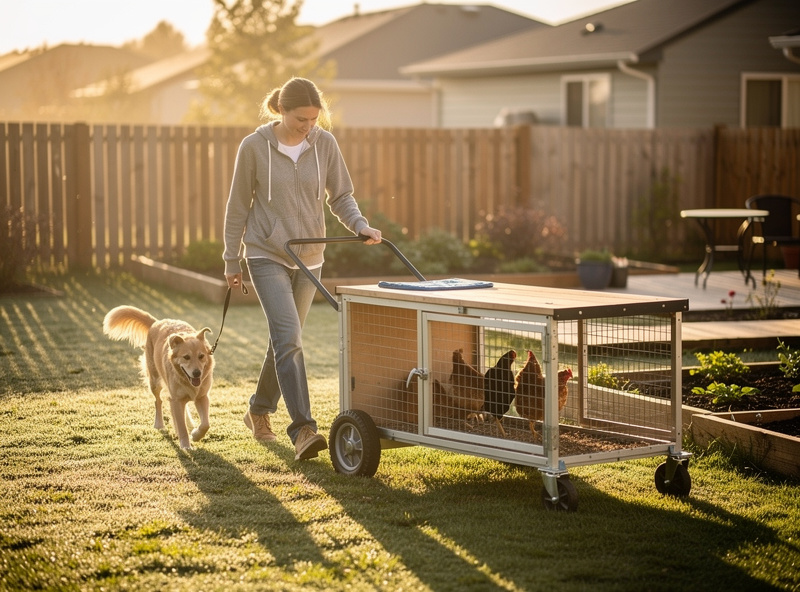
Movable coops typically weigh 150 to 400 lbs (heavier than tractors but light enough for two-person moves with proper handles or wheels). They’re sized for 6 to 12 birds (larger than typical tractors but smaller than full mobile pasture pens). They use lift-end wheel pairs or skidded construction (not full four-wheel rolling). The defining trait: you CAN move them daily but you don’t HAVE to.
This middle-ground category fits backyard keepers who want forage rotation benefits without the daily-discipline commitment — though the honest version of this trade-off isn’t a tidy percentage, it’s timing. Parasite larvae in droppings typically become infective within about two weeks of deposition, and resting ground for 30 to 60 days lets most of them die off before stock return. A weekly move keeps the flock ahead of that infective window and still captures most of the real benefit for a fraction of the labor. A monthly move mostly loses the parasite-prevention angle — by day 30 you’re often returning to ground that’s already carrying a fresh larval load again — but still helps with manure spreading and giving the run a hygiene break.
The Daily Rotation Grid
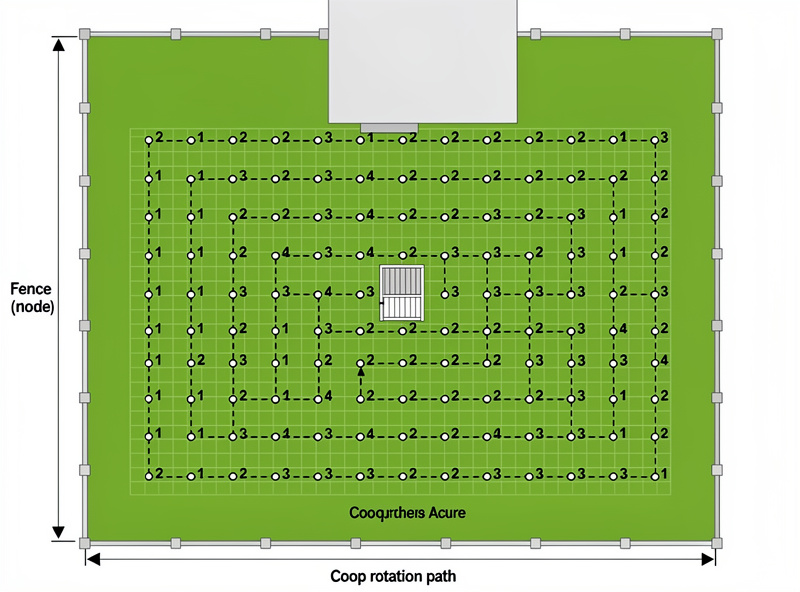
The defining technique for sustainable movable-coop use is the rotation grid — a planned pattern of coop positions that returns to previous spots only after the grass has fully recovered. Without a planned grid, most backyard keepers default to the same 3 or 4 spots and recreate the static-coop overgrazing problem.
For a 4×8 ft movable coop on a typical 1/4-acre suburban lawn, a back-and-forth grid pattern delivers 8 to 12 weeks of unique daily positions before repeating. Map the grid before you start: walk the yard, identify the usable area (subtract trees, beds, paths), and divide the area into 4×8 ft blocks. Mark the planned daily positions on a notepad or phone diagram. Most yards support 50 to 80 distinct positions in a back-and-forth pattern.
Grass recovery time depends on climate, fertility, and stocking density. In zones 6 to 8 with regular rain, grass under a 4×8 tractor with 4 hens recovers fully in 7 to 14 days. In drier zones or with heavier stocking density (5+ birds in the same tractor), recovery stretches to 21 to 30 days. Plan grid revisit timing to match your actual recovery rate, not the theoretical 7-day minimum.
Sustainable Daily Move Routines
The single biggest predictor of long-term movable-coop success is whether the daily move fits naturally into an existing household routine. Bolt-on routines that require new dedicated time slots fail within 30 to 60 days. Routines that piggyback on existing habits last for years.
The morning routine: Move the coop after morning egg collection but before breakfast. Total time: 90 to 120 seconds for a 4×8 wheeled coop. Best for adults with consistent morning schedules. Fails when work schedules shift unpredictably.
The dog-walk routine: Move the coop on the way back from the morning dog walk. The walk gets you outside, the coop is on your way to the back door anyway, and the coop move adds 60 seconds to a 15-minute existing routine. This is the most-recommended pattern for backyard keepers because it requires zero new habit formation — it is the one that finally stuck for me after two failed runs at a dedicated time slot.
The kid-chore routine: Assign daily coop moves to a 10+ year-old as a paid weekly chore. Kids enjoy the physical task more than adults, and the coop move teaches consistency, animal-care responsibility, and basic mechanical skill (wheel alignment, hinge maintenance). Pair with weekly paid bedding turnover for a complete chicken-care chore set.
The weekend reset: For light-rotation patterns (move every 5 to 7 days instead of daily), Saturday morning works well. Lower frequency means the move is a more substantial 5-minute event but only happens 4 to 5 times per month. Best for households where daily routines vary too much for daily moves. See our backyard chickens beginners guide for routine-design patterns.
Lawn Recovery and Rotation Patterns
Three rotation patterns handle different yard sizes and grass types. Picking the wrong pattern is the most common cause of bare-dirt failures even with disciplined daily moves.
| Pattern | Yard Size | Move Distance | Days Between Revisits | Best For |
|---|---|---|---|---|
| Linear back-and-forth | 1/8 acre or less | 1 coop length daily | 21-30 days | Long, narrow yards |
| Grid sweep | 1/8 to 1/2 acre | 1 coop length daily | 14-21 days | Square or rectangular yards |
| Multi-row sweep | 1/2+ acre | 1 coop length daily, 8 ft offset between rows | 21-30 days | Larger yards, fertile grass |
| Paddock rotation | 1+ acre | Move every 5-7 days into next paddock | 30-60 days | Pasture or large yards |
The grid sweep is the most-recommended pattern for typical suburban backyards. Walk the yard in parallel lines like mowing, with the coop following the path one position per day. After completing the full grid, restart from the beginning — by then the first positions have had 14 to 21 days to recover.
Grass type affects recovery rate. Cool-season grasses (fescue, ryegrass, Kentucky bluegrass) recover in 14 to 21 days during growing season — Penn State Extension puts spring/fall cool-season regrowth at roughly 2 to 3 weeks under good conditions, matching the low-pressure footprint of a backyard coop rather than a grazed pasture. Warm-season grasses (Bermuda, zoysia, St. Augustine) recover in 7 to 14 days during peak summer. In late summer when grass growth slows for any species, double the days-between-revisits target. For exact sizing math by flock count, see our chicken coop size guide.
Smart Features for Movable Coops
Movable coops accommodate slightly more smart-coop hardware than full daily-rotation tractors because the move frequency is lower and the heavier construction supports more battery weight. The smart-coop stack still focuses on battery-powered or solar-charged hardware that tolerates weekly relocation.
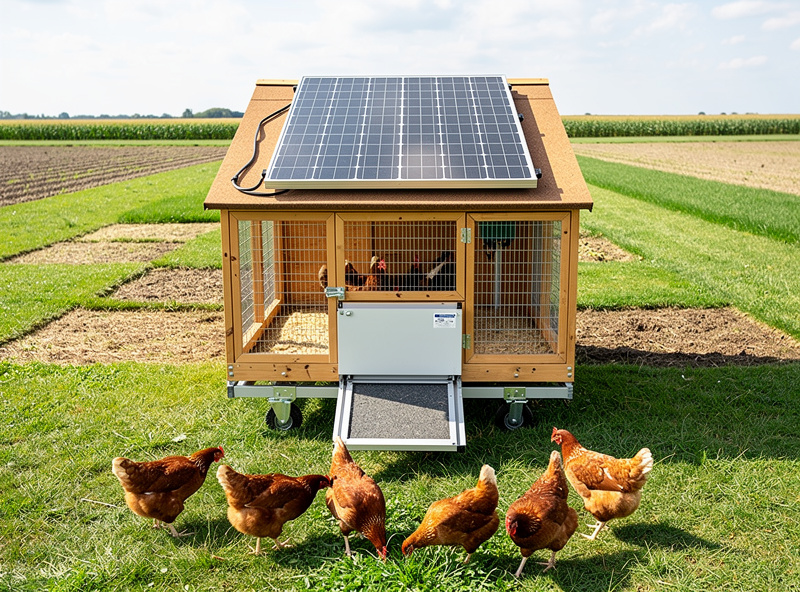
Solar-charged automatic door: The most valuable smart upgrade for any movable coop. A 10W solar panel mounted on the coop roof maintains battery charge across daily or weekly moves. See our automatic coop door buyer’s guide for solar-friendly models.
Wireless battery sensors with mesh extender: Battery-powered Zigbee or LoRa sensors with WiFi mesh extension work in movable coop applications up to 1,000 ft from the house router. Mount inside the coop near roost height. Battery life on Zigbee sensors runs 12 to 18 months. The full sensor strategy is in our smart coop monitoring guide.
Solar trickle-charge camera: A small outdoor security camera mounted to the coop frame with solar trickle-charge gives predator detection and laying observation. Most weekly-rotation movable coops can use the same outdoor cameras designed for property surveillance, since the move doesn’t disrupt connection patterns the way daily moves do.
Battery-friendly automatic feeder: Use treadle or timer feeders for movable applications. Avoid motor-driven hopper feeders that require constant power. The full smart-coop architecture, including patterns that adapt to mobile and movable coops, is in our smart chicken coop pillar guide.
Common Movable Coop Mistakes
Four mistakes account for nearly every “I gave up on the daily move” failure mode for movable-coop owners.
Mistake 1 — no rotation grid plan: The most common failure is moving the coop “somewhere new” each day without a planned grid. Within 4 to 6 weeks, you’ve defaulted to 3 or 4 favorite spots and the rest of the yard goes unused. Always map the grid in advance — back-and-forth rows, marked on a notepad.
Mistake 2 — bolt-on routine: Treating the daily move as a new dedicated time slot fails within 30 to 60 days. Piggyback the move onto an existing routine (morning dog walk, weekend mowing, daily school drop-off return) so it requires no new habit formation.
Mistake 3 — wrong pattern for the yard: Linear patterns waste 1/2-acre yards (you finish the grid in 2 weeks and start over while grass is still recovering). Grid patterns waste long narrow yards (the parallel-row pattern doesn’t fit). Match the pattern to the actual yard shape, not the standard suburban template.
Mistake 4 — ignoring grass recovery rate: Returning to the same spot on day 7 when your local grass needs 21 days of recovery creates rolling overgrazing — the coop arrives back at semi-recovered grass and finishes killing it. Verify your actual grass recovery rate by checking the first revisit position before continuing the rotation. If grass hasn’t fully recovered, expand the grid or extend the days-between-revisits target.
Frequently Asked Questions
What is a movable chicken coop?
A movable chicken coop is one designed for occasional or daily relocation, typically weighing 150 to 400 lbs and sized for 6 to 12 birds. It is heavier than a chicken tractor (designed for daily moves) but lighter than a fixed coop. The defining trait: you can move it but do not have to move it every day.
How often should you move a chicken coop?
Daily for tractors and small movable coops. Weekly for medium-sized movable coops. Every 5 to 7 days for wheeled pasture pens. Every 7 to 30 days for trailer-mounted coops following rotational grazing. Match move frequency to coop weight, flock size, and how often you can realistically maintain the routine.
How do you plan a chicken coop rotation grid?
Walk the yard and identify the usable area. Divide it into blocks the size of your coop footprint (typically 4×8 ft). Map a back-and-forth grid pattern on a notepad or phone, like mowing rows. Most 1/4-acre suburban yards support 50 to 80 distinct positions in a back-and-forth pattern, giving 8 to 12 weeks before grid repeat.
How long does grass take to recover under a chicken coop?
Cool-season grasses recover in 14 to 21 days during growing season. Warm-season grasses recover in 7 to 14 days during peak summer. In late summer when growth slows, double the days-between-revisits target. Verify recovery by checking the first revisit position before continuing the rotation.
Can two people move a chicken coop?
Yes. Two-person moves work well for movable coops in the 250 to 400 lb range with proper handles. The standard pattern: one person at the front handle, one at a rear assist handle, lifting and rolling together. Two-person moves take 30 to 60 seconds for distances up to 30 feet, similar to one-person tractor moves.
Are movable chicken coops worth it?
Yes, when you can commit to at least a weekly rotation. Parasite larvae in droppings typically become infective within about two weeks, so weekly moves keep the flock ahead of that window for a fraction of daily-tractor labor. Monthly moves mostly lose the parasite-prevention benefit but still help with manure spreading and coop hygiene. They are the right format for backyard keepers who want rotation benefits without the daily-discipline commitment but cannot justify the higher cost of full mobile pasture pens.
Bottom Line: Make the Move Routine, Not the Hardware
The right movable chicken coop is the one whose move routine fits naturally into your existing daily or weekly habits. Hardware matters (proper wheels, ergonomic handles, reasonable weight) but routine sustainability matters more. Map a rotation grid before you start, piggyback the move onto an existing routine, match the pattern to your actual yard shape, and verify grass recovery before completing the second cycle. Get those four things right and a movable coop pays back in healthier birds, lower feed costs, and parasite-free ground for years.
For other portable formats and broader rotation strategy, see our portable chicken coops hub. For specific A-frame designs, the chicken tractor guide covers the daily-rotation tractor format.
Related Guides
- Portable Chicken Coops & Tractors: Complete 2026 Guide
- Mobile Chicken Coops: Rotational Grazing & Pasture Picks
- Chicken Tractor: A-Frame Designs, Plans & Best Picks
- Chicken Coop on Wheels: Best Wheel Systems
- Chicken Coop Size Guide: How Many Chickens Per Square Foot
- Backyard Chickens for Beginners: Everything You Need to Know in 2026
Related Guides
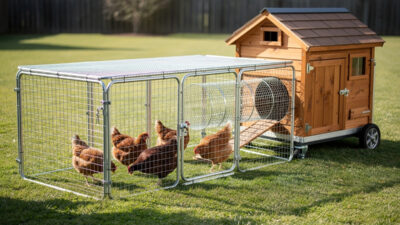
Portable Chicken Run: Modular Picks for Mobile Coops
A portable chicken run is a movable outdoor enclosure that connects to or follows a chicken coop, providing relocatable forage…
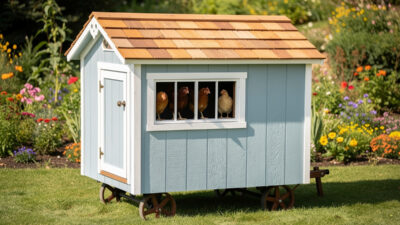
Portable Chicken House: Cottage, Plastic & Barn Picks
A portable chicken house is a movable enclosed structure focused on the housing/sleeping area, distinct from a portable chicken tractor…
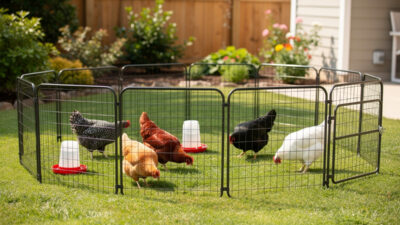
Portable Chicken Pen: 5 Best Picks for Daily Setup
A portable chicken pen is a lightweight enclosed outdoor area that hens can use during daylight hours, distinct from a…