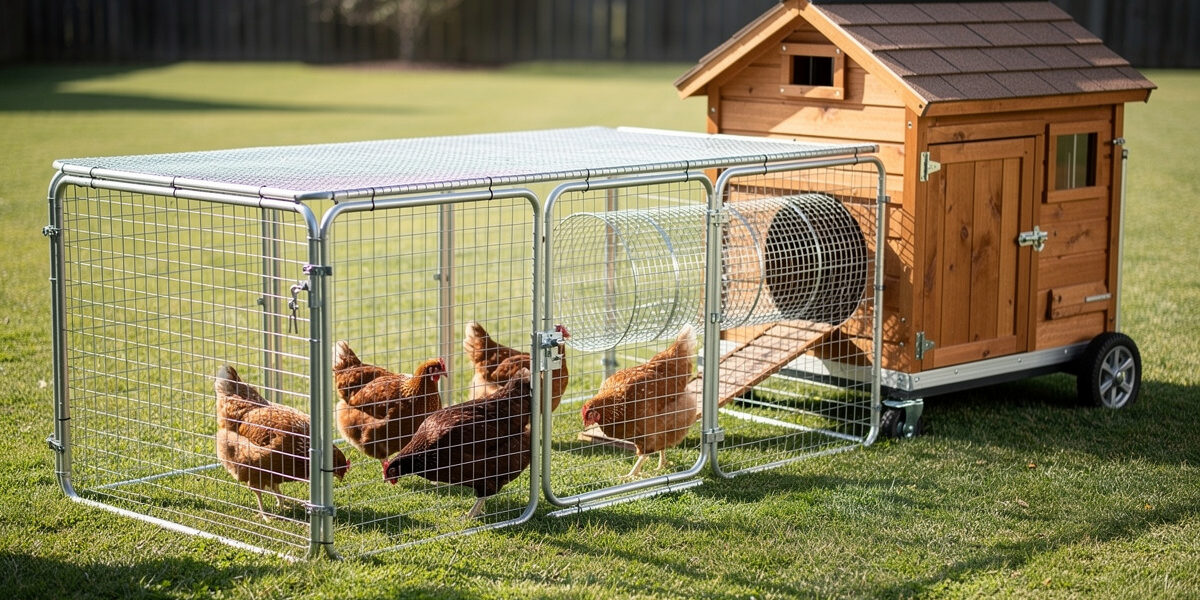
A portable chicken run is a movable outdoor enclosure that connects to or follows a chicken coop, providing relocatable forage space distinct from a fixed run that stays in one spot. Portable runs solve a specific problem: keeping the daily outdoor space fresh as the coop rotates, without rebuilding fixed fencing every time. They pair best with mobile or movable coops but can also extend the usable life of a fixed coop by adding rotational pasture access. I rotate my own flock through a netted forage zone and pair it with a closing-door coop at night, so the predator and connection details below are the ones I have actually had to get right.
This guide covers what separates a portable chicken run from a portable pen or fixed run, the four portable run formats that work in real backyards, the connection patterns for pairing portable runs with portable coops, the predator-proofing details that matter at this scale, and the four mistakes that turn a portable run into a stationary obstacle. For other portable formats, see our portable chicken coops hub.
As an Amazon Associate I earn from qualifying purchases.
Portable Run vs Portable Pen vs Fixed Run
The terminology overlap between portable run, portable pen, and fixed run causes most buyer confusion. Three distinct categories with overlapping features:
A portable chicken RUN attaches to or follows a coop and provides daily-use outdoor space sized for the flock at standard 10 sq ft per bird. Portable runs are sized larger than pens (typically 60 to 200 sq ft) and used for 8+ hours daily as the primary outdoor area. They move with the coop or get repositioned weekly to refresh the foraging ground.
A portable chicken PEN is a smaller temporary enclosure (40 to 80 sq ft) used for daytime supervision, brooder graduation, day-pen rotation, or quarantine. Pens get set up and taken down daily; runs typically stay deployed for at least several days at a time. See our portable chicken pen guide for the smaller-format specifics.
A FIXED chicken RUN is permanently attached to a stationary coop, providing the same 10 sq ft per bird outdoor space without movement. Fixed runs use heavier hardware cloth panels and buried wire skirts that you don’t relocate. They handle larger flocks (10+ birds) better than portable runs and don’t require daily setup discipline.
Four Portable Chicken Run Formats
Four portable run formats dominate the backyard market, each with a clear use case.
| Format | Typical Size | Bird Capacity | Setup Time | Best Use |
|---|---|---|---|---|
| Modular wire panel run | 60-160 sq ft | 4-12 hens | 10-20 minutes | Pairs with mobile coops, weekly relocation |
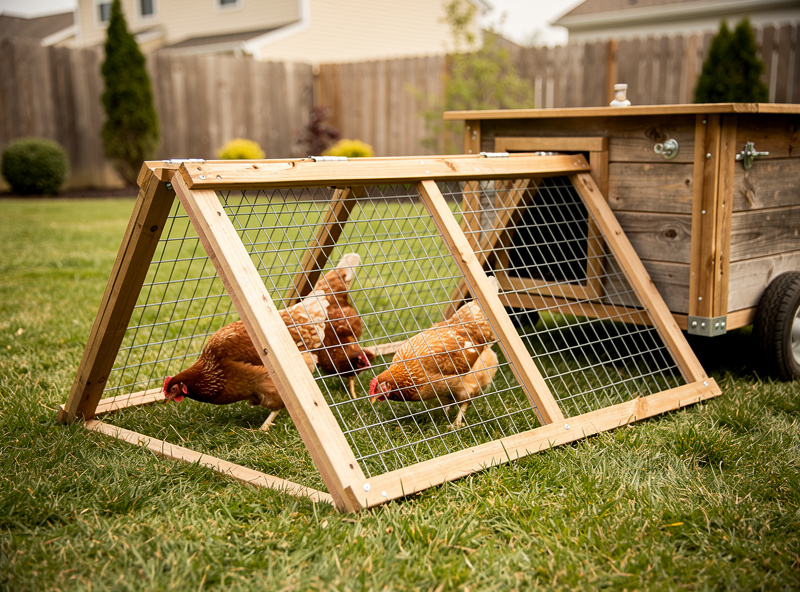
| Folding A-frame run extension | 32-80 sq ft | 3-6 hens | 5 minutes | Attaches to A-frame tractors for added space |
| Tunnel-style run | 2×10 to 3×20 ft | 3-8 hens | 15-25 minutes | Connects two areas, narrow yard rotation |
| Electric netting enclosure | 164 ft perimeter (typical) | 10-30 hens | 20-30 minutes | Large pasture areas, predator deterrent |
Modular wire panel runs (multiple linked 4×4 ft or 6×4 ft panels) dominate the mid-tier portable run market. They’re configurable into any rectangular shape that fits your yard, store flat for off-season, and pair well with portable coops via attachment clips or gates. Folding A-frame run extensions are designed specifically to add daily forage space to A-frame chicken tractors. Tunnel-style runs (long, narrow, often arched over) connect two areas — useful for letting hens travel between a fixed coop and a rotating forage zone. Electric netting works as both a portable run and a predator deterrent for larger areas — it is what I run around my own rotated forage zone.
Connecting Portable Runs to Coops
The connection between a portable run and the coop determines daily usability. Three connection patterns work; getting the wrong pattern creates daily friction that kills the rotation routine.
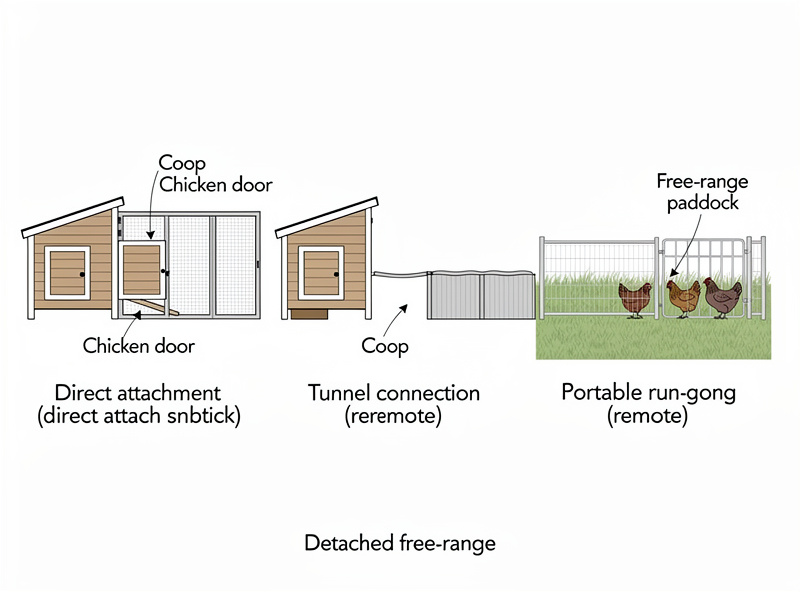
Direct attachment (gate or door): The run connects directly to the coop’s chicken door, with hens passing through the door into the run. Best for portable runs that move with the coop as a unit. Setup requires aligning the run with the door each time you reposition. Pair with a battery-powered automatic coop door for hands-off dawn/dusk transitions.
Tunnel connection: A narrow tunnel (2 to 3 ft wide) connects the coop to a separate run located 5 to 30 ft away. Best when the coop sits in one spot but you want to rotate the run across different yard areas. The tunnel itself is usually a portable run section you reposition with the run. Allows the run to follow a rotation grid without moving the coop.
Detached free-range with run boundary: The run sits as a fully separate enclosure that hens enter through a manually-opened gate. Best for keepers who want supervised daytime free-range with the run as the boundary. Requires you to open and close the gate at dawn and dusk, since hens won’t navigate to a separate enclosure on their own. Less convenient than direct attachment but more flexible for yard layout.
For exact sizing math by flock count when planning the run footprint, see our chicken coop size guide.
Predator-Proofing Portable Runs
Portable runs are MORE vulnerable to predators than fixed runs because the lighter materials and lack of buried wire skirts give ground predators easier access. Daytime supervision is the assumed baseline; never leave hens in a portable run after dusk without predator protections matching fixed-run standards.
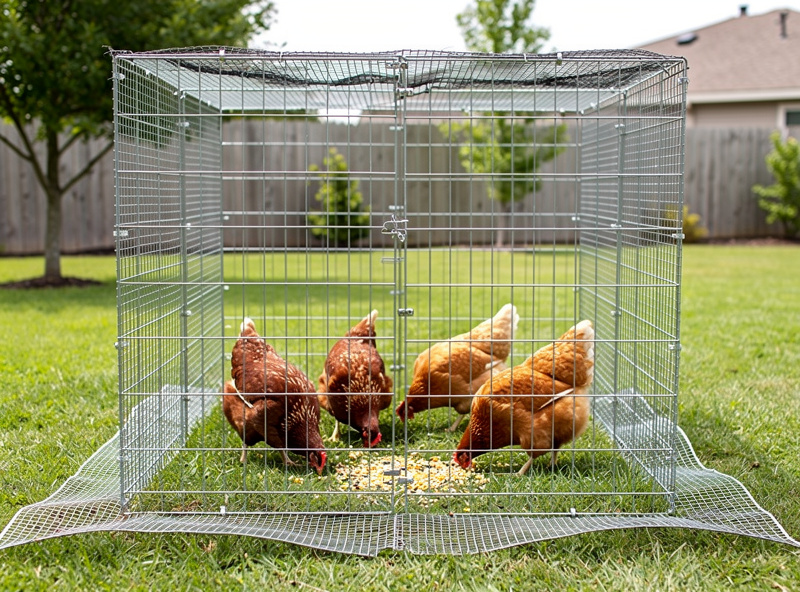
Hardware cloth, not chicken wire: Always use 1/2 inch galvanized hardware cloth for any wire panel that touches the ground or could be reached from outside. Chicken wire is sized to keep chickens IN, not predators OUT — a determined raccoon defeats it in under 60 seconds. This single spec separates real portable runs from decorative ones.
Top coverage: Open-top runs leave hens vulnerable to red-tail hawks, though the risk isn’t spread evenly across the flock — eXtension’s predator-management guidance notes hawks rarely take standard-sized adult chickens but will readily carry off a young or bantam bird. Cover any portable run housing chicks, bantams, or smaller breeds with hawk netting, light tarp, or wire mesh top; standard hens in a covered-enough yard carry lower but non-zero risk.
Ground-level protection: Without buried wire skirts, ground predators find the edge quickly once they start working it. Add a 12-inch wire skirt around the run perimeter laid flat on the ground (held with landscape stakes or rocks) every time you reposition — eXtension recommends burying hardware cloth at least 12 inches to stop digging predators, which is exactly what a flat-laid apron accomplishes without actual trenching. The skirt deploys and retracts in 5 minutes and prevents the most common dig-under attacks.
Nighttime closure: Pair every portable run with a closing-door coop where hens go at dusk. Never leave birds in a portable run overnight regardless of predator measures — even electric netting fails when battery dies or storm damages the perimeter. The full predator-proof setup pattern is in our automatic coop door comparison.
Run Rotation Patterns
The reason to use a portable run instead of a fixed run is to rotate the foraging ground. Two rotation patterns work well at backyard scale.
Run-and-coop together: The portable run moves with the portable coop on the same rotation schedule (daily for tractors, weekly for movable coops). Both pieces follow the same grid pattern across the yard. Best for rotation purists and operations where the coop is genuinely portable. See our movable chicken coop guide for routine patterns.
Coop-stays, run-rotates: The coop stays in one spot (maybe a fixed coop or a rarely-moved portable house). The portable run rotates across different yard areas every 5 to 14 days, connected to the coop via a tunnel section that also moves. Best for keepers with fixed coops who want some forage rotation without moving the main structure. Reduces total yard area used (the coop position never gets foraged) but simpler than full mobile-coop rotation.
Match the rotation cadence to grass recovery time. Cool-season grasses recover in 14 to 21 days during growing season; warm-season grasses recover in 7 to 14 days. In late summer when grass slows, double the days-between-revisits target regardless of pattern.
Common Portable Chicken Run Mistakes
Four mistakes account for nearly every “the portable run failed” complaint on backyard chicken forums.
Mistake 1 — chicken wire instead of hardware cloth: Cheap portable runs use chicken wire that any predator defeats in seconds. Always verify 1/2 inch galvanized hardware cloth. The $30 to $60 upgrade cost prevents the $200+ flock-loss event.
Mistake 2 — no top coverage: Open-top runs put chicks and bantams at real hawk risk (standard adult hens are lower-risk but not zero). Add hawk netting or light tarp top to any portable run before unsupervised use, especially one holding younger or smaller birds. Cost: $20 to $50 in netting plus 30 minutes of installation.
Mistake 3 — undersized for the flock: Buyers often size a portable run for “how it looks” rather than the standard 10 sq ft per bird. A 60 sq ft run is the minimum for 6 birds — anything smaller triggers feather pecking within 30 days. For exact sizing, see our chicken coop size guide.
Mistake 4 — using a portable run as overnight enclosure: Even predator-resistant portable runs become death traps after dark. Always pair with a properly-built closing-door coop for nighttime housing. New keepers from our beginners guide often skip this and lose flocks within the first 6 months.
Frequently Asked Questions
What is a portable chicken run?
A portable chicken run is a movable outdoor enclosure that connects to or follows a chicken coop, providing relocatable forage space distinct from a fixed run. Portable runs typically range from 60 to 200 sq ft, weigh 30 to 80 lbs, and pair with mobile coops to keep the outdoor space fresh as the coop rotates.
What is the difference between a portable chicken run and a portable chicken pen?
A portable chicken run is sized for daily 8+ hour use as the primary outdoor area (60 to 200 sq ft, 10 sq ft per bird). A portable chicken pen is a smaller temporary enclosure (40 to 80 sq ft) for daytime supervision, brooder graduation, or quarantine. Runs stay deployed for days; pens get set up and taken down daily.
How big should a portable chicken run be?
Use the standard 10 sq ft per bird minimum. A run for 6 hens needs 60 sq ft (6×10 ft or 8×8 ft). For 10 hens, 100 sq ft. For boredom prevention and better behavior, target 15 to 20 sq ft per bird. Free-ranging hens 2 to 4 hours daily lets you shrink the attached run to 8 sq ft per bird.
How do you connect a portable run to a portable coop?
Three connection patterns work: direct attachment via the chicken door, tunnel connection through a 2-3 ft wide tunnel section, or detached free-range with manual gate. Direct attachment is most convenient and best for runs that move with the coop. Tunnel connection is best when the coop stays in one spot but the run rotates.
Can you leave chickens in a portable run overnight?
No. Even predator-resistant portable runs become death traps after dark – electric netting fails when batteries die, hardware cloth gets defeated by determined predators given enough time. Always pair every portable run with a closing-door coop where hens go at dusk. Use the run for daytime only.
How much does a portable chicken run cost?
Modular wire panel runs cost $150 to $400 for 60-160 sq ft configurations. Folding A-frame run extensions cost $80 to $200. Tunnel-style runs cost $120 to $300. Electric netting enclosures cost $180 to $300 including a solar charger. DIY portable runs from hardware cloth and 2×2 lumber cost $80 to $200 in materials.
Bottom Line: Portable Runs Make Mobile Rotation Practical
A portable chicken run pairs with a mobile or movable coop to keep the daily outdoor space fresh as the coop rotates, or extends a fixed coop with rotating forage access. Pick modular wire panel runs for configurable layouts, folding A-frame extensions for tractor pairing, tunnel runs for separated coop-and-run patterns, or electric netting for larger pasture areas with built-in predator deterrence. Always specify hardware cloth (not chicken wire), add hawk-netting top coverage, and pair with a closing-door coop for nighttime housing.
For the broader portable category and rotation strategy, see our portable chicken coops hub. For smaller temporary enclosures, the portable chicken pen guide covers day-pen formats.
Related Guides
- Portable Chicken Coops & Tractors: Complete 2026 Guide
- Portable Chicken Pen: 5 Best Picks for Daily Setup
- Movable Chicken Coops: Daily Rotation Routine Guide
- Mobile Chicken Coops: Rotational Grazing & Pasture Picks
- Chicken Coop Size Guide: How Many Chickens Per Square Foot
- Automatic Chicken Coop Doors: Complete Buyer’s Guide 2026
Related Guides
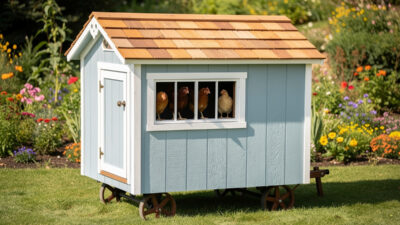
Portable Chicken House: Cottage, Plastic & Barn Picks
A portable chicken house is a movable enclosed structure focused on the housing/sleeping area, distinct from a portable chicken tractor…
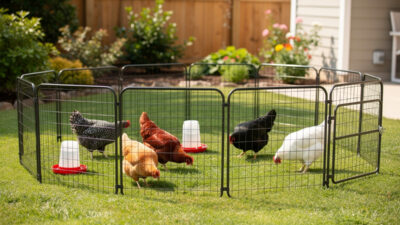
Portable Chicken Pen: 5 Best Picks for Daily Setup
A portable chicken pen is a lightweight enclosed outdoor area that hens can use during daylight hours, distinct from a…
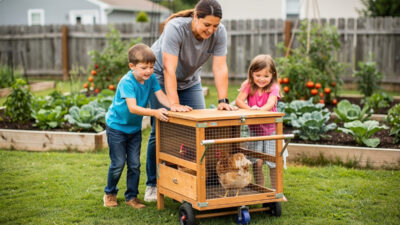
Movable Chicken Coops: Daily Rotation Routine Guide
A movable chicken coop is one designed for occasional or daily relocation around a yard, distinct from “portable” coops built…