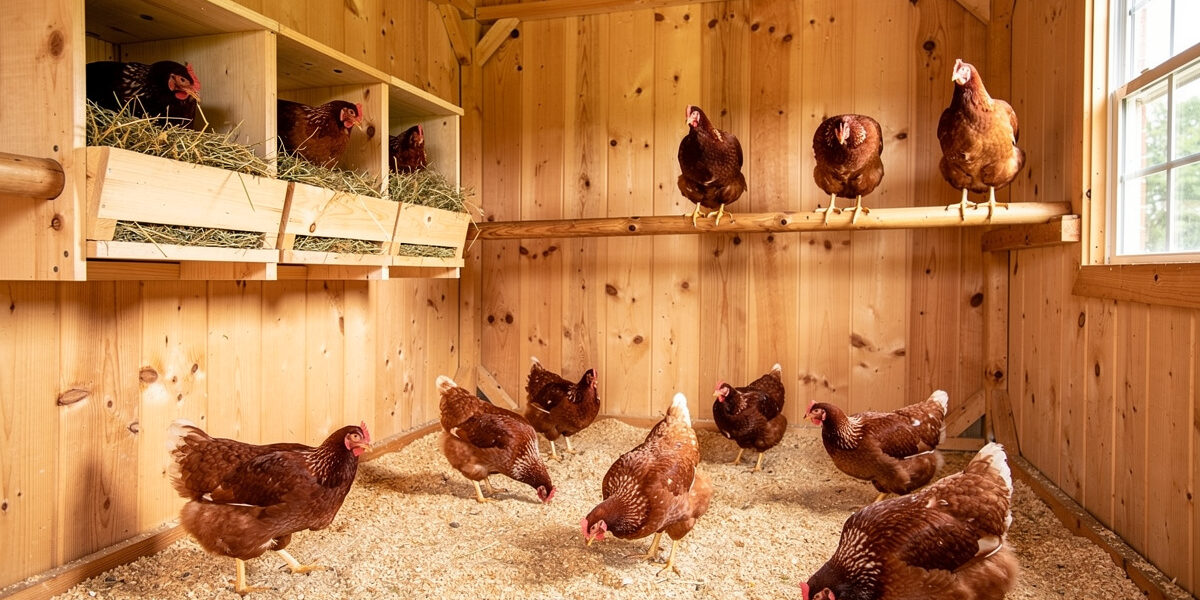
A chicken coop for 10 chickens needs 40 square feet of interior floor (a 5×8 or 6×8 ft footprint) plus a 100 square foot run, total 140 sq ft of yard space. Ten birds is the threshold where lift-top prefabs stop being practical and walk-in coops become the only sensible option — bending into a 5×8 ft enclosure twice a day for eggs and cleaning gets old fast.
This guide covers the dimensions that work for 10 birds, the three coop styles that scale to this flock size, why ten is the sweet spot for smart-coop ROI, and the four mistakes that turn a 10-bird coop into a 7-bird disappointment by year two. Full sizing math for other flock counts is in our chicken coop size guide.
How Big Should a Coop for 10 Chickens Be?
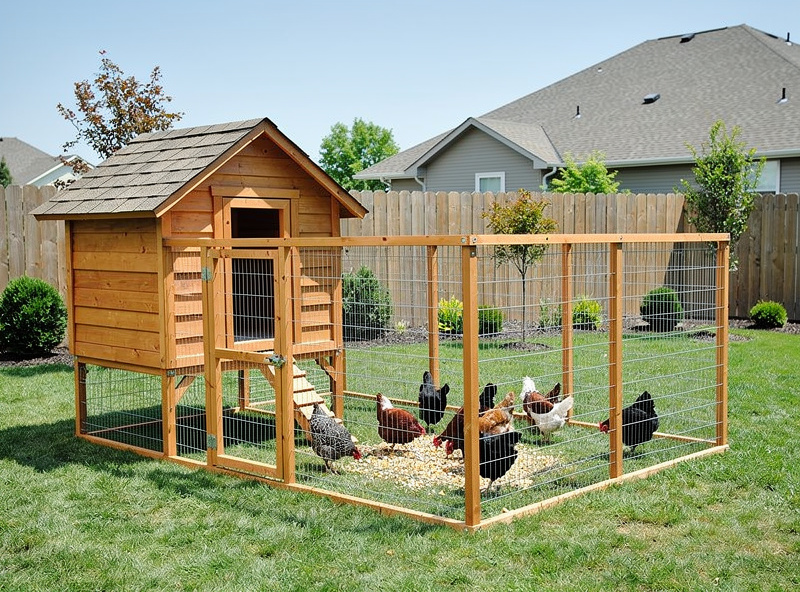
Ten standard-breed hens need 40 square feet of coop floor (5×8 or 6×8 ft) plus a 100 square foot run (10×10 or 8×12 ft), consistent with the per-bird sq-ft guidance published by university extension poultry programs (Alabama Cooperative Extension). For cold climates or heavy breeds, target 48 to 60 sq ft of coop and 150 sq ft of run. Heavy breeds like Brahmas at 10 birds push the math to 60 sq ft minimum.
The 10-bird threshold is also where the practical coop format changes. Below 8 birds, lift-top backyard coops dominate because the small interior is fast to clean from outside. At 10+ birds, the interior is large enough that bending in to clean gets genuinely awkward and slow — and that’s where walk-in shed-style coops or full converted sheds take over. Standing upright to muck out deep litter and swap waterers is a meaningfully faster daily routine than bending through a lift-top lid at this flock size.
Run size is the bigger surprise at this scale. A 100 sq ft run sounds large, but for 10 birds it’s only 10 sq ft per bird — the absolute minimum. Boredom-driven feather pulling shows up faster in larger flocks because a single instigator can affect 9 other birds. Target 150 to 200 sq ft of run for 10 hens (15 to 20 sq ft per bird) to keep behavior healthy.
Recommended Coop Dimensions for 10 Birds
The table below compares the three coop footprints that work for a 10-bird flock. The cost gap between options widens at this scale because materials don’t scale linearly with size.
| Coop Footprint | Interior sq ft | Recommended Run | Best For | Approx. Cost |
|---|---|---|---|---|
| 6×8 ft walk-in coop | 48 | 10×12 ft (120 sq ft) | First-time walk-in buyers, mild climates | $1,200-$2,200 |
| 8×8 ft converted shed | 64 | 10×16 ft (160 sq ft) | Cold climates, heavy breeds, smart automation | $600-$1,500 (DIY conversion) |
| 6×10 ft prefab walk-in | 60 | 10×15 ft (150 sq ft) | Long-term keepers, expansion to 12-15 birds | $1,800-$3,500 |
The 6×8 walk-in is the entry-level walk-in pick and the smallest size where standing-height interior makes sense. The 8×8 converted shed is the value play — a $400 prefab shed plus $200 to $600 in coop conversion materials (nesting boxes, ventilation, chicken door, roost bars) hits the same usable interior as a $2,000 prefab walk-in. The 6×10 prefab is the long-term play if you plan to expand the flock past 10 — same coop handles 15 birds without rebuild.
Best Coop Styles for 10 Chickens
Three coop styles work at the 10-bird scale. The walk-in requirement narrows the field dramatically compared to smaller flock sizes.
6×8 ft prefab walk-in coop: The default 10-bird pick. Standing-height interior (5 to 6 ft ceiling), human-access door, integrated nesting box bank (typically 3 boxes), and a chicken door for the run side. Trap: integrated boxes are often crammed into 10×10 inches. Replace with proper 12×12 boxes if needed.
8×8 ft converted garden shed: The best 10-bird value. Start with a $400 to $700 prefab shed and convert it: cut a chicken-door opening, build 3 nesting boxes from plywood scrap ($30 in materials), install a 6 to 8 ft roost bar ($15 in 2×4 lumber), add 1 sq ft of high ventilation per 10 sq ft of floor space, and add a window for daylight. Total conversion under $300 in materials and 8 to 12 hours of labor. Our $200 DIY automation guide covers the smart-coop additions for this build.
10×10 ft barn corner or stall conversion: If you have an existing barn, sectioning off a 10×10 corner with chicken wire and a chicken door delivers a 100 sq ft coop for 10 birds at near-zero capital cost. The catch: barn coops attract rodents at 3x the rate of standalone coops and require more aggressive feed storage discipline. Worth it if you have the space.
Run Size for 10 Chickens
One hundred square feet is the minimum for 10 birds (10 sq ft per bird), but the practical target is 150 to 200 sq ft for boredom prevention. At this flock size, run shape matters more than at smaller scales because group dynamics get more complex.
Long, narrow runs (4×40 ft or 5×30 ft) outperform square runs of the same area. Birds spread out along the length, dominance fights drop, and foraging time increases. Add visual barriers — small bushes, perch platforms, dust bath stations — every 6 to 8 feet to break sight lines and create the multiple “zones” that 10-bird flocks naturally segregate into.
Predator pressure compounds at larger flock sizes because a single breach can wipe out half the flock. The standard for 10-bird runs is hardware cloth (1/2 inch mesh) on all sides, including the top, plus an 18-inch buried apron and motion-sensor lights (Garden Betty). Pair with an automatic coop door that closes at dusk so birds self-secure inside the coop overnight.
Nesting Boxes and Roost Bars for 10 Birds
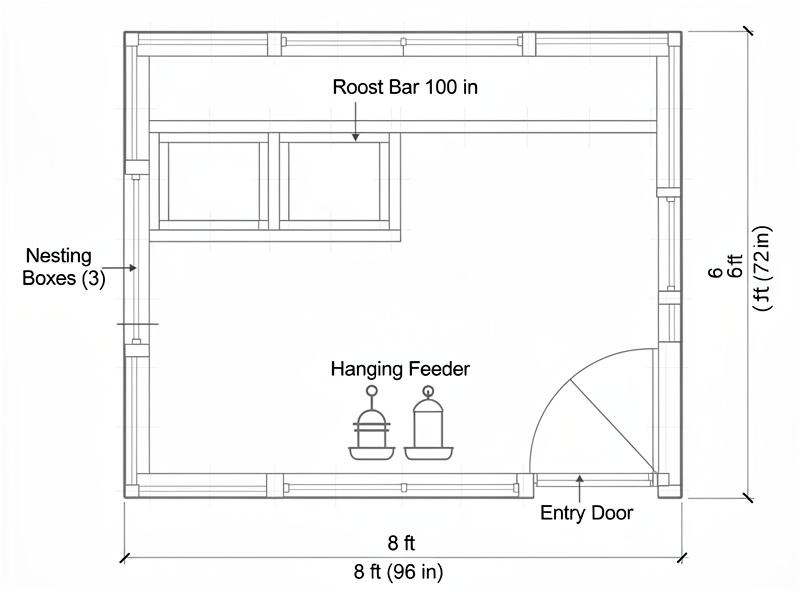
Ten hens need 2 to 3 nesting boxes (1 box per 4 to 5 hens) and 100 inches of roost bar length (10 inches per standard bird). The standard layout: 3 boxes mounted in a horizontal row in the darkest corner, single 100-inch (8.3 ft) roost bar across the back wall at 18 to 24 inches above the floor.
Adding a 4th nesting box rarely changes laying behavior because hens crowd into 1 or 2 favorite boxes regardless of count. The exception: mixed-flock coops with both bantams and standards benefit from one box at low height and others at standard height — bantams won’t hop into a 24-inch-high box reliably.
For roost bars at 10 birds, a single 100-inch bar works better than two 50-inch bars at different heights. Stacked roosts trigger nightly dominance fights for the top spot. If you must use two bars, mount them at the SAME height with 18 inches of horizontal separation — that gives subordinate birds room to land without invading the dominant bird’s perch zone.
Smart Setup for a 10-Bird Coop: The Sweet Spot
Ten birds is the smart-coop sweet spot for ROI. The egg output (50 to 60 eggs per week at peak production) covers the cost of a $400 to $600 smart automation stack within 14 to 18 months in feed savings, time savings, and predator-loss prevention. Below 6 birds the math is marginal; above 15 birds you need commercial-grade gear that costs 3x more.
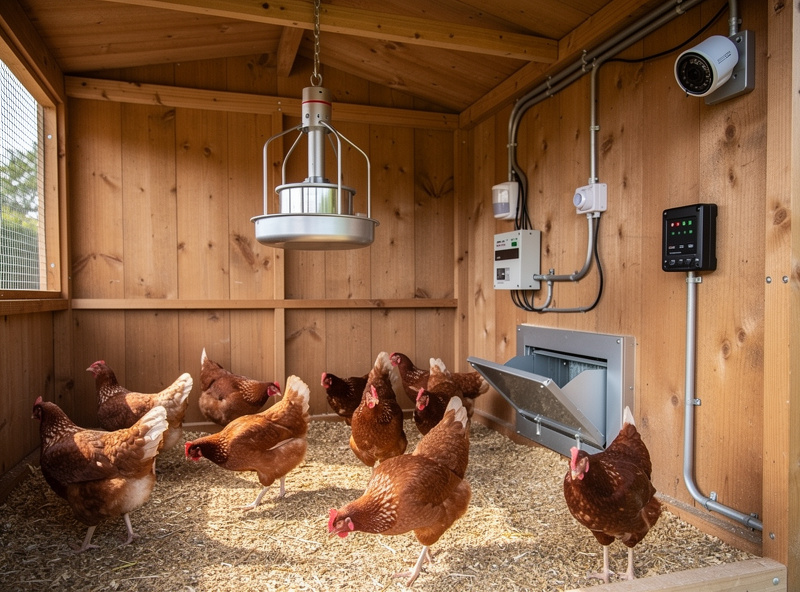
Sensor coverage: A 48 sq ft coop fits within the cone of a single PIR motion sensor mounted at one wall. A 64 sq ft converted shed needs two sensors at opposite corners for full coverage. Mount temperature and humidity sensors at roost height, and one ammonia sensor at floor level near the droppings zone — high ammonia is the strongest early warning of bedding-change need.
Camera placement: A single 1080p camera mounted in the upper corner opposite the door covers the entire 48 sq ft floor. For 64+ sq ft coops, use two cameras at opposite corners. Position so nesting boxes are in frame — egg production data is the most actionable smart-coop metric. See our smart coop monitoring guide for camera and sensor selection.
Equipment placement: A 10-bird coop has plenty of floor space, but smart positioning still matters. Wall-mount the battery backup high (out of pecking range), hang the automatic feeder from the ceiling at hen head height, and place the heated waterer on a raised platform to prevent bedding contamination. The full retrofit math is in our smart chicken coop pillar guide.
Common Mistakes Sizing for 10 Chickens
Four mistakes account for nearly every 10-bird coop rebuild request on backyard chicken forums.
Mistake 1 — buying a lift-top coop “rated for 10”: Lift-top coops above 5×6 ft become impractical because the lift weight gets too heavy and the interior reach gets too far. Any “fits 10” lift-top is either oversized lift-top (will fail) or capacity-inflated. Walk-in is the correct format at this flock size.
Mistake 2 — undersizing the run: A 100 sq ft run is the absolute minimum and triggers feather pecking within 30 days at this flock size. Plan for 150 to 200 sq ft. The added run material cost is $100 to $300, far less than treating a feather-pulling spiral.
Mistake 3 — single roost bar too short: A 60-inch roost in a 10-bird coop only fits 6 birds at proper spacing. The other 4 sleep on the floor or fight nightly. Always size roost bar at 10 inches per bird, minimum.
Mistake 4 — ignoring breed mix sizing: Mixed flocks of bantams, standards, and heavy breeds need sizing for the heaviest weight class. A 10-bird flock with 2 Brahmas, 5 Plymouth Rocks, and 3 bantams needs 60 sq ft (sized for the Brahmas), not 40 sq ft (averaged). New keepers who build mixed flocks from our beginners guide should size for adults, not pullets.
Frequently Asked Questions
What size coop do I need for 10 chickens?
Ten standard-breed chickens need a 5×8 or 6×8 ft coop (40 to 48 square feet) plus a 10×10 ft run (100 square feet) at minimum. For cold climates, heavy breeds, or expansion to 12-15 birds, upgrade to a 6×10 ft walk-in with a 10×15 ft run.
Can 10 chickens fit in a 4×8 coop?
No. A 4×8 coop is only 32 square feet, which fits 8 standard-breed hens at proper density. Putting 10 birds in that space is a reliable trigger for stress-related drops in egg production and feather pecking. The minimum for 10 standard chickens is 40 square feet (5×8 or 6×8 ft).
How many nesting boxes do I need for 10 chickens?
Two to three nesting boxes is correct for 10 hens (one box per 4 to 5 hens, rounded up). Boxes should be 12x12x12 inches, mounted in a horizontal row in the darkest corner of the coop, and lower than the roost bar.
How big should the run be for 10 chickens?
One hundred square feet is the absolute minimum for 10 birds (10 sq ft per bird). Target 150 to 200 sq ft for boredom prevention. Run shape matters more at this flock size: a 5×30 ft long run beats a 10×15 ft rectangle for behavior. Free-ranging hens 2 to 4 hours daily lets you shrink the run to 80 sq ft.
Is a converted garden shed good for 10 chickens?
Yes. An 8×8 ft converted garden shed delivers 64 square feet of interior, more than enough for 10 standard hens, with room for heavy breeds or flock expansion to 14 birds. Conversion costs $200 to $400 in materials (nesting boxes, roost bars, ventilation, chicken door) and 8 to 12 hours of labor. Often the best value at this flock size.
What is the cheapest 10-chicken coop?
A converted 8×8 ft garden shed is the cheapest option that delivers proper 10-bird capacity, total cost $600 to $1,000 including the shed and conversion materials. Prefab walk-in coops at this size start around $1,200 and most quality models run $1,500 to $2,500. Avoid prefab walk-ins under $900 – they typically use thin OSB that fails within 2 winters.
Bottom Line: Walk-in is Mandatory at 10 Birds
Picking the right chicken coop for 10 chickens means stepping up to walk-in format and committing to either a $1,200+ prefab or a $600 to $1,000 garden-shed conversion. The 40 sq ft coop floor and 100 sq ft run are the math; the walk-in access is the daily-chore-time savings that makes 10 birds sustainable. Plan run space at 150 sq ft, not 100, and your flock stays calm and laying through year three.
For sizing math at smaller and larger flocks, see our chicken coop size guide with the full sq-ft chart by flock count, or step down to the 6-chicken coop guide if you’re scaling back rather than up.
Related Guides
Related Guides
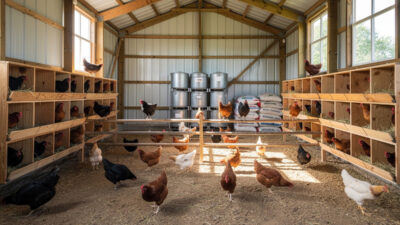
Large Chicken Coops: 25+ Bird Capacity Compared (2026)
A large chicken coop is anything sized for 25 or more birds — typically 100 to 250+ square feet of…
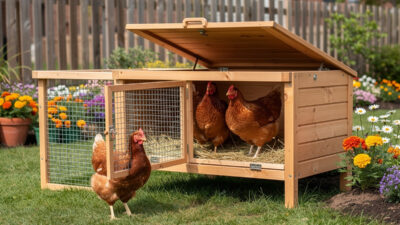
Small Chicken Coops: Best Picks for 2-4 Birds (2026)
A small chicken coop is anything sized for 2 to 4 birds — typically 8 to 16 square feet of…
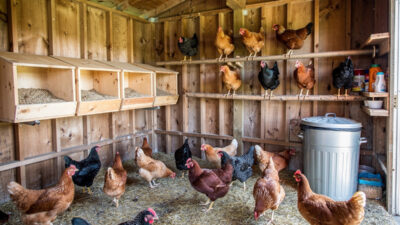
Chicken Coop for 20 Chickens: Walk-In & Shed Picks
A chicken coop for 20 chickens needs 80 square feet of interior floor (an 8×10 ft footprint) plus a 200…