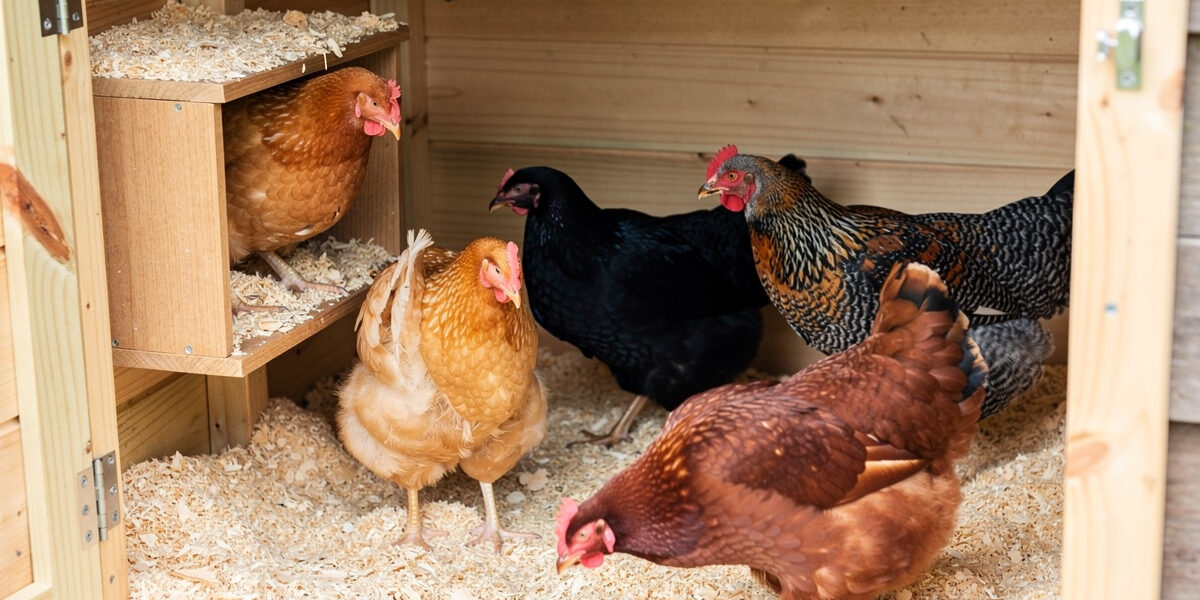
A chicken coop for 4 chickens needs 16 square feet of interior floor (a 4×4 ft footprint) plus a 40 square foot run, total roughly 56 square feet of yard space. Four birds is the most common HOA-permitted limit and the most popular first-flock size in the US — which is why this category has more bad prefab options than any other. Most “fits 4 to 6” listings are actually 3-bird coops once you do the math.
This guide gives you the exact dimensions that work for 4 birds, the three coop styles that hit the price-to-quality sweet spot, the smart-coop limitations that surprise first-time buyers, and the trap of buying too small “just to start.” Use the table below to pick once and avoid the upgrade most 4-bird keepers face by year two — I built my first coop for four and it was holding seven by the next spring, so I am biased toward sizing up. Full sizing math for other flock sizes is in our chicken coop size guide.
As an Amazon Associate I earn from qualifying purchases.
How Big Should a Coop for 4 Chickens Be?
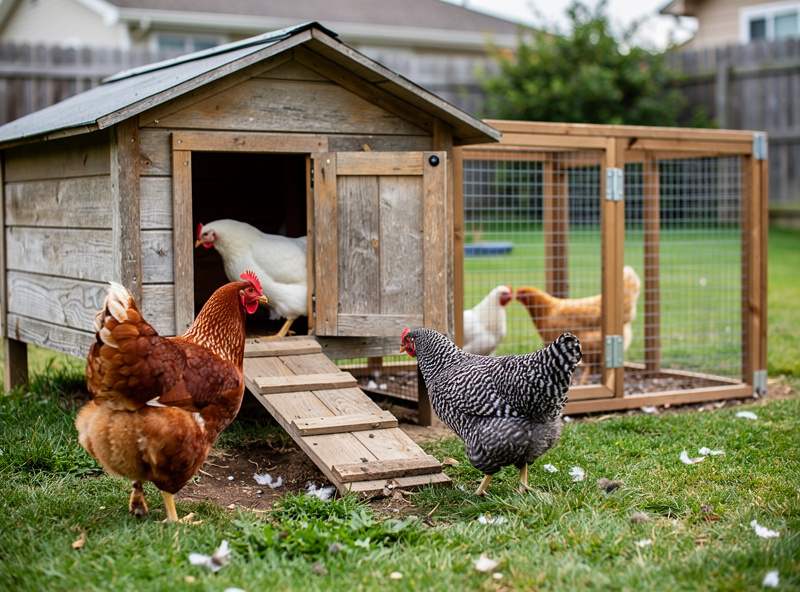
Four standard-breed hens need 16 square feet of coop floor (4×4 ft) plus a 40 square foot run (4×10 or 5×8 ft). That’s the absolute minimum. Cold climates, heavy breeds, or any plan to expand the flock pushes the recommended target to 24 sq ft of coop and 60 sq ft of run — which is the same footprint as a 6-bird setup.
The 4-bird category is where buyers most often make the “tiny coop” mistake. Manufacturers love to label 12 to 14 sq ft coops as “fits 4 chickens” because the photo with 4 hens fits the frame. In reality, 12 sq ft is a 3-bird coop. Forcing 4 birds into that space is a well-documented trigger for stress-related drops in egg output and the feather pecking that makes year-two replacement expensive (Alabama Cooperative Extension).
Why does the math get tighter at small flock sizes? Floor space lost to feeders, waterers, and nesting boxes is a percentage hit, not a fixed cost. A standard treadle feeder takes 2 sq ft regardless of coop size. In a 50 sq ft coop, that’s 4 percent of floor space. In a 16 sq ft coop, it’s 12.5 percent. Wall-mount or hang every piece of equipment you can in a 4-bird coop or you lose a full bird’s worth of usable space to gear — I learned that in my own first small coop, where a floor-standing feeder and waterer quietly turned a 4-bird footprint into a cramped 3-bird one until I hung everything.
Recommended Coop Dimensions for 4 Birds
The table below compares the three coop footprints that work for a 4-bird flock, with the cost and use-case trade-offs that matter at this scale.
| Coop Footprint | Interior sq ft | Recommended Run | Best For | Approx. Cost (prefab) |
|---|---|---|---|---|
| 4×4 ft lift-top | 16 | 4×10 ft (40 sq ft) | HOA-limited yards, beginners on a budget | $280-$550 |
| 4×6 ft compact walk-in | 24 | 6×10 ft (60 sq ft) | Cold climates, expansion planning, smart automation | $500-$900 |
| 4×8 ft mobile A-frame tractor | 16 + 16 ground level | Built-in (rotates daily) | Pasture rotation, mild climates, no fixed run | $350-$700 |
The 4×4 lift-top is the entry-level pick and what most first-time keepers buy. It works, but it leaves zero buffer — heavy breeds, cold winters, or one extra bird and you’re rebuilding. The 4×6 walk-in costs roughly twice as much and fits 6 birds with the same coop, which is the smart move if your local laws allow more than 4 hens. The 4×8 A-frame tractor is the fastest path to fresh-grass eggs and the cheapest way to keep 4 birds in summer climates, but it fails as a winter coop in zones 3 to 5 because the ground-level floor offers no insulation.
Best Coop Styles for 4 Chickens
Three coop styles dominate the 4-bird category. Each has a clear best-fit scenario and a clear trap.
4×4 ft lift-top backyard coop: The default starter coop. Lift-top access, integrated 2-box nesting unit, attached run via a chicken door. Trap: integrated nesting boxes are usually 10×10 inches (smaller than the 12×12 standard) and the lift-top hinges fail at 18 to 24 months under daily use. Buy a model with metal hinges, not plastic.
4×6 ft compact walk-in: Best long-term value at the 4-bird scale. Human-height interior makes weekly cleaning a 5-minute job instead of a 25-minute back-bending one. Easier to retrofit smart equipment — sensor mounting, camera placement, and battery backup all have wall space to work with. Cost is roughly double a 4×4 lift-top but the labor savings recover the difference in 18 months.
4×8 A-frame chicken tractor: Mobile coop on skids or wheels. Move daily across pasture and 4 birds clear weeds, fertilize lawn, and produce eggs without supplemental feed during peak growing season. Tractor failures happen in winter (no floor insulation) and during predator pressure (light frame, no apron). Best as a 7-month-per-year solution paired with a separate winter coop, or as a primary coop in zones 7 and warmer. See our budget DIY automation guide for tractor-friendly automation patterns.
Run Size for 4 Chickens
Forty square feet is the absolute run minimum for 4 birds (10 sq ft per bird). Sixty to eighty square feet is what experienced keepers settle on after one bored-flock cycle of bald-back hens. Free-range time of 2 to 4 hours daily lets you shrink the attached run to 32 sq ft, which fits the same footprint as a small garden bed.
Run shape matters more at small flock sizes than large ones. A 4×10 ft long run gives 4 birds clear escape distance from each other, breaking dominance fights before they start. A 6×6 square run forces close encounters and drives feather pulling. Where you can’t go long, add visual barriers — a low platform, dust bath area, or hanging cabbage — every 3 to 4 feet to break sightlines.
Predator-proofing is non-negotiable on a small run because losses hit harder. Losing one hen from a 12-bird flock is 8 percent. Losing one from a 4-bird flock is 25 percent — and a predator event is well known to leave surviving birds visibly stressed and laying less for a stretch afterward, on top of the bird you actually lost. Hardware cloth (1/2 inch mesh) on all sides plus an 18-inch buried apron is the standard (Garden Betty). Add an automatic coop door so birds self-secure at dusk regardless of whether you’re home.
Nesting Boxes and Roost Bars for 4 Birds
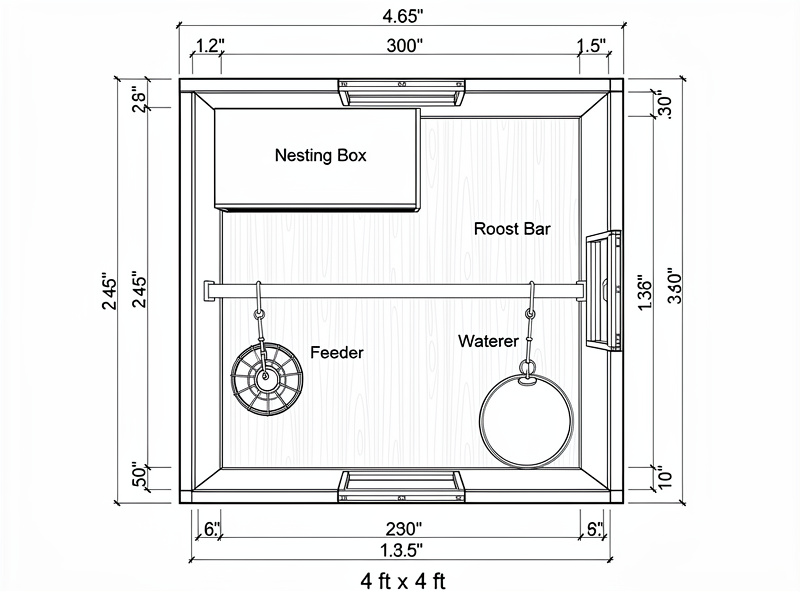
Four hens need 1 nesting box (1 box per 4 to 5 hens) and 40 inches of roost bar length (10 inches per standard bird). The single nesting box is the most contested piece of math in the 4-bird category, but the data is clear — adding a second box rarely improves laying behavior because hens crowd into one favorite box regardless.
The exception: if you keep mixed-temperament breeds (a docile Buff Orpington with a flighty Leghorn, for example), 2 boxes reduces the chance that a dominant hen blocks a subordinate from a laying spot. For most 4-bird flocks, 1 box at 12x12x12 inches in the darkest corner is correct.
For roost bars on 4 birds, a single 40-inch bar (a 2×4 laid flat-side up) works perfectly. Mount at 18 to 24 inches above the floor, always higher than the nest box so hens don’t sleep in the box. Stacked or staggered roosts trigger nightly dominance fights even at 4 birds — keep it simple with one horizontal perch.
Smart Setup for a 4-Bird Coop: The Equipment Footprint Trap
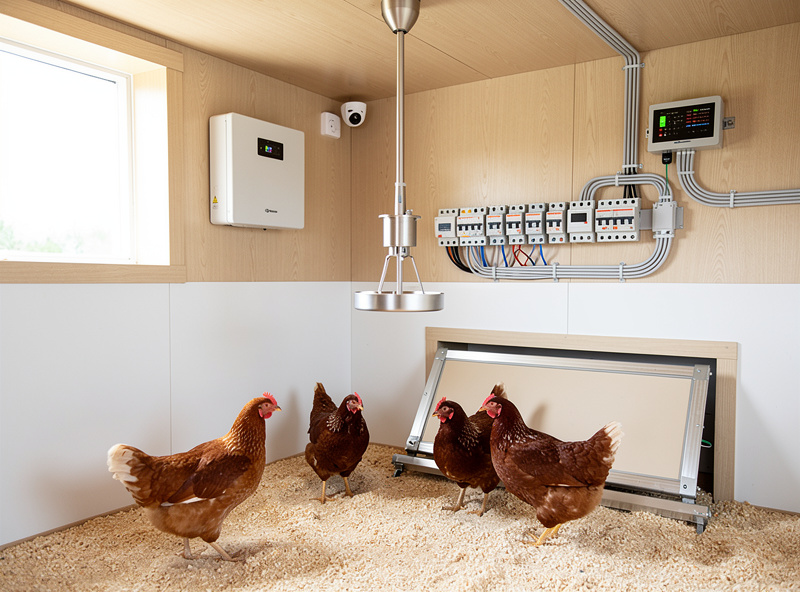
A 4-bird coop is the smallest size where smart automation makes economic sense — and the size where equipment footprint creates the biggest planning trap. The smart-coop stack steals 4 to 6 sq ft of floor space, which is a quarter of a 16 sq ft coop. Wall-mount, ceiling-mount, or hang every piece of gear or you lose 1 bird’s worth of space to electronics.
Sensor coverage: A single PIR motion sensor mounted in the back corner covers a 16 sq ft floor entirely. Mount the temperature and humidity sensor at roost height (18 to 24 inches up), not at floor level — that’s where ammonia and condensation hit the birds.
Automatic door: Standard chicken doors run 12 inches wide by 14 inches tall and bolt to any wall with 16+ inches of vertical clearance above the door opening. A 4×4 coop has plenty of wall space, but the wall you mount the door on becomes off-limits for nesting boxes or feeders. Plan the door wall first. Our automatic chicken coop door buyer’s guide covers the dimensional specs by brand.
Equipment placement: Mount the automatic feeder from the ceiling instead of on the floor — saves 1.5 sq ft. Wall-mount the battery backup high (out of pecking range) — saves 2 sq ft. Use a hanging heated waterer instead of floor-standing — saves 1 sq ft. Total floor savings vs. floor-mounted equipment: 4.5 sq ft, or one full bird’s worth of capacity. The full retrofit math is in our smart chicken coop pillar guide.
Common Mistakes Sizing for 4 Chickens
Three mistakes account for nearly every “I should have gone bigger” post on backyard chicken forums at the 4-bird scale.
Mistake 1 — buying a 12-14 sq ft “fits 4” coop: This is the most common 4-bird error. Manufacturers stretch capacity claims hardest at the small end of the market because $300 coops outsell $600 coops by 3:1. Always verify interior dimensions and divide by 4. If the result is below 16 sq ft, it’s a 3-bird coop regardless of the listing.
Mistake 2 — buying for 4 with no expansion buffer: “Chicken math” — starting small and adding birds within a year or two — is one of the most consistent patterns in backyard keeping, and it’s exactly what happened with my own first flock. If your HOA or local law allows more than 4 hens, sizing for 6 from the start costs $200 more and saves a $500 rebuild in year two. Pick the 4×6 walk-in over the 4×4 lift-top whenever the regulations allow.
Mistake 3 — undersizing for breed weight class: Hatchery photos show 8-week-old pullets, not the 8-pound Brahma those pullets become. Heavy breeds need 6 sq ft per bird inside the coop — a 4-bird Brahma flock needs 24 sq ft, not 16. New keepers who buy “any breed” assortment packs from our beginners guide often end up with mixed weight classes that demand the heavier per-bird sq ft target.
Frequently Asked Questions
What size coop do I need for 4 chickens?
Four standard-breed chickens need a 4×4 ft coop (16 square feet) plus a 4×10 ft run (40 square feet) at minimum. For cold climates, heavy breeds, or expansion to 6 birds, upgrade to a 4×6 ft walk-in coop with a 6×10 ft run.
Can 4 chickens fit in a 3×3 coop?
No. A 3×3 coop is only 9 square feet, which fits 2 standard-breed hens at proper density. Putting 4 birds in that space is a reliable trigger for stress-related drops in egg production and feather pecking. The minimum for 4 standard chickens is a 4×4 coop.
How many nesting boxes for 4 chickens?
One nesting box is correct for 4 hens (one box per 4 to 5 hens). The box should be 12x12x12 inches, mounted in the darkest corner of the coop, and lower than the roost bar. Mixed-temperament flocks may benefit from a second box to prevent dominant hens from blocking subordinates.
How big should the run be for 4 chickens?
Forty square feet is the absolute minimum for 4 birds (10 sq ft per bird). Target 60 to 80 sq ft for boredom prevention. Free-ranging hens 2 to 4 hours daily lets you shrink the run to 32 sq ft. Run shape matters: a 4×10 ft long run beats a 6×6 ft square at the same area.
Is a chicken tractor a good option for 4 chickens?
Yes, a 4×8 ft A-frame tractor works well for 4 birds in zones 6 and warmer if you move it daily across pasture. Tractors fail as winter coops in cold climates because the floor sits on the ground and offers no insulation. Use a tractor as a 7-month-per-year solution or as a primary coop in mild climates.
What is the cheapest coop that actually fits 4 chickens?
A 4×4 ft lift-top prefab coop in the $280 to $400 range is the cheapest option that delivers genuine 4-bird capacity. Avoid anything under $250 at this footprint – the materials are typically thin OSB or pine that fails within 2 winters. A DIY 4×4 build from scratch runs $150 to $250 in lumber and hardware.
Bottom Line: Pick the Coop That Survives Year Two
The chicken coop for 4 chickens math is simple: 16 sq ft floor, 40 sq ft run, 1 nesting box, 40 inches of roost bar. The harder decision is whether to buy at the 4-bird minimum or upgrade to the 6-bird footprint that survives flock expansion. If your local laws cap you at 4 hens permanently, the 4×4 lift-top is correct. Anywhere else, the 4×6 walk-in pays for itself the first time you add 2 birds.
For full sizing math across larger flock sizes, see our chicken coop size guide or jump straight to the next step up at chicken coop for 6 chickens.
Related Guides
- Chicken Coop Size Guide: How Many Chickens Per Square Foot
- Chicken Coop for 6 Chickens: Best Picks & Layout
- How to Build a Smart Chicken Coop: The Complete 2026 Guide
- Automatic Chicken Coop Doors: Complete Buyer’s Guide 2026
- Backyard Chickens for Beginners: Everything You Need to Know in 2026
Related Guides
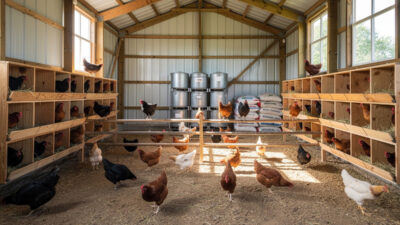
Large Chicken Coops: 25+ Bird Capacity Compared (2026)
A large chicken coop is anything sized for 25 or more birds — typically 100 to 250+ square feet of…
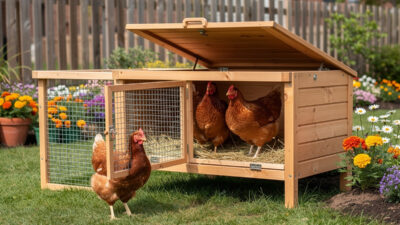
Small Chicken Coops: Best Picks for 2-4 Birds (2026)
A small chicken coop is anything sized for 2 to 4 birds — typically 8 to 16 square feet of…
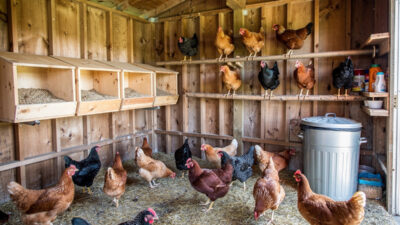
Chicken Coop for 20 Chickens: Walk-In & Shed Picks
A chicken coop for 20 chickens needs 80 square feet of interior floor (an 8×10 ft footprint) plus a 200…