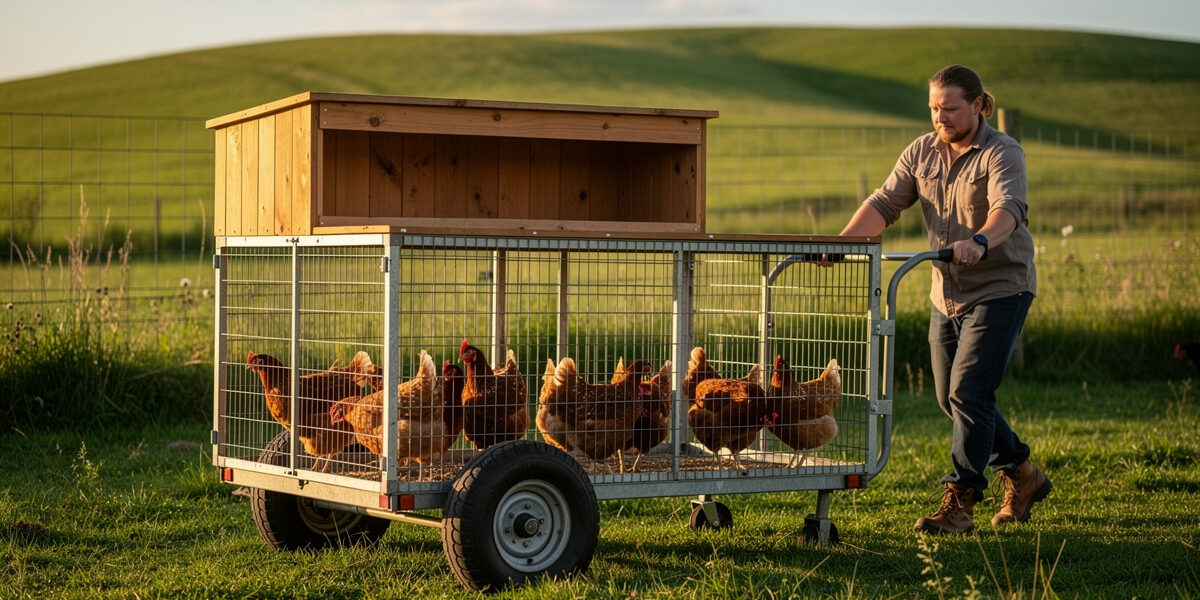
A mobile chicken coop is any coop designed to relocate around your property — from lightweight 50-lb A-frame tractors to 800-lb trailer-mounted coops that follow rotational grazing herds. The “mobile” category is broader than chicken tractors, encompassing every format that moves: A-frames, wheeled coops, skidded coops, towable trailers, and bus-conversion eggmobiles. The right mobile format depends on flock size, terrain, and whether you’re rotating in a backyard or across actual pasture.
This guide covers what counts as a mobile coop, the four scale tiers each fit a different use case, the integration patterns with rotational grazing of larger animals, the smart-automation considerations for coops that move daily, and the four mistakes that turn a $1,500 mobile coop into a stationary one within 90 days. For the broader portable category, see our portable chicken coops hub.
As an Amazon Associate I earn from qualifying purchases.
What Counts as a Mobile Chicken Coop?
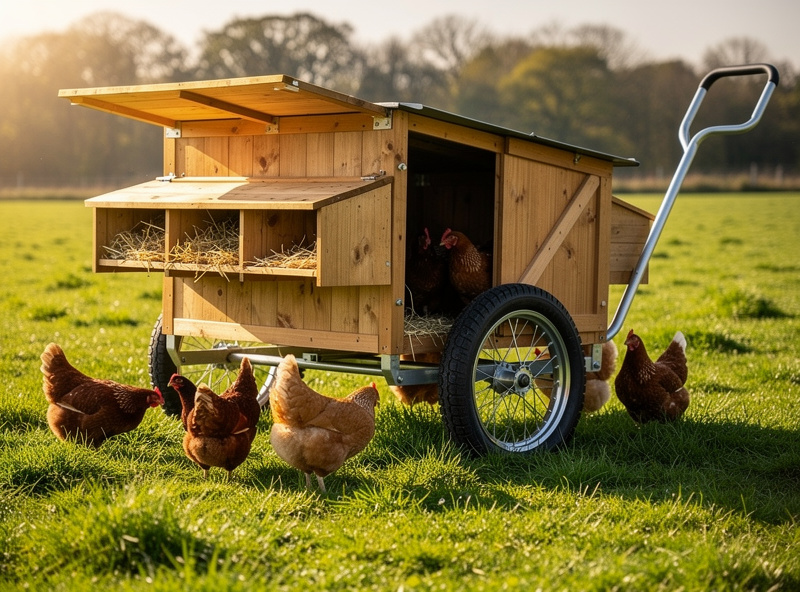
A mobile chicken coop is any coop that gets moved on a planned schedule — daily, weekly, or with the seasonal rotation pattern of a larger grazing system. The defining feature is intentional movement built into the operation, not the specific hardware design. A 60-lb A-frame moved daily, a 400-lb wheeled coop moved every 5 days, and a 1,500-lb trailer-mounted “eggmobile” moved every 2 weeks all qualify as mobile coops.
What separates mobile coops from portable coops: portable coops are built for occasional relocation (move when needed, often static-by-default). Mobile coops are designed around regular planned movement — the rotation IS the operating model, not an exception. A backyard tractor moved daily is mobile. A “portable” coop sitting in one spot for 6 months is just a coop with rolling pretensions.
Mobile coops trade away some advantages of static coops (heating efficiency, in-coop feed storage, complex smart automation) for benefits that scale with rotation discipline: fresh forage daily, parasite-free ground rotation, intentional fertilization across pasture, and integration with multi-species grazing systems. The trade-off only works if you actually rotate.
Four Scale Tiers of Mobile Coops
Mobile coops break into four scale tiers, each fitting a different operation size and use case.
| Scale Tier | Typical Size | Bird Capacity | Move Method | Best For |
|---|---|---|---|---|
| Backyard tractor | 4×6 to 4×8 ft | 2-6 hens | Hand-drag or 2-wheel lift | Suburban yards, daily moves |
| Pasture pen / wheeled coop | 5×10 to 8×12 ft | 6-15 hens | 2-wheel cart or push-handle | Small homesteads, weekly moves |
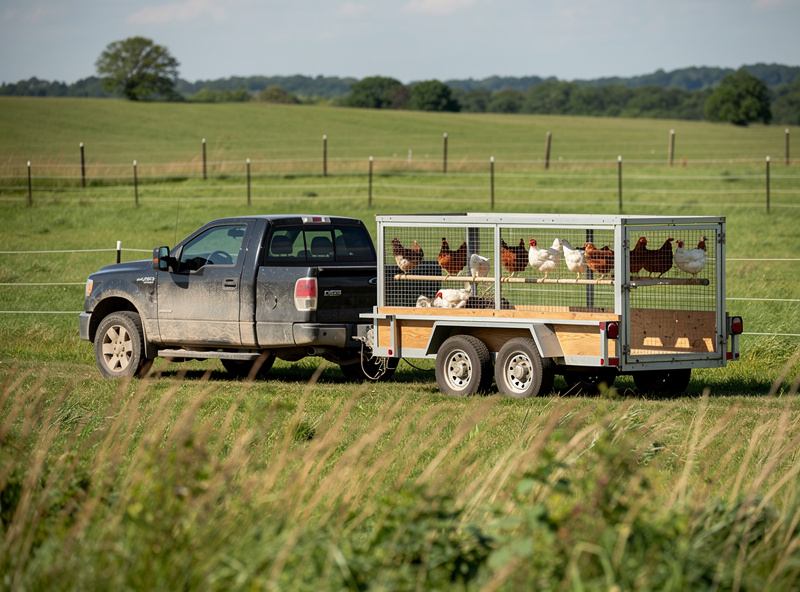
| Trailer-mounted coop | 8×12 to 10×16 ft | 15-50 hens | Tow with truck or ATV | Rotational grazing, 7-30 day moves |
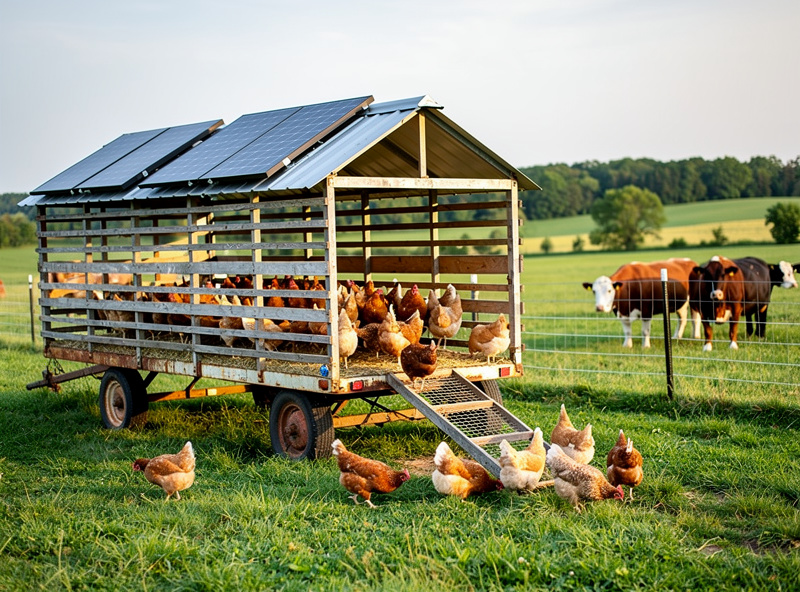
| Eggmobile (full conversion) | 12×20 to 8×24 ft | 50-300 hens | Tow with truck or tractor | Pasture-based egg operations, 2-7 day moves |
The backyard tractor tier is what most chicken keepers think of as “mobile” — light enough for one-person daily moves, sized for 2 to 6 hens. See our chicken tractor design guide for A-frame specifics. The pasture pen tier crosses into small-homestead territory and is the smallest scale where weekly (rather than daily) moves work well. Trailer-mounted coops require a vehicle and are the entry point for serious egg operations. Eggmobiles are pasture-business hardware — Joel Salatin popularized the format at Polyface Farm, where Salatin describes moving his non-hybrid layers almost daily behind grazing cattle rather than parking a flock in one spot for weeks.
Mobile Coops in Rotational Grazing Systems
The strongest case for larger mobile coops is integration with rotational grazing of cattle, sheep, or goats — though this is territory I hedge on a little more than the rest of this guide, since my own flock rotates on a cattle-panel hoop coop and A-frame tractor around the yard and garden beds, not behind an actual cattle herd. The pattern keepers running mixed livestock describe: cattle graze a paddock for 2 to 4 days, then move on, with the mobile chicken coop following 2 to 5 days behind so hens can scratch through the manure, eat fly larvae, and spread nutrients across the pasture.
The “chickens cut cattle parasites by X percent” claim gets repeated a lot in homestead content, and I want to be straight with you about it: the one controlled trial I could track down on the actual mechanism found the opposite of the folklore. Researchers at the University of Minnesota’s West Central Research and Outreach Center penned pastured broilers behind dairy cows and measured face-fly larvae survival in the dung pats — survival rates were statistically the same with or without chickens present, because the broilers mostly stayed near their shelter and were rarely observed actually foraging in the pats. Free-ranging layers on a looser rotation may behave differently, but treat “chickens after cattle knocks out X percent of parasites” as an unproven folk claim rather than an engineering number until better field data exists. What’s better documented is the feed side: pasture access measurably lowers the feed bill, with a commonly cited pasture-nutrition estimate putting forage at roughly 5 to 20 percent of a free-ranging bird’s diet depending on season and forage quality — real, but nowhere near “half the feed bill.”
For backyard scale without cattle, mobile coops can rotate behind a small flock of sheep or goats, follow your lawn-mowing schedule, or simply rotate across orchard rows. Each pattern delivers similar parasite-prevention and feed-cost-reduction benefits scaled to the operation. For exact sizing math by flock count, see our chicken coop size guide.
Best Mobile Coop Designs by Scale
Match the design to your scale tier.
Backyard scale (2-6 hens): A 4×8 ft A-frame tractor or 4×8 ft compact wheeled coop — a prebuilt chicken tractor kit gets most backyard keepers moving in a weekend instead of building from scratch. Hand-drag for A-frames; 2-wheel lift for wheeled coops. Daily moves across a planned grid pattern. This is the tier I actually run — my own A-frame tractor and a cattle-panel hoop coop move daily across the garden and yard from spring thaw through the first hard frost, then get pulled entirely for winter back onto the main fixed coop. See our chicken tractor guide and 6-chicken coop guide for picks at this scale.
Small homestead (6-15 hens): A 5×10 to 8×12 ft wheeled pasture pen with a push-handle. Weekly moves across a 4-paddock rotation. Often built on heavy 2×4 framing with metal roofing for 10+ year service life. Best builds use galvanized hardware cloth on all sides, a 12-inch buried wire skirt for predator protection, and a section of electric poultry netting around the coop footprint to expand the grazing area without full predator exposure. See our 10-chicken coop guide for sizing guidance.
Trailer-mounted (15-50 hens): An 8×12 ft trailer-mounted coop on a single-axle utility trailer with appropriate tongue weight (typically 10 to 15 percent of total loaded weight). Tow with a 1/2-ton pickup or large ATV. Move every 7 to 30 days following a rotational grazing pattern. Custom builds dominate this tier — commercial offerings are rare and overpriced. Our 12-chicken coop guide covers sizing for the lower end of this tier.
Eggmobile scale (50-300 hens): A 12×20 to 8×24 ft converted school bus, hay wagon, or custom trailer. Move every 2 to 7 days following cattle rotation. This scale crosses into commercial egg-operation territory and typically requires a small farm classification (see our 20-chicken coop guide for the small-farm threshold and large coop guide for the 25+ bird tier).
Smart Automation for Mobile Coops
Mobile coops constrain smart automation to battery-powered hardware that tolerates daily or weekly relocation. Wired electrical, NAS-based camera systems, and high-power smart hubs all fail in mobile applications. The smart-coop stack that works in mobile coops is a focused subset of full smart-coop builds. My fixed coop runs everything off Home Assistant — sunrise/sunset door offset, temp and humidity sensors, freeze-watch on the waterer. None of that comes along to the hoop coop; running wire out to gear that moves every day isn’t worth it, so the mobile side stays solar and battery only.
Solar-charged automatic door: The single most valuable smart upgrade for mobile coops. A solar-rechargeable auto-door (typical $180 to $300) handles dawn/dusk transitions without daily intervention, which is critical when the coop is 50+ feet from the house or moving across pasture. Battery life with solar trickle-charge runs 12 to 24 months between battery replacements. See our automatic coop door buyer’s guide for solar-friendly picks.
WiFi-extended sensors: Battery-powered Zigbee or LoRa sensors with mesh extenders work in pasture applications up to 1,000 ft from the house WiFi router. Mount inside the coop near roost height. Battery life on Zigbee sensors runs 12 to 18 months. The full sensor strategy is in our smart coop monitoring guide.
Cellular-trickle camera: For trailer-mounted and eggmobile-scale coops that move outside WiFi range, a cellular-equipped trail camera with solar trickle-charge sends daily snapshots to your phone. Higher hardware cost ($300 to $500) but works across any pasture distance. Avoid traditional WiFi cameras for any mobile coop that moves more than 200 ft from your router.
Battery-friendly automatic feeder: Use treadle or timer feeders rather than motor-driven hopper feeders for mobile applications. The full smart-coop architecture, including patterns that adapt to mobile coops, is in our smart chicken coop pillar guide, with budget builds in our $200 DIY automation guide.
Common Mobile Coop Mistakes
Four mistakes account for nearly every “I gave up on the mobile coop” failure mode.
Mistake 1 — buying mobile, using static: The most common failure is buying a mobile coop intending to rotate it, then leaving it in one spot for weeks. After 14 days in one position, every mobile coop becomes a static coop with parasite buildup, mud, and overgrazed dead grass. If you genuinely won’t rotate, a static coop with proper run sizing works better. Our backyard chickens beginners guide covers the static-vs-mobile decision in detail.
Mistake 2 — wrong scale for the operation: Buying a 200-lb wheeled pasture pen for a 4-bird suburban backyard creates moves that take 20+ minutes and skip days regularly. Buying a 60-lb A-frame for a 25-bird homestead creates undersized capacity and constant rebuild pressure. Match the scale tier to actual flock size and rotation distance.
Mistake 3 — using mobile coops in winter (cold climates): Mobile coops with bottomless or thin floors fail in zones 3 to 5 because the ground-level or thin-walled construction can’t hold heat. Use mobile coops as 7-month-per-year solutions in cold climates, paired with a static winter coop. Wheeled coops with insulated walls can extend service into mild winters in zones 6+. This is exactly why my own hoop coop and A-frame get parked once the ground freezes here in Sweden — the birds go back onto the insulated, deep-litter fixed coop for the winter, and the mobile gear doesn’t come back out until the rotation is actually worth it again.
Mistake 4 — wired electrical on mobile coops: Running extension cords to mobile coops, or trying to install fixed wiring, creates safety hazards and almost always fails within 2 to 3 moves. Plan for battery-powered or solar-charged smart hardware from the start. Skip any “smart” feature that requires constant wired power.
Frequently Asked Questions
What is a mobile chicken coop?
A mobile chicken coop is any coop designed for planned relocation – daily, weekly, or with seasonal rotation. The category includes backyard A-frame tractors (50-80 lb), wheeled pasture pens (200-400 lb), trailer-mounted coops (500-1,500 lb), and full eggmobiles (1,500+ lb). The defining feature is intentional movement built into the operation.
How do you move a mobile chicken coop?
Move method depends on scale. Backyard tractors (under 80 lb) hand-drag or use 2-wheel lift handles. Wheeled pasture pens (200-400 lb) use a push-handle or single-axis cart. Trailer-mounted coops (500+ lb) tow with a 1/2-ton pickup or large ATV. Eggmobiles tow with a tractor or heavy truck. Match the move method to the scale tier.
How often do you move a mobile chicken coop?
Move frequency depends on scale and stocking density. Backyard tractors move daily. Pasture pens move weekly to bi-weekly. Trailer-mounted coops move every 7 to 30 days following rotational grazing. Eggmobiles in cattle rotation move every 2 to 7 days behind the cattle herd.
Can a mobile chicken coop work with cattle or sheep?
Yes, sheep and goats work at backyard scale, with cattle rotations the classic pairing at larger scale. Chickens will scratch through manure looking for fly larvae and weed seed, but be skeptical of a specific percent-reduction number for parasites – the one controlled trial on the actual mechanism found pastured broilers had no measurable effect on fly-larvae survival, mostly because the birds stayed near shelter instead of foraging in the dung pats. What is better documented is the feed side: pasture forage covers roughly 5 to 20 percent of a free-ranging bird’s diet depending on season, a real offset even if it will not cut the feed bill in half.
How big should a mobile chicken coop be?
Match coop size to flock count using 6 to 8 sq ft per bird for daily-rotated tractors and 4 to 6 sq ft per bird for weekly-rotated wheeled coops. A 4×8 ft tractor handles 4 to 6 hens with daily moves. A 5×10 ft wheeled coop handles 8 to 12 hens with weekly moves. Above 50 birds, switch to trailer-mounted or eggmobile scale.
Are mobile chicken coops better than static coops?
Mobile coops win for fresh forage, parasite prevention, and integration with rotational grazing – but only if you actually rotate them. Static coops win for cold-climate year-round use, complex smart automation, and operations where daily labor is constrained. Pick mobile if you can commit to the rotation discipline; pick static if you cannot.
Bottom Line: Mobile is a Rotation Discipline, Not a Hardware Spec
The right mobile chicken coop matches your operation scale and your rotation commitment. Backyard tractors deliver fresh forage if you actually move them daily. Wheeled pasture pens handle small-homestead flocks with weekly rotations. Trailer-mounted coops integrate with rotational grazing systems. Eggmobiles are pasture-business hardware. Pick the scale tier that matches your flock and your willingness to maintain the rotation pattern that makes mobile coops work.
For broader portable formats, see our portable chicken coops hub. For specific A-frame designs and DIY plans, the chicken tractor guide covers the backyard scale tier in detail.
Related Guides
- Portable Chicken Coops & Tractors: Complete 2026 Guide
- Chicken Tractor: A-Frame Designs, Plans & Best Picks
- Chicken Coop Size Guide: How Many Chickens Per Square Foot
- Chicken Coop for 10 Chickens: Best Walk-In Picks
- Chicken Coop for 12 Chickens: Family-Flock Picks
- How to Build a Smart Chicken Coop: The Complete 2026 Guide
Related Guides
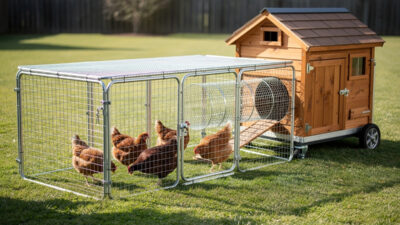
Portable Chicken Run: Modular Picks for Mobile Coops
A portable chicken run is a movable outdoor enclosure that connects to or follows a chicken coop, providing relocatable forage…
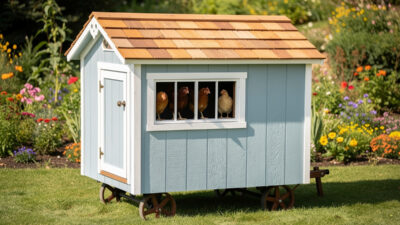
Portable Chicken House: Cottage, Plastic & Barn Picks
A portable chicken house is a movable enclosed structure focused on the housing/sleeping area, distinct from a portable chicken tractor…
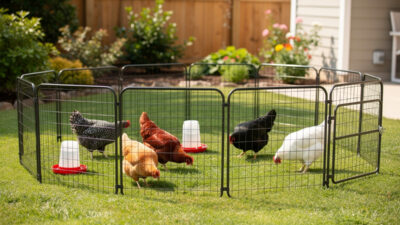
Portable Chicken Pen: 5 Best Picks for Daily Setup
A portable chicken pen is a lightweight enclosed outdoor area that hens can use during daylight hours, distinct from a…