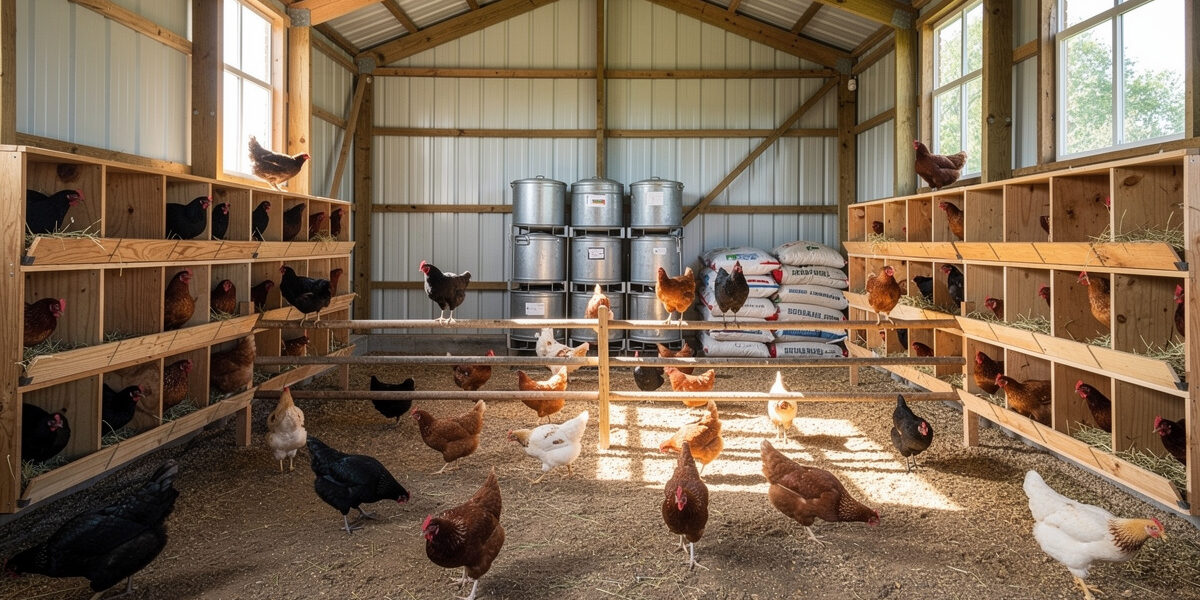
A large chicken coop is anything sized for 25 or more birds — typically 100 to 250+ square feet of interior floor with a 250 to 750 sq ft run or rotational paddock system. The category covers small homesteads, micro-farms, and serious egg-production operations. Prefab walk-in coops effectively don’t exist at this scale; large coops are pole barns, converted barns, or custom-built structures.
This guide covers what “large” really means in coop sizing, the three structures that work for 25+ bird flocks, why automation becomes mandatory at this scale, and the four mistakes that turn a large-flock operation into a chore-time sinkhole. I keep a backyard-scale flock myself, not a 75-bird operation — but the paddock-rotation, predator-scaling, and automation math below is the same logic I run on my own coop, just multiplied, and I have watched keepers who skipped it burn out inside a year. Full sizing math for smaller flocks is in our chicken coop size guide. For the closest prefab walk-in option that approaches large-coop capacity (15-25 birds in cedar walk-in), our Over EZ chicken coop review covers the XL model.
As an Amazon Associate I earn from qualifying purchases.
What Counts as a Large Chicken Coop?
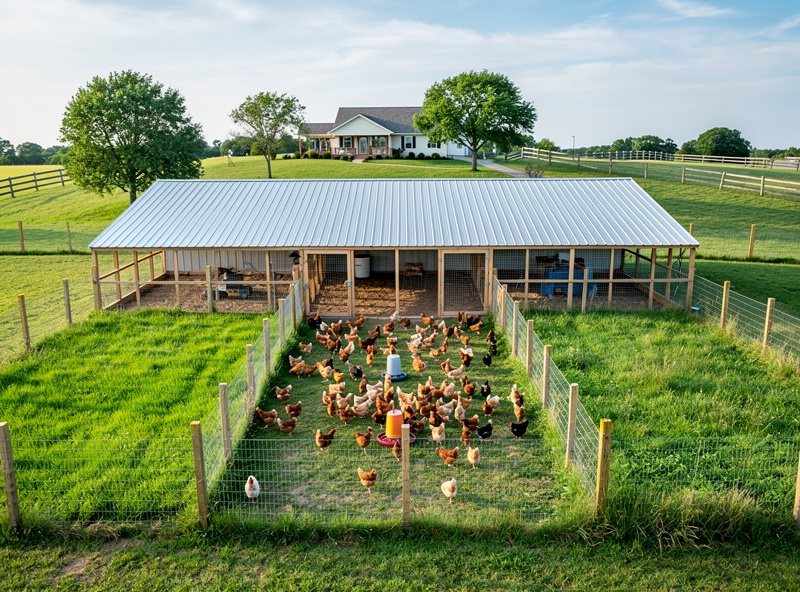
A large chicken coop is sized for 25 or more standard-breed hens, with at least 100 square feet of interior floor space. The category typically scales to 50 to 100+ birds in dedicated structures. The 4-and-10 rule still applies: 4 sq ft of coop floor and 10 sq ft of run per standard bird, scaled up, consistent with university extension per-bird sq-ft guidance (Alabama Cooperative Extension).
- 25 birds: 100 sq ft coop (10×10 ft) + 250 sq ft run
- 30 birds: 120 sq ft coop (10×12 ft) + 300 sq ft run
- 50 birds: 200 sq ft coop (10×20 or 12×16 ft) + 500 sq ft run
- 75 birds: 300 sq ft coop (12×25 or 14×21 ft) + 750 sq ft run
- 100 birds: 400 sq ft coop (16×25 or 20×20 ft) + 1,000 sq ft run
At this scale, the coop format shifts from “structure with attached run” to “structure with rotational paddock system.” A 75-bird coop with a single 750 sq ft run wears out the ground within 4 to 6 months, leaving bare dirt that turns to mud in winter and dust in summer. Two to four rotating paddocks of 200 to 400 sq ft each, used in 30-day cycles, keep grass alive and parasites in check. This is also the threshold where most operations cross from “backyard chickens” to “small farm” or “agricultural operation” in zoning terms.
Best Large Chicken Coop Structures
Three structure types work at the 25+ bird scale. Standard prefab walk-in coops do not — capacity claims above 80 sq ft are universally inflated and overpriced.
Converted pole barn or shed (12×16 to 14×20 ft): The most common large-coop structure. A $2,500 to $5,000 pole barn build delivers 200 to 280 sq ft of interior, room for 50 to 70 birds, and headroom for 4 to 6 nesting box banks plus dedicated feed storage. The pole construction handles snow loads, wind loads, and predator pressure that lighter prefabs can’t. Conversion adds nesting boxes, multiple roost banks, ventilation, chicken doors, and a dedicated feed/equipment area.
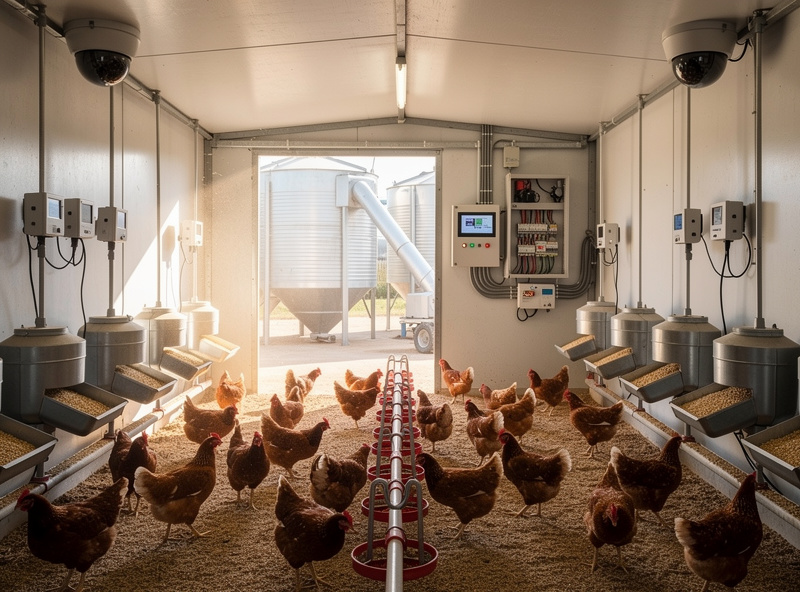
Dedicated chicken house (custom build): For operations targeting 50+ birds long-term, a custom 12×20 or 16×24 ft chicken house designed from the ground up costs $5,000 to $12,000 in materials and delivers 240 to 384 sq ft of optimized interior. Design choices that matter: 8+ ft ceilings for human comfort during long chore sessions, sloped concrete floor with central drain for hose-down cleaning, separate quarantine room for sick or new birds, mudroom-style entry to control rodent and mite migration.
Existing barn or stall conversion: If you have an existing pole barn or stall structure, sectioning off a 12×16 ft area with a 4-foot-high partition and chicken doors delivers 192 sq ft for 48 birds at low capital cost ($300 to $1,200 in conversion materials). Trap: barn coops attract rodents at 3x the rate of standalone structures, require strict feed-storage discipline, and benefit dramatically from smart camera systems for rodent and predator detection.
Run and Paddock System for Large Flocks
A 25 to 50 bird flock needs 250 to 500 sq ft of total run space, but a single static run wears out fast. The standard solution at this scale is a rotational paddock system: 2 to 4 separate enclosed areas of 100 to 250 sq ft each, with the flock cycling through one paddock at a time for 7 to 30 days while the others rest.
Paddock sizing depends on grass-recovery rate and climate. In zones 6 to 8 with regular rain, a paddock supporting 30 birds needs 25 to 30 days of rest to regrow grass after 7 days of use. In drier zones, recovery takes 45 to 60 days — plan for 3 to 4 paddocks instead of 2. Each paddock should have its own chicken-door access from the coop, gateable so you can lock birds into the active paddock and out of the resting ones.
Predator pressure scales sharply with flock value at this size. An unsecured 50-bird flock is a genuinely attractive target, and a single nighttime breach can wipe out a large share of it in one visit — devastating both economically and emotionally. Hardware cloth (1/2 inch mesh) on all paddock sides plus a 24-inch buried apron is the standard (Garden Betty). Cover at least 70 percent of each paddock with hawk netting or solid roofing. Pair with a robust automatic coop door system on every paddock entry, set to close 30 minutes before sunset.
Nesting Boxes, Roost Banks, and Interior Layout
A 25-bird flock needs 5 to 6 nesting boxes (1 box per 4 to 5 hens), 250 inches of roost bar, and a deliberate interior layout that keeps the coop functional for daily chores at scale. Boxes should be mounted in 1 to 2 horizontal banks at the same height, never stacked.
For 50+ bird flocks, build 2 nesting box banks of 6 boxes each on opposite walls. Splitting boxes prevents the bottlenecking that happens when 50 hens try to access a single box bank simultaneously during peak laying hours (typically 8 to 11 am). Mount both banks at 18 to 24 inches off the floor, in the darkest corners available.
Roost banks require careful planning at this scale. Use 2 to 4 parallel bars at the SAME height, separated by 18 to 24 inches of horizontal space — never staggered. A 50-bird coop needs 500 inches of total roost length, which works out to 4 parallel 125-inch bars (just over 10 ft each). Stacked roosts trigger nightly dominance fights, and at 50 birds those fights cause real injuries because the bottom of the pecking order has nowhere to retreat.
Smart Setup for Large Coops: Automation is Mandatory
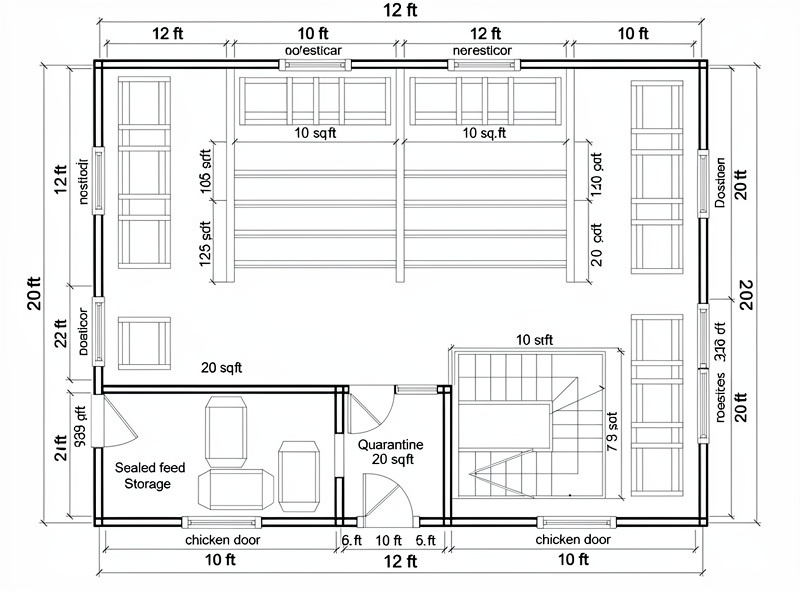
At 25+ birds, smart-coop automation crosses from “essential” to “mandatory.” Manual chores at this scale eat 25 to 40 hours per month — bulk feed handling, daily multi-paddock door duty, weekly bedding rotation, daily egg collection across 6+ nesting boxes. A $1,200 to $2,500 commercial-grade smart automation stack drops that to 6 to 10 hours per month. Skipping automation means burning out within 6 months or hiring help.
Multi-zone sensor coverage: A 200 sq ft coop needs 3 to 4 PIR motion sensors at staggered positions, plus 2 temperature sensors (one at roost height, one at feed storage), 1 humidity sensor, and 2 ammonia sensors at floor level near the heaviest droppings zones. The ammonia sensors are mandatory at this scale because daily droppings volume from 50 birds can build dangerous ammonia levels within 3 to 4 days of bedding age.
Camera coverage: A 200 sq ft coop needs 4 cameras for full coverage — one for each major zone (entry, both nesting box banks, roost area). For 300+ sq ft coops, plan for 6 to 8 cameras. The investment pays back through earlier disease detection, predator-attempt evidence for insurance claims, and egg-production analytics. See our smart coop monitoring guide for camera and sensor selection details.
Bulk feed and water automation: At 25 birds, you go through 50 lbs of feed every 8 to 10 days. At 50 birds, every 4 to 5 days. The math demands either weekly 100-lb bag deliveries or a 200 to 400 lb bulk feed silo. Wall-mount or ceiling-hang multiple automatic feeders sized to 20 to 30 lb capacity each. Replace single waterers with multi-station heated waterer systems. The complete commercial-grade smart-coop layout is in our smart chicken coop pillar guide.
Common Mistakes Sizing Large Chicken Coops
Four mistakes account for nearly every “should have planned bigger” or “should have automated sooner” failure mode at the large-flock scale.
Mistake 1 — converting an undersized structure: A common large-coop mistake is converting a 10×10 garden shed for 30+ birds. 100 sq ft fits 25 birds at proper density and triggers feather pecking the moment you push past that. Always do the math: usable interior sq ft divided by 4 = realistic standard-breed bird capacity. Leave 25 percent buffer for breed weight class, expansion, or quarantine flexibility.
Mistake 2 — single static run for 30+ birds: A single 300 sq ft run for 30 birds wears out within 4 to 6 months and never recovers without intervention. Plan rotational paddocks from day one — 3 paddocks of 150 sq ft each, used in 10-day cycles, keeps grass alive year-round in zones 6 to 8.
Mistake 3 — manual operation at 30+ birds: Manual feed, water, door, and chore duty at 30 birds eats 25 to 35 hours per month. Most large-flock keepers try to power through for 6 to 12 months before either downsizing the flock, hiring help, or building a smart-coop stack reactively. Plan automation from the structure design phase. New keepers from our beginners guide often underestimate the chore-time wall.
Mistake 4 — skipping the quarantine area: At 25+ birds, disease outbreaks can wipe out the entire flock in 7 to 14 days. A dedicated 10×10 quarantine area inside the coop (or a separate small structure) lets you isolate sick birds, new birds, or mite-infested birds without exposing the main flock. The retrofit cost is 10x the design-phase cost. Build it in from the start.
Frequently Asked Questions
What size coop do I need for 25 chickens?
Twenty-five standard-breed chickens need a 10×10 ft coop (100 square feet) plus a 250 sq ft run or rotational paddock system at minimum. For 50 birds, scale to 200 sq ft of coop (10×20 or 12×16 ft) plus 500 sq ft of total run space. Pole barn or converted shed structures dominate this size class.
Can a prefab coop fit 30 chickens?
No. Prefab walk-in coops top out around 80 sq ft of interior, which fits 20 birds at proper density. For 30+ birds, you need a converted shed (10×12 minimum), a custom-built chicken house, or a sectioned-off barn or pole building. Prefab capacity claims above 20 birds are universally inflated.
How many nesting boxes for 25 chickens?
Five to six nesting boxes is correct for 25 hens (one box per 4 to 5 hens). Boxes should be 12x12x12 inches, mounted in a horizontal row or two rows in the darkest corner of the coop. For 50+ birds, build two nesting box banks of 6 boxes each on opposite walls to prevent peak-laying-hour bottlenecks.
How many eggs will 25 chickens lay per week?
Twenty-five standard-breed hens at peak production lay 12 to 15 dozen eggs per week (150 to 180 eggs). Production drops to 6 to 8 dozen per week in winter or for older flocks. At 25 birds, the surplus regularly exceeds family consumption by 10+ dozen per month, which is enough for serious selling at $4 to $7 per dozen.
Do I need a permit for a large chicken coop?
Almost always. Operations with 25+ hens typically require small-farm or agricultural-use zoning, building permits for the coop structure, possible setback variances, and sometimes neighbor-notification or environmental review. Verify with your local zoning office and county agricultural extension before committing to 25+ birds.
How much does a large chicken coop cost?
A converted pole barn for 30 to 50 birds runs $2,500 to $5,000 in materials. A custom-built dedicated chicken house for 50 to 75 birds runs $5,000 to $12,000. Existing barn conversion is the cheapest path at $300 to $1,200 in conversion materials. Smart automation adds $1,200 to $2,500 but is mandatory at this scale to control chore time.
Bottom Line: Large Coops Are Small Farms, Plan Like One
A large chicken coop is a small-farm operation, not an oversized backyard project. The structure decision (pole barn, custom build, or barn conversion), the rotational paddock system, the multi-zone sensor and camera coverage, the bulk feed handling, and the quarantine area all need to be planned before you order birds. Underbuild any of those and the operation chews up your time and money for years before you finally rebuild correctly.
For sizing math at smaller flocks, see our chicken coop size guide, the 20-chicken coop guide for the small-homestead threshold, or the 12-chicken coop guide for family-flock sizing.
Related Guides
- Chicken Coop Size Guide: How Many Chickens Per Square Foot
- Chicken Coop for 20 Chickens: Walk-In & Shed Picks
- Chicken Coop for 12 Chickens: Family-Flock Picks
- How to Build a Smart Chicken Coop: The Complete 2026 Guide
- Best Smart Chicken Coop Devices & Automation Tools 2026
Related Guides
Small Chicken Coops: Best Picks for 2-4 Birds (2026)
A small chicken coop is anything sized for 2 to 4 birds — typically 8 to 16 square feet of…
Chicken Coop for 20 Chickens: Walk-In & Shed Picks
A chicken coop for 20 chickens needs 80 square feet of interior floor (an 8×10 ft footprint) plus a 200…
Chicken Coop for 12 Chickens: Best Family-Flock Picks
A chicken coop for 12 chickens needs 48 square feet of interior floor (a 6×8 ft footprint) plus a 120…