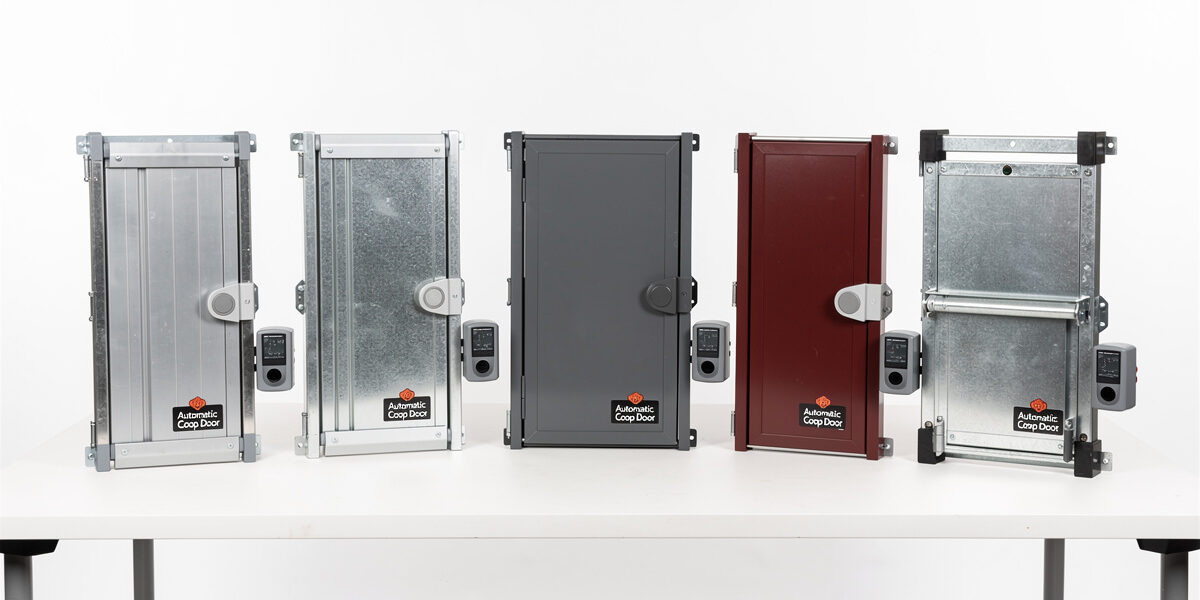
Compare 7 automatic chicken coop doors side by side — motor types, sensors, safety features, solar options, and smart connectivity. Find the best model for your coop and budget.
Choosing the best automatic chicken coop door means matching motor type, sensor system, power source, and build quality to your specific coop, climate, and flock size. This comparison breaks down seven popular models across every category that matters — so you can skip the guesswork and buy the right door the first time. I have run the ChickenGuard Extreme, the Run Chicken T50, and the Omlet Autodoor side by side on my own coop through full Nordic years, so where I have first-hand time on a door I say so.
As an Amazon Associate I earn from qualifying purchases.
What Makes a Chicken Coop Door “Best”
Marketing claims are easy. Reliability data is hard. The best automatic chicken coop door is the one that opens every morning and closes every evening for years without failure, regardless of weather, power conditions, or user error. That requires a combination of mechanical durability, smart sensor logic, adequate power management, and genuine safety features — because predation remains the single biggest killer of backyard flocks, and a door is only as good as its worst night (eXtension Poultry).
Every model in this comparison was evaluated against five core criteria:
| Criteria | Why It Matters | Weight |
|---|---|---|
| Reliability | A door that fails once can cost you an entire flock | 30% |
| Safety features | Anti-crush detection prevents chicken injuries | 25% |
| Weather resistance | Outdoor electronics must survive rain, frost, and heat | 20% |
| Ease of installation | Most keepers install themselves without electricians | 15% |
| Value for money | Price relative to features and expected lifespan | 10% |
7 Automatic Chicken Coop Doors Compared
1. ChickenGuard Standard
The ChickenGuard Standard is the entry point for the ChickenGuard range and one of the most widely sold automatic doors worldwide. It uses a string-lift motor with a lightweight aluminum door panel and offers both light sensor and timer modes.
What works well: Setup takes under 20 minutes. The interface is a simple three-button LCD panel — no app required, no Wi-Fi to configure. Battery life reaches 6 months on 4×AA batteries in moderate climates. The light sensor has adjustable sensitivity, handling most environments without false triggers.
What falls short: The string-lift mechanism is the weakest link. String replacement every 12 months is expected maintenance. The aluminum door panel is thin (1 mm) and offers minimal insulation or predator resistance — raccoons are strong and dexterous enough to bend or pry at light-gauge material the same way they defeat under-spec hardware cloth (Garden Betty). No anti-crush detection on the Standard model.
Best for: Budget-conscious keepers with small flocks (3-6 birds) in moderate climates who want simple, reliable operation without smartphone features. Check current price on Amazon →
2. ChickenGuard Extreme
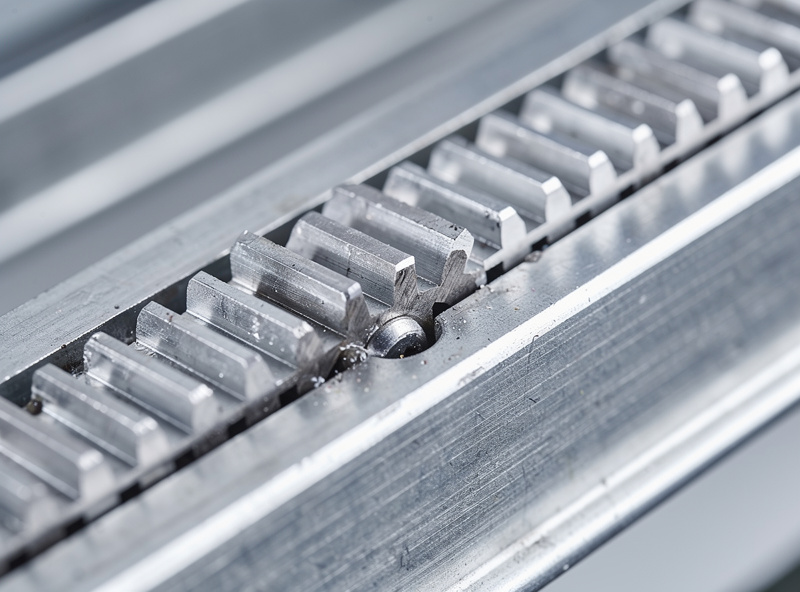
The upgraded ChickenGuard Extreme addresses the Standard’s main weakness with a rack-and-pinion drive system instead of string lift. The motor is significantly stronger, and the mechanism eliminates the string-replacement maintenance cycle entirely.
What works well: The rack-and-pinion system is robust — no string to fray, no spool to jam. Motor torque handles heavier door panels and still operates smoothly in freezing conditions where string-lift systems struggle. Includes both timer and light sensor modes with the same intuitive LCD interface. Weather sealing is improved over the Standard with a better-enclosed motor housing.
What falls short: Still no anti-crush detection. Price is roughly double the Standard, which is hard to justify for the mechanism upgrade alone. Battery consumption is higher due to the stronger motor — expect 4-5 months on 4×AA rather than 6. No smart/app features.
Best for: Keepers who want mechanical reliability without smart features, especially in colder climates where string mechanisms freeze. Check current price on Amazon →
3. Omlet Autodoor
Designed specifically for Omlet’s Eglu coop range but also retrofittable to wooden coops, the Omlet Autodoor features a horizontal sliding mechanism rather than vertical lift. This unique approach eliminates the need for clearance above the pop hole.
What works well: The horizontal slide is mechanically simple and reliable — fewer moving parts than vertical lift systems. Integration with Omlet’s ecosystem is seamless if you already own Eglu coops. Includes light sensor with wide sensitivity range. Build quality is premium with weather-sealed electronics. Anti-crush detection is included — the motor reverses when resistance is detected.
What falls short: Requires lateral clearance equal to door width, which not all coops offer. Retrofit kits for non-Omlet coops add cost and complexity. Priced at the premium end for what is essentially a mechanical-only door (no smart features). Limited compatibility with non-standard pop hole sizes.
Best for: Omlet Eglu owners and keepers with coops that lack vertical clearance above the pop hole. Check current price on Amazon →
4. Run Chicken Model T50
The Run Chicken T50 is a full-featured door at a mid-range price point. It combines light sensor, timer, and manual override in a compact unit with an aluminum door panel and string-lift motor. The standout feature is the built-in anti-crush detection — unusual at this price.
What works well: Anti-crush detection via current sensing adds genuine safety at no premium over comparable doors without it. The programmable timer includes separate weekday/weekend schedules. Battery life is impressive — up to 10 months on 4×AA in moderate conditions, thanks to an efficient low-power controller. The door panel locks magnetically at the bottom when closed, adding predator resistance.
What falls short: String-lift mechanism has the usual maintenance requirement. Plastic housing feels less premium than metal competitors. Light sensor can false-trigger in environments with reflective surfaces (snow, white walls). No smart connectivity.
Best for: Keepers who prioritize safety features (anti-crush) on a budget, especially those with bantam breeds or young birds. Check current price on Amazon →
5. ChickenGuard ASTi
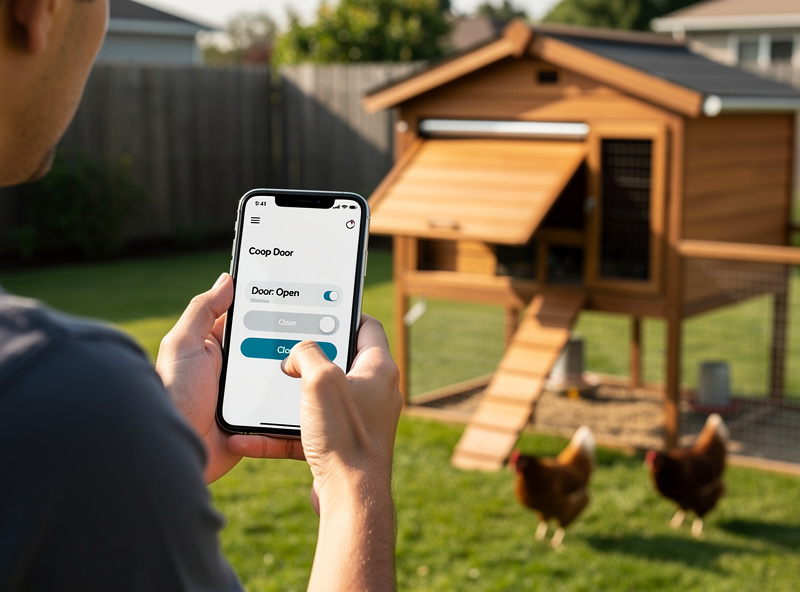
The ASTi is ChickenGuard’s premium smart model, adding Wi-Fi connectivity, app control, and programmable astronomical timing to the Extreme’s rack-and-pinion mechanism. It calculates local sunrise and sunset automatically based on GPS coordinates — no seasonal reprogramming needed.
What works well: Astronomical timing is genuinely innovative. Instead of a light sensor that can be tricked by weather or artificial light, the ASTi calculates exact sunrise and sunset for your GPS location and adjusts daily. The app provides remote open/close, schedule management, and battery level monitoring. Rack-and-pinion mechanism carries over the Extreme’s reliability. Push notifications confirm door status.
What falls short: Wi-Fi range is limited to roughly 30 meters — coops beyond this distance from your router need a Wi-Fi extender. No anti-crush detection despite the premium price. Battery life drops to 3-4 months due to Wi-Fi power consumption. The app has mixed reviews — functional but not polished. Requires 2.4GHz Wi-Fi (not 5GHz).
Best for: Tech-savvy keepers who want remote monitoring and astronomical timing without the hassle of seasonal reprogramming. Check current price on Amazon →
6. Vevor Automatic Door
Vevor’s entry targets the budget segment aggressively, offering a complete kit (motor, door panel, controller, light sensor) at roughly half the price of branded competitors. The string-lift motor and basic controller provide functional automation for keepers focused on value.
What works well: Price is the headline feature — under $40 for a complete working automatic door. Installation is straightforward with included mounting hardware. Light sensor and timer modes both included. The aluminum door panel is adequately sized for standard pop holes. A serviceable entry point for keepers testing whether automatic doors suit their setup before investing in premium models.
What falls short: Build quality reflects the price. Controller housing is not weather-sealed, requiring you to add your own protection (silicone sealant, plastic enclosure). No anti-crush detection. String quality is poor — replace immediately with braided nylon cord. Battery life is shorter (2-3 months) due to less efficient electronics. Instructions are minimal and poorly translated. Customer support is essentially non-existent.
Best for: Budget buyers, DIY tinkerers willing to improve the product, and keepers testing the concept before upgrading. Check current price on Amazon →
7. Coop Tender Solar Door
The Coop Tender combines solar power, rack-and-pinion drive, and smart connectivity in a premium package aimed at off-grid and eco-conscious keepers. The integrated solar panel charges a lithium battery that powers all operations without external power or battery replacement.
What works well: True solar independence — no batteries to replace, no wiring to run. The lithium battery holds enough charge for 14+ days without sun (cloudy stretches). Rack-and-pinion mechanism is strong and maintenance-free. Anti-crush detection included. App provides remote control and status monitoring. The aluminum door panel is 3 mm thick — substantially more predator-resistant than budget panels.
What falls short: Premium price reflects the solar hardware and smart features. The solar panel needs repositioning seasonally for optimal charging in higher latitudes. Larger footprint than battery-only doors due to integrated panel. Wi-Fi dependent for smart features — no standalone Bluetooth fallback if your internet goes down.
Best for: Off-grid coops, eco-conscious keepers, and anyone who never wants to think about batteries again. Check current price on Amazon →
Side-by-Side Comparison Table
| Model | Drive Type | Sensor | Power | Anti-Crush | Smart/App | Price Range |
|---|---|---|---|---|---|---|
| ChickenGuard Standard | String-lift | Light + timer | 4×AA battery | No | No | $60-80 |
| ChickenGuard Extreme | Rack & pinion | Light + timer | 4×AA battery | No | No | $120-150 |
| Omlet Autodoor | Horizontal slide | Light sensor | 4×AA battery | Yes | No | $100-130 |
| Run Chicken T50 | String-lift | Light + timer | 4×AA battery | Yes | No | $70-90 |
| ChickenGuard ASTi | Rack & pinion | Astro + timer | 4×AA battery | No | Yes (Wi-Fi) | $180-220 |
| Vevor Auto Door | String-lift | Light + timer | 4×AA battery | No | No | $25-40 |
| Coop Tender Solar | Rack & pinion | Light + timer | Solar + lithium | Yes | Yes (Wi-Fi) | $200-280 |
Which Door Wins for Each Situation
There is no single best door — only the best door for your specific situation. Here is the breakdown by keeper profile:
Best Overall Value: Run Chicken T50
At $70-90, the T50 delivers anti-crush detection (a $100+ feature elsewhere), dual-mode sensing, magnetic door locking, and 10-month battery life. The string-lift mechanism is its only significant compromise. For most backyard keepers with standard coops, this is the smartest purchase — it is the door I point friends to first, and the one I left mounted on my own pop door after the head-to-head.
Best Premium: Coop Tender Solar
If budget is not the primary constraint, the Coop Tender combines every desirable feature — solar power, rack-and-pinion reliability, anti-crush safety, and smart connectivity. The zero-maintenance power system justifies the premium for keepers who plan to use the door for 5+ years.
Best Budget: Vevor Automatic Door
Under $40 gets you a functional automatic door. It requires modifications (weather sealing, better string) and lacks safety features, but it opens and closes reliably. Ideal for testing the concept or equipping multiple coops affordably.
Best for Cold Climates: ChickenGuard Extreme
The rack-and-pinion mechanism handles freezing conditions where string-lift systems fail. No smart features to drain batteries faster. The robust motor operates down to -20°C without issue. Pair with lithium batteries for extreme cold.
Best Smart Door: ChickenGuard ASTi
Astronomical timing eliminates seasonal reprogramming entirely. The app provides peace of mind through remote monitoring. The rack-and-pinion mechanism is proven. Accept the shorter battery life as the cost of connectivity. Add a Wi-Fi extender if your coop is more than 30 meters from your router.
Buyer Checklist: Before You Order
Use this checklist to avoid the most common purchasing mistakes:
- Measure your pop hole: Width and height in centimeters. Standard doors fit 25-30 cm × 30-35 cm. Larger openings need adapter frames.
- Measure clearance above pop hole: Vertical slide doors need 30+ cm above the opening. If you have less, consider the Omlet Autodoor (horizontal slide).
- Check wall thickness: Most mounts handle 15-40 mm walls. Thick log-cabin walls need extended hardware.
- Assess your power situation: Grid power nearby? Solar viable? Or battery-only? This narrows your choices immediately.
- Consider your climate: Below-freezing winters? Avoid string-lift. Heavy snow? Ensure the motor can push through ice buildup.
- Count your flock: Bantam breeds and small birds need anti-crush protection. Larger flocks need wider pop holes and stronger motors.
- Check Wi-Fi range: Smart doors need connectivity. Test signal strength at your coop location before buying a Wi-Fi model.
Maintenance Schedule for Any Automatic Door
| Task | Frequency | Applies To | Time Required |
|---|---|---|---|
| Check battery voltage | Monthly | All battery models | 2 minutes |
| Clean light sensor | Monthly | Light sensor models | 1 minute |
| Lubricate tracks/rails | Quarterly | All models | 5 minutes |
| Inspect string for fraying | Monthly | String-lift only | 2 minutes |
| Replace lifting string | Annually | String-lift only | 10 minutes |
| Clean solar panel | Quarterly | Solar models only | 2 minutes |
| Check door seal/gasket | Quarterly | All models | 2 minutes |
| Test anti-crush function | Quarterly | Models with anti-crush | 1 minute |
| Update firmware/app | As available | Smart models only | 5 minutes |
Frequently Asked Questions
Which automatic chicken coop door is most reliable?
Rack-and-pinion models like the ChickenGuard Extreme and Coop Tender Solar are the most mechanically reliable because they eliminate the lifting string — the most common failure point in automatic doors. String-lift models require annual string replacement to maintain reliability. Among smart doors, the ChickenGuard ASTi’s astronomical timing avoids sensor-related false triggers entirely.
Is a solar chicken coop door worth the extra cost?
For coops without nearby power outlets, solar doors eliminate the ongoing cost and hassle of battery replacement. A solar door like the Coop Tender pays for the premium over battery models within 2-3 years through zero battery costs and zero maintenance downtime. For coops with easy access to power or batteries, the premium is harder to justify purely on economics.
Do I need anti-crush detection on my coop door?
Anti-crush detection is essential if you keep bantam breeds, young pullets, or any birds that tend to roost late. Standard automatic doors exert 2-5 kg of closing force — enough to injure small birds. The Run Chicken T50 and Coop Tender Solar both include current-sensing anti-crush at reasonable prices. If all your birds are standard-size hens with predictable roosting habits, anti-crush is less critical but still recommended.
Can I use a smart automatic door without Wi-Fi?
Smart doors like the ChickenGuard ASTi and Coop Tender Solar function as standard automatic doors (timer and light sensor) even without Wi-Fi. You lose remote control, push notifications, and app-based scheduling, but the door still opens and closes automatically. If your coop is out of Wi-Fi range, a Wi-Fi extender ($20-40) can bridge the gap.
How much does an automatic chicken coop door cost per year to run?
Battery-powered doors cost $10-30 per year in batteries (2-4 battery changes of 4×AA). Solar-powered doors cost $0 per year for power. Add $5-10 for string replacement on string-lift models. Smart doors may add $0-5 for Wi-Fi electricity usage. Total annual running cost ranges from $0 (solar, rack-and-pinion) to $40 (battery, string-lift, cold climate with frequent battery changes).
Related Articles
- How Automatic Chicken Coop Doors Work: Sensors, Motors, and Safety — understand the technology behind every model
- Automatic Chicken Coop Doors: Complete Buyer’s Guide 2026 — in-depth purchasing guide with installation tips
- How to Build a Smart Chicken Coop: The Complete 2026 Guide — integrate your door into a full smart coop system
- Automated Chicken Feeders & Waterers — the next automation upgrade after your door
- Smart Chicken Coop on a Budget: DIY Automation Under $200 — affordable automation options
Related Guides

Smart Coop Door Brand Compatibility & Failure Modes
Not every coop door brand actually plays nice with a smart-home schedule, and that’s the gap this guide fills. A…
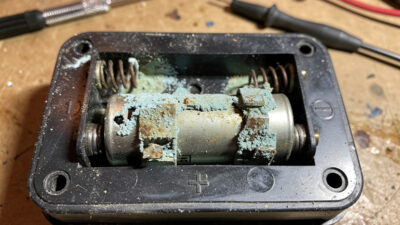
Automatic Coop Door Problems: Troubleshooting and Maintenance Guide
Fix every automatic coop door problem — dead batteries, stuck panels, sensor failures, grinding motors, and seasonal issues. Complete troubleshooting…
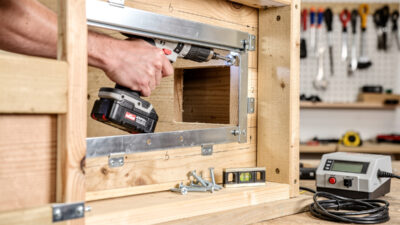
Automatic Chicken Door Openers: Installation and Setup Guide
Step-by-step guide to installing an automatic chicken door opener — tools, pop hole prep, mounting, sensor setup, testing, and troubleshooting…