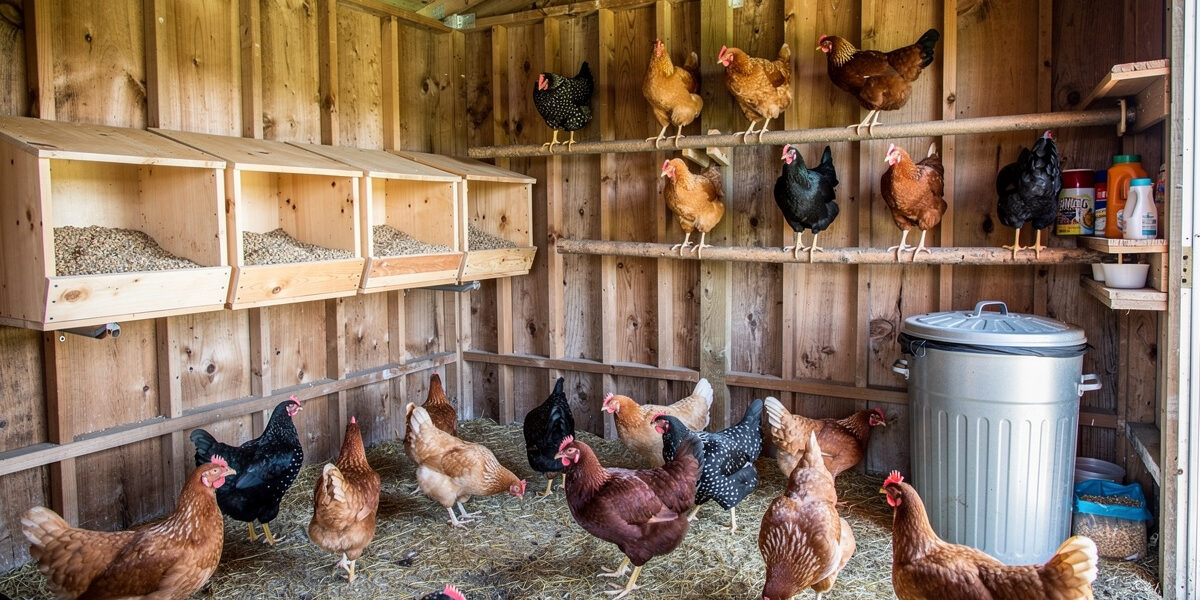
A chicken coop for 20 chickens needs 80 square feet of interior floor (an 8×10 ft footprint) plus a 200 square foot run, total 280 sq ft of yard space, consistent with university extension per-bird sq-ft guidance (Alabama Cooperative Extension). Twenty birds is the small-homestead threshold — 10 to 12 dozen eggs per week at peak, real surplus to sell or trade, and the flock size where smart automation stops being optional. Twenty hens with manual chores eats 12 to 15 hours per month; with automation that drops to 4 to 5.
This guide covers the dimensions that work for 20 birds, the three coop styles that scale to homestead size, the zoning trap that catches most 20-bird keepers, and the four mistakes that turn a 20-bird operation into a chore-time nightmare. My own flock has stayed in the 8-to-10 range in Sweden, but the automation logic at this scale is the same one I run — it just has to do more work per device. Full sizing math for smaller flocks is in our chicken coop size guide.
How Big Should a Coop for 20 Chickens Be?
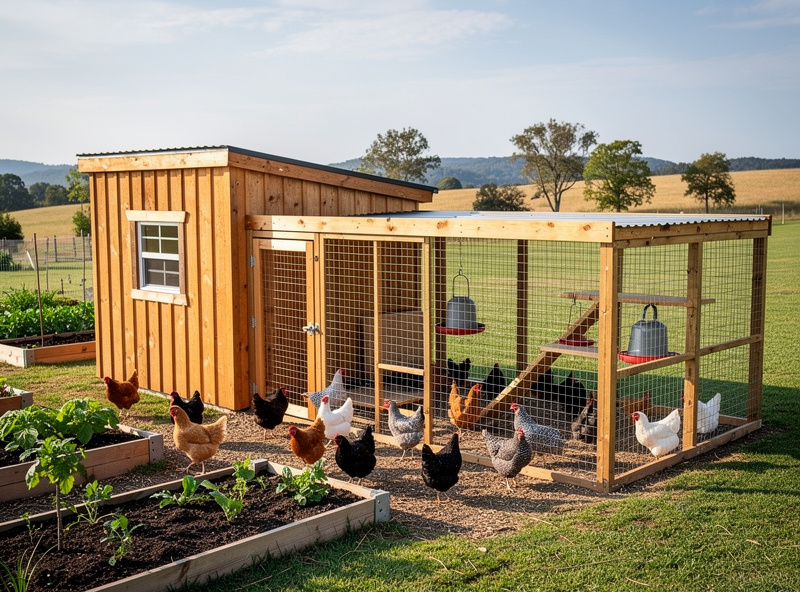
Twenty standard-breed hens need 80 square feet of coop floor (8×10 ft) plus a 200 square foot run (10×20 or 12×16 ft). For cold climates or heavy breeds, target 100 to 120 sq ft of coop and 300 sq ft of run. Heavy breeds like Brahmas at 20 birds push the math to 120 sq ft minimum and require careful roost-bar planning to prevent injuries during nightly settling.
Twenty birds is the small-homestead production threshold. At peak laying, 20 standard hens produce 120 to 144 eggs per week — roughly 10 to 12 dozen. That’s enough surplus to sell consistently at $4 to $7 per dozen at farmer’s markets or to neighbors, generating $30 to $80 per week in revenue. It’s also the size where most operations cross from “backyard flock” to “small farm” in zoning terms, which carries real legal and tax implications.
Run sizing scales with both behavioral and predator concerns at 20 birds. The 200 sq ft minimum is genuinely tight; 300 to 400 sq ft is what experienced homesteaders settle on after watching feather-pulling and hierarchy fights spike in undersized runs. A nighttime predator breach at this flock size can wipe out 10 to 15 birds in a single incident — predator-proofing investment scales accordingly.
Recommended Coop Dimensions for 20 Birds
The table below compares the three coop formats that work for a 20-bird homestead flock. Prefab walk-in coops above 80 sq ft are rare and overpriced — converted structures dominate this size class.
| Coop Footprint | Interior sq ft | Recommended Run | Best For | Approx. Cost |
|---|---|---|---|---|
| 8×10 ft converted shed | 80 | 10×20 ft (200 sq ft) | Standard breeds, suburban homestead, smart automation | $900-$2,200 (DIY conversion) |
| 10×12 ft barn corner conversion | 120 | 12×16 ft (192 sq ft) | Existing barn or pole building, heavy breeds, expansion to 30 birds | $300-$1,000 (partition + chicken door) |
| 10×14 ft prefab walk-in | 140 | 14×20 ft (280 sq ft) | Predator-heavy areas, full smart automation, no existing structure | $3,500-$6,500 |
The 8×10 converted shed is the workhorse 20-bird coop and the cheapest option that delivers proper capacity. Trade-off: 80 sq ft is the minimum, so heavy breeds or expansion plans push you to a 10×12 or larger structure. The barn corner conversion is the cheapest option if you have existing structure, but rodent pressure is 3x higher than standalone coops. The 10×14 prefab walk-in is rare and expensive — most homesteaders skip it in favor of converting a $1,500 prefab shed for half the cost.
Best Coop Styles for 20 Chickens
Three coop formats work at the 20-bird homestead scale. Prefab backyard coops do not work at this size — capacity claims above 16 birds are universally inflated.
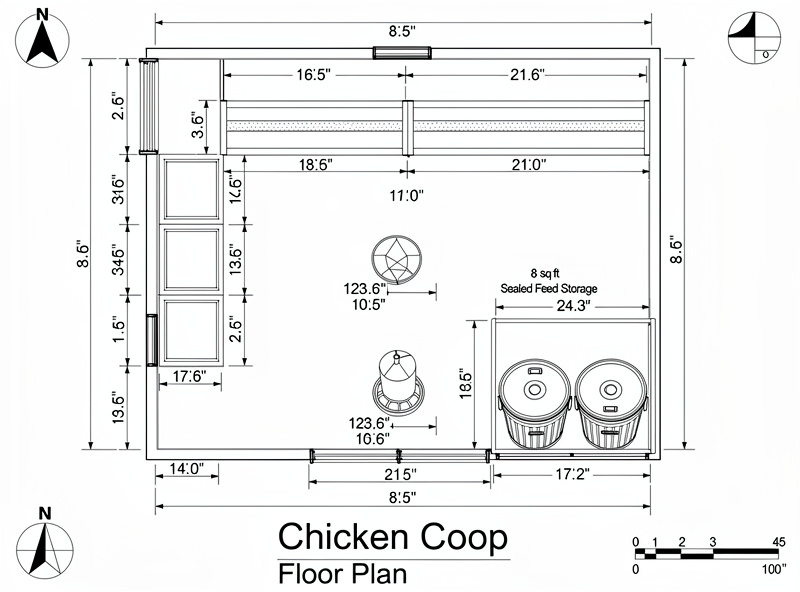
8×10 ft converted garden shed: The default 20-bird coop. Start with a $700 to $1,200 prefab shed and convert it: cut a chicken-door opening, build 4 nesting boxes from plywood scrap ($50 in materials), install a 200-inch roost bar (often as 2 parallel 100-inch bars at the same height), add 1 sq ft of high ventilation per 10 sq ft of floor, add 2 windows for daylight, and section off a 6 to 8 sq ft feed-storage corner. Total conversion under $500 in materials and 12 to 18 hours of labor. Our $200 DIY automation guide covers smart-coop additions for this build.
10×12 ft barn corner or stall conversion: The cheapest path to 20-bird capacity if you have existing structure. Section off a 10×12 corner with chicken wire and a chicken door — total cost $200 to $600 in materials. Requires aggressive feed-storage discipline (sealed metal containers, never open bags) because barn coops attract rodents at 3x the rate of standalone structures. Pair with a smart camera system for rodent detection.
Pole barn or dedicated chicken structure: For homesteaders planning to scale past 20 birds, building a dedicated 12×16 or 14×20 pole structure costs $2,500 to $5,000 in materials and delivers capacity for 30 to 50 birds. This is the long-term play if your homestead targets 12+ dozen eggs per week and you plan to keep this flock size for 10+ years.
Run Size for 20 Chickens
Two hundred square feet is the absolute minimum run for 20 birds (10 sq ft per bird). The practical target for behavioral health and predator-buffer space is 300 to 400 sq ft (15 to 20 sq ft per bird). At this flock size, run subdivision starts to make sense — splitting 400 sq ft into two 200 sq ft sections with an internal gate lets you rotate use and rest one half while the other recovers.
Run shape matters dramatically at 20 birds. A long 5×60 ft or 8×40 ft run prevents the dominance fights that emerge as flock size grows. Square runs (10×20 or 14×14 ft) work, but only with intentional visual barriers — small bushes, perch platforms, dust bath stations — every 6 to 8 feet to break sight lines. Twenty birds naturally form 2 to 3 sub-flocks within the larger group; run zones support that natural segregation.
Predator-proofing is non-negotiable at this scale because losses compound fast. A 20-bird flock generates more noise, more visibility, and more attraction than smaller flocks. Hardware cloth (1/2 inch mesh) on all sides plus a 24-inch buried apron (deeper than the standard 18-inch for smaller flocks) is the standard (Garden Betty). Cover at least 70 percent of the run with hawk netting or solid roofing. Pair with an automatic coop door set to close 30 minutes before sunset so the entire flock self-secures inside the coop overnight.
Nesting Boxes and Roost Bars for 20 Birds
Twenty hens need 4 to 5 nesting boxes (1 box per 4 to 5 hens) and 200 inches of roost bar length (10 inches per standard bird). Standard layout: 4 boxes mounted in a horizontal row on one wall, 200 inches of roost bar split across 2 parallel bars at the SAME height (never staggered) to prevent dominance fights for the top spot.
Four boxes is the right number for 20 hens — adding a 5th rarely changes laying behavior because hens crowd into 2 favorite boxes regardless. The exception: large mixed-breed flocks with both bantams and standards benefit from a 5th box mounted lower (12 to 14 inches off the floor) for the bantams. Mixed-height nesting helps subordinate birds avoid being blocked from preferred spots by dominant hens.
Roost bar planning is the single most important interior decision at 20 birds. Stacked roosts at different heights trigger nightly dominance fights for the top spot — at 20 birds, those fights cause real injuries because the bottom of the pecking order has nowhere to go. Use 2 parallel bars at the same height (18 to 24 inches off the floor), separated by 18 to 24 inches of horizontal space. That gives subordinate birds room to land and settle without invading the dominant bird’s perch zone.
Smart Setup for a 20-Bird Coop: Automation Becomes Essential
Twenty birds is where smart-coop automation crosses from “nice to have” to “essential.” Manual chores at this flock size eat 12 to 15 hours per month — feed refills, water changes, daily door duty, weekly bedding turnover. A $600 to $900 smart automation stack drops that to 4 to 5 hours per month, paying back within 8 to 12 months in time savings alone, before counting feed efficiency and predator-loss prevention.
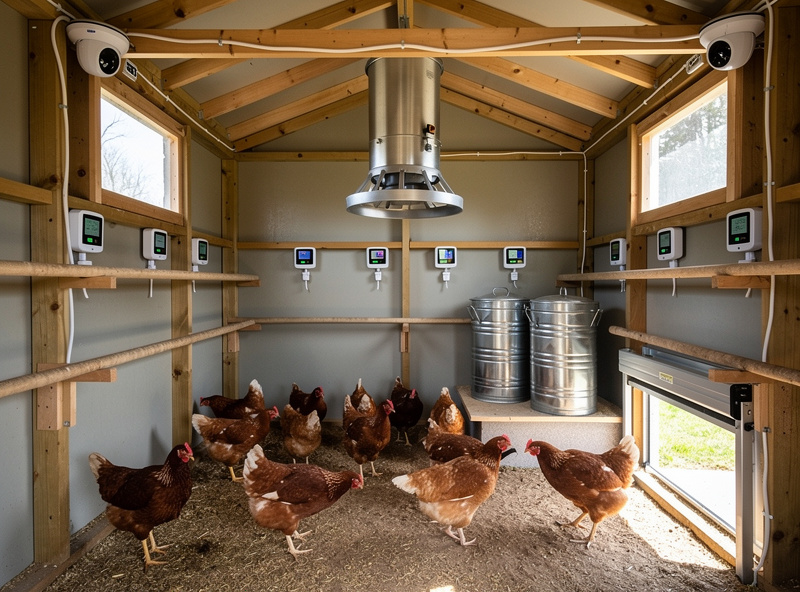
Multi-zone sensor coverage: An 80 to 120 sq ft coop needs 2 PIR motion sensors at opposite corners for full coverage, plus separate temperature, humidity, and ammonia sensors. Mount the temperature sensor at roost height (18 to 24 inches up) where the birds actually live, and a second temperature sensor at the feed-storage area to flag overheating that attracts pests. The ammonia sensor at floor level near the droppings zone is mandatory at 20 birds — daily droppings volume crosses the danger threshold within 4 to 6 days of bedding age.
Camera placement: Two 1080p cameras at opposite corners cover an 80 sq ft coop floor with overlap. For 120+ sq ft barn conversions, use 3 cameras to cover the full footprint. Position so the nesting box bank and both roost bars are visible. See our smart coop monitoring guide for camera and sensor selection details.
Bulk feed storage and automated feeding: At 20 birds, you go through 50 pounds of layer feed every 11 to 14 days. The math says 100 pounds in rotation (one bag in use, one bag spare). Allocate 8 sq ft of dedicated sealed feed storage inside the coop or attached structure — galvanized trash cans with clamp lids handle 50 lbs each. Wall-mount a high-capacity automatic feeder (10 to 15 lb capacity) and a 5-gallon heated waterer on raised platforms. The full retrofit math is in our smart chicken coop pillar guide.
Common Mistakes Sizing for 20 Chickens
Four mistakes account for nearly every “should have planned bigger” or “should have automated sooner” rebuild request at the 20-bird homestead scale.
Mistake 1 — buying a prefab walk-in “rated for 20”: Prefab walk-ins above 80 sq ft are rare, expensive, and almost universally over-rated for capacity. A 6×10 prefab “rated for 20” is 60 sq ft, which fits 15 birds at proper density. Always do the math: usable interior sq ft divided by 4 = realistic standard-breed bird capacity.
Mistake 2 — skipping zoning verification: Most US municipalities classify operations with more than 12 hens as “small farm” or “agricultural use,” which carries setback requirements, sometimes neighbor-notification rules, and occasionally property-tax implications. A $30 call to your local zoning office before you order birds prevents an expensive surprise at year two. New keepers from our beginners guide often skip this step and regret it.
Mistake 3 — undersized feed storage: Twenty birds eat through 50 lbs of feed every 11 to 14 days. Storing one bag in the garage means weekly trips to the feed store and frequent stock-outs. Plan for 100 lbs in rotation (8 sq ft of sealed storage) from the start. Retrofitting feed storage later forces awkward exterior cabinets or daily driveway trips.
Mistake 4 — manual chores at 20 birds: Manual feed, water, and door duty at 20 birds eats 12 to 15 hours per month. Most homesteaders try to power through for 6 to 12 months before burning out and either downsizing the flock or building a smart-coop stack reactively. Plan automation from day one — a $600 smart stack saves $1,500 in time over 18 months and prevents the burnout cycle entirely.
Frequently Asked Questions
What size coop do I need for 20 chickens?
Twenty standard-breed chickens need an 8×10 ft coop (80 square feet) plus a 10×20 ft run (200 square feet) at minimum. For cold climates, heavy breeds, or expansion to 30 birds, upgrade to a 10×12 ft barn conversion or a 12×16 ft pole structure with a 14×20 ft run.
Can 20 chickens fit in a 6×8 coop?
No. A 6×8 coop is 48 square feet, which fits 12 standard-breed hens at proper density. Putting 20 birds in that space is a reliable trigger for stress-related drops in egg production and severe feather pecking. The minimum for 20 standard chickens is 80 square feet (8×10 ft).
How many nesting boxes for 20 chickens?
Four to five nesting boxes is correct for 20 hens (one box per 4 to 5 hens). Boxes should be 12x12x12 inches, mounted in a horizontal row in the darkest corner of the coop. Mixed-breed flocks with bantams benefit from one lower box at 12 to 14 inches off the floor.
How big should the run be for 20 chickens?
Two hundred square feet is the absolute minimum for 20 birds (10 sq ft per bird). Target 300 to 400 sq ft for behavioral health and predator-buffer space. Run shape matters: a long 5×60 ft or 8×40 ft run beats a 10×20 ft rectangle for behavior. Free-ranging hens 2 to 4 hours daily lets you shrink the run to 160 sq ft.
Is 20 chickens a small farm?
In most US municipalities, yes. Twenty hens typically crosses the threshold from “backyard flock” to “small farm” or “agricultural use” classification, which can trigger zoning setbacks, neighbor-notification requirements, and occasionally property-tax implications. Verify with your local zoning office before committing to 20 birds.
How much feed does 20 chickens eat per month?
Twenty standard-breed laying hens consume roughly 100 to 120 pounds of layer feed per month (5 to 6 ounces per bird per day). That works out to 50 lbs every 11 to 14 days. Plan for 100 lbs in rotation (one bag in use, one bag spare) and 8 sq ft of sealed feed storage to prevent rodent issues.
Bottom Line: Twenty Birds is a Small Homestead, Plan Accordingly
Picking the right chicken coop for 20 chickens means treating the operation as a small homestead, not an oversized backyard flock. The math — 80 sq ft coop, 200 sq ft run, 4 to 5 nesting boxes, 200 inches of roost bar split across 2 parallel bars — is the easy part. The harder decisions are zoning verification, feed-storage planning, and committing to smart automation from day one. The 8×10 converted shed delivers the best value at this scale; barn corner conversion is cheaper if you have the structure available.
For sizing math at smaller flocks, see our chicken coop size guide, the 12-chicken coop guide, or the smaller 10-chicken coop guide.
Related Guides
Related Guides
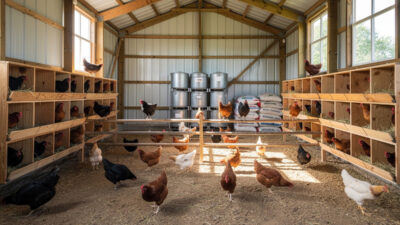
Large Chicken Coops: 25+ Bird Capacity Compared (2026)
A large chicken coop is anything sized for 25 or more birds — typically 100 to 250+ square feet of…
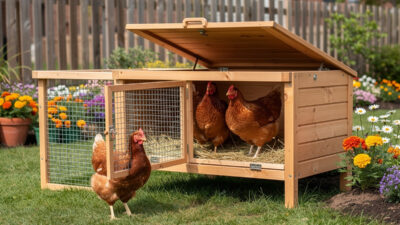
Small Chicken Coops: Best Picks for 2-4 Birds (2026)
A small chicken coop is anything sized for 2 to 4 birds — typically 8 to 16 square feet of…
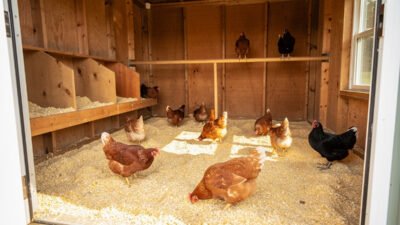
Chicken Coop for 12 Chickens: Best Family-Flock Picks
A chicken coop for 12 chickens needs 48 square feet of interior floor (a 6×8 ft footprint) plus a 120…