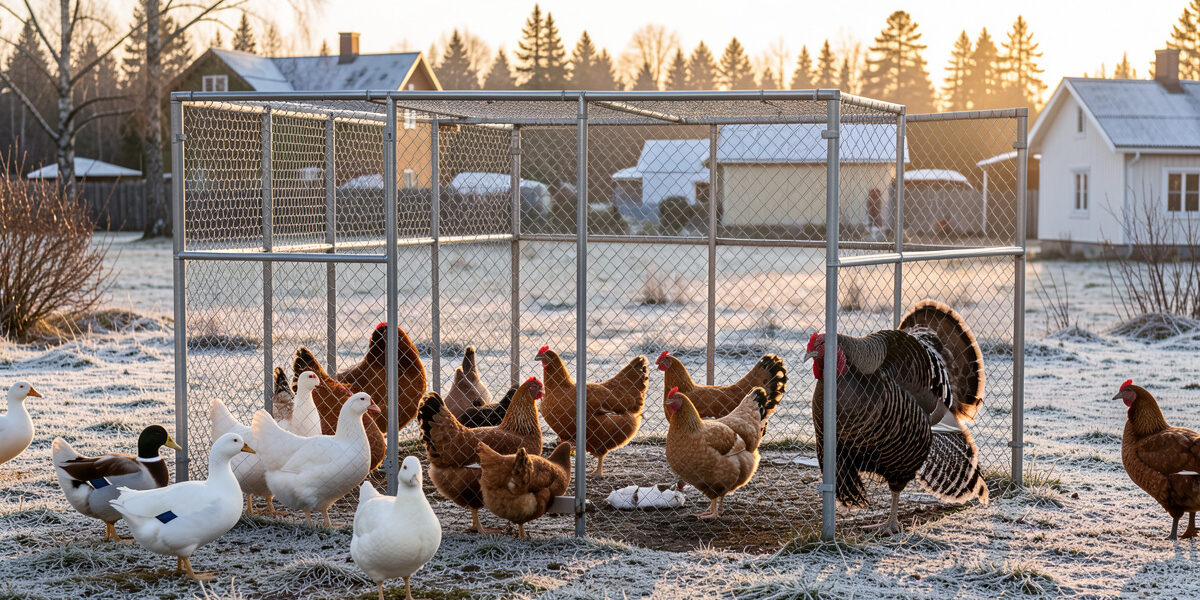
Ducks, quail, guinea fowl, and turkeys alongside chickens, from a keeper who runs a cold-climate flock.
A backyard poultry guide that stops at chickens is half a guide. Ducks lay through a Swedish winter when my hens slow down, quail give eggs in a hutch the size of a bookshelf, guinea fowl clear ticks off the run, and a heritage turkey turns a corner of the yard into a project. Across the birds I keep and the ones I have run alongside the flock, the system is the same: housing, predator-proofing, and automation, just sized to a different tenant.
I came to this the way I come to everything in the workshop — the welder built the run frame, the 3D printer made the brackets, and Home Assistant runs the door on a sunrise offset. Once that machine exists, adding ducks or quail to it is mostly a question of mesh size, waterer type, and floor space, not a brand-new build. This guide walks through every species I would actually recommend for a backyard, what each one demands that a chicken does not, and how to fold them into one cold-hardy, predator-proof setup.
Why Keepers Look Beyond Chickens
Chickens are the obvious first flock, but they are not always the best answer. Ducks out-lay many hens in cold, wet weather and shrug off mud that turns a chicken run miserable. Quail reach point of lay at six to eight weeks and fit where no coop will. Guinea fowl earn their keep eating ticks and sounding the alarm before my cameras even catch the fox. Each species solves a problem chickens create or cannot touch.
The trap is treating them as interchangeable. They are not. A duck needs water it can dunk its whole head in or it develops eye and sinus problems; a chicken needs that water kept off the bedding. Quail will fly straight up into a hard roof and break their necks if you house them like bantams. Turkeys outgrow a chicken-sized roost in weeks. The skill is matching the bird to housing you can build and maintain — and that is what the rest of this guide is about. If you are still deciding on chickens themselves, start with my best backyard chicken breeds and cold-hardy breed picks first.
The Backyard Poultry Lineup at a Glance
Before the deep dives, here is the honest comparison I wish someone had handed me before I started adding species. These figures are the ones I plan housing and feed around — space per bird, eggs per year, cold-hardiness, and the one thing each species needs that chickens do not.
| Species | Eggs / year | Min. space per bird (coop) | Cold-hardiness | The non-chicken demand |
|---|---|---|---|---|
| Laying ducks (Khaki Campbell / Welsh Harlequin) | 250–320 | 4 sq ft floor, no roost needed | Excellent (waterproof feathers) | Open water deep enough to submerge the head |
| Coturnix quail | 250–300 | 1 sq ft floor each | Good with a draft-free, low hutch | Padded or low roof — they flush vertically |
| Guinea fowl | 60–100 (seasonal) | 3–4 sq ft, high roosts | Good once acclimated; hate snow underfoot | Range to forage; very loud |
| Heritage turkeys | 50–100 (seasonal) | 8–10 sq ft, sturdy low roost | Good; large combs/snoods risk frostbite | Far more space and roost strength |
| Laying chickens (reference) | 200–280 | 4 sq ft floor + roost | Good with small-comb breeds | — |
Notice what the table does not say: it does not say one species is best. It says each trades something. Quail give you the most eggs per square foot but no meat to speak of and a short laying life. Guinea fowl give you pest control and an alarm system but few eggs and a noise complaint waiting to happen. Read the demand column twice before you buy birds — that column is where new keepers get hurt.
Ducks: The Wet-Weather, Cold-Climate Workhorse
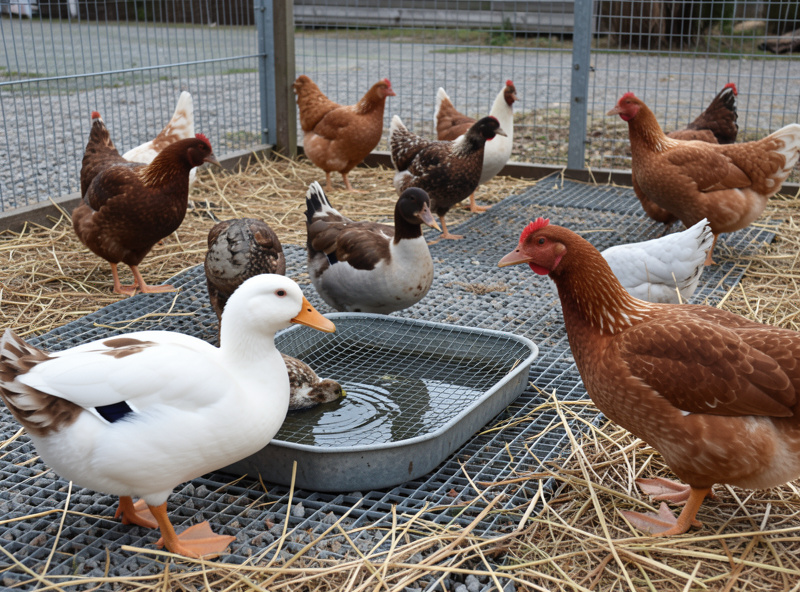
If I had to add one non-chicken species to a backyard, it would be ducks. The laying breeds — Khaki Campbell, Welsh Harlequin, Runner — out-produce most hens, lay larger eggs prized for baking, and keep going in cold and wet that drops chicken laying off a cliff. Their feathers are genuinely waterproof, so a Swedish drizzle that has my hens sulking under the coop has the ducks out working the yard.
What ducks demand is water management. They need water deep enough to submerge their heads to clear their nostrils and eyes, but they will turn any open water into mud and foul it within hours. My answer is a tucked-away dunk station on a gravel-and-drain pad, refilled by an automated valve, away from the bedding. Ducks do not roost — they sleep on the floor — so they need clean, dry, deep bedding more than perches. I run the same deep litter method for them, just turned more often near the water. For the full setup, see my raising backyard ducks guide, and if you are choosing between the two birds, the ducks vs chickens comparison lays out the real trade-offs side by side.
Quail: Eggs From a Footprint the Size of a Bookshelf
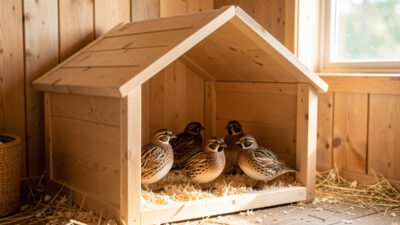
Coturnix quail are the answer for keepers with no room or no permission for a coop. A covered hutch on a balcony or in a shed corner, roughly one square foot per bird, produces 250 to 300 eggs a year per hen, and the birds reach point of lay at six to eight weeks — faster than any chicken. Five quail eggs roughly equal one chicken egg, and they are a genuine delicacy.
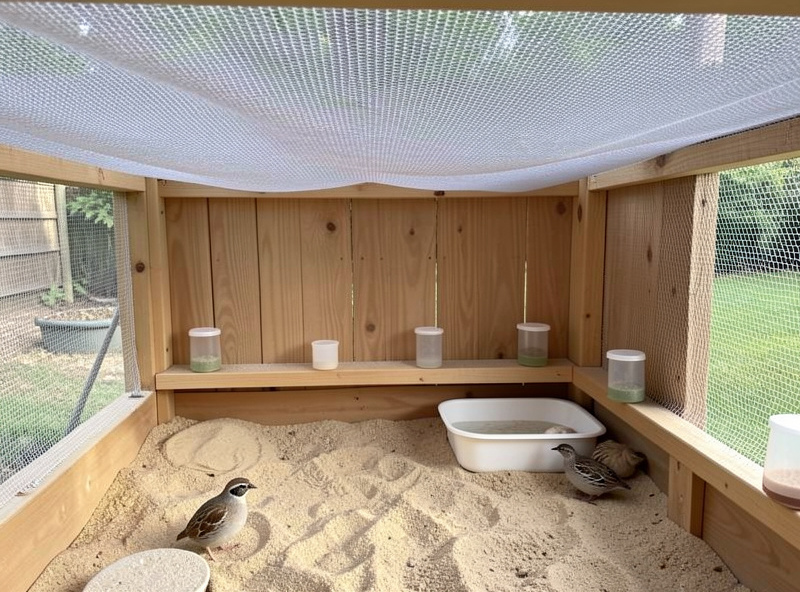
The catch is housing geometry. Quail flush straight up when startled, and a hard roof at standard height means broken necks. I keep mine in a low hutch, under about 18 inches of headroom or with a soft mesh ceiling, so a panicked bird never builds up speed. They also need fine mesh — half-inch hardware cloth will let a chick through and a weasel in, so quail get quarter-inch cloth. Wire floors with a droppings tray keep them clean, but I add a sand-filled corner for dust bathing. Full housing, feed, and incubation details are in my backyard quail for eggs guide.
Guinea Fowl: Pest Patrol and Living Alarm System
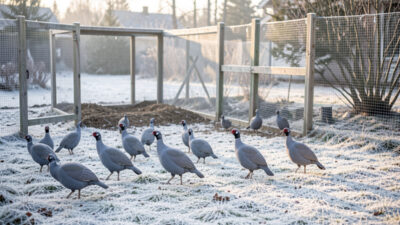
Guinea fowl are not pets and they are not quiet, but they are the best tick and insect control I have ever put in a yard. A small flock ranges all day eating ticks, beetles, and grasshoppers without scratching up garden beds the way chickens do, and they sound a deafening alarm at anything new — including the hawk overhead long before my coop cameras register it. Several keepers credit a guinea flock with clearing a tick problem off a property in a single season.
The trade-offs are real. They are loud enough to start a feud with neighbors, they prefer to roost in trees unless trained young to a coop, and they are flighty and semi-wild compared to chickens. I keep mine penned with the flock for the first weeks so they imprint on the coop as home, then let them range. They tolerate cold but hate walking on snow, so a cleared, bedded run matters in winter. My full guinea fowl pest control guide covers keets, coop training, and keeping the peace with the neighbors.
Heritage Turkeys: The Big-Bird Backyard Project
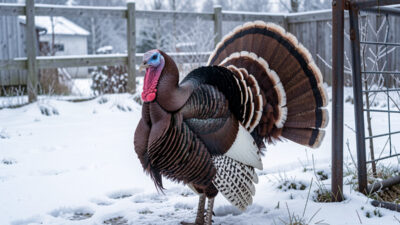
Heritage turkeys — Bourbon Red, Narragansett, Royal Palm — are a different scale of commitment, and that is the appeal. Unlike the broad-breasted commercial birds that cannot breed naturally or live long, heritage turkeys forage, fly to a roost, breed on their own, and can live for years as standout characters in a mixed yard. They need eight to ten square feet of coop space each and a low, sturdy roost that will not collapse under a 20-pound bird.
In a cold climate, the watch-point is the head: a turkey’s large snood and caruncles are exposed skin that frostbites, so the same dry, well-ventilated housing logic that protects chicken combs applies double here. Turkeys are also susceptible to blackhead disease (histomoniasis), which is why many keepers are cautious about running them with chickens — I cover that risk honestly in the raising heritage turkeys guide and again in the mixed-flock section below. This is general husbandry; for a sick bird, see an avian vet.
Running a Mixed Poultry Flock
The dream is one yard, one run, every species coexisting. It is achievable, but it is the advanced move, not the starting point. The biggest issues are health (the turkey-chicken blackhead risk), water (ducks foul what chickens must keep dry), and space and temperament conflicts at feeders and roosts. I run ducks and chickens together successfully by separating the water zones; I keep turkeys and quail on their own.
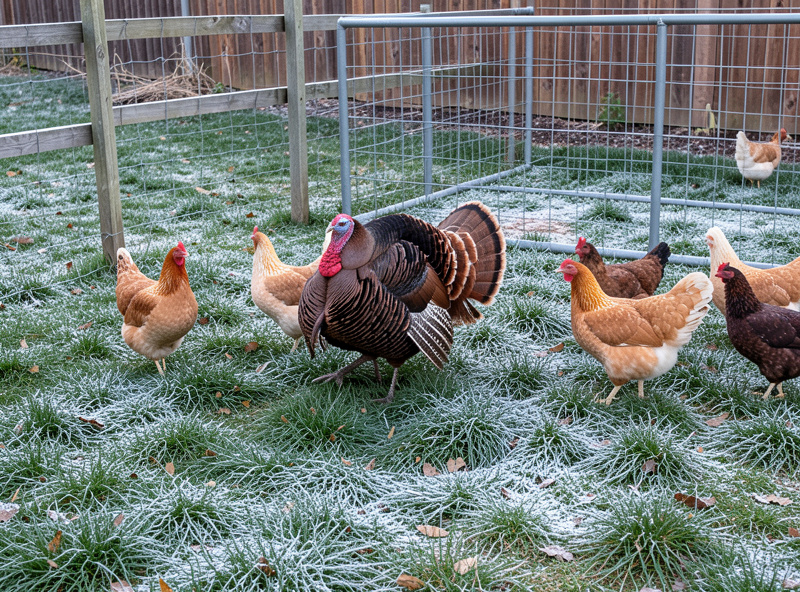
If you want to combine species, plan it deliberately: match the mesh to the smallest bird, give separate water stations, provide more feeder space than the bird count suggests to cut squabbling, and quarantine new birds before introduction. My mixed poultry flock guide walks through which combinations actually work and which ones I would never put in the same run.
Housing, Predators, and Automation Across Every Species
Here is the part that does not change no matter what bird you keep: the structure has to keep predators out and moisture under control, and the boring jobs should be automated. Every species above gets the same non-negotiables — hardware cloth, never chicken wire, a buried dig apron, and latches a raccoon-class predator cannot work. The mesh size shrinks for quail (quarter-inch) and the run height grows for guinea fowl, but the principle is identical.
Ventilation is the other constant. Moisture, not cold, is what frostbites a comb or a snood, so the coop needs passive ridge-and-soffit airflow that dumps humidity without drafting the birds — the same math I lay out in the coop ventilation guide. On the automation side, the automatic door runs on a sunrise/sunset schedule in Home Assistant for every species (ducks just need a slightly larger opening), and automated feeders and waterers handle the daily grind. For predator strategy as a whole, the predator-proof coop guide applies to all poultry, not just chickens.
Feeding a Multi-Species Backyard Flock
Different poultry have different protein and calcium needs, and getting this wrong is the quiet mistake. Quail need a high-protein game-bird feed around 24 to 28 percent; laying ducks and hens do well on a layer feed near 16 to 18 percent with calcium on the side; growing turkeys need higher protein than chickens for their first months. In a mixed flock I feed a flock-raiser-style ration that suits most birds and offer free-choice oyster shell so layers self-regulate calcium, rather than forcing a single layer feed on everyone.
Niacin is the duck-specific gotcha: ducklings need more niacin than chick starter provides, or their legs develop poorly. I supplement accordingly. For the chicken baseline that the rest builds on, see my complete chicken feeding guide. And whatever you feed, the bedding and manure all feed back into the coop-to-compost cycle that closes the loop with the garden.
Cold-Climate Reality for Non-Chicken Poultry
Everything I keep has to survive a Nordic winter, and the species behave differently in it. Ducks are the easiest — waterproof and cold-loving — as long as their water does not freeze solid and they have dry bedding to sleep on. Quail handle cold in a draft-free hutch but their small bodies lose heat fast, so wind protection matters more than heat. Guinea fowl tolerate cold air but refuse to walk on snow, so a cleared, bedded run keeps them from sulking indoors and going off-lay. Turkeys are hardy but their exposed head skin is the frostbite risk.
The universal winter rule is the heated waterer. A waterer that freezes solid by 7 a.m. is the failure that actually kills backyard birds in winter, far more than the cold itself. I run thermostatically heated waterers on a freeze-watch automation across every species, the same way I cover for winter egg laying in the hens. Whatever you keep, plan the water before you plan anything else — that is the line between a flock that thrives in January and one that just survives it.
How to Choose Your First Non-Chicken Bird
If you are standing in the yard trying to decide, work backward from your actual constraint. Tight on space or renting? Quail — they lay heavily in a footprint smaller than most balconies and reach point of lay before a chick is even feathered. Wet, cold climate and you want eggs? Ducks, every time, for their waterproof feathers and cold laying. A tick or insect problem on acreage with tolerant neighbors? Guinea fowl. Want a project bird with presence and you have the room? A heritage turkey or two.
Then sanity-check against three things before you buy: the space figures in the table above, your local rules (some municipalities allow hens but ban roosters, and a guinea fowl flock can run afoul of noise ordinances), and your willingness to manage the species’ one non-negotiable demand — duck water, quail headroom, guinea noise, turkey space. New keepers fail by buying the bird they find charming rather than the one that fits the setup they can actually build and maintain. Match the bird to the system, not the other way around, and the rest gets easy.
Sourcing Your Birds and the First Two Weeks
Where the birds come from shapes the first month more than any gear you buy. Hatchery day-olds ship well for chicks and ducklings but arrive stressed and chilled, so I want the brooder already at temperature before the box lands, not after. Local pickup of started birds skips the shipping risk and lets you see the flock you are buying, which is how I source point-of-lay pullets and most of my ducks. Straight-run is cheaper but a coin-flip on sex, and a yard that bans roosters cannot afford a 50/50 gamble — pay for sexed birds if your local rules or your neighbours leave you no room for a surprise male.
Whatever the source, every new bird goes through quarantine before it meets the flock, and on a multi-species place that matters double, because one imported bug can reach four species at once. I keep new arrivals penned well away from the established flock for two to three weeks, watching for respiratory signs, mites, scaly leg, and anything off in droppings or appetite, before they ever share air and ground. The see-but-do-not-touch step comes next: a divider or an adjacent pen so birds meet through the mesh for several days, which takes most of the violence out of integration. Rushing this is how keepers import disease and bloodied combs in a single move.
Match the brooder to the species while they settle. Ducklings and turkey poults are messier and more fragile than chicks; poults need that 24 to 28 percent game-bird protein, and ducklings need the niacin chick starter lacks. Get the sourcing and the first two weeks right and the flock that walks out into your run is healthy, sexed to your situation, and already used to the building it will spend its life in.
One System, Many Tenants: The Polymath Build
The reason I can fold five species into one yard without five separate builds is that the coop was never really about chickens — it was about building a small, cold-hardened machine that happens to have living tenants. The welder that built the chicken run frame welds a duck-height pop door or a turkey-grade roost from the same stock. The 3D printer that makes nesting-box brackets prints quail feeder guards and sensor mounts. The auto-door runs on the same Home Assistant sunrise-offset logic whether a hen or a duck walks through it.
That is the genuine advantage of treating poultry as a systems problem rather than a species problem. Every camera, temperature sensor, freeze-watch automation, and dig apron I built for the hens carries straight over to whatever I add next. Adding ducks meant a bigger water drain and a wider door; adding quail meant finer mesh and a low hutch; neither meant starting from scratch. Build the system once, build it right, and the question stops being “can I keep this bird?” and becomes “what do I want to keep next?”
Frequently Asked Questions
What is the easiest backyard poultry to keep besides chickens?
Ducks are the easiest non-chicken poultry for most keepers. Laying breeds like Khaki Campbell out-lay many hens, tolerate cold and wet better, and do not need roosts. Their one real demand is open water deep enough to submerge their heads, kept away from bedding.
Can you keep ducks, chickens, and other poultry together?
Ducks and chickens can share a run if you separate water zones, since ducks foul water that chickens need kept dry. Turkeys and chickens are riskier because of blackhead disease. Quail should be housed separately. Match mesh to the smallest bird and give extra feeder space.
Which backyard poultry lays the most eggs?
Laying ducks like Khaki Campbell and Welsh Harlequin lead at 250 to 320 eggs a year, edging out most hens. Coturnix quail lay 250 to 300 but the eggs are tiny, roughly five to one chicken egg. Guinea fowl and turkeys are seasonal layers producing far fewer.
Do guinea fowl really control ticks and pests?
Yes. A small guinea flock ranges all day eating ticks, beetles, and grasshoppers without scratching up garden beds the way chickens do, and many keepers credit them with clearing a tick problem in one season. The trade-off is significant noise and a tendency to roost in trees.
What space does each type of backyard poultry need?
Plan roughly 4 square feet of coop floor per duck, 1 square foot per quail in a low hutch, 3 to 4 square feet per guinea fowl with high roosts, and 8 to 10 square feet per heritage turkey with a sturdy low roost. Run space should be larger for every species.
Is special housing needed for quail compared to chickens?
Yes. Quail flush straight up when startled, so they need a low hutch under about 18 inches of headroom or a soft mesh ceiling to prevent neck injuries. They also need quarter-inch hardware cloth rather than the half-inch used for chickens, since they are small enough to slip through larger mesh.
Related Guides
- Raising Backyard Ducks: The Complete Keeper Guide
- Raising Backyard Quail for Eggs
- Guinea Fowl for Backyard Pest Control
- Raising Heritage Turkeys in the Backyard
- Ducks vs Chickens: Which Backyard Bird Is Right for You
- The Mixed Poultry Flock Guide
Related Guides
Raising Heritage Turkeys in the Backyard
A keeper guide to raising heritage turkey breeds in a backyard flock.
Guinea Fowl for Backyard Pest Control
How guinea fowl control ticks and pests, plus the keeping reality.
Raising Backyard Quail for Eggs
A keeper guide to raising Coturnix quail for eggs in a small footprint.