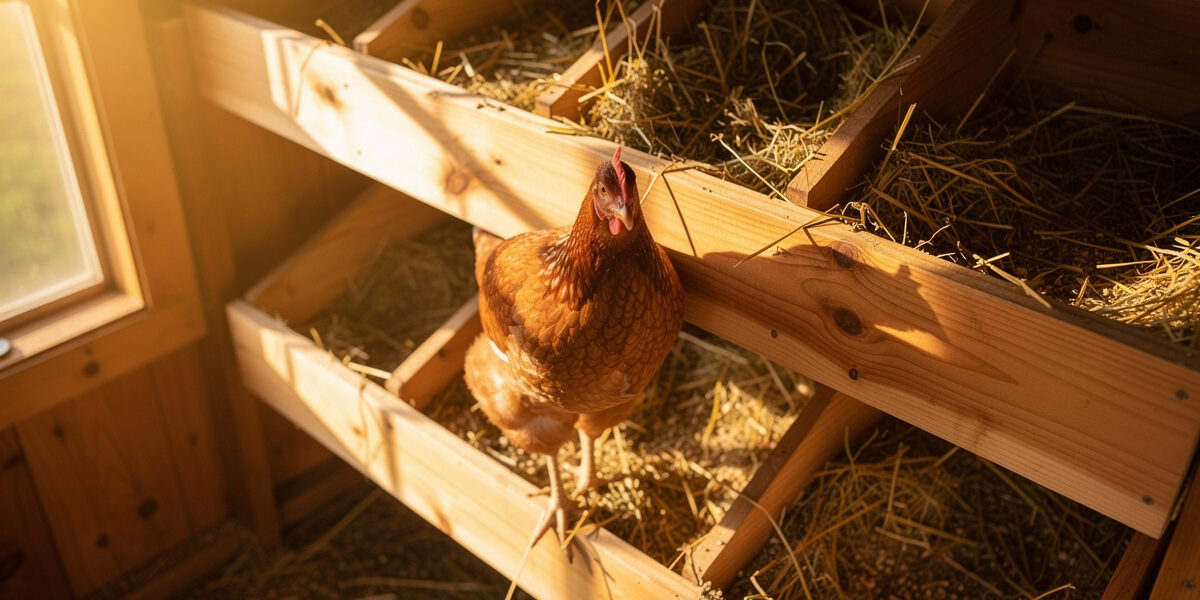
Most flocks need one nesting box per 4–5 hens, sized about 12" wide × 12" deep × 14" tall for standard breeds, mounted 18–24" off the floor, and lined with 3–4 inches of soft bedding. Get any of those wrong and hens lay on the floor, fight over boxes, or sleep (and poop) inside them.
This guide pulls together every nesting box decision a backyard keeper has to make — how many, what size, what material, where to mount them, what to put inside, and which commercial models actually hold up. It also flags the smart-coop integrations that turn nesting boxes from a passive fixture into a data source, because that is what SmartCoopHQ optimizes for. If you are building or shopping a coop right now, start with our Smart Chicken Coop Complete Guide for the full system, then come back here for the box-level detail.
How Many Nesting Boxes Per Hen
The standard ratio is 1 nesting box per 4 hens, with 5:1 acceptable for laid-back breeds and 3:1 a smart upgrade for high-production layers like Leghorns or Sex Links. Hens do not actually need their own box — the entire flock often picks one favorite and ignores the rest — but you still need redundancy so a broody hen, a sick hen, or a mid-morning peak does not block laying.
Going under-spec is the more common mistake. With only 1 box for 8 hens, you will see hens laying in corners of the run, on the coop floor, or on top of each other in the same box. Eggs get crushed, and floor eggs train the flock to lay outside the boxes for life. Going over-spec rarely hurts; extra boxes cost only material and floor space. For a deeper sizing breakdown by flock count, see Nesting Boxes For Hens: How Many You Actually Need.
Nesting Box Dimensions & Sizing
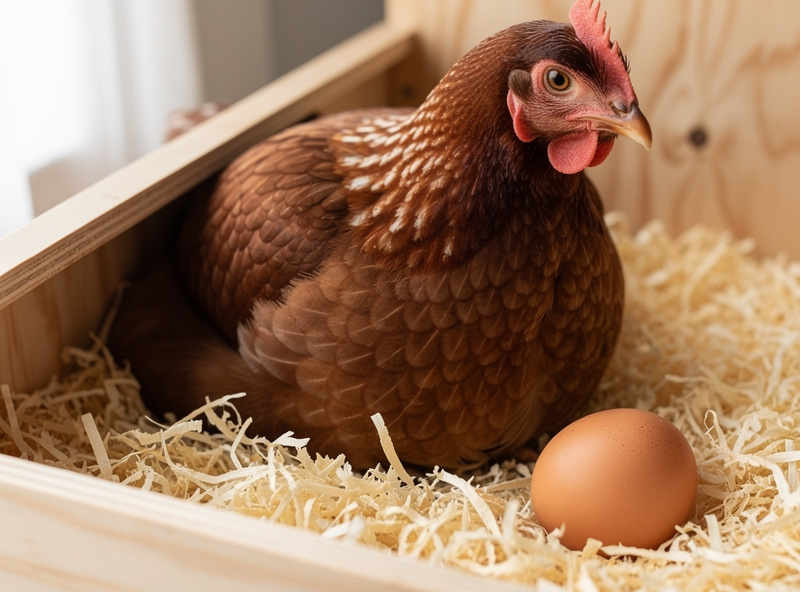
For standard breeds (Plymouth Rocks, Australorps, Orpingtons, Rhode Island Reds), each box should be 12" wide × 12" deep × 14" tall, with a 4–6" lip across the front to hold bedding in. Bantams need only 10" × 10" × 12". Heavy breeds like Jersey Giants or Brahmas need 14" × 14" × 16" minimum or hens will hang their tails out and dirty the eggs.
| Breed Class | Average Weight | Recommended Box (W × D × H) | Front Lip |
|---|---|---|---|
| Bantams (Silkie, Sebright) | 1.5–2 lb | 10" × 10" × 12" | 3" |
| Light layers (Leghorn, Ancona) | 4–5 lb | 12" × 12" × 12" | 4" |
| Standard dual-purpose (Australorp, RIR, Orpington) | 6–8 lb | 12" × 12" × 14" | 4–5" |
| Heavy breeds (Jersey Giant, Brahma, Cochin) | 9–12 lb | 14" × 14" × 16" | 5–6" |
| Mixed flock (assume largest) | — | 12" × 12" × 14" | 5" |
The single most overlooked dimension is the front lip. Without it, bedding spills every time a hen scratches in or jumps out, and you end up replacing nesting material twice as often. A removable lip (a 1"×6" board screwed into slots) lets you raise it for laying season and drop it for cleaning. If the box is part of an external lift-top section, add a 2" gap above the lip so you can sweep crumbs out without removing the lip itself.
Best Nesting Box Materials: Wood, Plastic, Metal
The three real choices are plywood, food-grade plastic (HDPE), and galvanized metal. Each has a clear use case. Wood is cheapest and easiest to modify, plastic is the easiest to disinfect, and metal lasts longest in humid climates but conducts heat in summer.
| Material | Cost (per box) | Lifespan | Mite Resistance | Ease of Cleaning | Best For |
|---|---|---|---|---|---|
| Plywood (3/4" ext-grade) | $8–$15 | 5–8 yrs | Low — wood absorbs mite bodies and feces | Moderate — needs scraping | Budget DIY, modular layouts, easy modifications |
| HDPE / food-grade plastic | $25–$60 | 10–15 yrs | High — wipes clean, no porosity | Easy — hose & disinfect | Production layers, mite-prone climates, daily cleaners |
| Galvanized metal | $30–$50 | 15–20 yrs | Medium — needs sealed seams | Easy when smooth, hard with rivets | Humid Southeast, predator-rich areas |
| Plastic milk crates (DIY) | $3–$8 | 5–7 yrs | High | Easy | Backyards under 8 hens, rapid setup |
For most backyard flocks under 12 hens, plywood with a wipe-down polyurethane finish hits the sweet spot — it’s what I run on my own coop, with 3D-printed mounting brackets holding the boxes to the wall studs instead of screwing straight through the plywood siding. Above 12 hens, the mite-cleaning advantage of plastic starts paying back its higher upfront cost — a single mite outbreak can cost more in lost eggs and treatment than the plastic price difference. For full material trade-offs at the coop level, see our Chicken Coop Materials Guide and Plastic Chicken Coops for details on HDPE durability.
Nesting Box Placement & Height
Mount the bottom of nesting boxes 18–24" above the coop floor and always lower than the lowest roost bar. Hens will sleep on the highest available perch, and if the boxes are higher than the roosts, they will sleep (and poop) in the boxes — which contaminates eggs and ruins bedding nightly.
The 18" minimum keeps boxes clear of floor bedding, droppings, and most ground predators. The 24" maximum keeps heavy or older hens from injuring themselves jumping down. For Brahmas, Cochins, and Orpingtons — heavy breeds prone to bumblefoot from hard landings — stay at the 18" end and add a small landing perch 6" below the box opening.
Position boxes on the shadiest, calmest wall of the coop. Hens want to lay in the dark, hidden corner farthest from human traffic. Boxes mounted near the door or opposite the pop door get used last. If you have an external lift-top egg-collection box, orient it on the north or east wall to keep eggs cool through the day.
Nesting Box Bedding
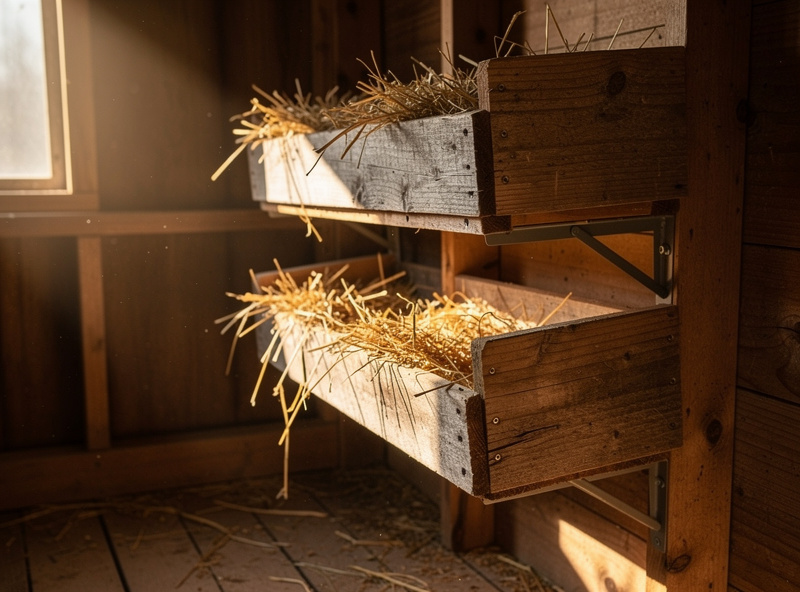
Use 3–4 inches of soft, dust-free bedding: pine shavings, straw, or hemp are all proven choices. Avoid cedar (toxic terpenes), sawdust (respiratory irritant), and hay (molds when damp). Refresh bedding when you see broken eggs, droppings, or matting — usually every 1–2 weeks for active boxes.
Nesting pads (washable rubber or paper liners) are an upgrade option for production layers. They meaningfully cushion eggs against cracking compared with bare bedding alone and let you spot-clean rather than refill. For the broader bedding decision across coop, run, and nesting, see Best Chicken Coop Bedding: Complete Material Guide.
Roll-Away vs Standard Nesting Boxes
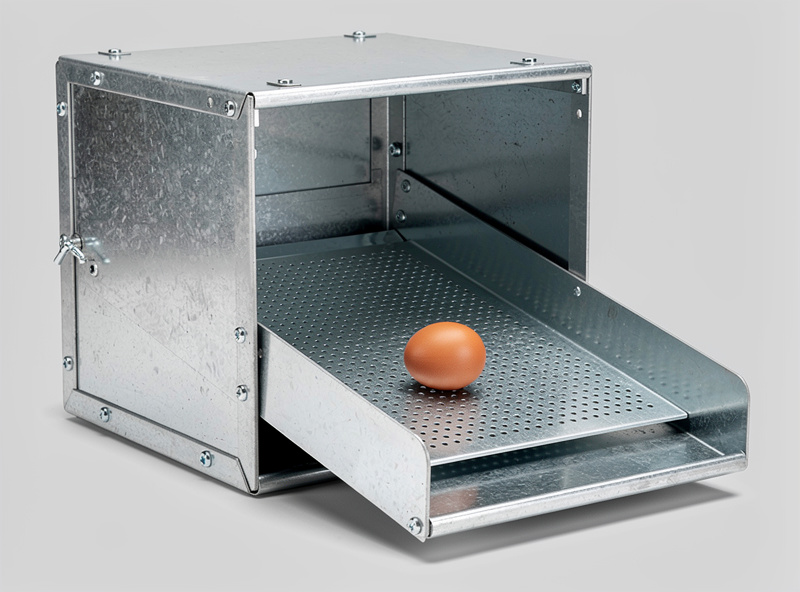
Roll-away boxes have an angled floor (typically 7–10°) that gently rolls the egg out of the hen's reach into a collection tray below. The advantages are real: egg-eating drops to near zero, eggs stay clean (no bedding contact after the first second), and broody hens cannot sit on a clutch they cannot reach.
The drawbacks are weight and ergonomics. Roll-away boxes are typically 30–50% more expensive than equivalent standard boxes, and the collection tray adds depth — which means external-access designs need a wider lift door. They also require near-perfect leveling; a box tilted the wrong way will not roll. For a side-by-side decision, see Roll-Away Nesting Boxes: Worth the Upgrade?.
Communal vs Individual Nesting Boxes
Most prefab coops sell individual divided boxes (12"-wide cubicles), but a single communal box — a long, open trough about 24" wide × 18" deep — works equally well for flocks under 8 hens and is dramatically cheaper to build. Hens in nature lay communally; the dividers are a human convention.
Where individual boxes win is in larger flocks (12+ hens) where rank squabbles can drive submissive hens away from the only box, and in roll-away systems where each box needs its own slope. For a flock of 4–8 birds with a stable pecking order, a single 2-foot communal box with one perimeter lip and 4 inches of bedding outperforms a 4-cubicle setup at half the build cost.
Privacy Curtains: Do They Help?
Nesting box curtains — usually a strip of burlap or fabric covering the front opening — claim to discourage egg-eating, reduce broody-hen disturbance, and lower stress in shy breeds. Real-world testing is mixed. For an established flock with chronic egg-eating or pecking-order bullying at the boxes, curtains help; pullets coming into lay tend to ignore them.
If you want to test curtains, install them in only half your boxes for two weeks and watch which set hens prefer. The full breakdown of when curtains earn their place is in Nesting Box Curtains: Do They Actually Help?.
Common Nesting Box Problems
Three problems account for most nesting box headaches: egg-eating, broody hens, and mites.
Egg-eating usually starts when one hen accidentally cracks a soft-shelled egg and discovers it tastes good. Once the habit is set, it spreads. Fixes (in order): add calcium (oyster shell free-choice), darken the boxes (curtains or move to shadier wall), switch to roll-away boxes, identify and isolate the culprit by candy-egg trick (blow out an egg, fill with mustard).
Broody hens sit on the box for 21+ days refusing to leave, blocking other hens and risking dehydration. If you do not want chicks, break broody behavior by lifting her off twice daily and placing her in a wire-bottom cage with no bedding — the airflow under her chest interrupts the incubation cycle, typically within 3–5 days, though some hens take longer.
Nesting box mites hide in wood crevices and feed on hens at night. Signs: pale combs, restless hens, red specks in box corners. Treatment is a deep clean (everything out, scrape, scrub with permethrin or diatomaceous earth, refresh bedding) repeated weekly for 3 weeks to kill hatching cycles.
Best Commercial Nesting Boxes 2026
If you are buying rather than building, the boxes below are the ones that consistently perform across flocks and climates. Prices reflect mid-2026 retail.
| Model | Material | Style | Capacity | Price | Best For |
|---|---|---|---|---|---|
| RentACoop 3-Compartment Roll-Out Reversible | Galvanized steel frame, reversible plastic floor | Roll-away | 10–12 hens | ~$160 | Mid-size flocks needing clean eggs |
| Hatching Time 3-Compartment (Front Collection) | ABS plastic | Standard, stackable | Up to 30 hens | ~$160 | Larger flocks, easy-clean plastic |
| Little Giant Deluxe Plastic Nesting Box | HDPE plastic | Standard, single | 4–5 hens | ~$35 | Small backyards, retrofits |
| Harris Farms 2-Hole Nesting Box | Galvanized steel | Standard | ~8 hens | ~$70 | Long-term durability |
| VEVOR 4-Compartment | Galvanized steel frame, plastic inserts | Standard | 16–20 hens | ~$78 | Budget larger flocks |
| Omlet Eglu Go Roosting Bars & Nesting Box | Plastic | Communal insert | Up to 4 hens | ~$35 | Eglu Go system owners |
Cross-reference these picks with our Best Chicken Coop Brands guide and Over EZ Chicken Coop Review — Over EZ's built-in roll-away is one of the few premium coops that ships with the roll-away system fully integrated rather than sold as an add-on.
One buying note: nearly every prefab coop on the market under $400 ships with undersized nesting boxes (typically 10" × 10" × 10") regardless of advertised flock capacity. If a coop claims to house 8 hens with a 2-box system, measure the boxes before buying — almost always you will find that the boxes themselves accommodate only 4–5 standard hens before crowding starts. Cheap Chicken Coops Under $400 covers exactly which budget models pass the box-size test.
For a separate breakdown of how nesting boxes integrate with the broader coop choice — and which prefabs to skip altogether — see Prefab Chicken Coop: 4 Tiers Compared.
DIY Nesting Box Builds
A 4-cubicle plywood box for 12–16 hens costs about $25 in materials and 90 minutes of build time: one sheet of 1/2" exterior plywood, deck screws, and a hinge for the lift-top lid. The dimensions above (12 × 12 × 14 per cubicle) translate directly to a 50"-wide × 14"-deep × 18"-tall box — small enough to mount on most coop walls without bracing.
Milk-crate retrofits work for under-8-hen flocks: line a standard 13" × 13" crate with rubber matting, zip-tie a 4" lip across the front, mount on a shelf bracket. Total cost under $5 per box. Full plans, cut lists, and photo walk-throughs are in our DIY Nesting Box Plans.
Whatever mounting method you use, don’t rely on screws straight through thin plywood siding into open air — over a season or two of hens jumping in and out, that connection works loose and the whole bank of boxes starts to sag forward. Mount into wall studs or blocking wherever possible, and if you print your own brackets (mine are 3D-printed from the same filament I use for door guide rails), oversize the screw bosses — undersized printed screw holes are the single most common point of failure I’ve seen on printed coop hardware, mine included on the first attempt.
Seasonal Nesting Box Adjustments
Boxes that work in mild spring conditions need three tweaks for the temperature extremes.
Winter (under 35°F): double the bedding depth to 5–6 inches and switch from straw to chopped pine shavings — denser bedding insulates better and resists frost compaction. Eggs collected from frozen boxes crack along the membrane within 4 hours; collect at least twice daily once your overnight low drops below 28°F. If your coop is unheated, see Solar Chicken Coop Heater Winter Guide for the heating math that keeps eggs from freezing without rotting your bedding.
Summer (over 90°F): the opposite problem — bedding gets dusty, mites breed faster, and eggs left in hot boxes start informal incubation once they sit near incubator temperatures (roughly 99-100°F) for an extended stretch. Reduce bedding to 2–3 inches for airflow, switch to hemp or sand-rich bedding that does not mat, and collect eggs morning and afternoon. Position the box on a shaded north or east wall.
Mud-season transitions: the worst time for nesting box mites is the wet weeks of early spring and late fall. Pull all bedding, scrape, and dust with diatomaceous earth before refilling with fresh material. This single 30-minute task heads off the large majority of seasonal mite outbreaks I’ve dealt with or helped neighbors through — mites establish fastest in exactly the damp, undisturbed bedding these transitions leave behind.
Cold-Climate Nesting Box Adjustments
Standard seasonal tips (deeper bedding, twice-daily collection) cover most winters, but a genuinely cold climate — the kind where overnight lows sit well below freezing for weeks at a stretch — needs a different baseline, not just a tweak to the summer setup.
On my own coop in Sweden, the nesting boxes sit on an interior wall rather than an exterior one. It sounds like a small detail, but an exterior-wall box in a −15°C stretch runs noticeably colder than the ambient coop temperature, because it is losing heat through an extra exposed face the rest of the structure does not have. Moving boxes to an interior wall, or at minimum insulating the exterior-facing side with a layer of rigid foam under the siding, keeps the bedding from developing the frozen crust that cracks eggs on contact.
Condensation is the other cold-climate trap. A tightly sealed nesting box in a humid coop collects moisture on the underside of the lid overnight, and that moisture drips onto bedding and eggs by morning. The fix is the same principle that governs the rest of coop ventilation: passive airflow above the roost line pulls moisture out before it settles, rather than sealing the whole structure and hoping for the best. A nesting box that shares airspace with a properly ventilated coop rarely has a standalone condensation problem; one that is boxed off in its own sealed compartment often does.
Heated nesting pads exist and work, but I would reach for better ventilation and an interior-wall placement before adding electrical heat to a box hens only occupy for a few minutes at a time. Heat is worth the wiring for a waterer that needs to stay liquid all day — it is a lot of complexity for a surface hens visit intermittently.
Nesting Box Layout: Single Row, Multi-Tier, or L-Shaped
Most backyard coops default to a single row of boxes along one wall, and for flocks under 10 hens that is usually the right call — it is the simplest to build, the easiest to keep level for roll-away systems, and the easiest to reach for daily collection.
Multi-tier stacking (two rows, one above the other) doubles box count per linear wall foot, which matters in a small coop footprint. The tradeoff is that the lower tier needs to clear the 18″ minimum off the floor and the upper tier needs to stay clearly below the lowest roost bar — in a short coop, those two constraints can leave very little vertical room to work with, and hens tend to favor the lower tier anyway, defeating some of the space savings.
An L-shaped or corner layout, wrapping boxes around two adjoining walls, is the option most DIY plans skip but that solves the multi-tier problem cleanly: it adds box count without stacking, keeps every box at the same height and light level, and uses corner space that is otherwise dead area in most coop layouts. It costs slightly more framing lumber than a single straight run of the same box count, but for anyone building from scratch rather than retrofitting an existing structure, it is worth drawing out both options before committing to lumber.
When to Replace Nesting Boxes
A wooden box reaches end-of-life when the grain has absorbed enough urea and droppings that scrubbing no longer removes the smell — usually 5–8 years of daily use. By then the wood is also softened enough that screws pull loose and a determined raccoon can breach the side panel. Replace, do not patch.
Plastic boxes signal end-of-life by UV-stress cracking at the seams (look for fine spider-web cracks) or surface chalking that no longer wipes clean. HDPE boxes typically last 10–15 years; if yours is fading on the south-facing side after 5, you mounted it in too much sun.
Metal boxes fail at the seams. Inspect rivets and welds annually; if any rivet shows rust bloom, the next mite outbreak will hide there and become impossible to clean. Re-seam with food-safe silicone or replace.
Camera Placement Around Nesting Boxes
If you are running PoE cameras for broody checks or predator forensics elsewhere in the coop, the nesting box wall deserves its own thinking rather than whatever angle a general coop-interior camera happens to catch.
Mount the camera to see the front lip of every box, not the boxes from directly above — an overhead angle tells you a hen is in a box but not which one, and it is the individual-box data (which hen favors which box, how long she sits, whether the same box shows repeated egg-eating) that actually earns its keep. On my own coop the nesting-wall camera sits opposite and slightly above the boxes, angled down just enough to see inside each opening without pointing straight into the lip and losing the interior to shadow.
Night-vision IR matters more here than almost anywhere else in the coop. Hens lay in the early morning, often before there is enough ambient light for a standard camera sensor, and a camera that only performs in daylight will miss the exact window you are trying to monitor. This is the same lesson from the general coop camera guidance — the cheap Wi-Fi units that perform fine in a bright test video and then go dark at 6 a.m. in November — applied specifically to the one wall where morning timing is the whole point.
If you are adding a load-cell or break-beam egg counter alongside the camera, run both sets of wiring through the same conduit pass during the build. Retrofitting a camera mount and a sensor separately, months apart, means opening the wall twice for a job that takes the same amount of time to do together.
Smart Coop Integration: Sensored Nesting Boxes
Modern smart coops use nesting boxes as data sources, not just laying spots. Three integrations are practical in 2026:
Egg counters use a load cell or IR break-beam to log every egg as it rolls (or is laid). Pair with a Home Assistant or Hubitat dashboard and you get per-day production, broody alerts, and seasonal-decline trends. This is one of the DIY sensor builds I’d point most keepers toward over a commercial unit — a load cell under the roll-away tray, wired into the same automation hub that runs the rest of the coop, costs less than most off-the-shelf options and integrates directly with whatever door and camera automations you already have. On the commercial side, AI-camera systems like The Smart Coop’s flock-monitoring app take a different approach — tracking eggs and activity through computer vision rather than a physical sensor — worth a look if you would rather not wire anything yourself.
Box-occupancy sensors (PIR or weight) tell you when a hen has been sitting more than 2 hours — a proxy for dystocia (egg-bound) or broodiness. A simple tasker rule sends a phone notification.
Climate sensors (BME280 or Zigbee Aqara) track temperature and humidity inside the box; eggs collected from boxes hotter than 95°F are likely to start incubating in summer and need pulling within 4 hours. For the full smart-coop integration stack, see our Best Smart Coop Devices Guide and Retrofit a Standard Coop into a Smart Coop.
Frequently Asked Questions
How many nesting boxes do I need for 6 hens?
Two nesting boxes is the right answer for 6 hens — one box per 3-4 hens with a small redundancy buffer. A single box leads to traffic jams during morning peak laying and risks crushed eggs. Three boxes is overkill but never hurts.
What size should a nesting box be?
For standard backyard breeds, 12 inches wide by 12 inches deep by 14 inches tall is the proven dimension. Bantams need 10x10x12, heavy breeds like Brahmas need 14x14x16. Add a 4-5 inch lip across the front to hold bedding in place.
How high should nesting boxes be off the floor?
Mount the bottom of nesting boxes 18-24 inches above the coop floor and always lower than the lowest roost bar. Higher than the roosts and hens will sleep (and poop) in the boxes; below 18 inches and floor bedding contaminates the eggs.
Should nesting boxes have a slope or be flat?
Flat boxes are standard and cheapest. Sloped (roll-away) boxes have an 8-10 degree angle that rolls eggs out of reach into a tray, eliminating egg-eating and keeping eggs cleaner. Roll-away costs 30-50% more but pays back in 6-12 months for production flocks.
Can I use a milk crate as a nesting box?
Yes — a 13×13 inch plastic milk crate makes a serviceable nesting box for under 8 hens. Line it with rubber matting, zip-tie a 4-inch lip across the front, and mount on a shelf bracket 18-24 inches off the floor. Total cost under 5 dollars per box.
Why are my hens not using the nesting boxes?
Common causes: boxes mounted higher than the roosts (hens sleep there instead), boxes placed near the door (too much traffic), bedding too thin or too dirty, mites in the box, or the boxes are simply too small. Check height, location, bedding depth, and dimensions in that order.
Nesting Box Cluster: All Our Deep-Dive Guides
This guide gives you the system-level overview. For the specific decisions you will face, the four guides below go deeper:
- Count: Nesting Boxes For Hens: How Many You Actually Need — full sizing table for flocks of 3 to 25, breed-specific ratios, and when to add or skip a box.
- Build: DIY Nesting Box Plans From $5 — five plans and upgrades from a $5 milk-crate retrofit to a $55 4-cubicle plywood bank, with cut lists, mounting hardware, and the three mistakes that ruin first builds.
- Upgrade: Roll-Away Nesting Boxes: Worth the Upgrade? — the egg-eating, cleanliness, and broody-breaking benefits, payback math for your flock size, and best 2026 commercial picks.
- Behavior: Nesting Box Curtains: Do They Actually Help? — when curtains fix bullying and shy-hen problems (and when a flock just ignores them), with a 2-week A/B test pattern.
Related Articles
- How to Build a Smart Chicken Coop: The Complete 2026 Guide
- Best Chicken Coop Bedding: Complete Material Guide
- Chicken Coop Size Guide: How Many Chickens Per Square Foot
- Best Chicken Coop Brands 2026: 10 Compared
- Best Smart Chicken Coop Devices & Automation Tools 2026
Related Guides
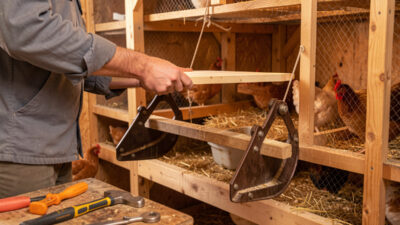
DIY Removable Roost Bars for Fast Cleaning and Mite Checks
The best roost you can build is one you can lift out in ten seconds without a tool. Removable roost…
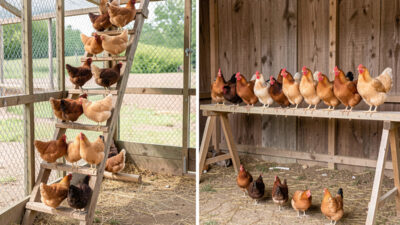
Ladder Roost vs Single-Level: Which Suits a Mixed Flock
For most mixed-size backyard flocks, a single-level roost wins. Putting every bird on one horizontal bar at the same height…
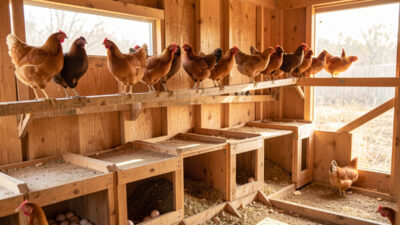
Roost Above the Nesting Box: The Height Rule for Floor Eggs
The rule is simple: the roost must sit higher than the top of your highest nesting box — ideally 6…