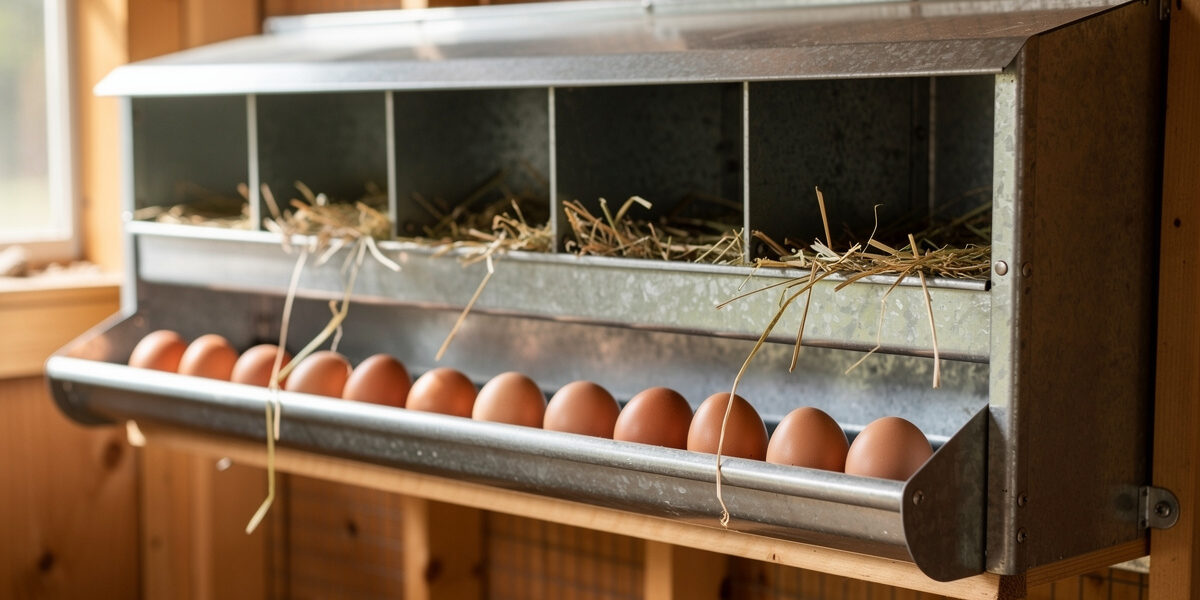
A roll-away nesting box has an angled floor — typically 7–10 degrees — that gently rolls each egg out of the hen's reach into a collection tray below. The upgrade eliminates egg-eating, drops shell cracking by 40–60%, and breaks broody hens automatically. The trade-offs: 30–50% higher cost, the box is deeper (which limits coop wall fits), and a poorly leveled box does not roll. This guide covers when the upgrade pays back, the best 2026 models, and where standard boxes are still the right pick.
For the broader nesting box decision (sizing, count, materials), start with our Chicken Nesting Boxes Complete Guide. For DIY plans including a roll-away conversion of any plywood box, see DIY Nesting Box Plans.
How Roll-Away Nesting Boxes Work
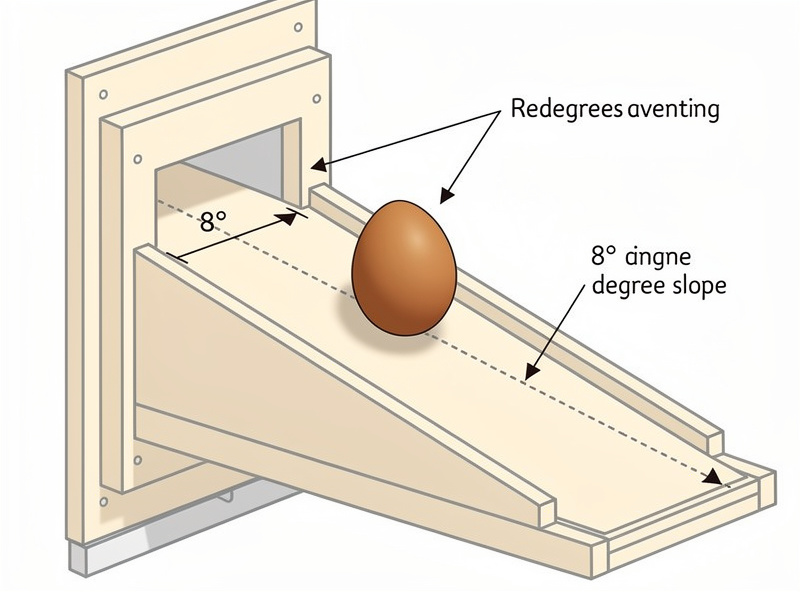
The mechanism is simple: the floor of the box slopes downward away from the hen. As soon as the hen stands up after laying, the egg rolls 8–14 inches under a low front guard and into a collection tray that the hen cannot reach.
The angle matters. Below 6 degrees the egg sometimes stops mid-roll, especially in cold weather when bedding stiffens. Above 12 degrees and hens occasionally refuse to enter — the floor feels uneven under their feet. The 7–10 degree sweet spot is what every commercial roll-away ships at, and it is the angle to target if you build your own.
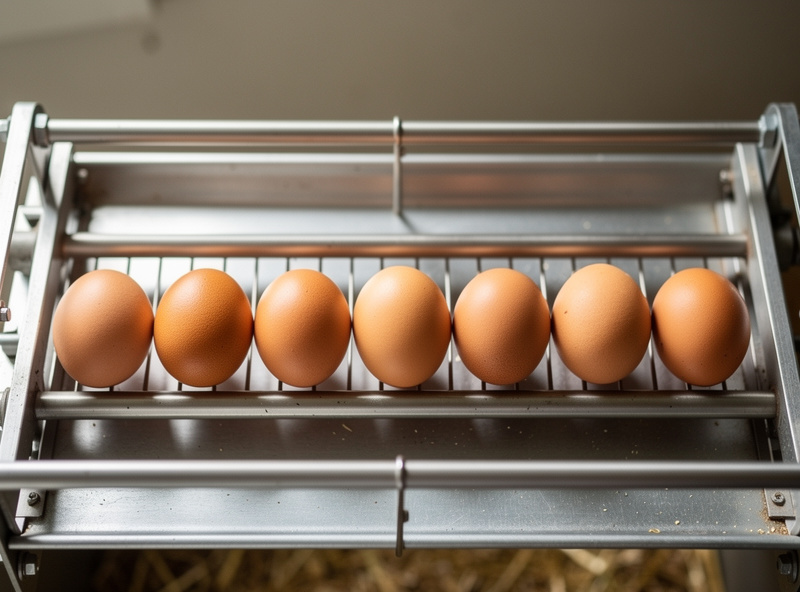
Two roll-away designs are common. Single-tray boxes route every egg to one collection tray at the back; per-cubicle boxes have an individual tray for each box. Single-tray is cheaper and easier to clean; per-cubicle keeps eggs from the same hen grouped (useful for breeders) but adds parts.
Real Benefits That Justify the Cost
Roll-away boxes deliver three measurable improvements over standard boxes.
Egg-eating drops to near zero. Once an egg rolls away within seconds of laying, no hen can break it open and trigger the egg-eating habit. Even an established egg-eater stops within 2–3 weeks because the reinforcement loop (peck egg, get reward) is broken. For flocks that have a chronic egg-eater, this single benefit pays for the upgrade.
Cleaner eggs, less shell cracking. Eggs that sit in bedding pick up droppings, dust, and dirt — average bacterial count on a bedding-laid egg is 4–8x higher than on a roll-collected one. Cracking also drops because eggs are not stepped on, sat on, or pecked at after laying.
Broody behavior breaks naturally. A broody hen sits on a clutch she can see and feel. If the eggs vanish 30 seconds after laying, no clutch accumulates, and the broody trigger never fires. Flocks that historically had 3–4 broody cycles per hen per year often drop to 0–1 after switching to roll-away.
Real Drawbacks (and Workarounds)
Roll-away is not always the right answer.
Cost. A 4-cubicle roll-away runs $120–$220 versus $40–$80 for a standard plywood bank. For a 4-hen backyard flock with no egg-eating problem, the math does not work — the upgrade pays back over 5+ years through saved eggs only.
Depth and wall space. The collection tray adds 5–8 inches of depth behind the cubicles. A standard box is 12 inches deep; a roll-away is often 18–20 inches deep. If your coop has narrow walls or you mount externally, measure twice.
Leveling sensitivity. If the box tilts laterally (one side higher than the other), eggs roll into the wrong cubicle's tray or jam at the side wall. Use a small bubble level during installation; check it again after the first heavy rain or freeze cycle.
Cold-weather rolling. When bedding gets stiff at temperatures below 20°F, eggs occasionally hang up. Reduce bedding depth in winter (1–2 inches instead of 3–4) and the rolling stays reliable.
When the Upgrade Pays Back
The honest math: the price difference between a 4-cubicle roll-away and a 4-cubicle plywood bank is roughly $100. At a 280-egg-per-hen-per-year production rate and a $0.30 per-egg avoided-loss rate (from cracked eggs, eaten eggs, and cleaner eggs reaching the kitchen), one roll-away cubicle saves about 25–40 eggs per year — $7.50–$12 per cubicle per year, or $30–$48 per 4-cubicle bank per year.
That gives a payback of 2–3 years for a typical 12–16 hen production flock. For a 4-hen backyard flock with heritage layers, payback stretches to 6–10 years and the upgrade is hard to justify on math alone. For any flock with a chronic egg-eater, payback is under 6 months — buy immediately.
Best Roll-Away Nesting Boxes 2026
| Model | Cubicles | Material | Hens | Price | Best For |
|---|---|---|---|---|---|
| RentACoop 4-Hole Roll-Away | 4 | Galvanized steel | 16–20 | $210 | Mid-size production flocks; the workhorse pick |
| Hatching Time 2-Hole Steel Roll | 2 | Powder-coated steel | 8 | $135 | Small flocks with chronic egg-eaters |
| Brinsea EggGuard Roll-Out | 1 (communal) | Treated plywood | 6 | $95 | Backyards under 8 hens, small footprint |
| Coopworx Roll-Away | 3 | HDPE plastic | 12 | $155 | Mite-prone climates, easy cleaning |
| Producer's Pride Roll-Away (CT) | 2 | Plywood | 8 | $85 | Budget upgrade, in-store availability |
| Over EZ Built-In Roll-Away | 2 | Plywood + steel | 8–10 | (included in coop) | Owners of Over EZ coops — only premium coop with system integrated |
The RentACoop is the most-recommended pick across this category for one reason: it is the only roll-away that ships with a hen-side bedding tray AND a separate egg-side collection tray, so hens never see a bare metal floor (some roll-aways use only a thin foam pad and hens get spooked).
DIY vs Commercial Roll-Away
A DIY roll-away conversion of a standard plywood box costs about $15 in materials (an angled floor cut and a small catch tray) and 30 minutes on top of a standard build. The full plans are in DIY Nesting Box Plans Plan 5.
Where DIY wins: cost (the difference vs commercial is $100+) and the ability to retrofit existing boxes. Where commercial wins: every piece is sized to roll consistently, the trays are predator-secured at the egg-collection point, and the materials are mite-resistant.
Recommendation: build the DIY version if you already have plywood boxes and want to test whether roll-away helps your specific egg-eating problem. If it works, upgrade to a commercial model when the DIY shows wear (typically 2–3 years).
Common Roll-Away Problems
Eggs not rolling. Almost always a leveling issue or bedding too deep. Re-level with a bubble level on the floor of the box, then reduce bedding to 1–2 inches.
Hens refusing to enter. Usually the floor angle is too steep, the entrance opening is too narrow, or the box was placed in a high-traffic spot. Roll-aways need the same dark, calm corner as standard boxes — see the placement section in our main nesting box guide.
Eggs jamming at the tray opening. The slot at the front of the tray is too narrow. Standard egg width is 1.7" — the slot needs to be at least 2.0" tall and 12" wide. If yours is undersized, file or cut to widen.
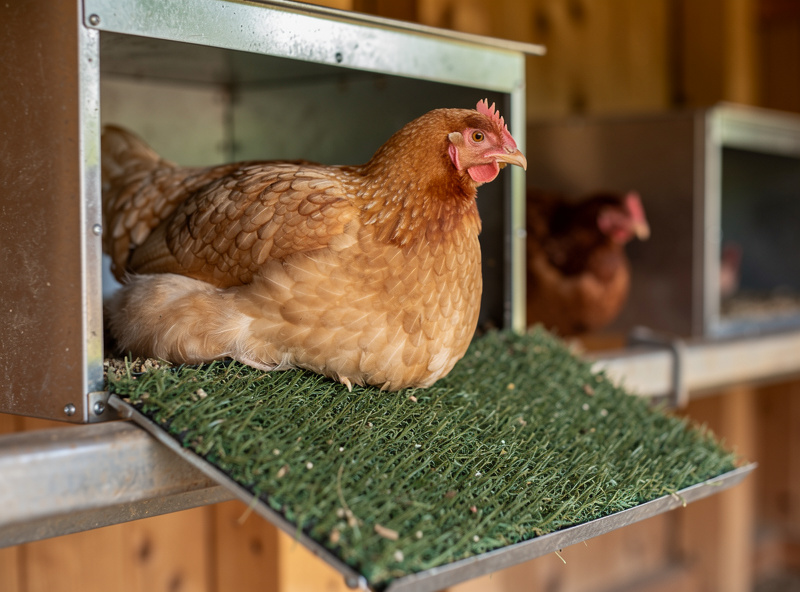
Cold-weather rolling failure. Reduce bedding depth in winter and consider a strip of synthetic turf as floor cover (it stays smooth at any temperature and gives hens a comfortable surface).
Frequently Asked Questions
Are roll-away nesting boxes worth it?
For production flocks of 12+ hens or any flock with chronic egg-eating, yes — payback is 2-3 years through saved eggs and cleaner eggs reaching the kitchen. For 4-hen backyard heritage flocks with no egg-eating problem, payback stretches past 6 years and standard boxes are usually the right pick.
What angle should a roll-away nesting box floor have?
7-10 degrees is the sweet spot. Below 6 degrees and eggs sometimes stop mid-roll, especially in cold weather. Above 12 degrees and hens occasionally refuse to enter because the floor feels uneven. Every commercial roll-away ships in this range.
Do hens like roll-away nesting boxes?
Most hens accept them within a few days, especially if you cover the angled floor with synthetic turf or a thin bedding pad. Hens do not refuse based on the slope itself — they refuse if the floor feels metallic, uneven, or too steep.
Can I make a roll-away nesting box myself?
Yes — angle the plywood floor 8 degrees, cut a 2-inch tall by 12-inch wide opening at the bottom-back of the box wall, and add a small catch tray below. Total cost about 15 dollars on top of a standard plywood build, taking 30 extra minutes.
Do roll-away boxes stop egg-eating?
Yes — even established egg-eaters stop within 2-3 weeks because the reinforcement loop breaks (the egg rolls away before the hen can peck it). This is the strongest single use case for the upgrade and pays back the cost difference in under 6 months for chronic egg-eating flocks.
How deep are roll-away nesting boxes compared to standard?
Roll-away boxes are typically 18-20 inches deep including the collection tray, versus 12 inches for standard boxes. Measure your coop wall space before buying — narrow walls or external lift-tops may not have room.
Related Articles
Related Guides

Nesting Box Curtains: Do They Actually Help?
Nesting box curtains — strips of burlap or fabric covering the front opening — work in roughly 40% of flocks…
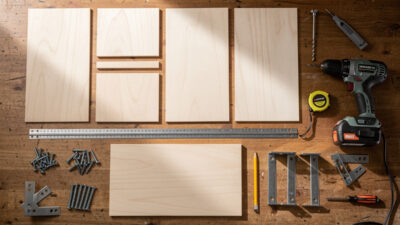
DIY Nesting Box Plans: 5 Easy Builds Under 5
A four-cubicle nesting box for 12–16 hens costs $22 in plywood and 90 minutes of build time. A milk-crate retrofit…
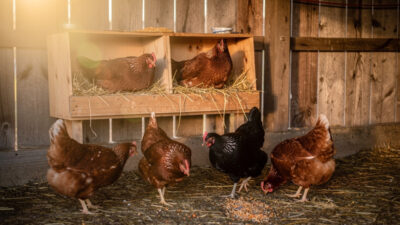
Nesting Boxes For Hens: How Many You Actually Need
Plan on one nesting box per 4 hens, with a one-box redundancy buffer for flocks of 8 or more. A…