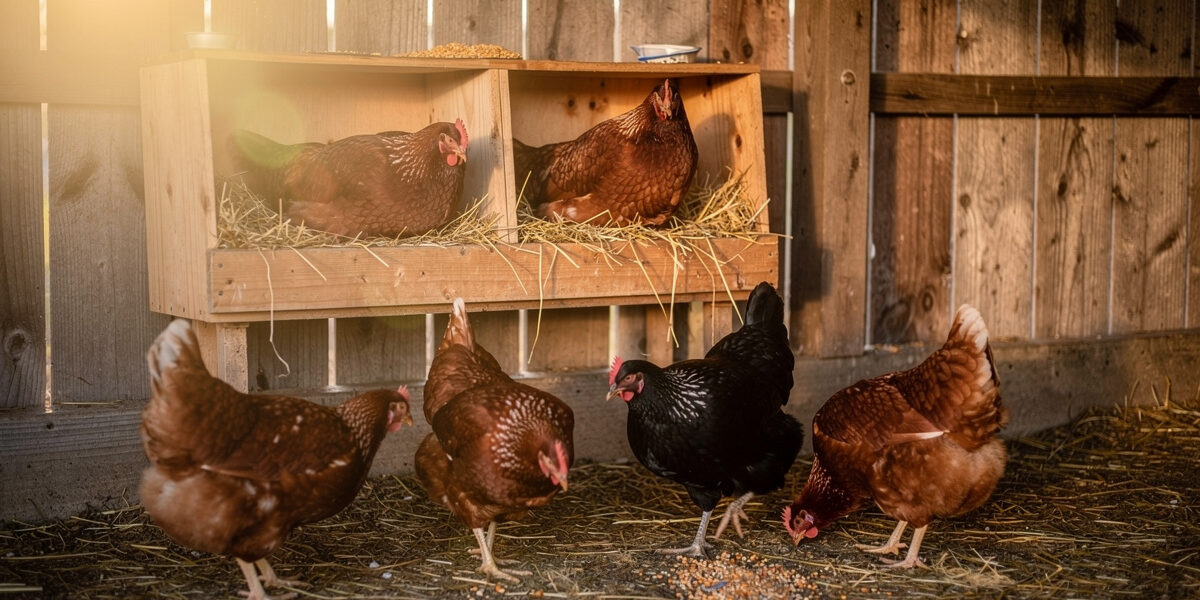
Plan on one nesting box per 4 hens, with a one-box redundancy buffer for flocks of 8 or more. A 6-hen flock needs 2 boxes, a 12-hen flock needs 3, a 20-hen flock needs 5. The math is simple, but the failure modes — buying too few, buying too many, mixing breed types — cost real money. I’ve built nesting-box banks for my own coop and helped a few neighbors size theirs, and the mistake I see most often isn’t undercounting, it’s overcounting “to be safe” and creating a mite reservoir out of boxes nobody uses. This guide walks through the actual decision for your flock count.
If you have not yet bought your boxes, read our Chicken Nesting Boxes Complete Guide first for sizing and material trade-offs, then come back here for the count question. If you are still picking the coop itself, the Chicken Coop Size Guide covers the floor-plan side of the same problem.
The 1-Per-4 Rule and Where It Breaks
The standard guidance — 1 nesting box per 4 hens (some extension programs frame it as 1 per 4–5) — is the consistent recommendation across land-grant extension poultry-housing guidance, and it lines up with what I’ve settled on across the coops I’ve built and helped neighbors size. It works because hens lay in clustered windows — most of a flock’s daily output happens in the morning hours after they come off the roost, not spread evenly across the day — and at 4 hens per box, the queue rarely exceeds 2–3 hens deep during that peak.
The rule starts breaking in three situations:
Production-heavy flocks (Leghorn, Sex Links, ISA Browns): these breeds lay 280–320 eggs per hen per year, almost daily, with strong morning clustering. Drop to 1 box per 3 hens or you will see shell breakage from queue-pressure laying.
Mixed-breed flocks with strong rank hierarchy: when an alpha hen claims one box and bullies others away, a 4:1 ratio collapses to effectively 1 box for the whole flock. Add boxes until the alpha can no longer guard them all — usually 3:1 with frequent dust-bathing distractions.
Pullets coming into lay (5–8 month range): first-time layers often pile into a single box because they imitate each other. This phase lasts 3–6 weeks; do not buy more boxes for it. Just ensure you have enough for the long-run ratio.
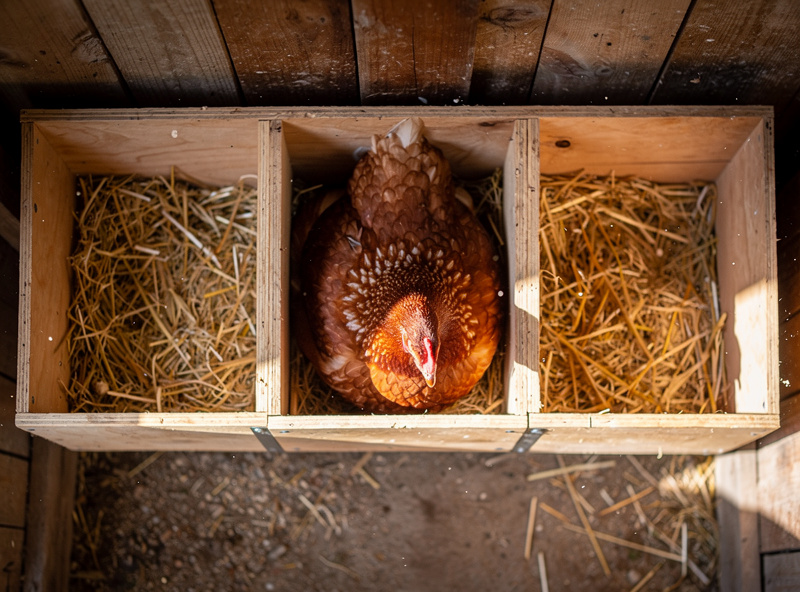
Boxes Needed by Flock Count
The table below gives the practical answer for the flock counts SmartCoopHQ readers most often build for. The "Pullet phase" column shows the number you need during the first 6 weeks of lay (when birds pile up); the "Steady state" column is the long-run ratio.
| Flock Size | Boxes (Pullet Phase) | Boxes (Steady State) | Total to Buy | Notes |
|---|---|---|---|---|
| 3 hens | 1 | 1 | 1 | One box is genuinely enough; add 2nd only for broody cycles |
| 4 hens | 2 | 1 | 2 | Buy 2 — pullet phase needs the redundancy |
| 6 hens | 2 | 2 | 2 | Most common backyard flock; 2 boxes is exact-fit |
| 8 hens | 3 | 2 | 3 | Hit 3 even though math says 2 — broody buffer |
| 10 hens | 3 | 3 | 3 | Three is the natural ceiling for most prefab coops |
| 12 hens | 4 | 3 | 4 | Step up to 4-box bank — see 12-chicken coop sizing |
| 16 hens | 5 | 4 | 5 | Two banks of 2 spread across opposite walls |
| 20 hens | 6 | 5 | 6 | See 20-chicken coop layouts |
| 25+ hens | 1 per 4 | 1 per 5 | 1 per 4 | Production scale — consider roll-away systems |
Two patterns drop out of the table. Below 4 hens, one box really is enough — there is no scenario where two birds need a box at the same time. Above 16 hens, the cost of extra boxes is small relative to the labor of dealing with floor-laid eggs, so over-buying by one is the right error to make.
Box Count vs Box Size: Pick One Strategy
Some keepers add boxes at every flock expansion. Others buy oversized boxes and skip adding new ones. Both can work, but mixing the strategies — adding a small box to a flock that already has oversized ones — creates rank confusion (alpha hens claim the bigger boxes first, leaving submissive hens crammed into the small one).
The cleaner approach: pick one strategy and stay with it. If you are running 12" × 12" × 14" standard boxes, add boxes when you add hens. If you are running 18" × 18" × 16" oversized communal boxes, hens will share more readily and you can stretch the count ratio to 1:6 or even 1:8.
For most backyard flocks under 12 hens, standard-size boxes with the count tracking the 1:4 rule is the simpler path. Above 12 hens, oversized communal boxes start saving meaningful coop wall space.
My own coop runs standard-size boxes and I’ve stuck with that strategy through two rounds of chicken-math flock growth — the coop I originally sized for 6 birds is holding closer to 10 now, and rather than switch systems mid-flock, I added a fourth box to the same bank instead of reworking the whole wall. Consistency saved a weekend of carpentry I didn’t need to spend.
Heritage vs Production Layers
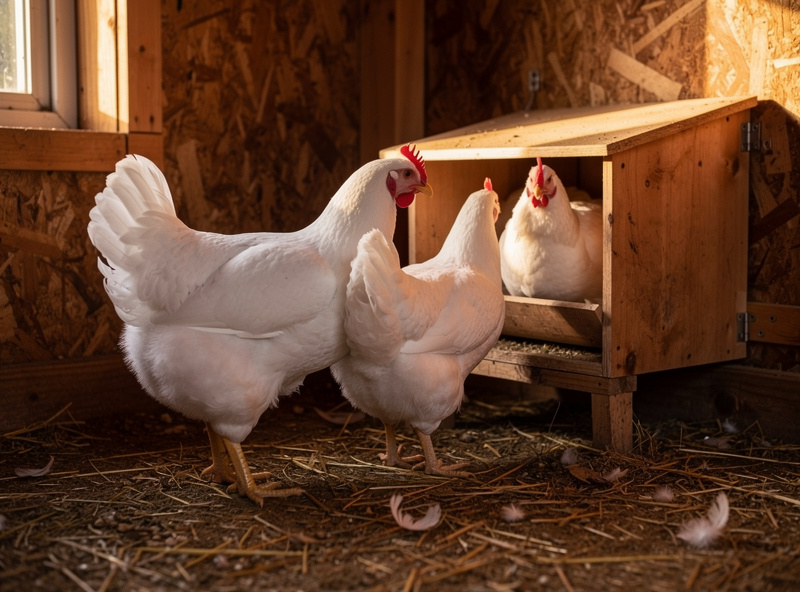
Heritage breeds (Orpingtons, Wyandottes, Plymouth Rocks) lay 200–250 eggs per hen per year with a relaxed schedule. They tolerate 1:5 ratios without shell breakage and frequently leave 1 box completely unused. If your flock is entirely heritage, buying to a 1:4 ratio gives you safe overcapacity.
Production layers (Leghorns, Sex Links, ISA Browns, Hyline Browns) lay 280–320 eggs per hen per year with intense morning clustering. They benefit from 1:3 ratios — the extra capacity reduces queue time during peak and meaningfully cuts the cracked-egg rate that comes from hens laying under queue pressure or on top of each other.
Dual-purpose flocks fall in the middle. Stick with 1:4 unless you see queue stress (multiple hens trying to enter the same box, hens laying on the floor next to occupied boxes) — then add one box and re-evaluate after 2 weeks.
When to Add Boxes vs When You Already Have Enough
Watch for these three signals:
Add a box when: you find more than one egg laid outside boxes per week, you see hens waiting in line behind an occupied box, or one hen shows signs of egg-binding (squatting, fluffed feathers, no egg) during peak laying — this often means she could not access a box in time.
You already have enough when: at least one box is empty during morning peak, eggs are consistently being laid in boxes (not floor or run), and the box-eating-egg incidence is low or zero.
You probably have too many when: two or more boxes show no use for a full week, or you find unhatched (cold) eggs in unused boxes — hens may be starting clutches in boxes they think are abandoned.
Integrating New Pullets Without Rebuilding Your Box Count
Chicken math is undefeated — almost every keeper who starts with a fixed flock number ends up adding birds within a year or two, and the nesting box question comes up again each time. The good news is that box count rarely needs to scale in lockstep with every small addition.
If you are adding 2–3 pullets to an existing flock of 6–8 mature hens, you usually do not need a new box immediately. New pullets take 5–8 months to reach point of lay, and by the time they start, they will often imitate the established hens and use existing boxes rather than needing dedicated ones — the pullet-phase piling behavior described above happens within a single new group, not when a few newcomers join an established flock that already has laying habits in place.
Where you do need to add a box ahead of time: if the addition pushes you across one of the table’s flock-size boundaries (say, from 7 hens to 11), or if you are adding a full second batch that will come into lay together rather than trickling in. In both cases, add the box a few weeks before the new birds are expected to start laying, not after you notice queue stress — retrofitting a nesting wall while active hens are already using it disrupts the whole flock’s routine more than building slightly ahead of need.
One thing I’d flag from my own experience: don’t judge box adequacy in the first two weeks after introducing new birds. Flock integration itself causes temporary laying disruption — stress from rank reshuffling can pause laying in established hens for several days, which makes box queues look artificially light right when you’re trying to judge whether you have enough. Wait until the new pullets are laying consistently and the pecking order has settled before deciding you need another box.
The Mistake of Buying Too Many Boxes
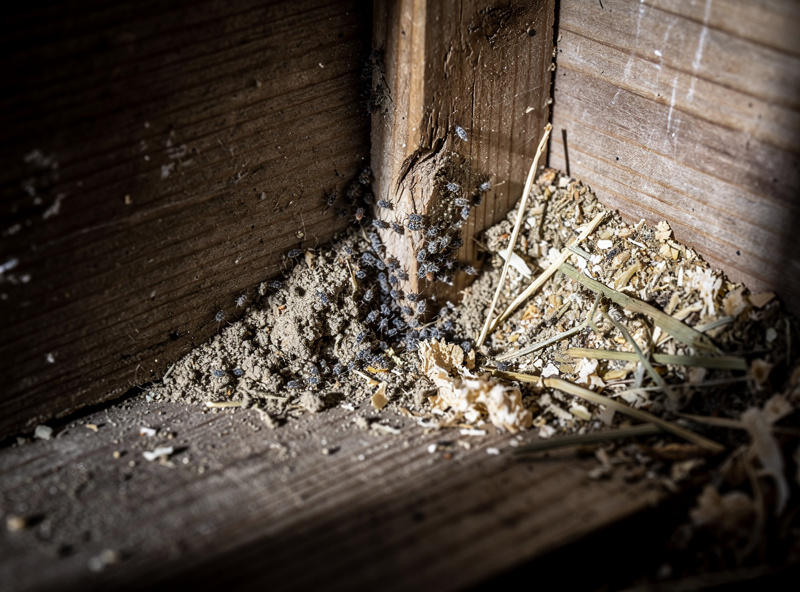
It feels safer to over-buy, but excess unused boxes create three real problems. First, they harbor mites — empty bedding stays warm and dry, and mites prefer that environment to active boxes (which get disturbed daily). Unused boxes are mite reservoirs that re-infect the active boxes after every cleaning.
Second, hens may switch to unused boxes if the active boxes get overcrowded with broody hens, then start a clutch — meaning eggs go missing for 21+ days because you stopped checking the "empty" box. Third, every extra box is wall space that could have been a feeder, a window, or a roost extension.
The pragmatic rule: buy to the "Total to Buy" column above and resist the urge to add more. If a problem appears later (egg-eating, broody buildup), add one box at that point — not preemptively.
What Smart-Coop Sensors Actually Tell You About Box Count
If you’re already running cameras or occupancy sensors on your coop, you have better data for this decision than any flock-size table can give you — including this one. A table gives you a starting point; your own coop tells you the real answer within a couple of weeks.
An occupancy or motion sensor on each box, feeding into a Home Assistant dashboard, answers the “add or not” question directly: if one box shows zero use for a week while another shows near-constant traffic during the morning window, you don’t have a box-count problem, you have a box-preference problem — and adding a box won’t fix it. The fix is almost always placement (the ignored box is in a brighter or more exposed spot) or a leftover mite issue making one box unattractive, not raw capacity.
A camera pointed at the nesting wall settles the ambiguous cases fast. If you can’t tell from a week of behavior whether you’re seeing genuine queue stress or just two hens who happen to prefer the same box at the same time of day, an hour of morning footage answers it in a way a flock-size table never will. This is the same lens I use for every other automation decision on the coop — the sensor doesn’t replace judgment, it just gives you real data instead of a guess before you commit to more lumber and wall space.
Frequently Asked Questions
How many nesting boxes do 6 hens need?
Two nesting boxes is correct for 6 hens — the 1-per-4 rule applied with a small redundancy buffer. One box works in a pinch but causes morning queue stress and risks cracked eggs. Three boxes is overkill and creates mite-harboring empty space.
Is 1 nesting box enough for 4 hens?
For pullets in their first 6 weeks of lay, no — buy 2 because pullets pile into one box. For an established flock of 4 mature hens, one box is technically enough but two gives you broody-cycle redundancy.
How many nesting boxes for 12 chickens?
Four nesting boxes is the right answer for 12 chickens, especially during pullet phase. Steady state allows three but four costs only 25 dollars more in DIY plywood and prevents queue stress during peak laying.
Do hens share nesting boxes?
Yes — hens almost always share. A flock of 8 will often pick 1-2 favorite boxes and ignore the rest. The 1-per-4 ratio exists for redundancy during peaks and broody cycles, not because each hen needs her own box.
Should I add more nesting boxes if hens are laying on the floor?
Maybe — but check the existing boxes first. Floor laying is more often caused by box height (too high or too low), light (boxes in the brightest spot), or mites in the bedding than by box count. Inspect those three first; add a box only if peak-time queue stress is also visible.
How many boxes for production layers like Leghorns?
Drop to 1 box per 3 hens for high-production breeds. Leghorns, Sex Links, and ISA Browns lay nearly daily with intense morning clustering, and the extra box capacity prevents shell breakage from queue pressure.
Related Articles
- Chicken Nesting Boxes: Complete Sizing & Setup Guide
- DIY Nesting Box Plans Under $25
- Roll-Away Nesting Boxes: Worth the Upgrade?
- Chicken Coop Size Guide
- Best Chicken Coop Bedding
Related Guides
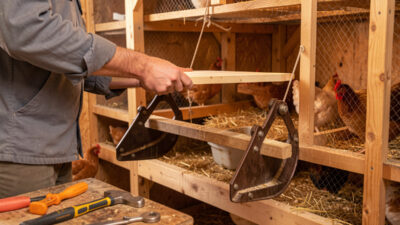
DIY Removable Roost Bars for Fast Cleaning and Mite Checks
The best roost you can build is one you can lift out in ten seconds without a tool. Removable roost…
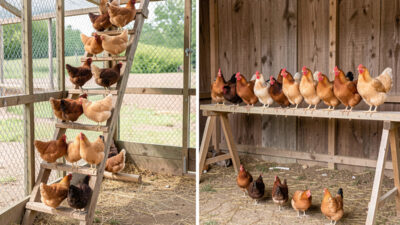
Ladder Roost vs Single-Level: Which Suits a Mixed Flock
For most mixed-size backyard flocks, a single-level roost wins. Putting every bird on one horizontal bar at the same height…
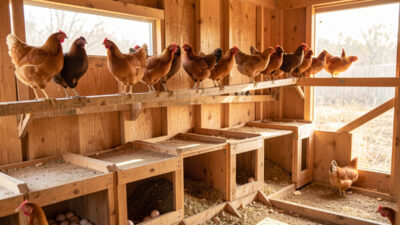
Roost Above the Nesting Box: The Height Rule for Floor Eggs
The rule is simple: the roost must sit higher than the top of your highest nesting box — ideally 6…