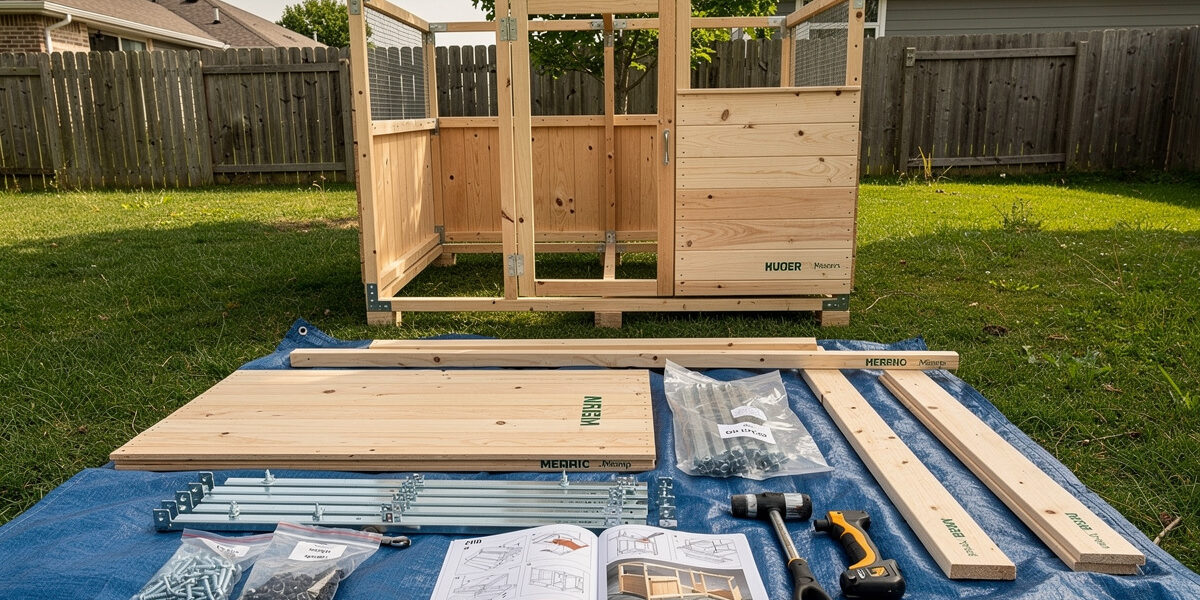
A prefab chicken coop is a factory-assembled or kit-form coop sold ready-to-deploy, distinct from a custom-built coop designed and constructed for your specific situation. Prefabs account for the large majority of residential coop purchases because they ship fast, cost less than custom, and require no carpentry skills — but they also drive most coop replacement cycles because the off-the-shelf format rarely matches buyer needs perfectly. I started with a big-box prefab before I welded my own walk-in run, so I have lived both sides of this — knowing the prefab-vs-custom math saves $300 to $1,500 in eventual rebuild costs.
This guide covers what makes a prefab coop genuinely prefab, the four prefab tiers and what each tier delivers, the prefab-vs-custom decision matrix that determines which path saves money long-term, the assembly realities most buyers underestimate, and the four mistakes that turn $700 prefabs into $1,200 mistakes. For full coop type comparison, see our best chicken coops buyer’s guide. For the dominant mid-range prefab brand, our Producer’s Pride chicken coop review covers Tractor Supply’s house line — the most-bought prefab in the US.
As an Amazon Associate I earn from qualifying purchases.
What Makes a Coop Prefab?
A prefab coop ships as either a fully-assembled unit or a flat-pack kit with pre-cut parts and labeled hardware. The defining feature is standardization — every unit comes from the same factory pattern, with no customization for your specific yard, climate, or flock requirements.
Prefab coops fall into two physical categories: fully-assembled (ships on a pallet, minimal setup) and flat-pack kits (ships in boxes, requires 2 to 8 hours of assembly with provided hardware). Fully-assembled prefabs cost 20 to 40 percent more due to shipping size constraints; flat-pack kits dominate the budget and mid-tier market.
What does NOT count as prefab: custom Amish-built coops (each unit is built to order, even if from a standard pattern), coops you build yourself from purchased plans (DIY, not prefab), or modular coops where you specify dimensions and configuration at order time (custom modular). The line blurs at “premium prefab” tier where some manufacturers offer limited customization options.
Four Prefab Coop Tiers
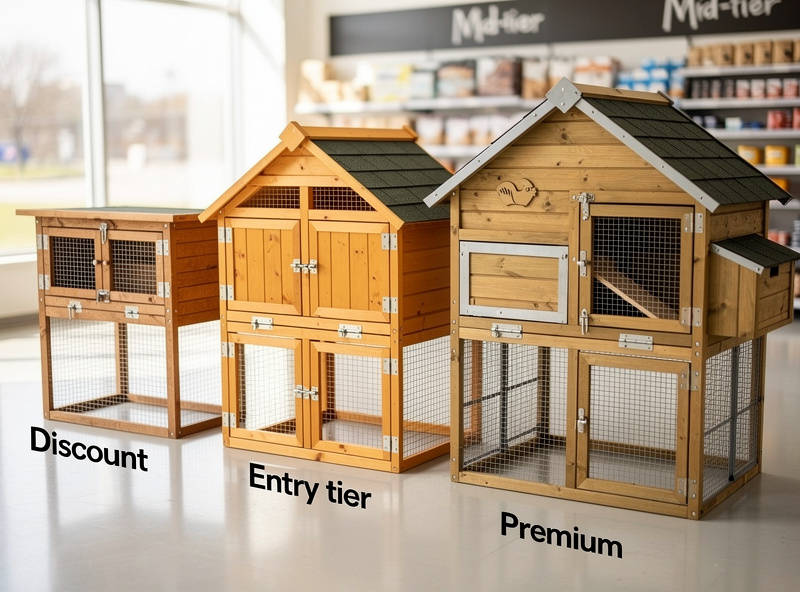
The prefab market splits into four distinct quality and price tiers. Each delivers predictable value within its range. The capacity-claim column below isn’t a formal survey — it’s the pattern I see every time I measure a listed “holds 6 hens” coop against the actual floor space and run it through the 4 sq ft/bird rule: the cheaper the tier, the more the listing overstates.
| Tier | Price Range | Capacity Claim Accuracy | Materials | Service Life |
|---|---|---|---|---|
| Discount prefab (Amazon, Wish, Temu) | $120-$250 | Frequently overstated | Thin OSB, chicken wire, plastic hardware | 6-18 months |
| Entry prefab (big-box farm stores) | $280-$550 | Sometimes overstated | 2×2 pine, hardware cloth, basic steel hinges | 3-5 years |
| Mid-tier prefab (specialty retailers) | $600-$1,500 | Usually close | 2×2 to 2×4 framing, hardware cloth, treated wood, metal roof options | 5-10 years |
| Premium prefab (Eglu, Carolina Coops) | $1,500-$4,000 | Accurate | HDPE plastic or premium hardwood, integrated smart features | 10-15+ years |
Discount prefabs at $120 to $250 are functional disasters and the false-economy trap that drives most prefab disappointment. Entry prefabs at $280 to $550 deliver genuine 3 to 5 year service life and represent the “good cheap coop” sweet spot. Mid-tier prefabs are the most-purchased category for serious backyard keepers — proper materials and accurate capacity claims at sustainable prices. Premium prefabs deliver longest service life and modern features but at prices that approach or exceed comparable custom builds.
Prefab vs Custom: The Decision Matrix
The prefab-vs-custom decision turns on three factors: time available, design specificity needed, and 5-year ownership horizon.
Choose prefab when: You need a coop deployed within 4 weeks. Standard dimensions work for your flock and yard. Budget caps under $2,000. You don’t need integration with existing structures (matching siding, specific roof angle, etc). 5-year horizon is acceptable. The chicken coops for sale guide covers prefab buying channels.
Choose custom when: You can wait 8 to 16 weeks for delivery. Standard dimensions don’t fit your specific yard or HOA constraints. Budget allows $2,500 to $12,000. You need design integration (matches house, fits between specific structures, particular climate adaptations). 10-15 year horizon justifies the higher upfront cost.
Cost crossover analysis: A $1,500 mid-tier prefab with 7-year service life costs $214 per year. A $4,500 custom-built coop with 15-year service life costs $300 per year. Prefab wins on annualized cost when service life expectations are similar. Custom wins when premium materials extend service life dramatically (galvanized metal roofing, treated hardwood framing, ball-bearing hinges).
Hidden prefab costs: Assembly time (2 to 8 hours), shipping ($50 to $400), required tools you don’t already own ($30 to $150), inevitable upgrades (replace plastic hinges with steel, add hardware cloth where chicken wire was used, paint or seal exposed wood, $80 to $250 in upgrade materials). Total prefab investment often runs 20 to 40 percent above the listed coop price.
Prefab Assembly Realities
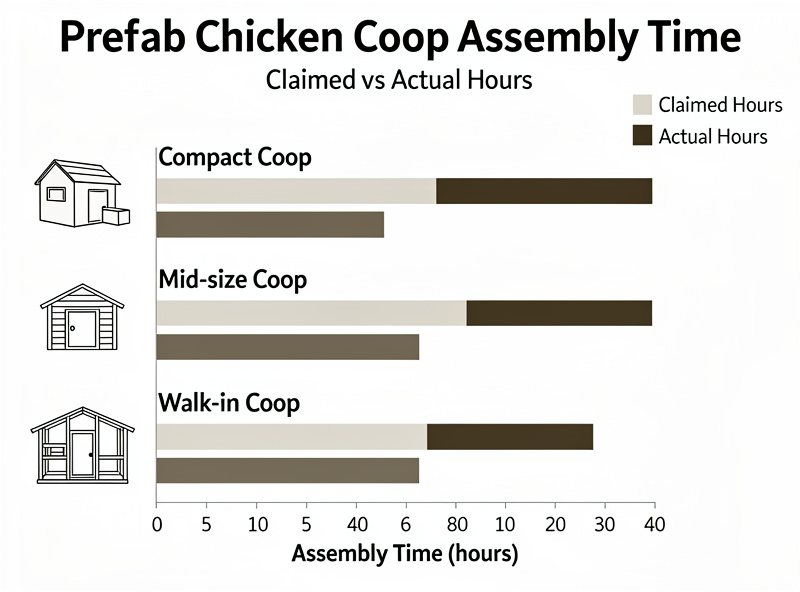
Most flat-pack prefab coops claim “easy assembly in 2 hours” on the listing. Real assembly time runs 2x to 4x the claimed time for first-time assemblers, with a sharp learning curve. The “easy 2-hour” walk-in I put together ate a full Saturday and most of a Sunday — and I am comfortable with tools.
Realistic assembly timeline:
- Compact 4×4 ft prefab: 3 to 5 hours actual time (claimed 1 to 2 hours)
- Mid-size 4×6 to 4×8 ft prefab: 5 to 8 hours actual time (claimed 2 to 3 hours)
- Walk-in prefab (6×6 to 8×10 ft): 10 to 16 hours actual time (claimed 4 to 6 hours)
Tools you’ll need (not always specified): Phillips and flat screwdriver set, adjustable wrench, hammer or rubber mallet, a drill with a bit set, level, tape measure, square, work gloves. Some flat-packs include all-in-one multi-tool but specifying what you actually need beforehand prevents mid-assembly hardware-store runs.
Two-person vs solo assembly: Compact lift-tops can be assembled solo. Mid-size and walk-in prefabs require 2 people for at least the wall-raising and roof-mounting steps. Solo assembly of larger coops doubles the time and frustrates most builders.
Common assembly mistakes: Skipping included pre-assembly steps (gaskets, seals, weatherproofing), torquing hardware too tight (cracks pre-drilled holes), or installing pieces in wrong orientation. The included instruction quality varies dramatically — read all instructions completely before starting any cut or fastener installation.
Smart-Coop Integration with Prefabs
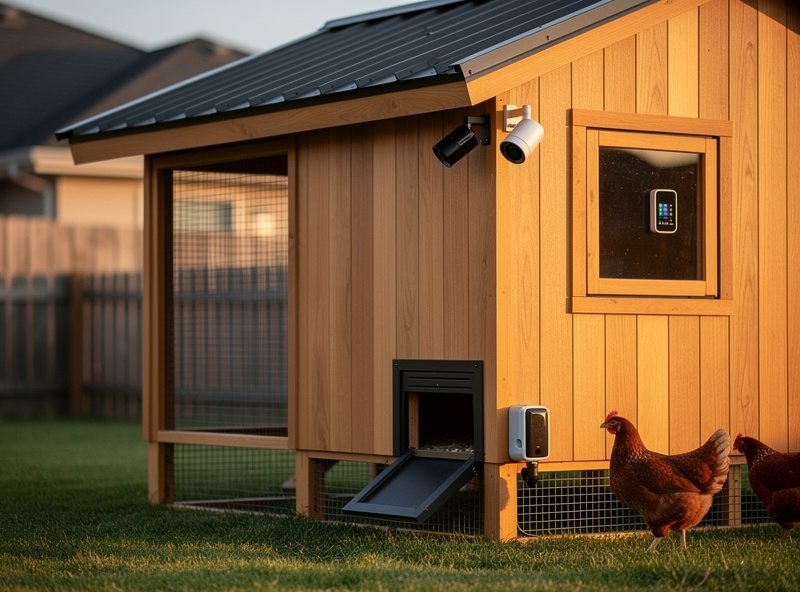
Prefab coops vary widely in smart-coop compatibility. Some premium prefabs ship with smart-feature provisions; most entry and mid-tier prefabs require modifications to add smart automation.
Auto-door wall area: Most automatic chicken doors have an actual opening in the 10 to 13-inch range, but the door plus its runners and opener unit needs more clearance than that — ChickenGuard’s own installation specs call for roughly 30 inches of flat wall for the runners and opener box combined, not just the opening itself. Many prefab coops have integrated nesting boxes or angled walls in this exact zone, requiring custom adapter plates ($30 to $80) or relocating the door to a less-ideal wall. See our automatic coop door buyer’s guide for compatibility specs by brand.
Sensor mounting: Solid-walled prefabs (most lift-tops, walk-ins) support easy sensor mounting on interior walls. Mostly-wire prefabs (A-frame tractors) require sensor brackets attached to framing. Plan placement before buying.
Camera mounting: Cameras need overhead clearance for full-floor coverage. Lift-top coops with shallow ceilings limit camera angles. Walk-in coops handle camera placement better. The smart coop monitoring guide covers placement details.
Power infrastructure: Static prefabs can use wired electrical from the house. Plan electrical conduit installation during initial coop placement, not after. Battery-powered alternatives work but require 12 to 18 month battery replacements. See our best smart coop devices guide for power options.
Common Prefab Coop Mistakes
Four mistakes account for most prefab purchase regret.
Mistake 1 — buying discount-tier prefabs: $120 to $250 prefabs are universally false economy. Materials fail within 18 months and replacement cost wipes out savings. Always start at the $280 to $550 entry tier minimum.
Mistake 2 — underestimating assembly time: Listed “2 hour assembly” claims understate real time by 50 to 100 percent. Plan for a full weekend rather than a single afternoon, especially for walk-in or larger prefabs. Buy with realistic expectations.
Mistake 3 — picking prefab when custom would fit better: If standard prefab dimensions don’t fit your yard or HOA constraints, forcing a prefab purchase typically results in compromised placement that draws complaints or fails legal compliance. Sometimes custom is the only viable option.
Mistake 4 — ignoring needed upgrades: Most entry and mid-tier prefabs need $80 to $250 in upgrades (replacing plastic hinges with steel, adding hardware cloth where chicken wire was used, painting or sealing exposed wood). Factor these into the budget BEFORE buying. New keepers from our beginners guide often skip this and end up with a “finished” prefab that needs immediate post-assembly work. Every prefab I have assembled got the same three upgrades before the birds moved in: the plastic latches swapped for a steel raccoon-proof latch, the chicken-wire panels re-skinned in 1/2 inch hardware cloth, and the bare wood sealed with a coat of exterior wood sealer. In predator country none of it is optional.
Frequently Asked Questions
What is a prefab chicken coop?
A prefab chicken coop is a factory-assembled or flat-pack kit coop sold ready-to-deploy, distinct from custom-built coops designed for your specific situation. Prefabs ship fast and cost less than custom but offer no customization for your yard, climate, or flock specifics. They account for the large majority of residential coop purchases.
How much does a prefab chicken coop cost?
Prefab coops cost $120 to $250 for discount-tier (avoid – typically fail in 18 months), $280 to $550 for entry-tier (3-5 year service life), $600 to $1,500 for mid-tier (5-10 year service life), and $1,500 to $4,000 for premium prefabs (10-15 year service life). Add 20 to 40 percent for shipping and required upgrades.
Are prefab chicken coops worth it?
Mid-tier and premium prefabs ($600 to $4,000) deliver good value for typical backyard scenarios. Entry-tier ($280 to $550) works for budget-conscious 4-hen flocks with proper material verification. Discount-tier ($120 to $250) is false economy that fails fast. Prefab loses to custom when you need specific dimensions, design integration, or 10+ year service life.
How long does it take to assemble a prefab chicken coop?
Real assembly time runs 2x to 4x the claimed time. Compact 4×4 ft prefabs take 3 to 5 hours (claimed 1-2). Mid-size 4×6 to 4×8 ft prefabs take 5 to 8 hours (claimed 2-3). Walk-in prefabs take 10 to 16 hours (claimed 4-6). Plan for a full weekend rather than a single afternoon.
Should I buy prefab or build a custom chicken coop?
Choose prefab if you need deployment within 4 weeks, standard dimensions work, budget caps under $2,000, and 5-year horizon is acceptable. Choose custom if you can wait 8-16 weeks, need specific dimensions or HOA-compliant design, budget allows $2,500 to $12,000, and 10-15 year horizon justifies higher upfront cost.
Do prefab chicken coops support smart automation?
Premium prefabs (Eglu, Carolina Coops) often ship with smart-feature provisions. Mid-tier prefabs typically require modifications – custom adapter plates, sensor brackets, or wall area selection compromises. Entry-tier prefabs need most extensive modifications. Always verify smart-coop compatibility before buying if you plan to automate within 24 months.
Bottom Line: Pick the Right Prefab Tier for Your Service-Life Expectation
Prefab chicken coops account for the large majority of residential purchases because they ship fast and cost less than custom — but tier selection matters more than brand. Skip discount-tier ($120-$250) entirely. Start at entry-tier ($280-$550) for budget-conscious 4-hen flocks. Move to mid-tier ($600-$1,500) for 5-10 year service life and accurate capacity claims. Choose premium ($1,500-$4,000) only for design-conscious buyers or smart-coop-integrated builds. Custom builds make sense when standard prefab dimensions don’t fit your yard or you need 10+ year horizon.
For matching coop type to your full buyer profile, see our best chicken coops buyer’s guide. For exact picks by flock count, the chicken coop size guide covers the breakdowns.
Related Guides
- Best Chicken Coops 2026: Complete Buyers Guide
- Chicken Coops For Sale: 6 Best Channels
- Cheap Chicken Coops Under $400: Best Budget Picks
- Chicken Coop Size Guide: How Many Chickens Per Square Foot
- Chicken Coop for 6 Chickens: Best Picks & Layout
- Automatic Chicken Coop Doors: Complete Buyer’s Guide 2026
Related Guides
Chicken Coops Near Me: Local Sourcing Guide (2026)
Searching “chicken coops near me” in 2026 surfaces a mix of local farm stores, regional builders, and individual sellers —…
Custom Chicken Coops: When to Pay for Bespoke
Custom chicken coops are designed and built for your specific situation — exact dimensions, particular climate adaptations, integrated smart-coop wiring,…
Amish Chicken Coops: Premium Build Quality (2026)
An Amish chicken coop is built by hand in a workshop in Pennsylvania, Ohio, Indiana, or Illinois — mortise-and-tenon joints,…