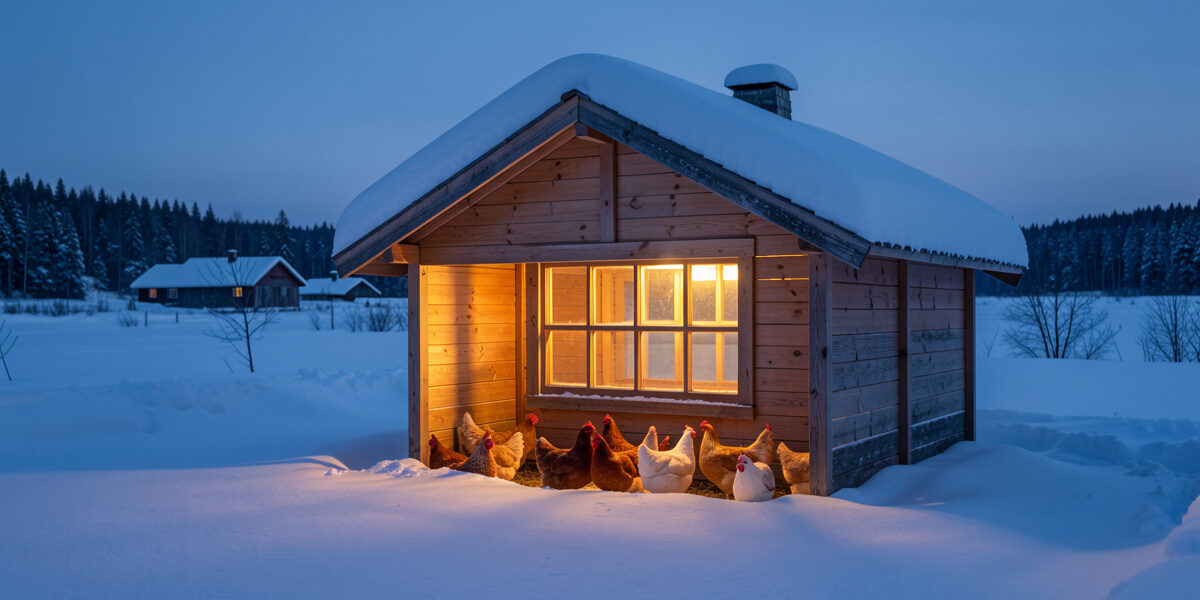
Chicken coop lighting for egg laying is the single cheapest upgrade that keeps a flock in eggs through a Nordic winter, and it works because laying is driven by day length, not temperature. Hens need roughly 14 to 16 hours of light a day to keep the reproductive cycle running; below about 12 hours, production tapers and then stops. At my latitude in Sweden, midwinter gives barely six hours of daylight, so without a supplemental light the coop goes dark on egg production from November to February.
I run a cold-hardy laying flock in a self-built, insulated coop here, and the light is wired into the same Home Assistant brain that drives the auto-door on a sunrise offset. This guide is the whole system, end to end: how much light, what color, when to add it, what timer to trust, how to power it when the sun barely shows, and — just as important — when supplemental light is the wrong call. I have made most of the mistakes already, including the 5 a.m. one where the light snaps off and the birds are stranded off the roost in the dark.
Why Light, Not Warmth, Drives Winter Laying
A hen’s body reads day length, not the calendar. Light entering the eye — and, in birds, directly through the skull to the pineal and hypothalamic region — suppresses melatonin and cues the pituitary to release the hormones that mature a yolk and push it down the oviduct. Longer days signal “good season to raise chicks,” and laying ramps up. Shortening days do the opposite. This is why a heated coop full of warm, comfortable hens still goes quiet in December: warmth was never the trigger. The day-length mechanism is standard husbandry, laid out in University of Maryland Extension’s home flock guide.
That single fact reframes the entire winter-egg problem. You are not fighting the cold; you are replacing missing daylight. A 9-watt LED on a timer does more for your egg basket than a 250-watt heat lamp ever will — and the heat lamp is a coop-fire risk I will not run. If your hens have stopped laying and you want the underlying mechanics, I cover the broader picture in my guide on why hens stop laying eggs and the seasonal angle in how to get chickens to lay eggs in winter.
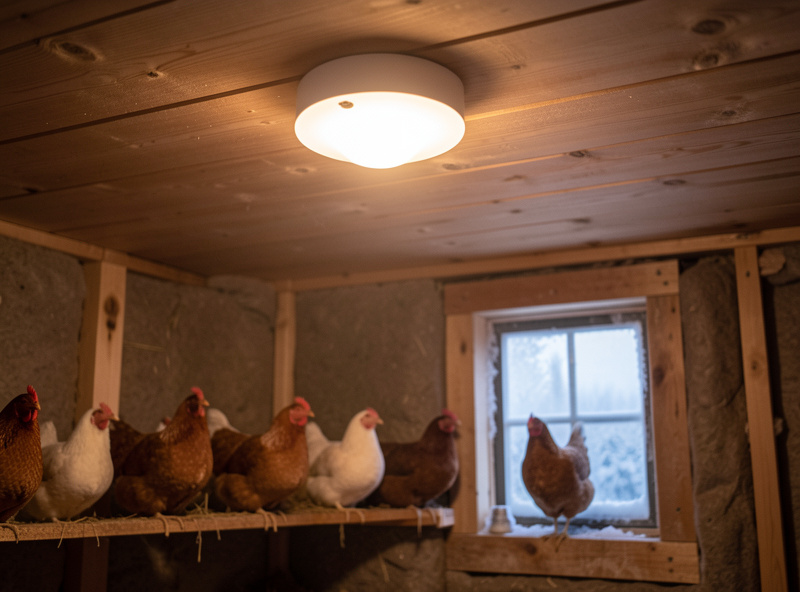
The 14 to 16 Hour Day: What the Number Means at a Nordic Latitude
The target is a total photoperiod of 14 to 16 hours, counting natural daylight plus supplemental light. Most keepers land on 14 to 15 as a sustainable figure; 16 pushes harder but leaves no margin and stacks the lifetime ovulation count faster. Michigan State University Extension’s guidance on managing light for backyard flocks lands on the same range. The further north you keep birds, the more of that total the bulb has to supply. In midsummer here I supply zero — the sky does 18 hours on its own. In midwinter the bulb does most of the work.
The way I calculate it is simple: pick a fixed “lights-up” target and let natural sunset end the day. If I want a 15-hour day and the sun rises at 08:45 in January, the light needs to come on around 05:00 to extend the morning. You never need to light both ends; you extend one end to hit the total. The exact arithmetic, season by season, is in my spoke on how many hours of light laying hens need.
| Season (approx. 60 degrees N) | Natural daylight | Supplement to hit 15h | Typical light-on time |
|---|---|---|---|
| Midsummer (Jun) | ~18 h | None | Off all season |
| Equinox (Sep/Mar) | ~12 h | ~3 h | Pre-dawn top-up |
| Late autumn (Nov) | ~7 h | ~8 h | ~04:30 morning |
| Midwinter (Dec/Jan) | ~6 h | ~9 h | ~04:00-05:00 morning |
Morning, Not Evening: Add Light Before Dawn
If you take one thing from this guide, take this: extend the morning, not the evening. A light that adds hours at the end of the day will switch off after dusk and drop the coop into instant darkness while birds are still on the floor — they cannot see to find the roost and end up sleeping in a heap on the litter, which is how you get pecking and chilled birds. Morning light comes on in darkness, the birds wake and feed, and natural dusk still falls gradually so they roost on their own schedule.
I learned this the hard way with an evening timer in my first winter. Now the coop light only ever extends the front of the day, and the natural sunset closes it. The full reasoning, and the one exception where a gentle evening dimmer is acceptable, is in morning vs evening coop light.
The Bulb: Brightness and Color Temperature
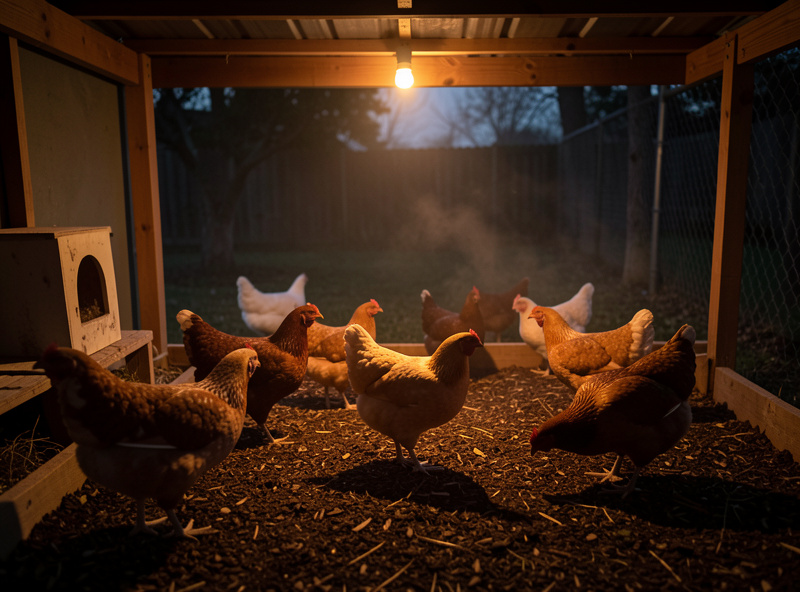
You need far less light than people assume. The benchmark keepers use is roughly 10 lux at bird height — bright enough to read a newspaper by, no more. In a standard backyard coop that is a single 6 to 9-watt LED, not a floodlight. Over-lighting does not produce more eggs; it just wastes power and can wind up a flock.
Color temperature matters more than wattage for behavior. Warm white in the 2700K to 3000K range is calm and still triggers laying; harsh cool-white 5000K-6500K light can read as agitating in a small coop and is the kind of glare that bleeds out of the windows and annoys the neighbours. I run warm white. I keep my notes on this in warm vs cool LED coop light color temperature. A simple low-wattage warm LED coop bulb is all most flocks need. As an Amazon Associate I earn from qualifying purchases.
The Timer: Mechanical, Digital, Smart, and Astro
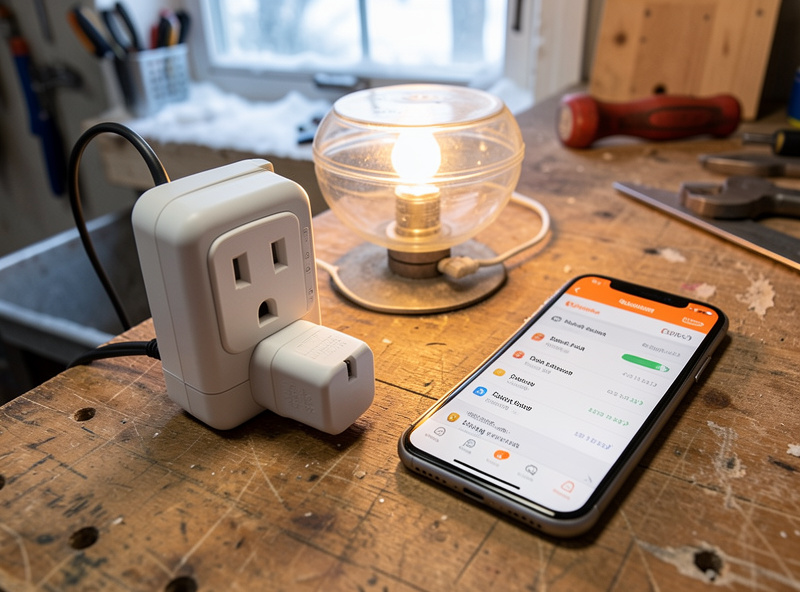
A coop light is only as reliable as the thing that switches it. The clock that runs it has to fire at 04:30 in a freezing, unattended coop, every day, without you. There are four real options, and they are not equal. A mechanical dial timer is dead simple and cheap but drifts and resets after a power cut. A digital timer holds time better and does multiple windows. A smart plug adds app control and schedules. A true astro schedule — what I run through Home Assistant — moves the on-time automatically as sunrise shifts through the season, so I set it once and never touch it again.
| Timer type | Tracks shifting sunrise | Survives power cut | Best for |
|---|---|---|---|
| Mechanical dial | No – manual resets | No (loses time) | Cheapest, simplest coops |
| Digital timer | No – manual resets | Usually (battery backup) | Set-and-forget on a fixed window |
| Smart plug | Some (astro feature) | Yes (re-syncs) | Wi-Fi coops, app control |
| Home Assistant / astro | Yes – automatic | Yes (re-syncs) | Integrated automated coops |
The astro schedule is the same logic that runs my pop door — sunrise offset, not a dumb clock — which I detail in the Home Assistant sunrise/sunset offset I actually run. For the full timer breakdown with the trade-offs that matter in a cold coop, see best coop light timer compared. A weatherproof outdoor digital outlet timer is the dependable middle ground if you are not running a smart hub.
Powering the Light: Wired vs Solar Through a Dark Winter
Here is the trap with solar coop lights in the north: the season you most need the light is the season the sun is gone. A solar lamp that charged beautifully in July gives you minutes, not hours, in December at 60 degrees N — exactly when the flock needs the bulb most. Solar has a real place for a run light or a coop with no power run to it, but for the core laying light in a hard winter, a wired low-voltage feed is what holds up.
I have run both. My laying light is wired; a small solar fixture handles the run gate where pulling cable was not worth it. The honest comparison, including battery sizing and what actually survives a Nordic winter, is in solar coop light vs wired, and the broader power math is in my guide to solar panel sizing for chicken coops.
The Dawn Dimmer: Avoiding the Light-Off Roost Scramble
A bare bulb on a timer snaps from full brightness to black in an instant. Even on a morning-only schedule, the cleaner setup ramps the light up gently at the start — a simulated dawn over a few minutes — and, where you do close the day with light, ramps it down so birds have time to roost. A dimmer that fades over five to ten minutes mimics real dawn and dusk and removes the panic moment entirely.
In my coop the light ramps from zero to full over about ten minutes, driven by the same hub. It is a small refinement that pays off in calmer birds and zero floor-sleeping. The how-to, including the cheap and the integrated way to build it, is in gentle dawn dimmer for the coop.
The Risks Supplemental Light Carries
Supplemental light is a tool, not a free lunch. A hen is born with a finite number of ova; pushing a long photoperiod year after year spends them faster and can bring laying problems earlier in life. Many experienced keepers deliberately give hens a lighting break in the deep of winter — or skip supplemental light entirely for a year — to let the flock molt, rebuild, and rest. There is also the molt itself: a hen in hard molt will not lay no matter how much light you give her, and forcing it is pointless.
I make this a personal choice per flock and per year, not a blanket rule. Pullets in their first winter often lay straight through without help. Older hens earn their rest. The full picture — burnout, molt timing, and the rest hens genuinely need — is in supplemental light risks for chickens. Anything that strays into a hen’s health beyond husbandry is a question for an avian vet, not a blog.
My Winter Lighting Setup, End to End
To make the system concrete: a single 9-watt warm-white (2700K) LED sits high in the coop on a dawn-ramp dimmer. Home Assistant turns it on at a sunrise offset so the total day lands near 15 hours, extending only the morning. The bulb ramps up over ten minutes; natural dusk ends the day. A temperature and humidity sensor shares the same coop node, and a freeze-watch automation runs the heated waterer — because a frozen waterer by 7 a.m. undoes everything the light bought you. I keep the whole automation logic in my complete Home Assistant coop guide.
None of it is exotic. The welder built the run frame, the 3D printer made the bracket the light hangs from, and the hub runs the schedule — the coop is just the workshop project with tenants. Ventilation still matters more than any of it; a damp coop frostbites combs no matter how good the light is, which is why I size winter ventilation to dump moisture first and add light second.
How Soon Will Eggs Come Back After You Add Light?
Adding light is not a switch that turns eggs back on overnight. The hormonal cascade takes time to spin up, so plan on roughly two to four weeks from when you start the longer photoperiod before production climbs back toward a normal winter rate. The lag is why I start supplementing in late autumn, as natural day length drops through about 12 hours, rather than waiting until the flock has already shut down in December — restarting a stopped flock takes longer than keeping a running one going.
Ramp the hours up gradually, too. Jumping a flock from a natural 7-hour day straight to 15 hours is a shock; I add light in steps over a week or two until the total lands where I want it. A hen that was already laying through autumn will respond faster than one that fully wound down. If your birds are also young pullets just reaching point of lay, light matters less — many lay straight through their first winter on day length alone, which I cover in the best laying breeds guide.
Five Lighting Mistakes I See Every Winter
The same handful of errors come up again and again in keeper forums and in my own early seasons. First: lighting the evening instead of the morning, which strands birds off the roost when the timer kills the light at dusk. Second: running a heat lamp as a light source — it is a fire hazard and the wrong tool; a 9-watt LED does the laying job a 250-watt lamp cannot do safely. Third: over-lighting with a blazing floodlight when 10 lux is plenty; brighter does not mean more eggs, it means more power burned and more glare leaking to the neighbours.
Fourth: a timer that resets after every power cut, so a January outage leaves the light dark for a week before you notice the egg count fall. A digital or smart timer with backup, or an astro schedule, removes that failure mode. Fifth: ignoring the rest question entirely — pushing a long photoperiod on the same hens year after year without ever giving them a winter off. I weigh that flock by flock, and I would rather lose a few midwinter eggs than burn a good layer out a year early. Every one of these is avoidable with the system laid out above, and each spoke in this cluster digs into one of them in full.
Frequently Asked Questions
How many hours of light do laying hens need in winter?
Hens need a total of 14 to 16 hours of light per day to keep laying. Most keepers target 14 to 15 hours, counting natural daylight plus supplemental light, and extend only the morning to reach that total.
Should I add coop light in the morning or the evening?
Add it in the morning, before dawn. Evening light switches off after dusk and leaves birds stranded off the roost in sudden darkness. Morning light comes on in darkness and lets natural sunset close the day gradually.
What wattage and color of light should a coop have?
A single 6 to 9-watt LED giving about 10 lux at bird height is enough. Use warm white, 2700K to 3000K, which triggers laying and keeps birds calm. Cool-white glare is unnecessary and can agitate a small flock.
Will a heat lamp make hens lay in winter?
No. Laying is triggered by day length, not warmth. A warm coop with short days still goes quiet. A low-wattage light on a timer drives laying, and it avoids the serious coop-fire risk that heat lamps carry.
Is supplemental light bad for chickens?
Used sensibly it is fine, but a hen has a finite egg supply, so a long photoperiod year after year spends it faster. Many keepers give the flock a winter lighting break to let hens molt and rest, especially older birds.
Does a solar coop light work in a northern winter?
Poorly for the core laying light. The darkest months give a solar panel little to charge with, so output collapses exactly when you need hours of light. A wired feed is more reliable up north; solar suits a run or gate light.
Related Guides
This hub anchors a full cluster on winter coop lighting. Work through the spokes for the detail behind each decision:
- How Many Hours of Light Do Laying Hens Need? The 14-16 Hour Window
- Morning vs Evening Coop Light: Why I Add Light Before Dawn
- Best Coop Light Timer: Mechanical, Digital, and Smart Compared
- Warm vs Cool LED Coop Light: Color Temperature for Laying and Calm
- Solar Coop Light vs Wired: Which Holds Up Through a Dark Winter
- Supplemental Light Risks: Burnout, Molt Timing, and Rest
- Gentle Dawn Dimmer for the Coop: Avoiding the Roost Scramble
For the wider winter picture, see my winter chicken keeping guide, best cold-hardy breeds, and the heated waterer guide that keeps the rest of the system running below zero.
Related Guides

Cooking With Fresh Farm Eggs: A Keeper Guide
Genuinely fresh farm eggs cook differently from store eggs in one frustrating way and several wonderful ones: they are miserable…

Grading Backyard Eggs: Quality and Size
Grading backyard eggs means two separate jobs: judging quality (candling for cracks, blood spots, and air-cell size) and sorting by…
Supplemental Light Risks: Burnout, Molt Timing, and the Rest Hens Need
Supplemental light keeps hens laying through winter, but it is not free of cost. The main risk is straightforward: a…