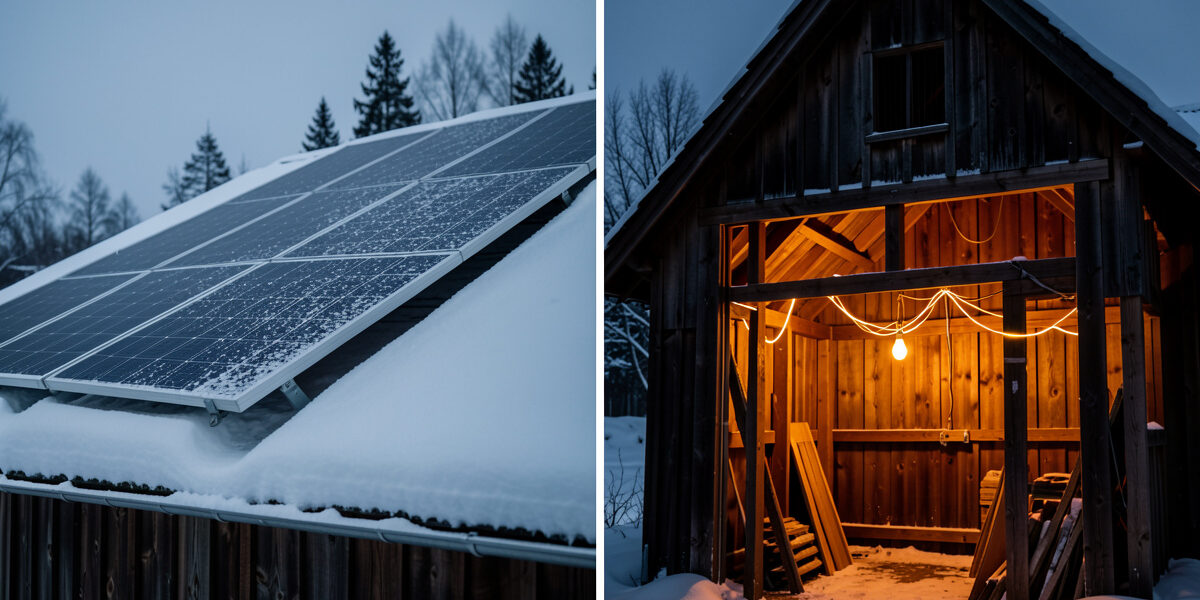
For the core laying light in a dark northern winter, wired beats solar — and it is not close. The cruel irony of a solar coop light is that the season you most need hours of supplemental light is the exact season a solar panel has almost nothing to charge with. A panel that ran a light beautifully in July gives you minutes, not the hours you need, in December at 60 degrees north. Solar earns its place for a run light, a gate, or a coop with no power nearby — but for keeping hens laying through a hard winter, a wired feed is what holds up.
I run both on my setup in Sweden. The laying light is wired into the coop’s low-voltage supply and driven on a sunrise schedule; a small solar fixture lights the run gate where pulling a cable was not worth the trench. That split is deliberate, and it comes from watching solar fall flat exactly when it mattered. Here is the honest comparison, including why cold makes it worse and where solar still makes sense.
The Winter Solar Trap
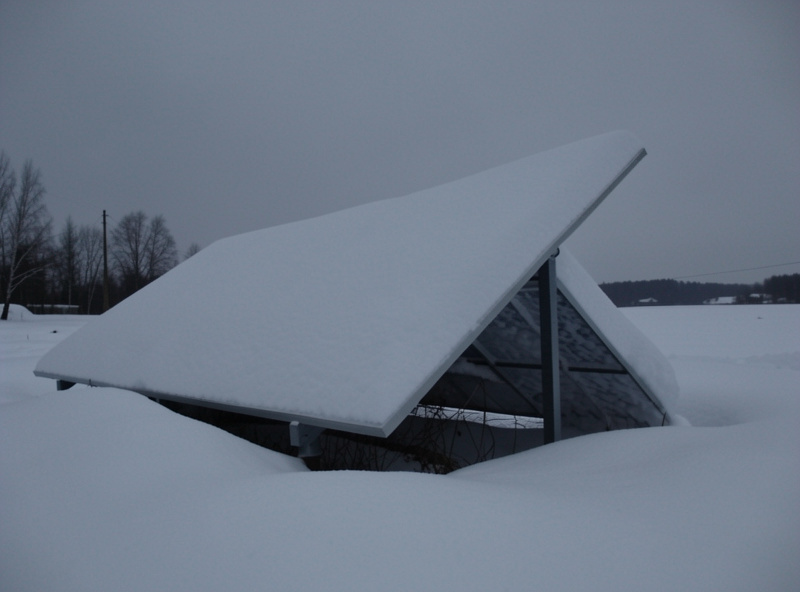
Solar lights work on a simple loop: the panel charges a battery by day, the battery runs the light by night. That loop assumes the day delivers enough sun to refill what the night drains. In a northern winter it does not. Short days, a low sun angle, heavy cloud, and a panel often dusted with snow or frost mean the battery never gets a full charge. By midwinter a solar coop light may give you a dim hour or two — useless when you need to add eight or nine hours before dawn to keep a flock laying — the 14-to-16-hour photoperiod Michigan State University Extension’s guidance on managing light for backyard flocks describes.
Summer hides the problem completely. In June a solar light runs all night on a couple of hours of charge, and you conclude solar is brilliant. Then November arrives, the panel sees almost no usable sun, and the light that drove your eggs goes dark in the exact week you needed it. The mismatch between supply and demand is structural, not a question of buying a better solar light.
Cold Makes It Worse
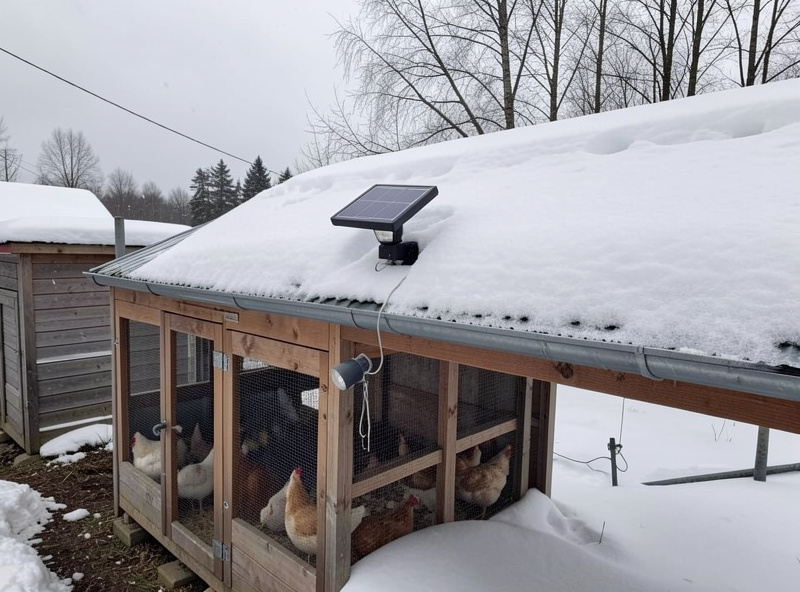
It is not just the lack of sun. Cold itself reduces the usable capacity of the batteries most solar lights carry, so even the little charge the panel manages does not all come back out. A pack that holds a useful charge at room temperature delivers noticeably less at sub-zero coop temperatures, and repeated deep discharges in the cold shorten its life. So the winter solar light is hit twice: less charge going in, and less of that charge usable coming out. A wired light has neither problem — it pulls steady power regardless of how dark or cold it is outside.
This is the same reliability logic I apply to the whole coop. A camera that dies at the run edge or a waterer that freezes by 7 a.m. is worse than not having relied on it, because you planned around something that quietly failed. A laying light is in that category — if it does not come on, you lose eggs before you notice. For the laying light, I want the boring certainty of a wire.
Solar vs Wired, Head to Head
| Factor | Solar coop light | Wired coop light |
|---|---|---|
| Winter reliability (far north) | Poor – little charge | Excellent – steady power |
| Cold tolerance | Reduced battery capacity | Unaffected |
| Install effort | Easy – no wiring | Harder – run cable |
| Running cost | None | Tiny (a few watts) |
| Best use | Run, gate, no-power coop | Core laying light |
| Works with a timer/hub | Limited | Fully |
Where Solar Still Earns Its Place
None of this means solar is useless. For a job where a missed night does not cost you anything — a path light, a run gate, a bit of evening visibility so you can see to lock up — a solar fixture is genuinely handy and saves you trenching a cable. My run-gate light is solar for exactly that reason: if it is dim one January evening, nothing is lost. The rule is simply to match the power source to the stakes. Low-stakes, intermittent light: solar is fine. The light your egg supply depends on: wire it.
If your coop has no mains access at all and running a cable is genuinely impossible, a solar-plus-battery system can drive a laying light, but you have to size it properly for the worst week of the year, not the average — a much bigger panel and battery than the all-in-one lights suggest. That sizing math is the same as for a solar door or heater, which I work through in solar panel sizing for chicken coops. Most keepers find that once they price a winter-proof solar system, running a low-voltage cable is cheaper and far more reliable.
How I Wire a Coop Light
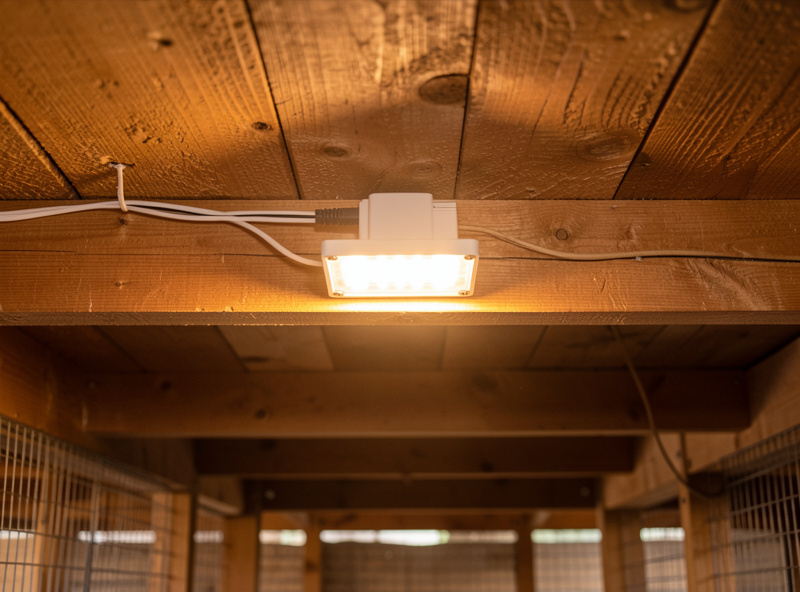
The wired side is not complicated. A low-voltage LED on the coop’s supply, switched by a timer or the smart hub, draws only a few watts — trivial running cost for the eggs it returns. I keep the wiring tidy and protected from the birds, run it on the same circuit as the door and sensors where practical, and put the whole thing on a sunrise-offset schedule so it tracks the season automatically. The timer choices for that are in the best coop light timer comparison, and the automation logic is in the complete Home Assistant coop guide.
If you are buying rather than building, a basic low-voltage wired LED coop light paired with a weatherproof timer covers it. As an Amazon Associate I earn from qualifying purchases. Keep the bulb warm white and dim, as covered in the color temperature guide, and you have a laying light that does not care how dark the winter gets.
Frequently Asked Questions
Is a solar coop light good enough for winter laying?
Not in the far north. Short, cloudy winter days give a solar panel little to charge with, so output collapses exactly when you need hours of supplemental light. For the core laying light in a hard winter, a wired feed is far more reliable.
Why does solar fail in winter when it works in summer?
Solar depends on the day delivering enough sun to refill what the night drains. Summer easily does that. A northern winter does not, due to short days, low sun, cloud, and snow on the panel, so the battery never fully charges.
Does cold affect solar coop lights?
Yes. Cold reduces the usable capacity of the batteries most solar lights use, so even the small charge the panel manages does not all come back out. The winter solar light is hit twice, by less charge in and less of it usable.
When is a solar coop light a good choice?
For low-stakes lighting where a dim or dark night costs nothing, such as a run gate, a path light, or a coop with no mains power. Match the power source to the stakes: solar for intermittent light, wired for the laying light.
Can solar run a laying light if I have no mains power?
It can, but only if you size the panel and battery for the worst week of winter, not the average, which means a much larger system than all-in-one solar lights provide. Often a low-voltage cable ends up cheaper and more reliable.
How much power does a wired coop light use?
Very little. A low-voltage LED laying light draws only a few watts, so the running cost is trivial against the eggs it returns. It pulls steady power regardless of how dark or cold it is, which is its whole advantage over solar.
Related Guides
- Chicken Coop Lighting for Egg Laying: The Winter Guide
- Best Coop Light Timer: Mechanical, Digital, and Smart
- Warm vs Cool LED Coop Light Color Temperature
- Solar Panel Sizing for Chicken Coops
- Home Assistant Chicken Coop Automation: Complete Guide
Related Guides
Water-Level and Flow Sensors: Knowing the Waterer Is Empty Before They Do
A coop water-level sensor tells you the drinker is going dry — or freezing solid — before the flock does,…
Ammonia Sensors for the Coop: Catching Air Problems Before You Smell Them
An ammonia sensor belongs at the birds’ breathing height, close to the litter where the gas is generated, because that…

Node-RED vs Home Assistant Automations for the Coop: When to Use Which
Use native Home Assistant automations for the coop’s simple, safety-critical rules — the sunrise door, the freeze-watch waterer — and…