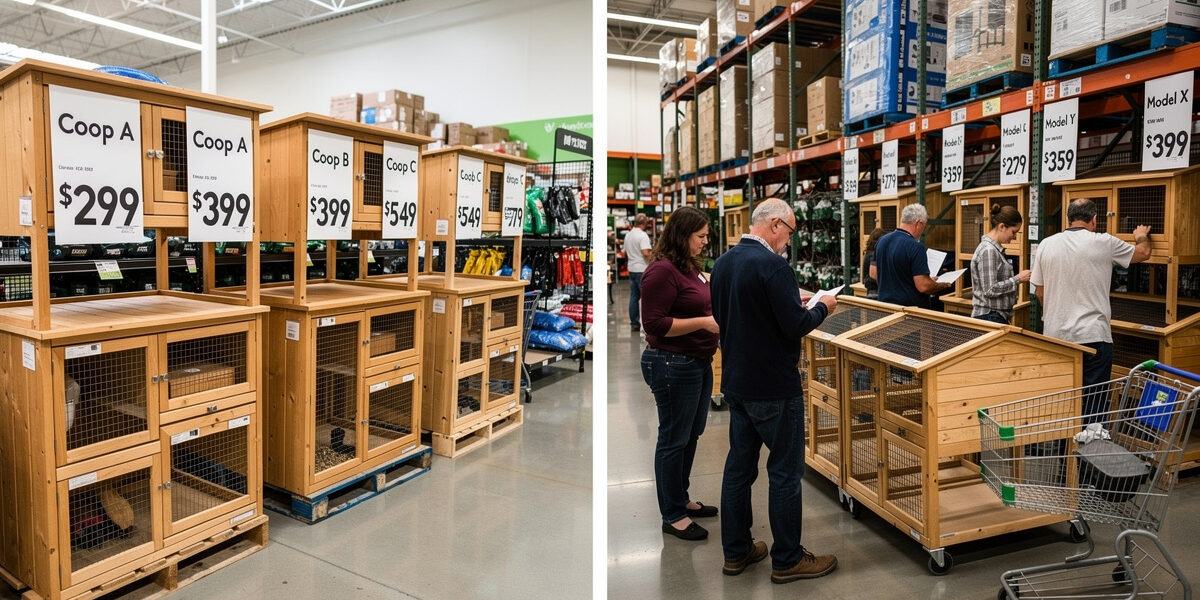
Chicken coops for sale fall into six distinct buying channels — big-box farm stores, online marketplaces, specialty backyard-chicken brands, custom Amish or Mennonite builders, local craigslist or Facebook Marketplace, and direct-from-manufacturer specialty companies. Each channel has predictable pricing, quality, and shipping patterns. Picking the wrong channel for your specific coop type creates the most common purchase regret — buyers shop for $1,500 walk-ins on Amazon and end up with $400 disposable lift-tops misrepresented as walk-ins.
This guide covers where to actually find chicken coops for sale in 2026, what each channel charges for what type of coop, the shipping considerations that matter at this scale, the new-vs-used market math, and the four mistakes that cause most coop purchase regret. For matching coop type to buyer profile, see our best chicken coops buyer’s guide. For retailer-by-retailer breakdowns of the actual chicken coop selection at the major stores, see our reviews of Tractor Supply, Lowes, Wayfair, and Amazon.
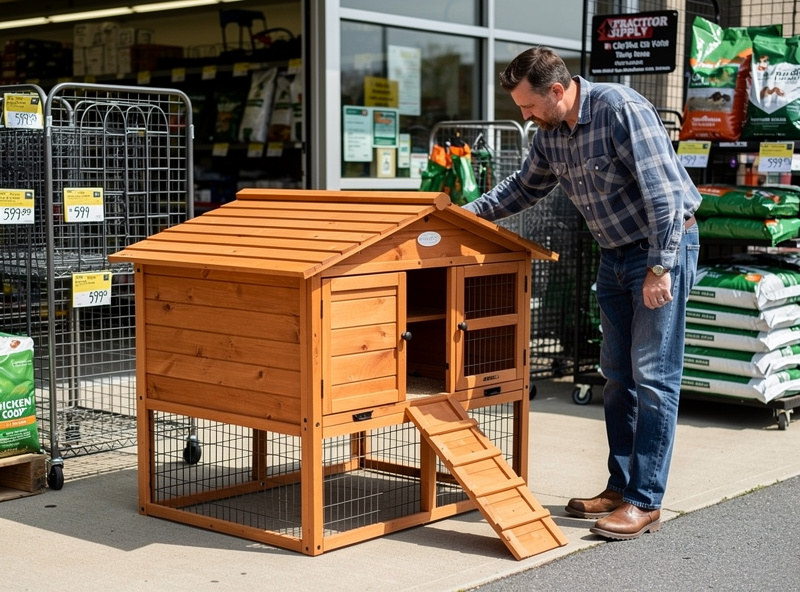
Where to Buy a Chicken Coop in 2026
Six buying channels cover the chicken coop market, each with predictable pricing tiers and quality patterns.
| Channel | Best Coop Type | Typical Price Range | Quality Pattern |
|---|---|---|---|
| Big-box farm stores (Tractor Supply, Rural King) | Compact lift-top, A-frame tractors | $280-$900 | Entry-level, thin lumber, 2-3 yr life |
| Online marketplaces (Amazon, Wayfair, Walmart) | Compact and mid-size lift-top | $200-$1,500 | Highly variable, capacity often inflated |
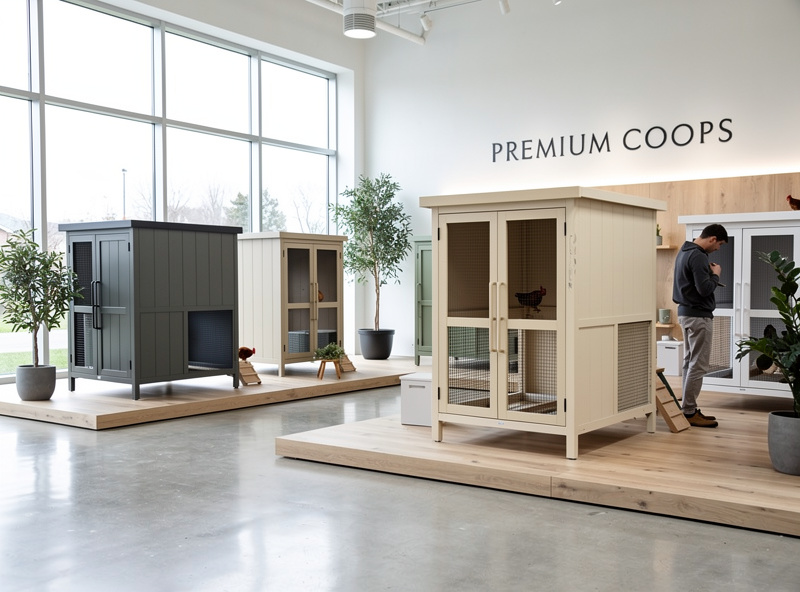
| Specialty brands (Eglu/Omlet, Carolina Coops, Roost & Root) | Premium walk-ins, plastic modulars | $1,500-$5,000 | Premium materials, 10+ yr life, modern features |
| Custom Amish/Mennonite builders | Walk-ins, barn-style, custom designs | $1,200-$4,500 | Heavy hardwood, traditional designs, 15+ yr life |
| Local Craigslist / Facebook Marketplace | Used coops of all types, DIY builds | $100-$1,500 | Variable, requires inspection |
| Direct from manufacturer | Mid-tier and premium walk-ins | $800-$3,500 | Often best value, factory-direct pricing |
Big-box farm stores dominate the entry-level market because shoppers can see the product before buying — but every chain stocks the same 3 to 5 entry-level models. Online marketplaces offer the widest selection but require careful spec-sheet reading. Specialty brands deliver premium materials and modern features at higher prices. Custom Amish builders offer the longest service life with traditional designs. Local marketplaces are hit-or-miss but can deliver $500 coops for $150 with patience — our chicken coops near me guide walks through how to find legitimate local sellers in your zip code. Direct-from-manufacturer is the most overlooked channel and often the best value for mid-tier walk-ins.
What Each Channel Sells Best
Channels specialize in different coop categories. Picking the right channel for your target coop type matters as much as picking the right model.
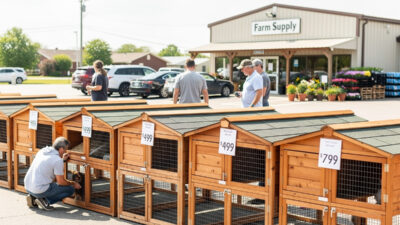
Big-box farm stores (best for entry-level prefab): Tractor Supply, Rural King, and similar chains stock 3 to 5 entry-level lift-top coops year-round, plus 2 to 3 A-frame tractors. Capacity ranges from 2 to 8 birds, prices from $280 to $900. Best for first-time buyers wanting to inspect before purchase. The trade-off is thin pine framing and chicken wire on most models — typical 2 to 3 year service life.
As an Amazon Associate I earn from qualifying purchases.
Online marketplaces (best for specific researched models): Amazon, Wayfair, and Walmart offer the widest selection — hundreds of coop models from dozens of manufacturers. Best when you’ve researched a specific model and need to verify pricing or shipping availability. Worst when shopping by category — capacity claims are often inflated and quality varies dramatically within the same price tier.
Specialty brands (best for premium walk-ins and design-conscious buyers): Brands like Eglu (HDPE plastic modulars), Carolina Coops (custom traditional walk-ins), and Roost & Root (modern wood designs) specialize in premium-tier coops with proper materials, longer warranties, and integrated smart-coop features. Higher prices but the longest service life in the market.
Custom Amish builders (best for traditional walk-ins): Pennsylvania, Ohio, Indiana, and Illinois Amish or Mennonite builders construct walk-in coops from heavy oak, cedar, or pine using traditional joinery. 15+ year service life, custom dimensions on request, but requires either driving to the builder or paying $200 to $500 in shipping for larger structures.
Local marketplaces (best for budget-conscious buyers with patience): Craigslist and Facebook Marketplace listings from sellers exiting chickens (downsizing, moving, kids leaving home) often go for 30 to 60 percent of new prices. Best when you can inspect in person and verify the eight quality markers before paying. Worst when you must buy quickly without inspection. I’ve picked through this market myself over the years — the good finds are usually well-built coops sold for reasons that have nothing to do with the coop (a move, a divorce, a family that simply stopped keeping birds), not coops with hidden problems. Ask why they’re selling before you drive out to look.
Direct from manufacturer (best for mid-tier walk-ins): Many manufacturers sell direct through their websites at 15 to 25 percent below retail markup. Best for mid-tier walk-ins ($1,500 to $3,000 range) where the savings are meaningful. Often comes with factory-direct shipping logistics that simplify delivery. Detailed picks for mid-flock walk-ins are in our 10-chicken and 12-chicken coop guides.
Shipping Considerations
Shipping costs scale dramatically with coop size. Below 200 lbs (compact lift-tops, A-frame tractors), standard parcel shipping handles delivery for $50 to $150. Above 200 lbs, freight shipping kicks in with very different cost and logistics patterns.
Parcel shipping (under 200 lbs): UPS, FedEx, or similar carriers handle delivery to your driveway. Total shipping typically $50 to $150 depending on distance. Most online marketplace coops ship via parcel. The compact size limits coop type to lift-tops under 4×8 ft and A-frame tractors.
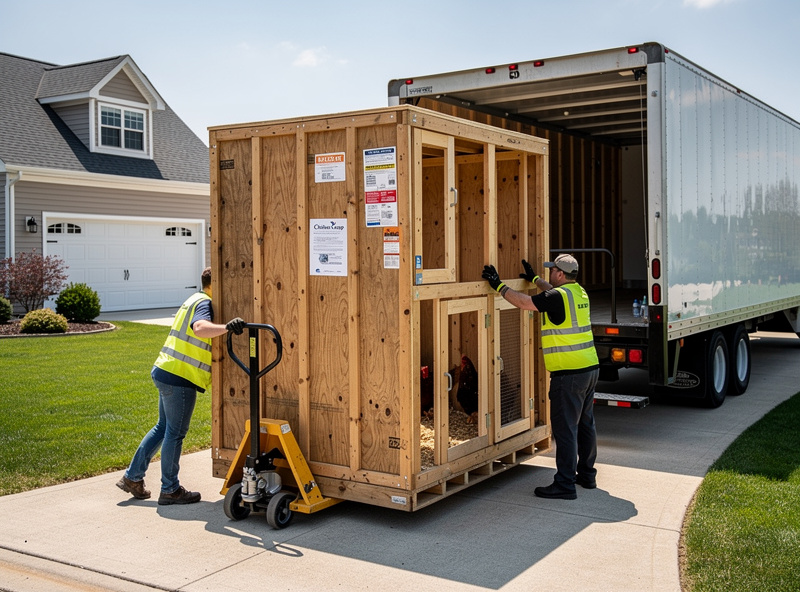
Freight shipping (200 to 800 lbs): LTL (less-than-truckload) freight handles delivery to your curb but typically NOT into your yard. Shipping costs $150 to $400 for typical mid-size walk-in coops. Plan for 2 to 4 strong adults to move the coop from the curb to the assembly location after delivery — I underestimated this on my own walk-in build and ended up borrowing a neighbor’s furniture dolly to get the heaviest panel section across the yard without a repeat of that afternoon.
Premium delivery (700+ lbs, large walk-ins): Some premium brands include white-glove delivery (uncrating, partial assembly, placement at your specified location) for $300 to $700 above standard freight. Worth paying for if the coop is too heavy to move with available labor.
Pickup-only (custom Amish, large structures): Some custom builders only sell at pickup. Plan for a 3/4-ton or larger pickup or trailer rental for typical 6×8 to 8×10 ft custom coops. Trailer rentals run $50 to $150 per day plus mileage.
New vs Used Coop Math
Used chicken coops save 40 to 70 percent off new prices but require more inspection effort and carry higher fail-faster risk.
Buy new when: You want a 5+ year service life, you live somewhere with limited used market, you need a specific feature (smart-coop integration, particular dimensions, brand warranty), or you’re buying a premium walk-in or specialty brand where used quality is rare.
Buy used when: Your budget caps under your target coop’s new price, you can inspect in person, you have basic carpentry skills to repair worn parts, or you’re testing the chicken-keeping commitment before buying premium new construction.
What to inspect on used coops: Wire panels for rust or sagging, framing lumber for rot at ground-contact points, hinges for play and rust, roof material for water damage, floor for urine staining and rot, nesting box dimensions (12x12x12 minimum), and any signs of mite infestation. Run a white cloth or a strip of tape along the underside of the roost bars — red or blackish specks mean roost mites are hiding in the cracks during the day and feeding on the birds at night (The Chicken Chick), and that infestation comes with the coop whether the seller mentions it or not. Walk around the coop and tap each major frame member — listen for hollow or soft sounds that indicate rot. Anything that creaks under load will fail within 6 to 12 months. Our backyard chickens beginners guide covers the broader new-vs-used decision.
Best Times to Buy Chicken Coops
Coop pricing is seasonal. Buying at the right time of year cuts retail by 20 to 40 percent on most models.
Best time: October through February. Off-season for chicken keeping. Big-box stores discount remaining inventory, online marketplaces run end-of-year clearance, and custom builders have empty schedules and accept smaller orders. Expect meaningful discounts off summer prices — every automation upgrade I’ve added to my own coop over the years got ordered in this window, same logic as buying the coop itself off-season.
Worst time: March through May. Peak chick-buying season. Coop demand spikes, prices jump 15 to 25 percent, and inventory sells out at popular price points. Avoid buying during this window unless you have no other choice.
Sweet spot for online marketplaces: late August through early October. Sellers who failed to move inventory during peak season drop prices to clear before winter. Best window for premium specialty brands like Eglu and Omlet that rarely discount during peak demand.
Custom builder timing: Order in November or December for spring delivery. Builders schedule work during winter slowdown, which gives you 4 to 6 month lead time at off-season prices. Trying to order a custom coop in April for May delivery typically costs 30 percent more and gets pushed to June or July anyway.
Common Coop Buying Mistakes
Four mistakes account for nearly every coop purchase regret reported on backyard chicken forums.
Mistake 1 — buying inflated-capacity prefabs: “Fits 8 chickens” listings on Amazon and Wayfair often deliver noticeably fewer birds at proper density. Always verify interior square footage and divide by roughly 4 sq ft per standard bird — extension space-allowance guidance for backyard flocks lands in that same range (poultry.extension.org). The chicken coop size guide covers the math.
Mistake 2 — wrong channel for the coop type: Shopping for premium walk-ins on Amazon or trying to find compact lift-tops at custom Amish builders wastes time and produces disappointment. Match the channel to the coop type — see the table above.
Mistake 3 — ignoring shipping costs: A $1,200 walk-in with $450 freight shipping is a $1,650 total cost — 38 percent above the listed price. Always factor shipping into the budget comparison, especially for online marketplace and direct-from-manufacturer purchases.
Mistake 4 — skipping the smart-coop check: If you plan to add smart automation within 24 months, buy a coop designed with smart integration in mind. Retrofitting smart features to unsuitable coops costs 2x more and rarely works as well. See our best smart coop devices guide for compatibility considerations.
Frequently Asked Questions
Where can I buy a chicken coop?
Six channels sell chicken coops: big-box farm stores (Tractor Supply, Rural King) for $280 to $900, online marketplaces (Amazon, Wayfair, Walmart) for $200 to $1,500, specialty brands (Eglu, Carolina Coops) for $1,500 to $5,000, custom Amish/Mennonite builders for $1,200 to $4,500, local Craigslist/Facebook Marketplace for $100 to $1,500, and direct from manufacturer for $800 to $3,500.
Are chicken coops sold online worth buying?
Yes for specific researched models. Online marketplaces offer the widest selection but capacity claims are often inflated. Always verify interior square footage and divide by 4 sq ft per standard bird. Avoid sub-$280 listings – they typically use chicken wire instead of hardware cloth and fail within 2 to 3 years.
What is the best chicken coop brand?
Brand quality varies by category. For premium plastic modulars, Eglu/Omlet leads. For premium walk-ins, Carolina Coops and Roost & Root deliver consistently. For traditional walk-ins, custom Amish builders in Pennsylvania, Ohio, Indiana, and Illinois offer the longest service life. Big-box brands at entry level are interchangeable – quality follows price tier more than brand name.
How much should I budget for a chicken coop?
Budget $280 to $550 for 2-4 hen lift-tops, $600 to $1,500 for 6-8 hen mid-size coops, $1,200 to $3,500 for 8-20 hen walk-in prefabs, and $700 to $1,800 for converted shed builds. Add 10 to 25 percent for shipping on online or specialty-brand purchases. Factor 5-year maintenance costs of $150 to $500 for quality coops.
Can I get a chicken coop delivered?
Yes, but shipping costs scale with size. Coops under 200 lbs ship via parcel for $50 to $150. Coops 200 to 800 lbs require LTL freight at $150 to $400 (curbside delivery only). Premium delivery with white-glove placement runs $300 to $700 extra. Custom Amish builders often require pickup with a 3/4-ton truck or trailer.
What is the cheapest place to buy a chicken coop?
Local Craigslist and Facebook Marketplace deliver the cheapest coops at $100 to $500 for used coops in good condition. Big-box farm stores are cheapest for new coops at $280 to $550 for compact lift-tops. DIY builds from scratch run $200 to $500 in materials for 4 to 8 hen capacity. Avoid prefab coops under $250 – they typically fail within 2 winters.
Bottom Line: Match Channel to Coop Type, Time the Purchase, Verify Quality
Chicken coops for sale exist across six channels with distinct strengths. Big-box stores work for entry-level inspection-before-buying. Online marketplaces win for specific researched models. Specialty brands deliver premium quality at premium prices. Custom Amish builders offer the longest service life. Local marketplaces beat retail when you can inspect in person. Direct-from-manufacturer is often the best value for mid-tier walk-ins. Time the purchase for October through February for the best discounts off peak prices, and verify the eight quality markers before paying.
For matching coop type to your specific buyer profile, see our best chicken coops buyer’s guide. For exact sizing math by flock count, the chicken coop size guide covers the breakdowns.
Related Guides
- Best Chicken Coops 2026: Complete Buyers Guide
- Chicken Coop Size Guide: How Many Chickens Per Square Foot
- Chicken Coop for 6 Chickens: Best Picks & Layout
- Chicken Coop for 12 Chickens: Family-Flock Picks
- Portable Chicken Coops & Tractors: Complete 2026 Guide
- Backyard Chickens for Beginners: Everything You Need to Know in 2026
Related Guides
Chicken Coops Near Me: Local Sourcing Guide (2026)
Searching “chicken coops near me” in 2026 surfaces a mix of local farm stores, regional builders, and individual sellers —…
Custom Chicken Coops: When to Pay for Bespoke
Custom chicken coops are designed and built for your specific situation — exact dimensions, particular climate adaptations, integrated smart-coop wiring,…
Amish Chicken Coops: Premium Build Quality (2026)
An Amish chicken coop is built by hand in a workshop in Pennsylvania, Ohio, Indiana, or Illinois — mortise-and-tenon joints,…