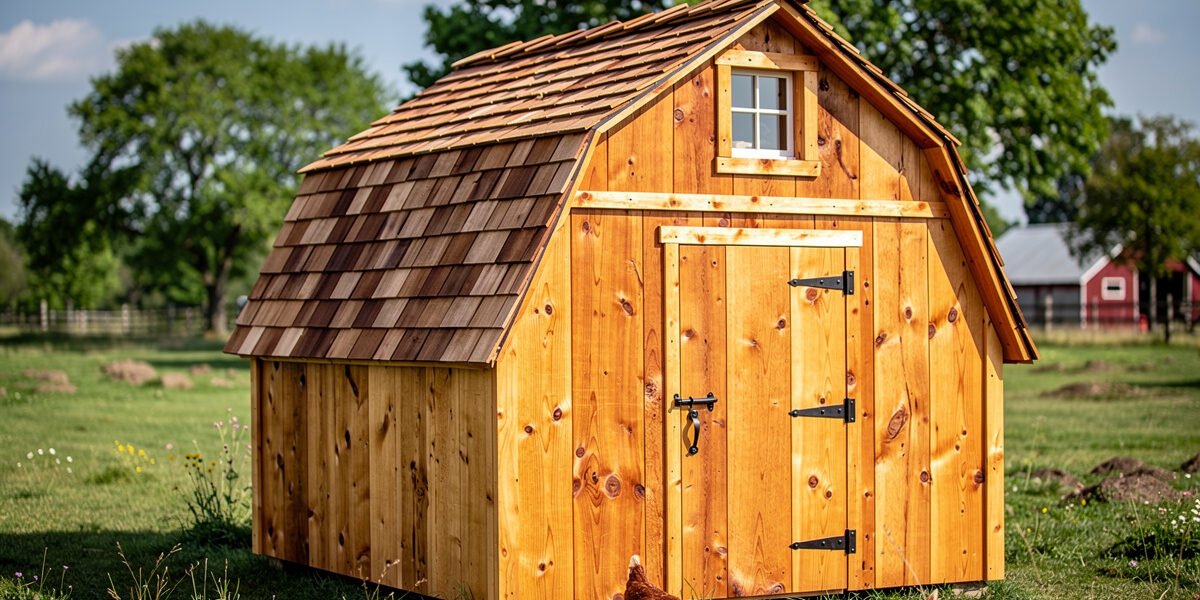
An Amish chicken coop is built by hand in a workshop in Pennsylvania, Ohio, Indiana, or Illinois — mortise-and-tenon joints, oak or cedar framing, and joinery techniques proven across multiple generations of farm use. The result is a structure with a 15-to-25-year service life: roughly 2x to 3x the lifespan of a typical prefab, and the longest in the residential chicken-coop market. The trade-off is cost — 30 to 80 percent above equivalent prefab pricing, which puts a compact 4×4-foot Amish coop at $1,000 to $1,500 and a walk-in 8×10 at $2,500 to $4,500.
For keepers with a decade-plus horizon, the annual cost crosses below prefab replacement math somewhere around year 8 or 9, and from there the Amish coop is cheaper per year for every additional year it stands. For keepers testing the hobby with a 3-to-5-year window, the same outlay is money spent against a coop that will be sold or scrapped before it earns the difference back. This article separates authentic Amish builds from the marketing term, walks through the construction quality that drives the longevity gap, and lays out the logistics of actually getting one home — including the verification step most buyers skip and the freight math that catches people off guard.
For matching coop type to your flock size and buyer profile, see the best chicken coops buyer’s guide. For the strongest non-Amish premium-tier alternative built from US-made cedar, the Over EZ chicken coop review covers the closest comparable option.
Authentic Build Versus Amish-Styled Marketing
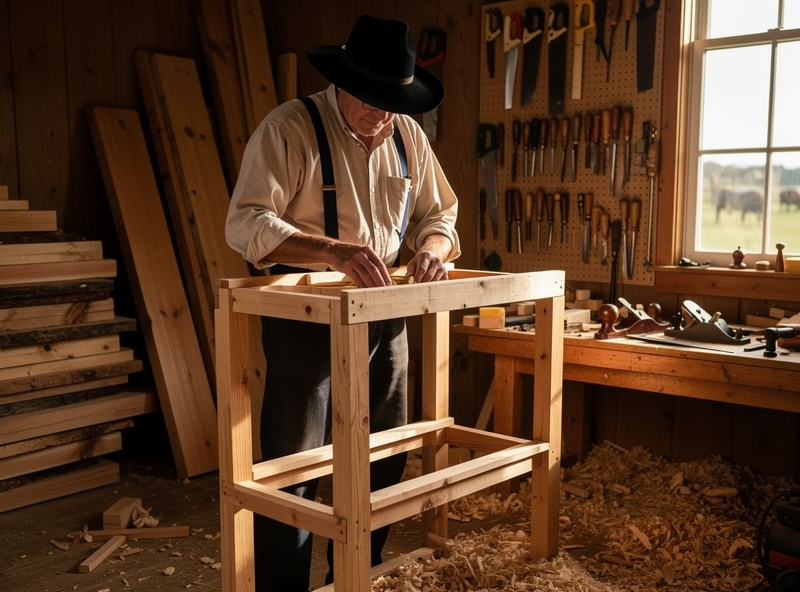
An authentic Amish chicken coop has three defining features that separate it from everything else on the market. It is built by an actual Amish or Mennonite craftsman in their workshop. It uses traditional joinery — mortise-and-tenon joints, dovetails, lap joints — rather than screws and nails alone. And it is constructed from heavy hardwood lumber: oak, cedar, or thick-dimension pine, not the thin softwood that prefab manufacturers stamp out by the thousand. All three features matter; remove any one and you have something that costs less for a reason.
The geographic concentration of Amish coop builders runs through Pennsylvania (Lancaster County — the largest and oldest Amish settlement in the country), Ohio (Holmes and Wayne counties, the second-largest settlement), Indiana (LaGrange and Elkhart counties, the third-largest), and Illinois (Arthur and Arcola areas, a smaller but established settlement). These rankings are confirmed by Elizabethtown College’s Young Center for Anabaptist and Pietist Studies, the standard academic source for Amish settlement data. Builders in these regions construct coops using techniques their fathers and grandfathers used — proven over multiple generations of farm use, not engineered for a catalog photo.
What does not qualify, despite the marketing: any coop labeled “Amish-styled” without a verifiable build location, mass-produced coops from manufacturers using Amish branding without Amish builders, and anything described as “Amish-inspired” or “Amish-quality” without specific builder attribution. The term has been diluted to the point of meaninglessness in online marketplaces. The single most reliable verification method is a phone call to the seller asking for the builder’s name and workshop address. If the seller cannot or will not provide that information, the coop is not Amish-built regardless of what the listing says. This is not a hypothetical caution — the gap between what is advertised as Amish and what is actually built by Amish craftsmen is wide enough that buyers who skip the phone call often end up with a factory product wearing a borrowed label.
Three Channels: Workshop, Co-op Store, Online Retailer
Authentic Amish coop builders sell through three primary channels, each with predictable logistics, pricing, and lead-time patterns. The table below maps the landscape.
| Channel | Typical Price Range | Lead Time | Delivery Logistics |
|---|---|---|---|
| Direct from Amish workshop (visit in person) | $1,000-$3,500 | 2-12 weeks | Pickup with truck or trailer required |
| Amish co-op stores (Lancaster, Holmes, etc.) | $1,200-$4,000 | 1-8 weeks (often in stock) | Pickup or local delivery within 200 miles |
| Verified Amish online retailers | $1,500-$4,500 | 4-16 weeks | Freight shipping nationwide ($200-$500) |
Direct workshop visits offer the lowest prices and the most customization, but they require driving to Pennsylvania, Ohio, Indiana, or Illinois. The drive is not trivial — buyers arriving with a sedan or a compact truck discover that a walk-in Amish coop does not fit, and the builder’s lot is not a storage facility for coop that cannot be transported. Plan for a 3/4-ton or larger pickup or a trailer rated for the coop’s weight, and map the route before committing. Amish co-op stores aggregate inventory from multiple builders and offer a middle path: broader selection without driving to individual workshops, and often in-stock inventory that eliminates the build lead time entirely. Verified Amish online retailers ship nationwide but at higher prices reflecting freight costs, longer lead times, and the retailer’s margin on top of the builder’s price.
Why These Coops Outlast Prefabs by a Decade
The longevity gap between an Amish coop and a typical prefab is not magic — it is a stack of specific construction decisions that each add years to the service life. Understanding those decisions matters because they are the reason the price premium exists, and they are also the checklist for evaluating any coop that claims to be Amish-built.
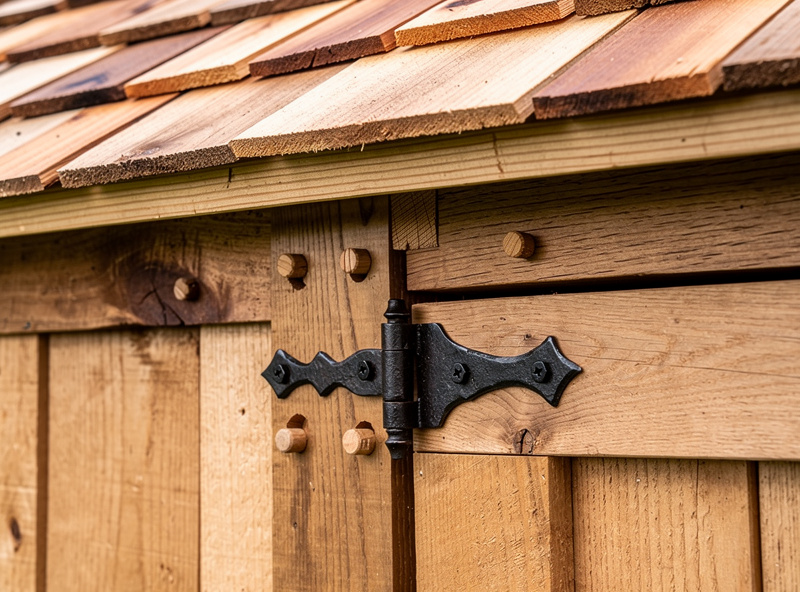
Mortise-and-tenon joinery is the structural backbone. Major frame connections use interlocking wood joints rather than metal fasteners alone. Joints stay tight as the wood expands and contracts seasonally, while screw-only construction develops play that allows water infiltration and rot. I built my own run frame welded, not joined — a different material solving the same problem — but the logic is identical to what draws me to a good mortise-and-tenon coop: a connection that does not rely on a fastener slowly working loose is the difference between a structure that outlives you and one you are patching every spring.
Heavy-dimension hardwood framing — 2×4 or larger in oak, cedar, or thick pine — versus the 2×2 or 1×2 pine and fir that prefabs typically use. Heavier framing tolerates years of weather exposure without warping, splitting, or rotting. The wood is dense enough that a sensor bracket screwed into it holds firm for a decade; thin prefab siding strips under the same screw are loose within two seasons.
Cedar shingle or galvanized metal roofing outlasts the materials prefab manufacturers use by a wide margin. Cedar shingle roofs commonly run 25 to 40 years and galvanized metal 30+ years with basic upkeep — per general roofing-material lifespan data, which cites house-grade asphalt shingles at 15 to 30 years. Both dramatically outlast the thin, unmaintained asphalt shingle a coop roof usually gets (often failing well inside 15 years in full weather exposure) or the treated plywood (5-8 years) used on most prefabs.
Tongue-and-groove hardwood floors with proper drainage handle 15+ years of moisture and bedding cycles without rotting through, versus plywood with no drainage that softens and fails inside a decade. Cabinet-grade hardware — heavy steel hinges, 2-point latches with throw bolts, often hand-forged — lasts 20+ years versus 5 to 8 years for the stamped pot-metal hinges and latches on prefab coops. And generous ventilation design — high gable vents, soffit vents, adjustable wall vents, often 2x to 3x the ventilation area of prefabs — extends interior wood life and improves hen comfort by dumping moisture before it condenses on cold surfaces. The chicken coop bedding guide covers how ventilation interacts with bedding management in detail.
Getting It Home: Pickup, Delivery, and Freight Reality
Amish coops do not ship via standard parcel carriers — they are too large and too heavy for UPS or FedEx ground. Three logistics paths exist, and the cost difference between them is significant enough to shape the buying decision.
Workshop or co-op pickup is the cheapest option. Drive to the builder location with a suitable truck or trailer, and the total cost is the coop price plus fuel and tolls — typically $50 to $200 round-trip from East Coast or Midwest locations. This path works for buyers within roughly 500 miles of the build regions. Beyond that radius, fuel and time costs erode the savings, and the logistics of a long-distance truck trip with a heavy, oversized load start to look less attractive.
Local delivery from co-op stores covers 100 to 200 miles for $100 to $400, available primarily in Pennsylvania, Ohio, Indiana, Illinois, and adjacent states. The delivery driver typically handles curbside placement only — moving the coop from curb to final position is the buyer’s responsibility. Nationwide freight shipping through verified Amish online retailers runs $200 to $500 via LTL freight, also curbside only. Plan for 2 to 4 strong adults to move the coop from driveway to placement. Ground-floor placement requires no special equipment; upper-yard or terrain-difficult placement may require dollies, ramps, or additional helpers.
Some custom builders include delivery in the coop price for orders above $2,500. Verify whether “delivery” means curbside drop or actual placement — these are very different services, and the difference matters when you are staring at an 800-pound hardwood coop sitting in your driveway. White-glove placement runs $300 to $700 above standard freight. For keepers weighing Amish-built against other custom paths, the custom chicken coops guide compares Amish builders, custom prefab brands, and local carpenters across price, lead time, and customization depth.
Wiring Automation Into Hardwood Framing
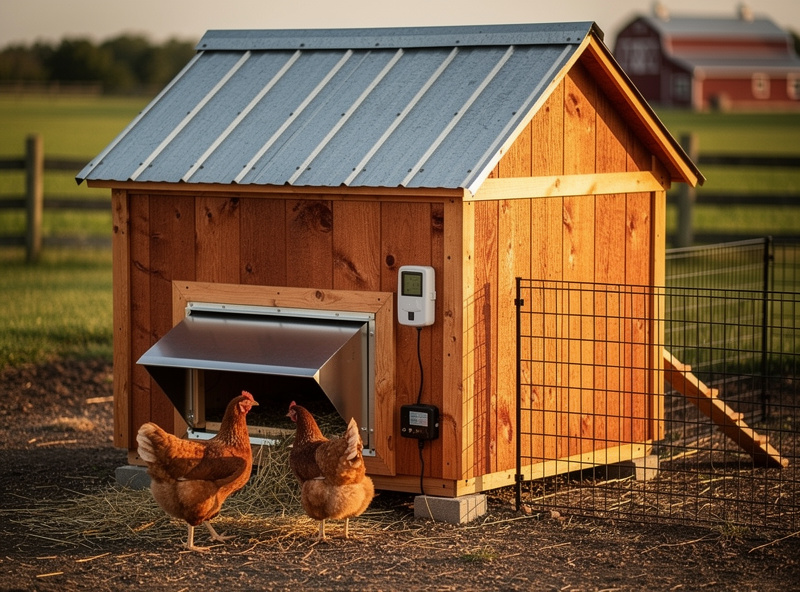
Amish chicken coops vary dramatically in smart-coop compatibility because individual builders have different preferences and different levels of exposure to modern automation. The assumption that Amish means smart-incompatible is outdated — and it is the assumption that costs buyers the most, because it eliminates a category of coop that may actually be easier to automate than the prefab alternative.
Traditional builders — the majority — construct coops without smart-feature provisions. Adding an automatic door, sensors, or cameras requires post-purchase modifications, typically $100 to $300 in adapter plates, mounting hardware, and electrical routing. But here is the part that matters: retrofitting automation onto a heavy hardwood frame is genuinely easier than doing the same on thin prefab walls. I would rather drill into solid oak than into OSB any day — solid wood holds a screw and a sensor bracket firmly, where particleboard strips out and the bracket sags within a season. You need a drill bit rated for hardwood and a little more patience, but the result is a mount that stays put for years rather than one that loosens under vibration and weather cycling.
A growing minority of Amish builders now offer “smart-coop ready” options: pre-cut auto-door openings, sensor mounting points, and conduit channels for wired electrical. These add $200 to $600 above traditional pricing but eliminate the post-purchase modification work entirely. Most builders do not advertise these options publicly — you have to ask. Which means the buyers who assume Amish equals traditional-only never discover that the builder would have happily pre-cut an auto-door opening for an extra few hundred dollars.
Custom-spec builds go further: direct workshop orders let you specify precise auto-door wall location, integrated sensor wiring, pre-installed camera mounts, and even custom nesting-box configurations that accommodate 3D-printed brackets or roll-away trays. These add $300 to $800 to typical pricing but deliver a coop genuinely designed around your automation plan rather than one you are adapting after the fact. The automatic coop door buyer’s guide covers the door dimensions and mechanisms to spec, and the smart chicken coop pillar guide covers the broader integration plan from sensors to Home Assistant routines.
The Annual-Cost Math Over a Decade-Plus
The long-horizon cost comparison is the single most important number in the Amish coop decision, and it is the number most buyers get wrong because they compare sticker prices instead of annual costs. The math is straightforward once you lay it out honestly.
A $2,500 Amish coop with an 18-year service life costs $139 per year. A $700 mid-tier prefab with a 7-year service life costs $100 per year on paper — but you replace it 2 to 3 times over the same 18-year period, factoring in the rebuild labor, the disposal of the old coop, and the disruption to the flock during each replacement cycle. By year 9 or 10, the Amish coop has crossed below the prefab’s cumulative cost, and every additional year it stands widens the gap. By year 18, the Amish coop has cost $2,500 total; the prefab path has cost $2,100 to $2,800 plus three disruption cycles. The crossover is real, but it requires a keeper who stays in the hobby long enough to reach it. A keeper who exits at year 4 has spent $2,500 on an Amish coop they are now selling used, versus $700 on a prefab they can donate or burn.
Cold-climate keepers in zones 3 to 5 get an additional edge from heavy-hardwood construction. Traditional Amish framing with proper insulation provisions handles -20°F nights better than typical prefab construction — the temperature difference inside the coop can be 10 to 15°F warmer, which is meaningful for hen comfort, comb health, and winter laying rates. I priced out an Ohio co-op build when I was scoping my own coop in Sweden, and the shipping math killed it — not the coop quality. Heavy hardwood freighted across an ocean stops being a value proposition fast. I ended up building double-wall insulated myself instead, but the thermal-mass logic that draws me to Amish construction in theory is exactly right: heavy wood holds heat better than thin prefab framing, and a coop that stores daytime solar gain in its walls releases it slowly overnight in a way that a plywood shell cannot match. The solar chicken coop heater guide covers cold-climate strategies that pair well with heavy-construction Amish builds.
On the aesthetic side, Amish coops look like traditional farm structures — cedar siding, cedar shingles, hand-forged hardware. They fit naturally into properties with existing barn, shed, or farmhouse character. They look out of place in stark modern yards or HOA-restricted suburban settings where the traditional look reads as rustic to the point of conspicuous. The backyard chickens beginners guide covers matching coop aesthetic to property style if that is a factor in your decision.
Frequently Asked Questions
What makes a chicken coop genuinely Amish-built?
An authentic Amish chicken coop is built by an Amish or Mennonite craftsman in their workshop, using traditional joinery (mortise-and-tenon joints, dovetails) rather than screws alone, and heavy hardwood lumber (oak, cedar, or thick pine) rather than thin softwood prefab materials. Verify the builder name and workshop location with a phone call before paying any deposit.
How much does an authentic Amish chicken coop cost?
Compact 4×4 ft Amish coops cost $1,000 to $1,500. Mid-size 4×6 to 4×8 ft coops cost $1,500 to $2,500. Walk-in 6×8 to 8×10 ft Amish coops cost $2,500 to $4,500. Custom-spec builds with smart-coop provisions add $300 to $800. Add $200 to $500 for nationwide freight shipping if you cannot pick up at the workshop.
How long do Amish chicken coops last compared to prefabs?
Authentic Amish chicken coops typically last 15 to 25 years with basic maintenance (paint or seal every 3-5 years, replace asphalt shingles at year 10-12 if used). Cedar shingle and galvanized metal roofs last 25-40 years. Hardware lasts 20+ years. The 15-year service life is roughly 2x to 3x typical prefab coop lifespan of 5-10 years.
Where can I buy an Amish chicken coop?
Three channels: direct from Amish workshops in Pennsylvania, Ohio, Indiana, or Illinois ($1,000-$3,500, pickup required); Amish co-op stores in those regions ($1,200-$4,000, local delivery within 200 miles); and verified Amish online retailers shipping nationwide ($1,500-$4,500, freight shipping). Always verify actual build location with a phone call before paying.
Can I automate an Amish chicken coop with smart features?
Yes. Traditional Amish coops require post-purchase modification for auto-doors and sensors ($100-$300 in hardware), but solid hardwood holds mounting hardware far better than thin prefab walls. A growing minority of builders offer smart-coop-ready options with pre-cut door openings and conduit channels for $200-$600 extra. Ask the builder directly — most do not advertise these options publicly.
More Coop Resources
Related Guides
Chicken Coops Near Me: Local Sourcing Guide (2026)
Searching “chicken coops near me” in 2026 surfaces a mix of local farm stores, regional builders, and individual sellers —…
Custom Chicken Coops: When to Pay for Bespoke
Custom chicken coops are designed and built for your specific situation — exact dimensions, particular climate adaptations, integrated smart-coop wiring,…
Prefab Chicken Coop: 4 Tiers Compared (2026)
A prefab chicken coop is a factory-assembled or kit-form coop sold ready-to-deploy, distinct from a custom-built coop designed and constructed…