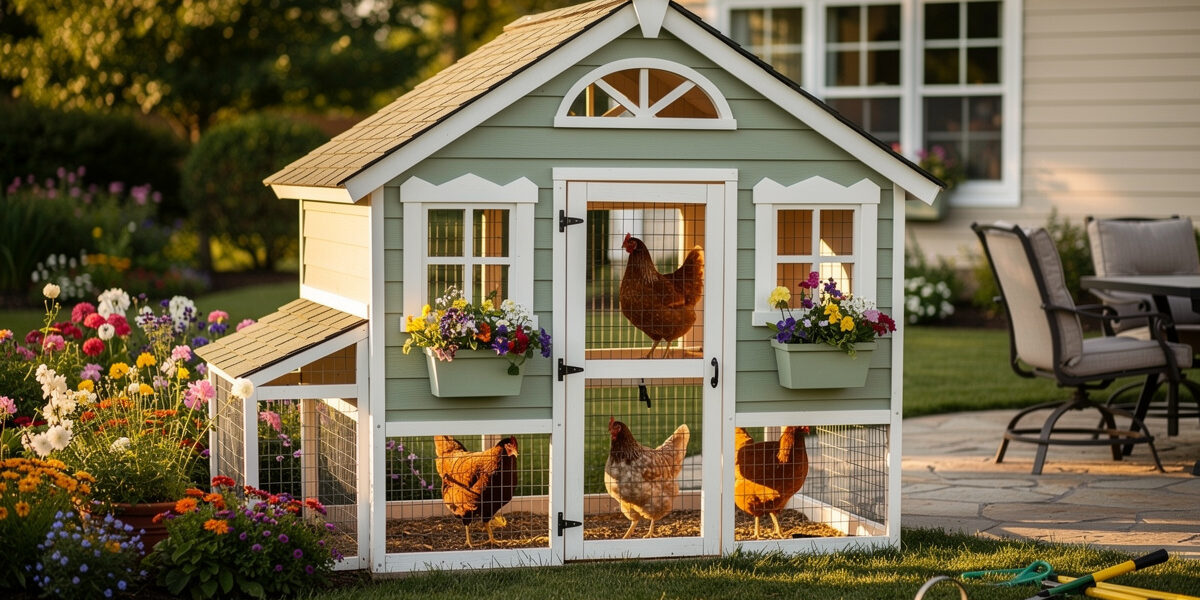
A backyard chicken coop is sized and configured for a typical residential lot — usually 1/8 to 1/2 acre, with HOA or municipal limits on flock size and setback distances. The category covers 4 to 12 hen capacity in coops between 16 and 60 square feet of interior, designed to fit alongside gardens, patios, and play areas without dominating the yard. Backyard coops are the most common purchase scenario in chicken keeping, but most generic “best coop” rankings ignore the specific zoning, setback, and aesthetic constraints that actually shape backyard buying decisions.
This guide covers what makes a coop genuinely backyard-friendly, the four backyard coop styles that dominate suburban and urban yards, the zoning and HOA constraints that affect placement, the neighbor-aesthetic strategies that prevent complaint mail, and the four mistakes that drive most backyard-keeper coop replacement cycles. For sizing math by exact flock count, see our chicken coop size guide.
What Makes a Coop Backyard-Friendly?
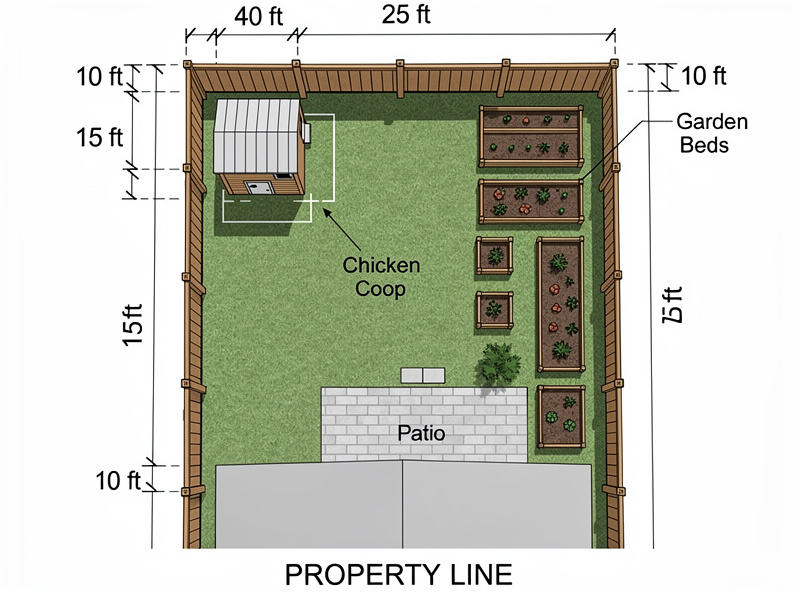
A backyard chicken coop fits five constraints that don’t apply to rural or commercial coops: total footprint under 100 sq ft (for 4-bird flocks) to 200 sq ft (for 12-bird flocks), respect for setback distances (typically 5 to 25 ft from property lines), aesthetic compatibility with the rest of the yard, low-noise design (no roosters, minimal hen-bock amplification), and easy daily-chore access from the house.
The footprint constraint is the most-violated. A “backyard” coop with a 280 sq ft total footprint dominates a 1/4-acre lot’s usable space. Fitting in means matching coop scale to yard scale — typically a 4×4 to 4×8 ft coop for most suburban yards, with the run extending 30 to 60 sq ft adjacent.
The setback constraint trips up most first-time buyers. Most US municipalities require coops to sit 5 to 25 ft from property lines, with stricter setbacks (sometimes 50 ft) from neighbor dwellings. Verify your local code before committing to coop placement — moving a coop after construction is expensive and disruptive. Our chicken coop size guide covers footprint planning for typical lot sizes.
Four Backyard Coop Styles
Four coop styles dominate the backyard market. Each fits a specific yard size and HOA reality.
| Style | Total Footprint | Bird Capacity | Best For | Approx. Cost |
|---|---|---|---|---|
| Compact lift-top with attached run | 40-70 sq ft | 2-4 hens | Small lots (under 1/8 acre), HOA-restricted | $280-$700 |
| Mid-size lift-top with separate run | 80-140 sq ft | 4-8 hens | Typical 1/4-acre suburban lots | $600-$1,500 |
| Walk-in coop with run | 120-200 sq ft | 8-12 hens | Larger 1/3 to 1/2 acre lots, max-flock keepers | $1,200-$3,000 |
| Aesthetic-focused decorative coop | 60-120 sq ft | 3-6 hens | Visible-from-street locations, design-conscious yards | $700-$2,500 |
Compact lift-tops dominate the smallest yards because they fit alongside the existing yard layout without dominating. Mid-size lift-tops are the most-common backyard pick — typical 4×6 ft coop plus 6×10 ft run fits a 1/4-acre suburban lot with room left for gardens and patios. Walk-in coops require a larger lot and typically take over the back corner of the yard. Aesthetic-focused coops (cottage-style, modern shed-style) prioritize visual fit over capacity — slightly higher cost per square foot but draws less complaint mail in HOA-sensitive neighborhoods.
Zoning, HOA, and Setback Realities
Backyard chicken keeping is regulated at three layers: state agricultural law, municipal zoning, and HOA covenants. Each layer can impose different constraints, and the strictest applicable rule wins.
Municipal zoning (the most common constraint): Most US cities allow 3 to 12 hens with no rooster, with setbacks that commonly run 5 to 25 ft from property lines and 25 to 50 ft from neighbor dwellings, though some jurisdictions push considerably wider (see the ordinance survey at Delve Experiences for how much this varies city to city). Some cities require permits ($25 to $150) and annual renewals. Verify with your local zoning office before buying any coop.
HOA covenants (often stricter than municipal): Many HOAs explicitly disallow chickens regardless of city zoning. Others allow chickens with additional restrictions (specific coop styles, neighbor notification, color matching). Read your HOA covenants carefully before assuming municipal allowance applies.
State law (rarely a constraint at backyard scale): State agricultural law typically only kicks in above 25 to 50 hens, classifying the operation as a small farm. Backyard scale (4 to 12 hens) almost never triggers state-level requirements.
Common setback patterns: 5 ft from property lines (most permissive), 10 ft from property lines (typical), 25 ft from neighbor dwellings (typical), 50 ft from neighbor dwellings (strictest). Measure carefully — a coop placed 8 ft from a 10-ft setback line is a code violation that can require relocation.
For larger flocks or properties with looser setback constraints, see our 12-chicken coop guide covering the family-flock threshold.
Neighbor-Aesthetic Strategies
Backyard chicken keeping succeeds or fails based on neighbor relations. Visible utility-grade coops draw complaint mail and code-enforcement visits; well-camouflaged or aesthetically-fitting coops get ignored.
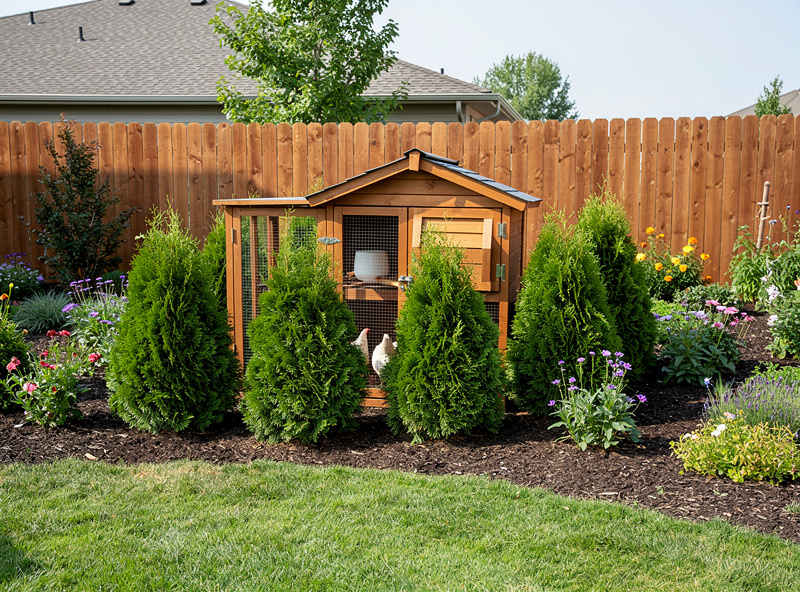
Stealth color and material choices: Coops painted in neutral garden colors (sage green, dark brown, weathered gray) blend into landscaping. Bright red barnyard-style coops or stark white finishes draw complaints. Match the coop palette to your existing fence, shed, or garden structures.
Strategic placement: Place coops on the side of the yard furthest from neighbor bedrooms. Position the coop so the run faces your house (not the neighbors), which both reduces visual impact and keeps the smelly side away from property lines. When I laid out my own welded run frame I was solving for wind and drainage more than sightlines — my nearest neighbor is a field, not a bedroom window — but I still oriented the run to face the house and back the solid wall into the prevailing wind, and it’s the same placement logic that keeps a suburban coop out of a neighbor’s eyeline.
Screening vegetation: A 6-foot privacy fence or row of evergreen shrubs blocks visual access to the coop from adjacent properties. The screening also reduces wind exposure (improves coop comfort) and noise transmission. Cost: $200 to $800 for fence sections, $80 to $300 for established shrubs.
Noise reduction: Hens don’t make rooster noise but do bock-bock during egg-laying and after dawn. Skip Mediterranean breeds (Leghorns, Anconas) that are louder; pick English breeds (Orpingtons, Australorps) that are quieter. The backyard chickens beginners guide covers breed temperament selection.
Smart Backyard Coops: The HOA-Friendly Automation Stack
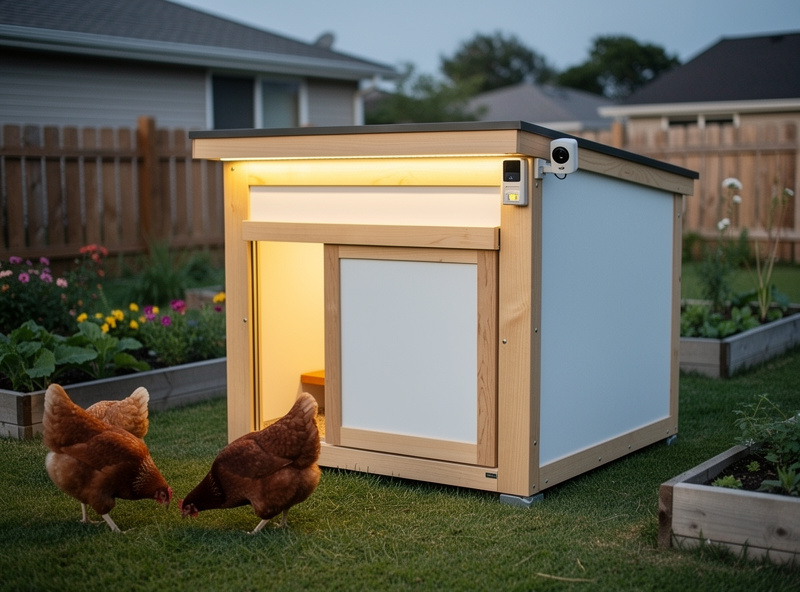
Smart-coop automation pairs particularly well with backyard scenarios because most automation reduces the daily-chore visibility that draws neighbor attention. Quiet automatic doors, scheduled feeding, and remote monitoring all reduce the human-in-yard time that triggers complaints.
Automatic doors: Battery-powered or wired automatic chicken doors close at dusk without you walking outside. Eliminates the dusk-and-dawn yard activity that some neighbors find annoying. See our automatic coop door buyer’s guide for backyard-friendly picks.
Scheduled lighting (winter laying support): A timer-controlled coop light extends winter laying without requiring you to enter the coop at 4 am. Use warm-white LEDs (2700K) at 5 to 10 watts — bright enough for hens, dim enough not to bother neighbors.
Remote monitoring cameras: WiFi cameras inside the coop let you check on the flock without entering the coop. Position so neighbor properties are NOT in the camera frame to avoid privacy complaints. On my own coop the door runs off Home Assistant on a sunrise/sunset offset rather than a flat timer, which quietly kills the two moments of the day — dusk close, dawn open — when I’d otherwise be out at the run in view of anyone watching from next door. The camera motion zones are set the same way: framed tight to my own fence line, nothing pointed past it. Our smart coop monitoring guide covers placement details.
Automatic feeders: Treadle or timer feeders reduce daily refill frequency from 1-2 times per day to once a week. Less yard activity, less feed-spill waste, fewer pest-attracting feed bag visits. Pair with our best smart coop devices guide for full hardware selection.
Common Backyard Coop Mistakes
Four mistakes account for most backyard coop replacement cycles.
Mistake 1 — ignoring setback distances: Buyers often place coops based on yard convenience rather than verifying setback compliance. Discovering a code violation after construction means either relocating the coop ($200 to $500 in moving costs) or paying ongoing fines until relocated.
Mistake 2 — buying a too-large coop for the lot: A 12-bird coop on a 1/8-acre lot dominates the entire yard. Match coop capacity to lot size — most suburban backyards work best with 4 to 6 hen capacity coops, even if zoning allows more.
Mistake 3 — skipping the HOA check: Roughly a third of U.S. homes now sit inside a community association — 35.2% nationally as of the Foundation for Community Association Research’s 2026 statistical review — and those covenants regularly go further than municipal zoning on chicken-keeping, sometimes banning it outright even where the city allows it. Verify HOA rules BEFORE buying birds or coop. The best chicken coops buyer’s guide covers the verification checklist.
Mistake 4 — generic placement without neighbor consideration: Coops placed against shared property lines or visible from neighbor windows generate complaints even when fully code-compliant. Strategic placement and screening won’t guarantee zero complaints, but in my experience it’s the single biggest lever a keeper controls beyond the legal minimum — a coop nobody notices doesn’t get reported, regardless of whether it’s technically compliant.
Frequently Asked Questions
What is the best backyard chicken coop?
The best backyard chicken coop matches your specific lot size, flock count, and HOA constraints. For typical 1/4-acre suburban lots, a 4×6 ft mid-size lift-top with a 6×10 ft run handles 4 to 6 hens at 80-140 sq ft total footprint, costing $600 to $1,500. Smaller lots need compact lift-tops; larger lots support walk-in coops with separate runs.
How big should a backyard chicken coop be?
Size depends on flock count and lot size. Use 4 sq ft of coop floor plus 10 sq ft of run per standard hen. A 4-hen backyard coop needs 16 sq ft coop + 40 sq ft run (56 sq ft total). A 6-hen coop needs 24 sq ft coop + 60 sq ft run (84 sq ft). Verify HOA and municipal setback distances before placing.
Do I need a permit for a backyard chicken coop?
Permit requirements vary by city. Most US municipalities require setbacks of 5 to 25 ft from property lines and prohibit roosters but do not require permits for coops under 100 sq ft. Some cities require permits ($25-$150) and annual renewals. Always verify with your local zoning office before buying any coop.
How far does a chicken coop need to be from neighbors?
Most US municipalities require 5 to 25 ft from property lines and 25 to 50 ft from neighbor dwellings. HOA covenants may impose stricter setbacks. Beyond legal requirements, place coops as far from neighbor bedrooms as possible to reduce noise complaints during pre-dawn laying activity.
Can I have a chicken coop in a small backyard?
Yes. A 4×4 ft compact lift-top coop fits in 40-50 sq ft of total backyard space (coop plus attached run) and houses 2 to 4 standard hens. Suitable for lots as small as 1/10 acre. Verify HOA covenants and municipal zoning, paying particular attention to setback requirements that may consume more yard than the coop itself.
How do you hide a backyard chicken coop from neighbors?
Three strategies reduce coop visibility: paint the coop in neutral garden colors (sage green, dark brown, weathered gray) to blend with landscaping; place the coop on the side of the yard furthest from neighbor bedrooms with the run facing your house; add screening with a 6-foot privacy fence or row of evergreen shrubs along property-line sides.
Bottom Line: Match Coop to Lot Size and Verify Constraints First
A backyard chicken coop succeeds when it matches the lot scale (4 to 6 hen capacity for typical suburban yards), respects setback distances, and visually fits the existing landscape. Verify HOA covenants and municipal zoning before buying any coop. Strategic placement and screening reduces neighbor complaints far more effectively than legal compliance alone. Smart-coop automation reduces daily yard activity and improves neighbor relations as a bonus.
For specific picks by flock count, see our 4-chicken coop guide and 6-chicken coop guide. For matching coop type to your full buyer profile, the best chicken coops buyer’s guide covers the framework.
Related Guides
- Best Chicken Coops 2026: Complete Buyers Guide
- Chicken Coop Size Guide: How Many Chickens Per Square Foot
- Chicken Coop for 4 Chickens: Best Compact Picks
- Chicken Coop for 6 Chickens: Best Picks & Layout
- Backyard Chickens for Beginners: Everything You Need to Know in 2026
- Automatic Chicken Coop Doors: Complete Buyer’s Guide 2026
Related Guides
Chicken Coops Near Me: Local Sourcing Guide (2026)
Searching “chicken coops near me” in 2026 surfaces a mix of local farm stores, regional builders, and individual sellers —…
Custom Chicken Coops: When to Pay for Bespoke
Custom chicken coops are designed and built for your specific situation — exact dimensions, particular climate adaptations, integrated smart-coop wiring,…
Amish Chicken Coops: Premium Build Quality (2026)
An Amish chicken coop is built by hand in a workshop in Pennsylvania, Ohio, Indiana, or Illinois — mortise-and-tenon joints,…