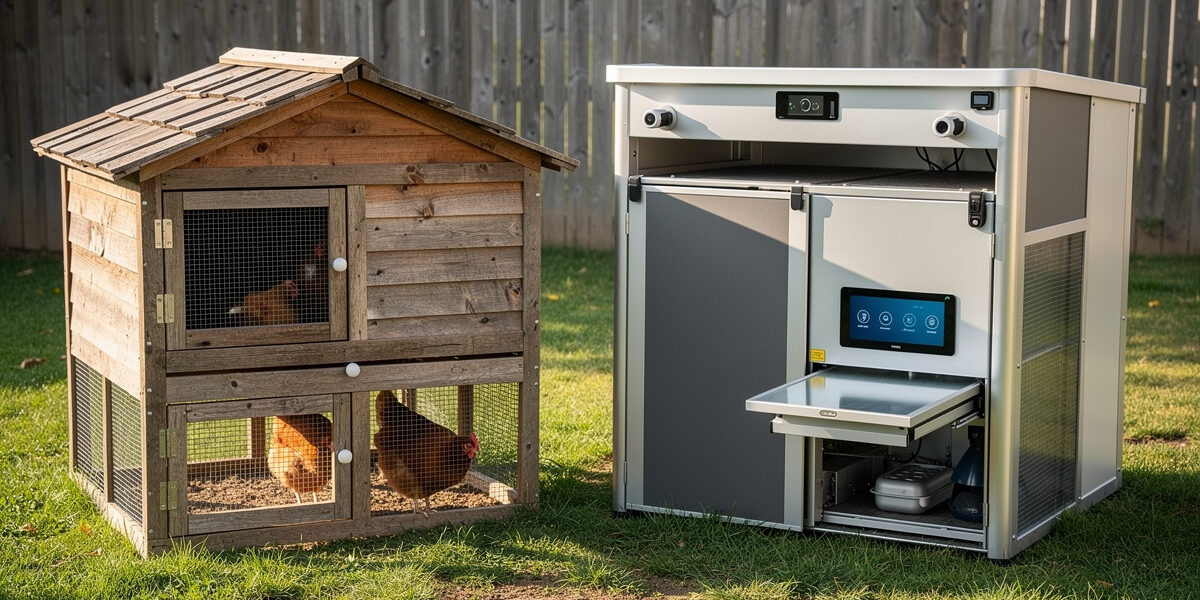
The smart chicken coop vs traditional decision comes down to one trade: $600–$1,500 in extra build cost plus annual replacements buys you back roughly 100–150 hours per year, prevents most dusk-related predator losses, and removes the schedule constraint of being home for door-close. For most working-age keepers the math favors smart by year two; for retirees or anyone who enjoys the chores, traditional often makes more sense.
This guide compares both side by side across cost, time, reliability, predator outcomes, and quality of life, so you can match the right approach to your situation. I ran a traditional coop for years before I automated mine — the numbers below are the same trade-offs I weighed on my own flock, not a theoretical comparison. For full smart-build context, see our complete smart chicken coop guide.
Side-by-Side Comparison Table
| Factor | Traditional Coop | Smart Coop |
|---|---|---|
| Build cost (4–8 birds) | $1,200–$2,000 | $1,800–$2,800 |
| Year-1 operating cost | $390–$650 | $390–$720 |
| 5-year TCO | $3,400–$5,500 | $4,400–$6,500 |
| Weekly chore time (peak season) | 3–5 hours | 1–2 hours |
| Schedule flexibility | Must be home at dusk | None — door automated |
| Predator loss risk | Meaningful without a door that closes every night — predation is the single most-cited challenge among backyard keepers | Sharply reduced once the dusk door-close is automated instead of forgotten |
| Vacation handling | Need coop sitter | Daily visit only (water + visual) |
| Egg yield (laying season) | Baseline | +5–10% (consistent climate/lighting) |
| Power requirement | Optional, mostly heated waterer | Required (grid or solar) |
| Tech-savvy required | None | Basic smartphone app skills |
| Component replacement cycle | Almost none (lumber + hardware) | Sensors annually, door year 4, etc. |
The cost difference is mostly upfront — about $600–$1,500 — and shrinks as smart components last 4–10 years before replacement. The time and predator differences compound over the coop’s lifetime.
Where Traditional Wins
Traditional coops are the right choice in five specific situations:
- You enjoy the chores. If feeding chickens is a calming morning ritual, automation removes value. The “time saved” math turns negative when the time was a positive in your life.
- You are home reliably at dusk. The auto-door’s main benefit is letting you stay out late. If your schedule is naturally aligned with chicken hours, the value drops.
- You have very small flock (2–3 birds). The build-cost premium scales poorly to tiny flocks. A 3-bird traditional coop at $700 vs a 3-bird smart coop at $1,400 — the doubling rarely pencils out.
- You have no power access and no sun. A coop on the shaded north side of a property with no grid connection nearby forces complex off-grid setups. Traditional sidesteps the problem entirely.
- You distrust technology. Smart coops add failure modes (WiFi drops, sensor batteries, software updates). If you would rather walk to the coop daily than troubleshoot an offline camera, traditional is right for you.
Where Smart Wins
Smart coops are the right choice in five mirror situations:
- You travel or work irregular hours. The auto-door alone justifies the premium. Never rushing home for dusk close changes how you live.
- You lost a bird to a predator before. Predation is consistently the top challenge backyard keepers report — a UC Davis flock-owner survey found it the most-cited concern, ahead of feed cost and zoning (Poultry Science survey coverage). A door that closes on schedule instead of “whenever I get home” removes the single most common failure point. After one loss, most keepers automate.
- You have children, demanding work, or active hobbies. The 100–150 hours per year saved is real. Smart coops give that time back with no reduction in flock health.
- You want winter eggs. Hens need enough photoperiod (hours of light per day) to keep laying hormones active — production drops off once daylight dips under about 12 hours, which is exactly what happens every fall (Penn State Extension’s winter lighting guide). A smart light schedule holds that photoperiod steady automatically. Manual timers exist but get forgotten; smart timers do not.
- You have aging mobility issues. Walking to the coop in icy conditions twice a day causes more falls than any other backyard task. Auto doors and remote monitoring eliminate the trips.
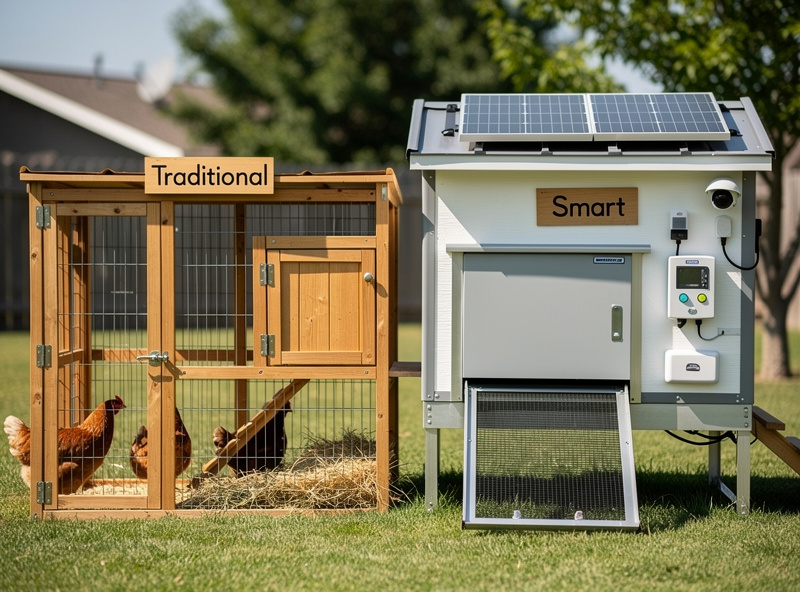
Capability Comparison
What each setup can and cannot do:
| Capability | Traditional | Smart |
|---|---|---|
| Open/close door at dawn/dusk | Manual only | Automatic with light sensor or timer |
| Detect predator activity | Visual evidence only (after the fact) | Motion alerts, camera footage |
| Track temperature trends | Manual thermometer reading | Continuous logging, alerts on excess |
| Verify chickens roosted | Visual check | Camera + door-close confirmation |
| Ventilate at temperature | Manual vent operation | Thermostatic fan |
| Extend winter laying | Manual light timer | Smart light schedule, dimmable |
| Replace bedding | Manual | Manual (no smart automation here) |
| Collect eggs | Manual | Manual (but camera tells you when) |
| Detect failed equipment | Trial-and-error | Real-time alerts and logs |
Two takeaways: smart adds many capabilities that traditional cannot match (continuous logging, alerts), but does not eliminate physical chores like cleaning and egg collection. Anyone selling “fully automated” is overstating it.
Time Profile Through a Year
Hours per week, traditional vs smart, across the seasons:
| Season | Traditional Hrs/Wk | Smart Hrs/Wk | Hours Saved |
|---|---|---|---|
| Spring (active laying, mild) | 3.5 | 1.5 | 2.0 |
| Summer (peak laying, heat) | 4.0 | 1.5 | 2.5 |
| Fall (transition, weatherproofing) | 3.0 | 1.5 | 1.5 |
| Winter (low laying, cold checks) | 2.5 | 1.0 | 1.5 |
| Annual total (52 weeks) | 169 hours | 71 hours | 98 hours |
The biggest time savings come in summer (auto-feeding, auto-watering, no extra heat checks) and winter (no door-rushing in cold/dark). Spring and fall savings are modest because seasonal tasks like bedding swaps remain manual.
Reliability Comparison
What can go wrong with each:
| Failure | Traditional | Smart |
|---|---|---|
| You forget to close door at dusk | Common — leading predator-loss cause | Eliminated by automation |
| Auto door fails to close | N/A | Rare with quality door (1–2× over 4 years) |
| Camera fails / signal drops | N/A | Recoverable (app shows offline, fix in 5 min) |
| Sensor batteries die without alert | N/A | Mitigated by heartbeat alerts (covered in our maintenance guide) |
| Heat lamp fire | Common cause of coop loss | Mitigated with smart thermostatic switching |
| Waterer freezes overnight | Daily winter risk | Auto-detected; alert + heated waterer |
| Predator dig under run | Goes unnoticed until loss | Motion alerts at the perimeter detect early |
Traditional coops fail in predictable, well-understood ways — usually rare but devastating events. Smart coops fail in different ways — usually small, recoverable nuisances. The trade favors smart for total risk-weighted impact: a $30 sensor battery you forgot is a much smaller problem than a forgotten dusk door close.
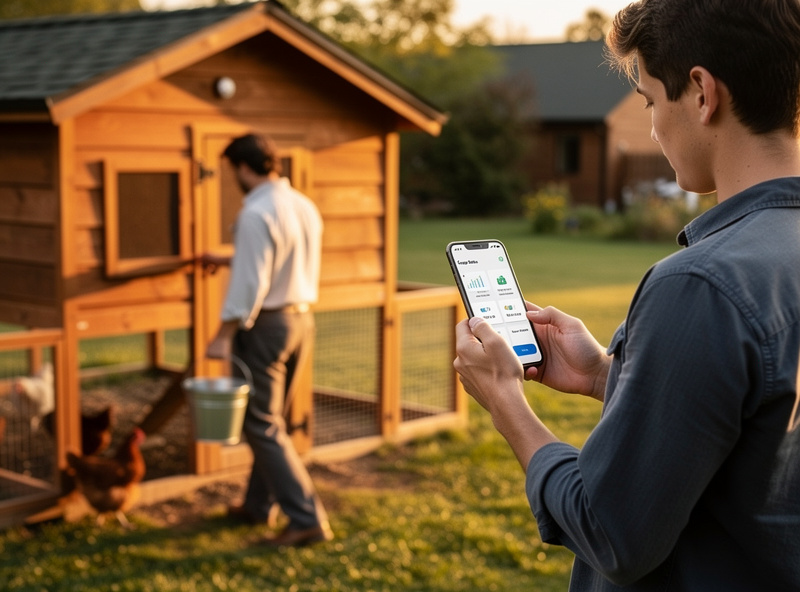
5-Year Cost of Ownership
| Year | Traditional Cumulative | Smart Cumulative | Smart Premium |
|---|---|---|---|
| 0 (build) | $1,650 | $2,300 | +$650 |
| 1 | $2,170 | $2,855 | +$685 |
| 2 | $2,690 | $3,470 | +$780 |
| 3 | $3,210 | $4,105 | +$895 |
| 4 | $3,750 | $4,880 | +$1,130 |
| 5 | $4,290 | $5,515 | +$1,225 |
The smart premium grows gradually because smart coops have higher annual replacement costs (sensor batteries, occasional component failures). At $1,225 over 5 years, the premium is $245/year — well below the value of the time saved at any reasonable hourly rate.
Hybrid Approach: Add Smart to a Traditional Coop
If you already have a traditional coop and the math feels uncertain, the hybrid path lowers the bar:
- Just add an auto door. Battery-powered, $150–$300, fits most existing doors. Captures most of the practical smart benefit — predator protection and schedule freedom — at a small fraction of a full smart-coop build cost.
- Add a single camera. $50–$120, plug-and-play. Lets you check on the flock remotely without committing to full automation.
- Add temperature/humidity sensors. $30–$60 for two Zigbee sensors. Catches climate problems before they hurt the flock.
This $230–$480 hybrid retrofit (covered in detail in our retrofit guide) is the right starting point for skeptics. It delivers most of the smart benefit at a fraction of the full-build cost, and you can stop there or add more over time — the auto door was the first thing I added to my own setup, and it’s still the single change I’d tell a skeptical keeper to make first.
Decision Tree
The fast path to your answer:
- Are you home reliably at dusk every night? Yes → Traditional likely fits.
- Have you lost a bird to a predator? Yes → Smart almost always pays back fast.
- Do you travel or work irregular hours more than 30 days per year? Yes → Smart pays back fast.
- Is your time worth $20+/hour? Yes → Smart pays back fast.
- Are you uncomfortable with smartphone apps and basic technology? Yes → Hybrid retrofit, or stay traditional.
- Do you want winter eggs without daily light-timer checks? Yes → Smart wins.
What Almost Everyone Gets Wrong
Three common mistakes when comparing smart vs traditional:
- Underestimating the value of saved time. Many keepers value their time at “$0/hr” because chicken chores feel like zero cost. But weekend mornings and evenings have real opportunity cost — at $25–$40/hour for typical readers, the math overwhelmingly favors smart.
- Overestimating the failure rate of smart components. Across the doors, cameras, and sensors I’ve run for years now, quality smart-coop hardware holds up far longer than people expect — outright failures are rare, and most “failures” are really a dead battery or a WiFi hiccup, not the unit itself giving out. Treating it like consumer electronics that fail constantly leads to over-conservative decisions.
- Treating it as all-or-nothing. The hybrid retrofit path covered above lets you adopt incrementally. Start with an auto door, see how it changes your routine, expand from there.
The Honest Bottom Line
For most working-age backyard chicken keepers with a 4–8 bird flock, smart coops are the right choice. The break-even is fast (8–18 months), the time savings are real (100+ hours per year), and the predator protection prevents the kind of losses that drive new keepers out of the hobby.
For retirees who enjoy the chores, very small flocks, or anyone uncomfortable with technology, traditional remains a fine choice. There is no single right answer — match the approach to your situation, and the math takes care of itself.
Frequently Asked Questions
Is a smart chicken coop better than a traditional one?
For most working-age keepers with 4–8 birds, yes. Smart coops save 100–150 hours per year, sharply cut the risk of a forgotten dusk door-close (the leading predator-loss cause keepers report), and cost only $600–$1,500 more upfront. For retirees who enjoy the chores or very small flocks, traditional often makes more sense.
How much more does a smart chicken coop cost than a traditional one?
The build premium is $600–$1,500 for a 4–8 bird flock. Annual operating costs are similar — both run $390–$720/year. Over 5 years the total cost difference is about $1,200–$1,500, mostly recovered through saved time and reduced predator losses.
Are smart chicken coops more reliable than traditional ones?
Different reliability profile. Traditional coops fail rarely but catastrophically (forgotten dusk door = predator loss). Smart coops fail more often but in small, recoverable ways (sensor battery, camera offline). Total risk-weighted impact favors smart.
Can I add smart features to my existing traditional coop?
Yes — a hybrid retrofit ($230–$480) adds an auto door, camera, and basic sensors to an existing traditional coop. This captures most of the practical smart benefit at a fraction of a full-build cost. The retrofit takes one weekend and works for most coops less than 8 years old.
Do smart coops actually reduce predator losses?
Yes. A forgotten or late dusk door-close is one of the best-documented predator-loss triggers keepers report, and a 2014 Poultry Science survey of U.S. backyard flock owners found minimizing predation was the single most-cited challenge in the hobby. An auto door that closes on a light-trigger or astro-schedule every night, without relying on you being home, removes that specific failure point.
What is the biggest disadvantage of a smart chicken coop?
Component replacement costs that traditional coops do not have — sensor batteries every 12–18 months ($8–$15/yr), auto door replacement at year 4–5 ($200–$300), occasional camera replacement at year 3–5. Plan $60–$120/year for these vs almost nothing for traditional.
Related Articles
Related Guides
Water-Level and Flow Sensors: Knowing the Waterer Is Empty Before They Do
A coop water-level sensor tells you the drinker is going dry — or freezing solid — before the flock does,…
Ammonia Sensors for the Coop: Catching Air Problems Before You Smell Them
An ammonia sensor belongs at the birds’ breathing height, close to the litter where the gas is generated, because that…

Node-RED vs Home Assistant Automations for the Coop: When to Use Which
Use native Home Assistant automations for the coop’s simple, safety-critical rules — the sunrise door, the freeze-watch waterer — and…