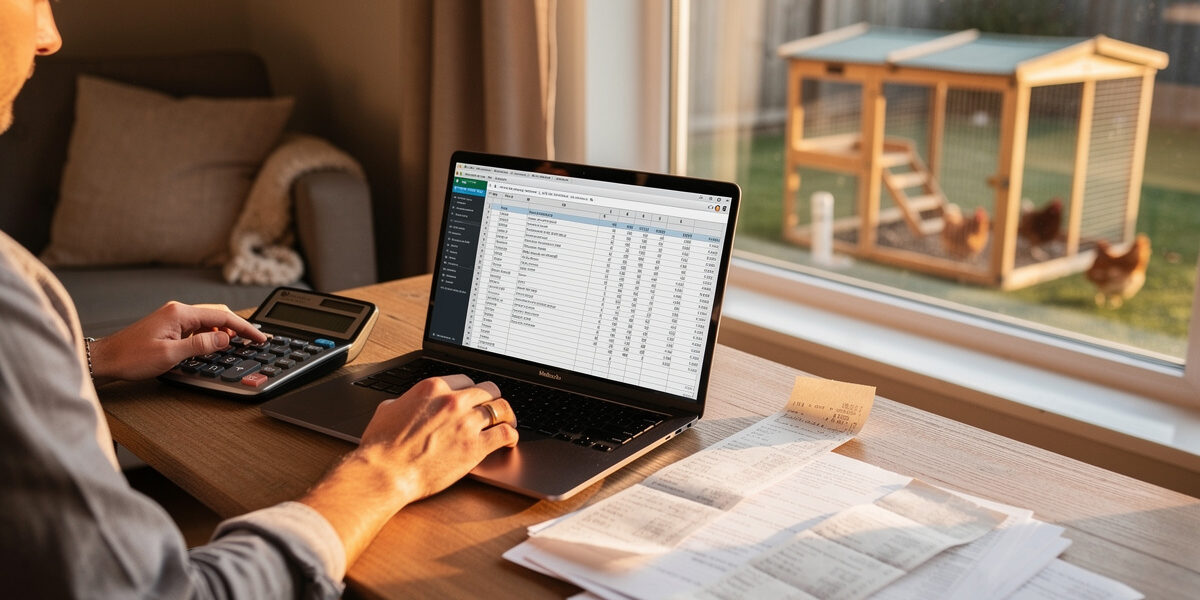
Smart chicken coop ROI typically lands between 3 and 12 months for the standard $600–$1,500 automation premium for most working-age keepers, depending on how you value your time — stretching to 3–5 years only if you already enjoy the daily chores or rarely travel, since reclaimed time is by far the biggest input. The math is rarely about saving money on eggs — it is about reclaiming 87–135 chore hours per year, eliminating $50–$200 in annual coop-sitter costs, and preventing the occasional $100–$300 predator loss that wipes out small flocks.
This guide quantifies each ROI input with realistic ranges so you can run the calculation against your own situation. For full build cost context, see our smart chicken coop cost guide.
The Four ROI Inputs
Every honest smart-coop ROI calculation has the same four inputs:
- Time savings — hours per year you no longer spend opening/closing doors, manually feeding, or checking conditions
- Predator loss prevention — value of birds saved by automatic doors and alerts
- Coop-sitter / vacation cost avoided — what you would pay (or trade favors for) to have someone tend the coop while away
- Better egg yield — modest increase from consistent climate, lighting, and reduced stress
Note what is NOT on this list: feed cost savings (smart coops do not feed less), reduced electricity bill (they often use slightly more), or reduced vet bills (mostly a wash). Anyone selling you on those is selling something.
Time Savings: The Biggest Input
Manual chicken keeping for a 4–8 bird flock takes 3–5 hours per week at peak season (spring/summer with daily egg collection, regular cleaning, and morning/evening door duty). Off-peak winter drops to 1.5–2.5 hours per week. Annual total: 130–210 hours.
A smart coop reduces this to under 1–1.5 hours per week — about 43–78 hours per year. The delta:
| Activity | Manual Hrs/Yr | Smart Hrs/Yr | Savings |
|---|---|---|---|
| Door open/close (daily) | 30–45 | 0 | 30–45 |
| Feeding (daily) | 25–40 | 5–10 | 20–30 |
| Watering (daily) | 20–30 | 3–8 | 17–22 |
| Climate checks (winter/summer) | 15–25 | 0–5 | 15–20 |
| Egg collection | 25–35 | 20–30 | 5–8 |
| Cleaning + bedding | 15–35 | 15–25 | 0–10 |
| Total | 130–210 | 43–78 | 87–135 |
The dollar value depends on what your time is worth. Even at minimum wage equivalent ($12–$15/hour), 100 saved hours = $1,200–$1,500/year. At a more realistic value of leisure time ($25–$40/hour for most readers), the savings hit $2,500–$5,400/year — paying back the entire build cost in year one. On my own coop, the door and the camera did more for my actual weekly time budget than any other single piece of gear — the rest of the automation was incremental on top of that.

Predator Loss Prevention
Predation is consistently the top-cited management problem for backyard flock owners — a nationwide survey of over 1,400 flock owners published in Poultry Science found minimizing predation was the single most common challenge, cited by 49% of respondents, ahead of feed cost, soil management, and zoning combined. Exact annual bird-loss rates vary too much by region, fencing, and local predator pressure to put one number on it, but the failure mode is consistent: a forgotten door at dusk is the single biggest predation trigger in a manual coop, and it’s exactly what an automatic door removes. Smart automation cuts this dramatically:
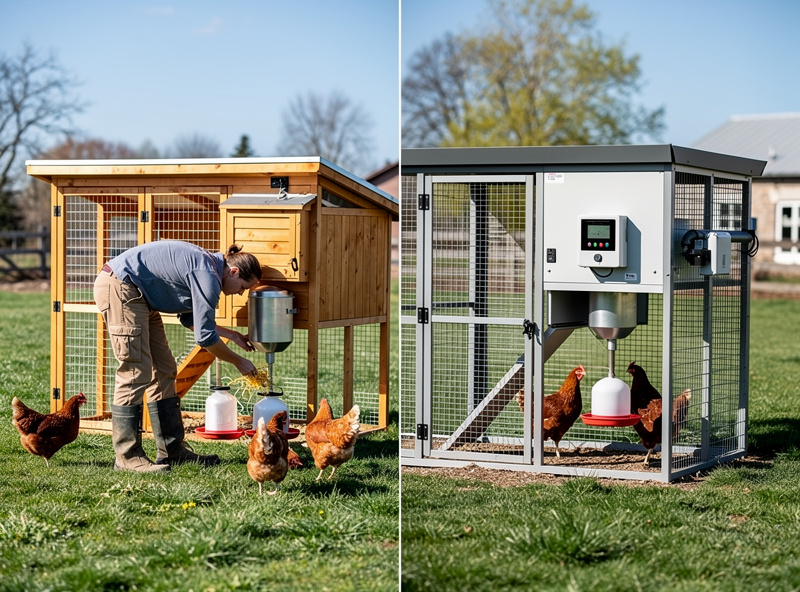
- Automatic door (timer or light sensor) — eliminates the #1 cause: forgotten close at dusk. This is the single biggest lever in the whole ROI calculation.
- Camera + motion alerts — catches active probing by raccoons or weasels before they breach. Modest impact on loss prevention but high impact on early intervention.
- Sensor-triggered lighting — deters most nocturnal predators. Marginal added value when paired with a closed door.
The real value: a $20 chicken can be a $0 chicken if she lays 250 eggs/year × $5/dozen = $104/year for 3 years = $312 lifetime production. Lose her at year one and you lose $250–$300 in unrealized value. A smart coop preventing 1–2 predator losses over 4 years is worth $500–$600 in raw avoided losses, never mind the emotional weight of finding your favorite hen dead.
Coop-Sitter Cost
Vacation, business travel, and weekends away all create a coop-sitter problem. Three options:
| Option | Cost | Reliability |
|---|---|---|
| Friend/family favor | $0–$30 thank-you gift | Variable |
| Paid neighbor/teen | $10–$25 per day | Decent |
| Professional pet sitter | $25–$50 per day | Reliable |
Most readers use a mix. Real-world chicken-sitting rates run $10–$50/day, consistent with the ranges above. Annual cost for a household that travels 14–21 days per year with a manual coop: $80–$300 in paid sitting plus the social cost of asking favors.
A smart coop with auto door, auto feeder, and remote monitoring eliminates 80% of the work — reducing sitter time to 5-minute daily visits for water and visual check, often handled by a neighbor for free. Net savings: $60–$240/year. My own arrangement is exactly that: a neighbor with the Home Assistant app on her phone, a five-minute water-and-eyeball check, no cash changing hands.
Modest Egg Yield Boost
Consistent climate (no extreme heat or cold spikes), reliable lighting (winter laying continuation), and reduced stress (no late-night human activity) typically boost laying-hen output by 5–10% in flocks where conditions had been variable. For a 6-bird flock laying 1,500 eggs/year, that is 75–150 extra eggs annually = $30–$60 in retail-equivalent value.
Not life-changing. Worth counting once and forgetting.
Putting It Together: Annual ROI
| ROI Input | Conservative | Realistic |
|---|---|---|
| Time savings (at $15/hr) | $1,300 | $1,800 |
| Predator loss prevention (averaged) | $80 | $150 |
| Coop-sitter avoided | $60 | $180 |
| Egg yield boost | $30 | $60 |
| Annual ROI | $1,470 | $2,190 |
Against a $600–$1,500 automation premium over a manual coop, payback is roughly 5–12 months at conservative assumptions, 3–8 months at realistic assumptions. Most keepers have positive ROI by month nine.
Where ROI Gets Slower
Three setups where break-even pushes out beyond 18 months:
- You enjoy the chores. If feeding chickens is meditative for you, the time-savings input drops to near zero. The ROI then comes only from predator prevention and vacation flexibility — payback stretches to 3–4 years.
- You retired and have unlimited time. Same logic — time has lower marginal value, and the predator/vacation inputs alone may not cover the build premium for 4+ years.
- You skip every check. Smart coops still need monthly maintenance (covered in our maintenance guide). Skip it and you eat replacement costs that erode ROI.
For most working-age keepers with a job, kids, or hobbies competing for time, the math is overwhelmingly favorable — positive ROI inside a year is the norm, not the exception. For retirees on fixed schedules with no travel, the case is weaker. I underbuilt my own first automation pass thinking the door alone would cover most of the time savings — the camera and the freeze-watch sensors ended up doing more of that work than I’d budgeted for going in.

5-Year Lifetime ROI
| Year | Cumulative Cost | Cumulative Value | Net |
|---|---|---|---|
| 0 (build) | $2,300 | $0 | -$2,300 |
| 1 | $2,855 | $1,800 | -$1,055 |
| 2 | $3,470 | $3,800 | +$330 |
| 3 | $4,105 | $5,900 | +$1,795 |
| 4 | $4,880 | $8,100 | +$3,220 |
| 5 | $5,515 | $10,400 | +$4,885 |
By year five, a standard smart coop has delivered roughly $4,800–$5,200 in net value over an equivalent manual coop — driven almost entirely by reclaimed time. Run the actual cash flows against your own build cost and payback timeline and the return comfortably beats any traditional low-risk investment, though a precise annualized rate depends too much on your own hourly time-value assumption to state as a single figure.
Hidden ROI: Quality of Life
The numbers above understate two non-financial benefits that matter to most keepers:
- Mental load reduction. Manual coop owners constantly track time-of-day to be home for door close. Smart owners stop thinking about it within a month.
- Trip flexibility. Last-minute weekends become possible. Family emergencies do not require panic-arranging coop care.
Talk to anyone who has run both a manual and an automated coop and “less stress” is usually the first thing they mention, ahead of the actual dollar figures. That subjective value is real but does not show up in any ROI table.
How to Run Your Own ROI Calculation
For your specific situation:
- Track your manual coop time for one week. Multiply by 52. Compare to the 43–78 hours typical for smart coops.
- Multiply your hourly time savings by your honest “value of leisure time” — for most readers, $20–$35/hour.
- Add $80–$200 for predator prevention (mid-range of typical loss values).
- Add 50–80% of your annual coop-sitter spend.
- Add $40 for egg yield boost.
- Divide your automation premium ($600–$1,500) by the annual total. That is your payback period in years.
For most working-age backyard keepers with a 4–8 bird flock, the answer comes back at under a year. For retirees with no travel, the answer is 3–5 years. I ran a version of this calculation before I welded the run frame and settled on which door to buy — the travel-flexibility line item is the one most keepers underweight going in, and it was the one that ended up mattering most on mine.
What the ROI Does Not Cover
Three risks that can erode the calculation:
- Component failures during warranty gap. A $250 auto door failing in year 4 is normal and built into the maintenance budget. A $250 auto door failing in year 2 because of a manufacturing defect can hit harder if outside warranty — buy from established brands with 2-year warranties.
- Tech obsolescence. A camera or hub that loses cloud support after 3–4 years effectively forces an upgrade. Stick to platforms with self-hosted or open standards (Home Assistant, Zigbee2MQTT) where possible.
- Insurance gaps. Some homeowner policies do not cover predator-caused livestock loss. Smart coops reduce exposure but do not eliminate it.
Build the calculation with realistic assumptions and the answer rarely changes — smart coops earn their premium back fast for anyone whose time matters.
Frequently Asked Questions
How long does a smart chicken coop take to pay for itself?
For most working-age backyard keepers with a 4–8 bird flock, the $600–$1,500 automation premium pays back in roughly 3–12 months through reclaimed chore time, predator prevention, and avoided coop-sitter costs, depending on how conservatively you value your time. Retirees with no travel see longer payback periods of 3–5 years.
Do smart chicken coops save money on feed?
No, smart coops do not feed less than manual coops. Automatic feeders dispense the same total daily ration; they just do it consistently. The savings come from time, predator prevention, and reduced coop-sitter costs, not from feed efficiency.
How much time does a smart chicken coop save per week?
A typical smart coop reduces weekly chore time from 3–5 hours to under 1–1.5 hours, saving roughly 87–135 hours per year. The biggest savings come from automated door operation, scheduled feeding, and remote monitoring instead of in-person climate checks.
What is the financial value of preventing a predator loss?
A productive laying hen represents about $300 in lifetime egg value over 3 years at retail equivalent prices. Preventing 1–2 predator losses across 4 years (typical for an automated coop versus manual) is worth $500–$600 in raw avoided losses.
Is the time savings from a smart coop really worth it?
At any reasonable hourly value of your leisure time ($20–$35/hour for most working-age adults), 100 saved hours per year equals $2,000–$3,500 in annual value — easily exceeding the entire $600–$1,500 automation premium in year one.
What hidden costs erode smart coop ROI?
Three risks: component failures outside warranty (year-4 auto door replacement runs $200–$300), tech obsolescence when cloud-only platforms lose support, and insurance gaps where homeowner policies exclude livestock losses. Buy established brands and use open standards where possible.
Related Articles
Related Guides
Water-Level and Flow Sensors: Knowing the Waterer Is Empty Before They Do
A coop water-level sensor tells you the drinker is going dry — or freezing solid — before the flock does,…
Ammonia Sensors for the Coop: Catching Air Problems Before You Smell Them
An ammonia sensor belongs at the birds’ breathing height, close to the litter where the gas is generated, because that…

Node-RED vs Home Assistant Automations for the Coop: When to Use Which
Use native Home Assistant automations for the coop’s simple, safety-critical rules — the sunrise door, the freeze-watch waterer — and…