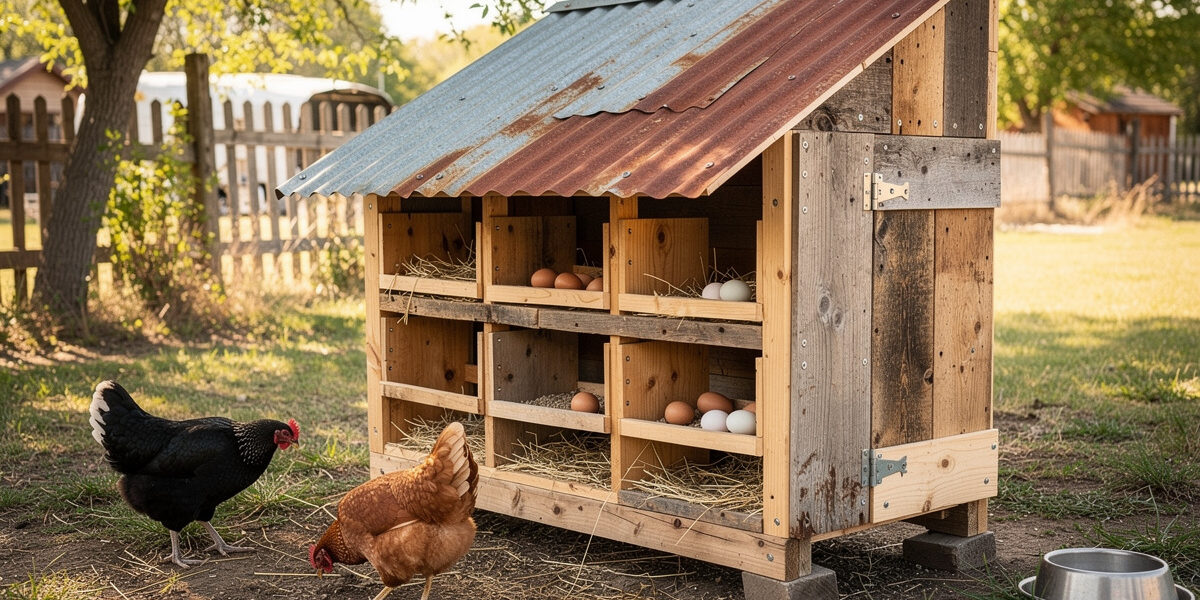
A DIY chicken house — the small enclosed shelter where birds sleep, lay, and wait out bad weather — can be built from scratch in 8–18 hours for $200–$500 depending on size and materials. Unlike a full coop with attached run, a chicken house is the indoor structure only; you pair it with a separate run or free-range space. This guide covers six beginner-friendly chicken house builds at three sizes (3-bird, 6-bird, 10-bird) with materials, time, and the build details that matter for first-time woodworkers.
For full coop+run builds, see our DIY chicken coop plans guide. For broader build sequence, see our building a chicken coop step-by-step guide.
What a Chicken House Is (and Isn’t)
The terminology varies regionally:
- Chicken house = enclosed sleeping/laying shelter (this guide)
- Chicken coop = often used interchangeably with house, sometimes implies house + attached run combo
- Chicken run = outdoor enclosed daytime space
- Chicken pen = smaller temporary or daytime enclosure
This guide focuses on the indoor structure only — the small building (typically 16–48 sq ft) where chickens roost overnight, lay eggs, and shelter from weather. The run or free-range area is a separate consideration covered in our chicken run guide.
Six Beginner-Friendly Chicken House Builds
| Build | Size | Capacity | Materials | Time |
|---|---|---|---|---|
| 3×4 Mini House | 12 sq ft | 3 birds | $180–$280 | 8–12 hrs |
| 4×4 Compact House | 16 sq ft | 4 birds | $220–$340 | 10–14 hrs |
| 4×6 Standard House | 24 sq ft | 6 birds | $280–$420 | 12–18 hrs |
| 4×8 Family House | 32 sq ft | 8 birds | $340–$520 | 14–22 hrs |
| 6×6 Walk-In House | 36 sq ft | 9 birds | $420–$640 | 16–24 hrs |
| Repurposed Doghouse / Playhouse | 10–25 sq ft | 2–6 birds | $80–$280 (existing structure) | 6–10 hrs |
The 4×6 Standard House is the realistic baseline most readers should target. It comfortably holds 6 birds, leaves room for nesting boxes and a roost, and uses standard 4×8 plywood sheets without much waste.
Build 1: 3×4 Mini House (Smallest Practical Size)
For 3-bird flocks where space is tight. Materials cut from a single 4×8 sheet of plywood:
- Floor: 3×4 ft (12 sq ft)
- Walls: two 3×4 long walls + two 3×3 short walls + 1×3 doors
- Roof: single slope from 4 ft tall front to 3 ft tall back
Materials: 1 sheet 5/8″ T1-11, 8 ft of 2×4 framing, hardware cloth, hinges, latch. Cost: $180–$280. Time: 8–12 hours.
This is the smallest realistic chicken house. Below 12 sq ft, even 3 birds get cramped — the 4 sq ft per bird minimum drives this floor.
Build 2: 4×4 Compact House
The standard small house: 16 sq ft floor, 4 birds, fits in a corner of any backyard. Most popular first build for new keepers.
- Floor: 4×4 ft
- Walls: 4 ft front (with door) + 4 ft back + two 4 ft sides
- Roof: shed-style or low-pitch gable
- Two nesting boxes side by side, accessible from outside via lift-up lid
Cost: $220–$340. Time: 10–14 hours over one weekend.
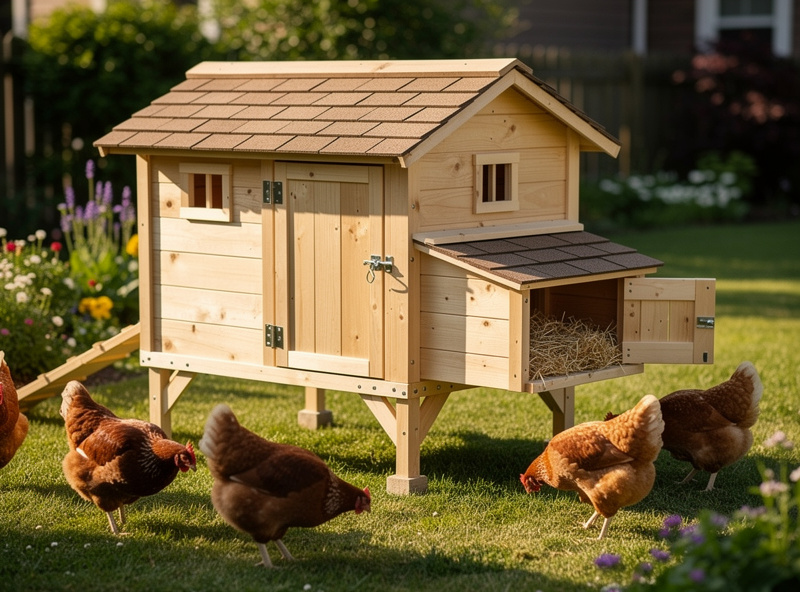
Build 3: 4×6 Standard House (Recommended Default)
The realistic recommendation for most backyard keepers. Holds 6 birds with room to spare:
- Floor: 4×6 ft (24 sq ft = 4 sq ft per bird for 6 birds)
- Walls: 4-foot tall, with people-access door on one short side
- Roof: gable or single-slope, asphalt shingles
- 3 nesting boxes (one per 2 birds)
- 2-foot roost bar (8 inches per bird × 4 birds, plus 2 birds rotating)
Cost: $280–$420. Time: 12–18 hours over 1–2 weekends.
Pair this with a 6×12 or 8×12 run from our chicken run guide for a complete setup.
Build 4: 4×8 Family House
For larger flocks (8 birds) or expansion-minded builders. Uses 4×8 lumber dimensions with no waste.
- Floor: 4×8 ft (32 sq ft)
- Walls: 4-foot or 5-foot tall
- 4 nesting boxes
- 3-foot roost bar (8 inches × 4 birds, with 2 birds at any time on the floor or rotating)
Cost: $340–$520. Time: 14–22 hours over 2 weekends.
Build 5: 6×6 Walk-In House
For builders who want walk-in human access (6+ ft ceiling) without a much-larger structure. 36 sq ft inside, 9 birds capacity.
- Floor: 6×6 ft
- Walls: 6.5 ft tall at peak, 5.5 ft at eaves
- Standard people door, walk-in interior
- 4 nesting boxes
Cost: $420–$640. Time: 16–24 hours over 2–3 weekends.
Walk-in houses make daily egg collection and weekly cleaning much easier. The 25–30% material premium pays back in maintenance time within the first year.
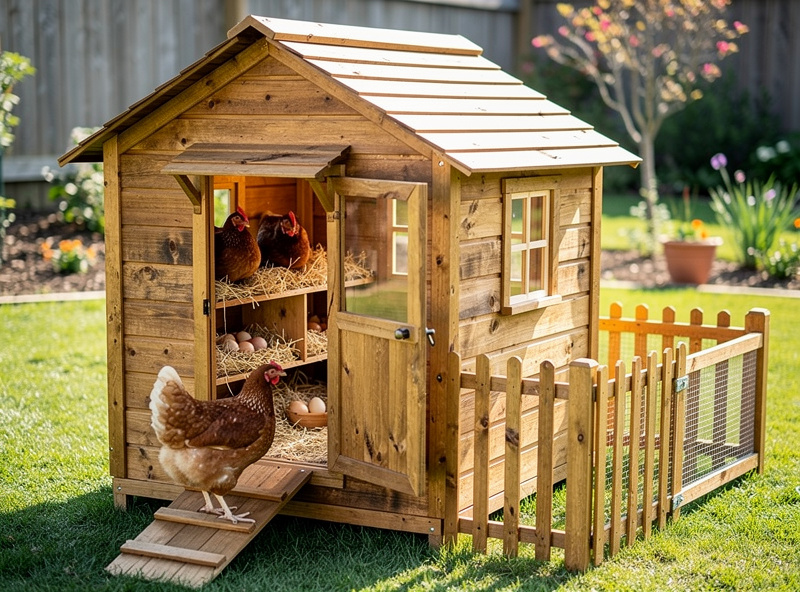
Build 6: Repurposed Doghouse or Playhouse
The fastest path to a chicken house if you have an existing structure to repurpose. Common candidates:
- Old wooden doghouse (after thorough cleaning)
- Children’s playhouse outgrown by the kids
- Backyard storage shed at 4×6 to 6×8 size
- Greenhouse with solid walls
Conversion cost: $80–$280 for new hardware (ventilation hardware cloth, nesting boxes, roost, predator-proofing). Time: 6–10 hours.
This is often the cheapest path if you have a candidate structure already on the property. Cleaning before deployment is critical — pressure wash, then disinfect with a fresh 1:10 bleach-to-water solution (mix it the day you use it; it loses strength fast) and let the structure dry completely before introducing birds.
Standard Materials for Any Chicken House
| Component | Specification | Notes |
|---|---|---|
| Floor framing | Pressure-treated 2×4 | Always treated where wood touches concrete or ground |
| Floor sheathing | 3/4″ plywood (CDX or BCX) | Treats moisture better than OSB |
| Wall framing | Kiln-dried 2×4 | 16″ on center for studs |
| Wall siding | 5/8″ T1-11 plywood OR LP SmartSide | LP costs $20–$40 more, lasts 5–10 years longer |
| Roof framing | 2×4 rafters at 16″ or 24″ OC | Heavier framing in snow regions |
| Roof sheathing | 5/8″ OSB or 1/2″ plywood | Either works; plywood is more rot-resistant |
| Roofing | 3-tab asphalt shingles | Or metal panels for snow regions |
| Hardware cloth | 1/2″ mesh, 19-gauge | 1/4″ for chick areas |
| Hinges and latches | Stainless or galvanized steel | Avoid plain steel that rusts |
| Paint or stain | Exterior-grade, 2 coats | Refresh every 5–7 years |
Sticking to these standards delivers a chicken house that lasts 15–25 years with minimal maintenance. Cutting corners (untreated floor lumber, OSB siding instead of plywood) drops lifespan to 5–10 years.
Interior Layout Essentials
A functional chicken house needs four interior elements:
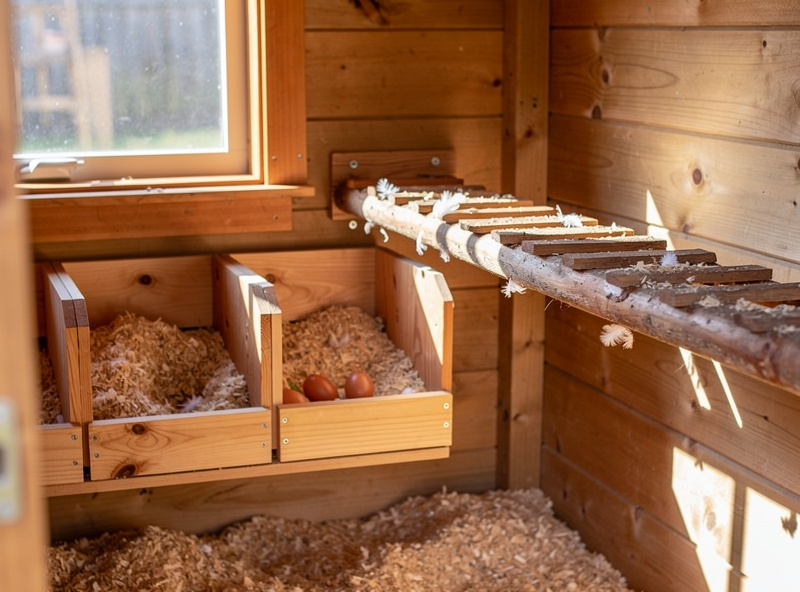
Roost Bar
A 2×2 or 2×4 (laid flat side up so feet can wrap properly) mounted 18–24 inches off the floor, allowing 8–12 inches per bird. Higher than nesting boxes — chickens roost in the highest spot, and you do not want them roosting in the nesting boxes (eggs get fouled).
Nesting Boxes
One box per 3–4 birds. Standard box dimensions: 12x12x14 inches. Mount lower than the roost. External access (lift-up lid on the outside wall) makes egg collection a 30-second daily task instead of a 5-minute one.
Pop Door
9–13 inches wide, 12–16 inches tall. Mount on the wall facing the run or free-range area. The pop door is what chickens use to enter and exit the house; the people door is for you to clean and access the interior.
Ventilation
1 sq ft of vent area per 10 sq ft of floor area is the baseline most extension guides reference. Place vents high (gable ends or near roof eaves) to prevent drafts on roosting birds. Cover all vents with 1/4″ or 1/2″ hardware cloth. On my own coop the ridge and soffit vents do the work passively — no fans — and the difference shows up as dry litter instead of frosted-over rafters on the coldest mornings; moisture, not cold, is what actually damages a comb.
Bedding and Floor Treatment
The floor of the chicken house gets the most chicken waste exposure. Three options:
- Plain plywood + bedding. Pine shavings or hemp 4–6 inches deep. Cheapest; clean every 4–8 weeks.
- Vinyl flooring on plywood. Wipeable surface; bedding still required but cleaner. Adds $40–$80 to materials.
- Concrete-board floor. Most durable; easiest to disinfect. Adds $60–$100 and 2–3 hours of build time.
For most backyard houses, plain plywood + deep-litter bedding works fine — it’s what I run in my own house, and the litter itself becomes part of the moisture management if the ventilation above it is doing its job. Detailed bedding choices in our chicken coop bedding guide.
Common DIY Chicken House Mistakes
- House without ventilation. Sealed houses trap moisture and ammonia, damaging chicken respiratory systems. 1 sq ft of vent per 10 sq ft of floor minimum.
- Roost lower than nesting boxes. Birds roost in the highest spot. If nesting boxes are higher, eggs get sat on and fouled.
- No people-access door. Tiny pop-only access makes cleaning impossible. Build at least one human-sized door.
- Skipping the predator apron. Even tiny houses need apron protection if used overnight.
- Untreated bottom plate. An untreated bottom plate sitting on damp ground or concrete is one of the more common ways a coop’s structure fails early. Always pressure-treated, and ideally with a capillary break (sill gasket) between the plate and the slab or blocks — pressure-treated wood resists rot but is still porous, and it can wick moisture up into the untreated studs above it if there’s no break.
- Tarp roof. Tarps fail within 2 years. Use real shingles or metal.
- Chicken wire on vents. Universal mistake. Hardware cloth.
- Mounting nesting boxes inside the people-door area. Birds will block you whenever you try to clean. Place boxes opposite the people door.
House + Run Integration
The house and run connect at the pop door. Three approaches:
- Direct attachment. Run framing meets house wall, pop door is the only chicken access. Most predator-tight.
- Tunnel connection. A short hardware-cloth tunnel between separate house and run structures. Useful when terrain or layout requires offset.
- Shared wall. Run uses house wall as one of its boundaries. Saves materials but requires careful weatherproofing of the joint.
For most builds, direct attachment is the right choice. It minimizes the joint area where predators find gaps.
Build Schedule Examples
| Build | Realistic Schedule |
|---|---|
| 3×4 Mini | Saturday + Sunday (12 hrs) |
| 4×4 Compact | One weekend (12–14 hrs) |
| 4×6 Standard | 1.5 weekends (15–18 hrs) |
| 4×8 Family | 2 weekends (16–22 hrs) |
| 6×6 Walk-In | 2–3 weekends (18–24 hrs) |
| Repurposed Doghouse/Playhouse | One weekend (8–10 hrs) |
First-time builders should plan toward the high end. Experienced woodworkers compress these timelines by 20–30%.
Smart-Coop Compatibility
Even small DIY chicken houses integrate well with smart automation. During build, plan for:
- Conduit run from house to power source. Cheap to add during construction; expensive to retrofit.
- Auto door cutout sized correctly. Standard 9–13″ wide × 12–16″ tall fits most commercial auto doors.
- Camera mounting block. A solid 2×4 block in one upper interior corner for future camera mount.
- Sensor placement. Mid-wall blocking for temperature and humidity sensors.
For full smart-coop wiring details, see our smart chicken coop wiring guide. I ran conduit and left blocking in the walls on my own build before the siding went up, and every camera and sensor I’ve added since has been a bolt-on instead of a wall-opening project — cheap insurance for a decision that costs almost nothing to make during framing and real money to fix afterward.
Size for more birds than your current plan calls for, too. Chicken math is undefeated — the house I originally sized for 6 birds is holding closer to 10 now, and I’ve helped a couple of neighbors plan their first builds one size larger than they thought they needed for exactly that reason.
Frequently Asked Questions
How big should a DIY chicken house be?
Allow 4 sq ft per bird inside the house. For 4 birds plan 4×4 (16 sq ft), for 6 birds plan 4×6 (24 sq ft), for 8 birds plan 4×8 (32 sq ft). Build for 50% larger than your starting flock since most keepers expand within 24 months.
What is the difference between a chicken house and a chicken coop?
The terminology overlaps. A chicken house typically refers to the indoor sleeping/laying shelter only. A chicken coop sometimes means the same thing, sometimes means the house plus an attached run. This guide uses ‘house’ to mean the indoor structure specifically.
Can a beginner build a DIY chicken house?
Yes — basic chicken house construction is at the simplest end of carpentry. Straight cuts, square corners, screws and nails. The 3×4 mini house and 4×4 compact house are realistic first builds for someone who can hang a shelf and follow a measuring tape. Plan 8–14 hours over one weekend.
What materials do I need for a DIY chicken house?
For a 4×6 standard house: pressure-treated 2×4 floor framing, kiln-dried 2×4 wall framing, 5/8 inch T1-11 plywood siding, 3/4 inch plywood floor, asphalt shingles, 1/2 inch hardware cloth for vents, hinges, latches, screws. Total cost $280–$420 in 2026 lumber pricing.
Can I convert a doghouse or playhouse into a chicken house?
Yes — repurposing existing structures is often the cheapest and fastest path. Plan $80–$280 in conversion materials for ventilation hardware cloth, nesting boxes, roost bar, and predator-proofing. Pressure wash thoroughly with diluted bleach before introducing chickens.
How long does it take to build a DIY chicken house?
A 3×4 mini house takes 8–12 hours. A 4×4 compact house takes 10–14 hours. The popular 4×6 standard size needs 12–18 hours over 1–2 weekends. Walk-in 6×6 houses require 16–24 hours over 2–3 weekends. First-time builders should plan toward the high end of these ranges.
Related Articles
- DIY Chicken Coop Plans: 12 Free Designs by Skill Level
- Building a Chicken Coop From Scratch: Step-by-Step
- Chicken Run Guide: Sizing, Materials & Best 2026 Models
- Chicken Coop Size Guide: How Many Chickens Per Square Foot
- Portable Chicken House: Cottage, Plastic & Barn Picks
Related Guides
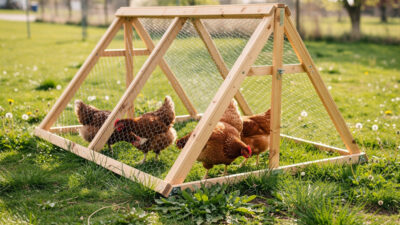
DIY Chicken Tractor Plans: Free Mobile Coop Builds
A DIY chicken tractor — the mobile coop+run combo on wheels or skids — is one of the most-built backyard…
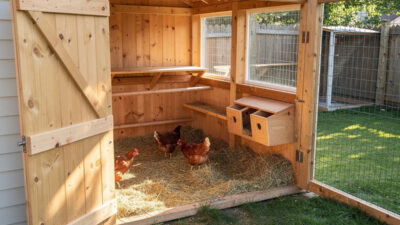
Walk-In Chicken Coop Plans: Free Blueprints
A walk-in chicken coop built with free blueprints delivers the maintenance-friendly height (6.5+ ft ceiling) most backyard keepers eventually wish…
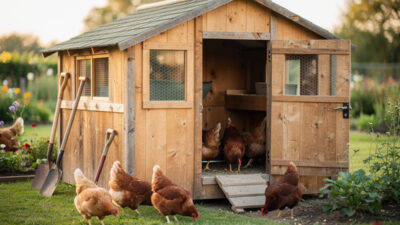
Chicken Coop Shed Conversion: Garden Shed to Coop
Converting a garden shed into a chicken coop shed takes 8–16 hours and $200–$500 in materials, delivers far better insulation…