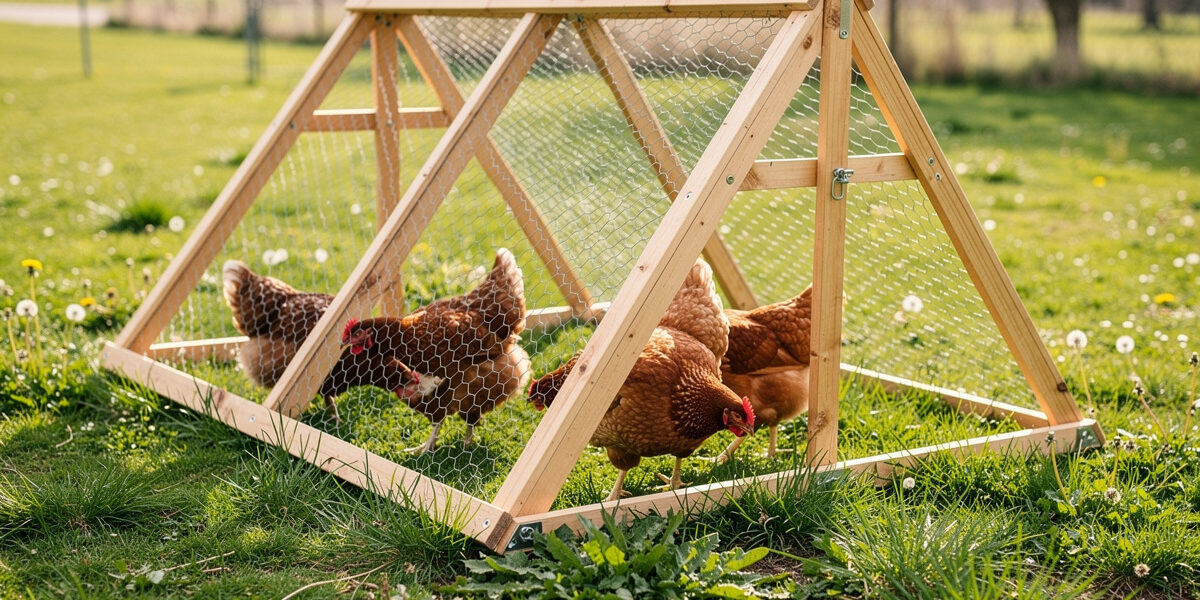
A DIY chicken tractor — the mobile coop+run combo on wheels or skids — is one of the most-built backyard chicken structures and one of the easiest to plan. Free chicken tractor plans exist for A-frame, hoop, rectangular, and sled-style designs, all build-able for $280–$680 in materials over 12–32 hours of work. The right plan depends on flock size, terrain, and how often you want to move the tractor. I have built two of these for my own pasture rotation — a cattle-panel hoop and an A-frame — and this guide compares the four most-popular DIY tractor plans with materials, build details, and the design choices that determine whether your tractor moves smoothly across a yard or fights you every time. Mine fought me every move until I rounded the skid noses.
For broader chicken tractor context (pre-built options, rotation strategies), see our chicken tractor guide. For the broader DIY plans menu, see our DIY chicken coop plans guide.
As an Amazon Associate I earn from qualifying purchases.
Why Build a Chicken Tractor?
Five reasons backyard keepers build tractors instead of fixed coops:
- Pasture rotation. Move the tractor every 1–7 days; chickens fertilize fresh ground without parasite buildup.
- Lawn fertilization. Chicken droppings compost into nitrogen-rich soil amendment as the tractor passes over each spot.
- No permanent structure. No permits, no foundation, can be sold or stored when not needed.
- Cheaper than coop+run combos. $280–$680 vs $700–$1,500 for equivalent fixed setup.
- Ideal for small flocks (2–8 birds). Most tractors top out at 8 birds, fitting typical backyard scale.
Tractors do not work for very large flocks (10+ birds), heavy snow regions in winter, or properties with rough terrain that prevents smooth movement.
The Four Free Tractor Plans
| Plan | Footprint | Capacity | Materials | Build Time |
|---|---|---|---|---|
| A-Frame Tractor | 4×8 ft | 3–6 birds | $325–$515 | 14–22 hrs |
| Hoop Tractor (cattle panel) | 4×12 ft | 4–8 birds | $280–$450 | 12–18 hrs |
| Rectangular Box Tractor | 4×8 ft | 4–6 birds | $415–$650 | 16–24 hrs |
| Sled-Style Tractor (Salatin design) | 10×12 ft | 6–10 birds | $420–$680 | 22–32 hrs |
The A-frame is the most-built design for first-time tractor builders. The hoop is the cheapest — and the one I run most, because two cattle panels go up in a morning and the arch sheds Nordic snow load far better than any flat-roofed box I have tried. The Salatin sled is the most efficient at scale (popularized by Joel Salatin’s Polyface Farm). All four work well — pick based on flock size and aesthetic.
Plan 1: A-Frame Tractor (Most Popular)
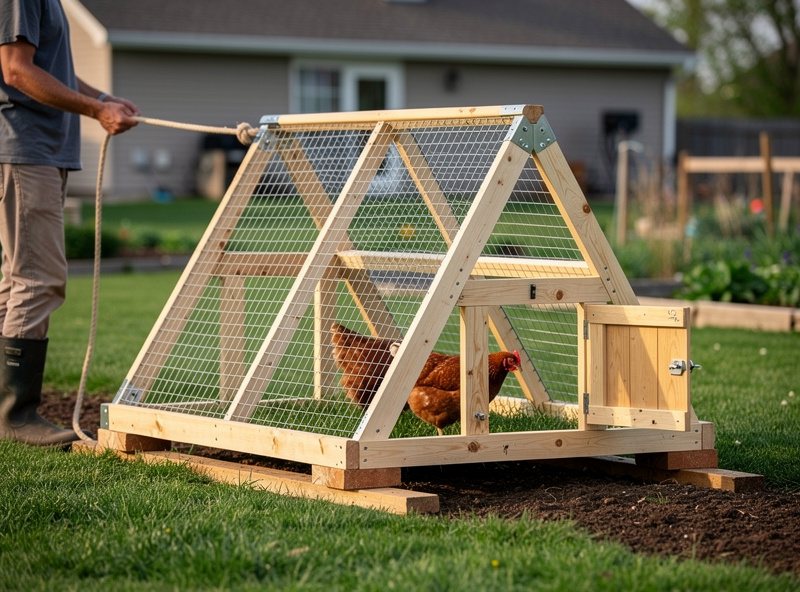
Triangular profile with a coop section at one end (enclosed) and an open run section at the other (hardware cloth on all sides). Skids on the bottom, no wheels.
Materials List
- 2x4x8 lumber: 12 boards ($90–$130)
- 2x4x10 lumber for skids: 2 boards ($20–$30)
- 1/2″ T1-11 plywood for coop section: 1 sheet ($60–$90)
- 1/2″ hardware cloth: 50 sq ft ($60–$90)
- Asphalt shingles for coop section: 1/2 bundle ($25–$45)
- Hinges, latches, screws: $40–$70
- Two nesting boxes: $30–$60 in materials
Total: $325–$515. Build time: 14–22 hours over 1–2 weekends.
Movement
One person can move a 4×8 A-frame tractor by lifting one end while the skids slide. Two people make the move much easier. Move every 2–4 days during active growing season; less often in winter.
Plan 2: Hoop Tractor (Cattle Panel)
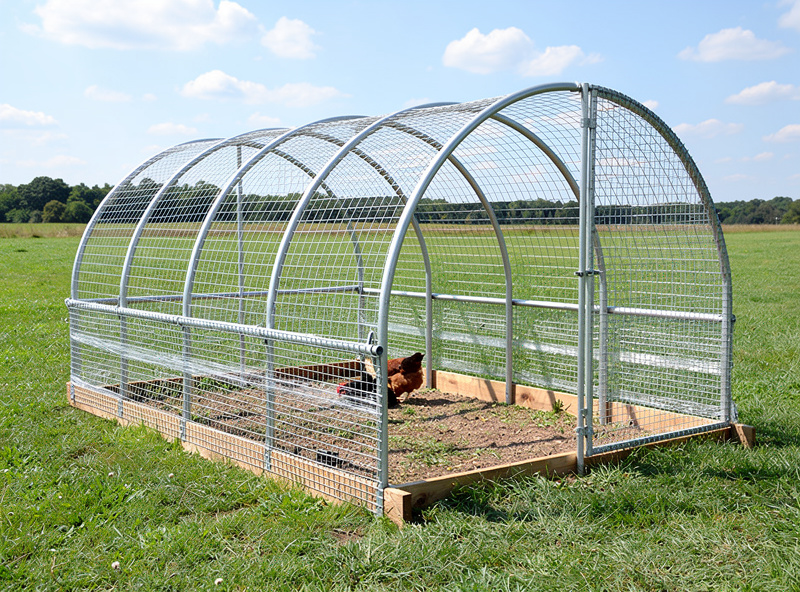
Two 16-ft cattle panels arched between treated posts to form a curved roof. The structure self-supports without internal framing. Walk-in height at the peak (5–6 ft) tapering to 3 ft at the sides. Skids on the bottom.
Why Hoop Tractors Win
- Cheapest cost per square foot of any tractor design
- Curved roof sheds rain and snow naturally
- Self-supporting structure — no roof framing
- Walk-in height for easy maintenance
- Lightweight relative to enclosed area
Materials List
- 2 cattle panels (16 ft x 50″): $50–$90
- 1/2″ hardware cloth: 80 sq ft ($90–$140)
- Pressure-treated 2×6 for skids: 2 boards ($30–$50)
- Pressure-treated 2×4 for end frames: 4 boards ($20–$30)
- 1/2″ plywood for coop section: 1 sheet ($60–$90)
- Hinges, latches, screws: $30–$50
Total: $280–$450. Build time: 12–18 hours.
The hoop tractor is genuinely the cheapest functional tractor design. 4×12 ft footprint gives 48 sq ft for 4–8 birds.
Plan 3: Rectangular Box Tractor
Four-sided rectangular structure with framed walls, a flat or shed-style roof over the coop section, and an open hardware-cloth run. More aesthetic than the A-frame but heavier to move.
Why Choose a Box Tractor
Rectangular tractors have more usable interior space than A-frames (where the angled walls reduce floor area). They are easier to outfit with proper nesting boxes and roost bars at correct heights. The downside is more weight and harder movement.
Materials
Similar to a small fixed coop with skids substituted for foundation:
- 2×4 framing: 14 boards ($100–$150)
- 2×6 skids: 2 boards ($30–$50)
- 5/8″ T1-11 siding: 2 sheets ($120–$180)
- 1/2″ hardware cloth: 60 sq ft ($70–$110)
- Asphalt shingles: 1 bundle ($45–$70)
- Hinges, hardware, screws: $50–$90
Total: $415–$650. Build time: 16–24 hours.
Plan 4: Salatin Sled Tractor (10×12 ft)
Joel Salatin’s Polyface Farm popularized this design for pasture-raised broilers and laying hens. 10×12 ft footprint, low profile (3–4 ft tall), tarp roof, designed to be moved daily by one person dragging it across pasture.
Distinctive Features
- Lightweight construction (under 100 lbs assembled)
- Front handle for one-person dragging
- Tarp roof shelters part of the run; rest is open hardware cloth
- 120 sq ft footprint — much larger than other tractor styles
- Designed for daily moves on pasture
Materials
- 2×2 lumber for lightweight framing: 30 boards ($120–$200)
- 2×4 sled runners: 2 boards ($20–$30)
- 1/2″ hardware cloth: 100 sq ft ($110–$170)
- Tarp roof material: 8×10 ft tarp ($30–$50)
- Hinges, latches, drag handle: $60–$100
- Small coop section materials: $80–$130
Total: $420–$680. Build time: 22–32 hours.
The Salatin sled is the production-oriented choice — best for keepers who want to maximize pasture rotation efficiency on larger properties.
Materials Standards for Any Tractor
| Component | Specification |
|---|---|
| Skids/runners | Pressure-treated 2×6 (treated for ground contact) |
| Frame | Kiln-dried 2×4 (minimum) |
| Wall siding (coop section) | 5/8″ T1-11 plywood or 1/2″ plywood |
| Roof | Asphalt shingles, metal panels, or tarp (for sled designs) |
| Mesh | 1/2″ hardware cloth on every opening |
| Hinges/latches | Stainless or galvanized steel |
| Screws/nails | Outdoor-rated, galvanized or coated |
Skid-bottom tractors do not need pressure-treated framing for the upper structure since the structure does not contact ground. Only the skids themselves need treated lumber.
Universal Build Sequence
- Build skids/runners—pressure-treated 2×6 with rounded front ends for smoother dragging
- Frame the structure—A-frame triangles, cattle panel hoop, or rectangular walls
- Add coop enclosure—plywood walls on the sleeping/laying section
- Install nesting boxes—external access if possible, internal otherwise
- Install roost bar—2×4 mounted in the enclosed coop section
- Wrap hardware cloth—every wall and roof of the run section
- Install the door(s)—coop access door for cleaning, plus pop door if separate from main door
- Final hardware—hinges, latches, drag handle
- Roofing—shingles, metal, or tarp depending on design
For most tractor designs, total build time is 12–24 hours over 1–2 weekends. The Salatin sled takes longer due to size.
Wheels vs Skids
Two main movement systems:
| System | Pros | Cons |
|---|---|---|
| Skids (treated 2×6) | Cheap, simple, no maintenance | Heavy to move; drag wears grass |
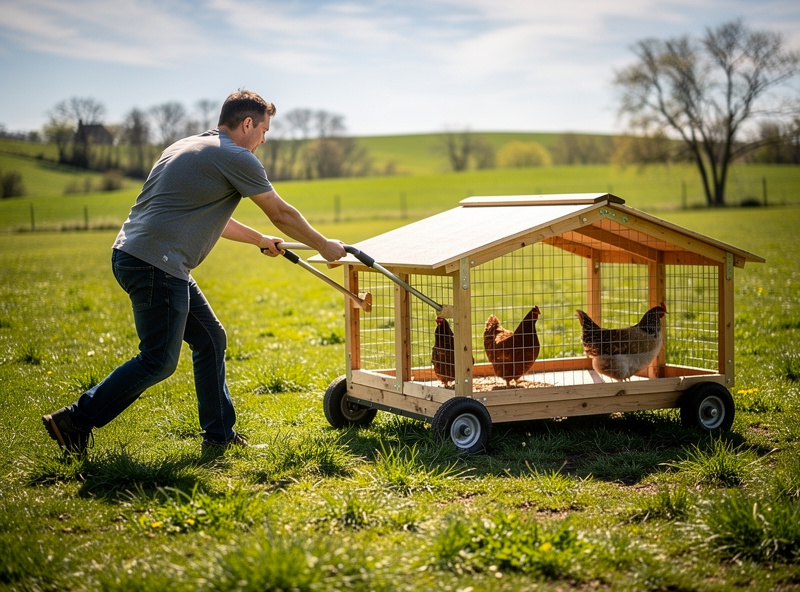
| Wheels (lawn-mower wheels) | Easier movement, less grass damage | $60–$120 in wheels, hubs, axles; harder to keep predator-tight |
| Wheelbarrow style (front wheels + rear handles) | Easiest one-person move | Need rear lift handles, structural reinforcement |
| PVC roller pipe (under one end) | Cheap, allows rolling on flat ground | Only works on level surfaces |
For most readers, simple skids work fine. Add lawn-mower-style wheels only if you have rough terrain or a heavy tractor design.
Sizing by Flock
Tractors typically allow less floor area per bird than fixed coops because birds spend most time outside on fresh pasture:
| Birds | Tractor Footprint | Square Feet per Bird |
|---|---|---|
| 3 birds | 4×8 (32 sq ft) | 10.7 sq ft |
| 4 birds | 4×8 to 4×10 (32–40 sq ft) | 8–10 sq ft |
| 6 birds | 4×12 to 5×10 (48–50 sq ft) | 8–10 sq ft |
| 8 birds | 5×12 or 6×10 (60 sq ft) | 7.5 sq ft |
| 10 birds | 10×12 sled (120 sq ft) | 12 sq ft |
Tractors can run lower bird-density than fixed coops because the daily fresh ground replaces some of the space requirements. Birds get effective new space each time the tractor moves.
Movement Schedule
Daily moves work best for pasture management (Salatin-style production); every 2–3 days is the practical balance for most backyard keepers; weekly works for low-density flocks of 3–4 birds. Move at the same time each day so chickens learn the routine — usually first thing in the morning before letting birds out.
Common Tractor Build Mistakes
- Too heavy. Weight is the single biggest reason pastured-poultry pens get abandoned — a tractor that takes two people to move never gets moved. Use 2×2 lumber for non-structural framing on smaller tractors to drop weight.
- Skids that snag. Square-cut skid front ends catch on grass and dirt. Round or chamfer the front ends.
- Open bottom. Tractors typically have no floor (so chickens forage directly on grass), but this means hardware cloth on the bottom edge of every wall must extend to the ground or predators dig under — I lost a hen to a fox that went under a tractor wall before I learned to pin a wire skirt at every move.
- Ventilation through the run only. The enclosed coop section needs separate ventilation; otherwise it traps ammonia.
- No predator-proof roost area. Chickens roost at night in the coop section. That section must be fully enclosed with hardware cloth and a tight-closing pop door.
- Tarp roof failure. Tarps fail within 1–2 years of UV exposure. Plan to replace, or use a metal or shingle roof on the coop section.
- Forgetting external feeder/waterer access. Refilling food and water from inside the tractor is awkward. Plan external access points.
Tractor Predator-Proofing
Tractors have a unique predator-proofing challenge: there is no buried apron because the tractor moves. Three solutions:
- Hardware cloth skirt. Wire extending 6–12 inches outward from each wall, lying flat on the ground. Pinned with bricks or weighted with sandbags. Stops most digging predators while allowing tractor movement.
- Lock chickens in coop section overnight. The coop section has a closing pop door; close it at dusk. Run section can be more lightly built since no birds are in it overnight.
- Move into a fully predator-proof area at night. Some keepers park the tractor inside an electric-fenced perimeter overnight.
The lock-in-overnight approach works for most setups. The coop section needs to be as predator-tight as a fixed coop’s sleeping area; the run section can be lighter because birds are not vulnerable in it overnight.
Tractor vs Fixed Coop Decision
| Choose Tractor If… | Choose Fixed Coop If… |
|---|---|
| You want pasture rotation | Fixed location is fine |
| Flock size 2–8 birds | Flock size 10+ birds |
| Mild to moderate climate | Heavy snow / extreme cold |
| Plan to relocate or sell | Long-term property |
| Limited budget ($280–$680) | Comfortable with $700+ for fixed |
Both setups work for healthy chicken keeping; tractors require more daily management while fixed coops require more upfront investment.
Where to Find More Tractor Plans
Reliable free sources include Joel Salatin’s Pastured Poultry Profits (the book that popularized the sled design covered above), state land-grant extension programs (coverage of tractor-specific plans varies by state — check your own extension office), the BackyardChickens forum (user-built designs with photos), and YouTube build-along videos. For pre-built tractor options, see our chicken tractor guide and chicken tractor for sale guide.
Frequently Asked Questions
How much does it cost to build a DIY chicken tractor?
DIY chicken tractor costs range from $280 (hoop tractor with cattle panels) to $680 (Salatin sled tractor at 10×12 ft). The most popular A-frame design runs $325–$515 in materials. All four save meaningfully versus equivalent prefab tractors at $700–$1,500.
What is the easiest chicken tractor to build?
The hoop tractor with cattle panels is the easiest because the cattle panels self-support without complex roof framing. Total build time 12–18 hours, materials $280–$450. The A-frame is slightly more involved but produces a more polished result and is the most-built design overall.
How big should a chicken tractor be?
Allow 8–10 sq ft per bird in the tractor footprint. For 4 birds plan 4×8 (32 sq ft). For 6 birds plan 4×12 or 5×10 (48–50 sq ft). For 8 birds plan 5×12 or 6×10 (60 sq ft). The Salatin 10×12 sled holds up to 10 birds for production-oriented setups.
How often should I move a chicken tractor?
Daily for production-oriented pasture rotation, every 2–3 days for typical backyard use, weekly for low-density flocks of 3–4 birds on lush grass. Move at the same time each day so chickens learn the routine. Less than weekly defeats the rotation benefit.
Should I use wheels or skids on my chicken tractor?
Skids work fine for most backyard tractors and require no maintenance. Wheels make movement easier on rough or sloped terrain but add $60–$120 in cost and are harder to keep predator-tight. Wheelbarrow-style (front wheels plus rear handles) is the easiest one-person system for heavier tractors.
Can I leave chickens in a tractor overnight?
Yes if the coop section (where they roost) is fully enclosed with hardware cloth on every surface, a tight-closing pop door, and a hardware-cloth skirt extending outward to deter digging. The run section can be more lightly built since birds are locked in the coop overnight.
Related Articles
- DIY Chicken Coop Plans: 12 Free Designs by Skill Level
- Chicken Tractor: A-Frame Designs, Plans & Best Picks
- Portable Chicken Coops & Tractors: Complete 2026 Guide
- Chicken Coop on Wheels: Best Wheel Systems Reviewed
- Movable Chicken Coops: Daily Rotation Routine Guide
Related Guides
Walk-In Chicken Coop Plans: Free Blueprints
A walk-in chicken coop built with free blueprints delivers the maintenance-friendly height (6.5+ ft ceiling) most backyard keepers eventually wish…
Chicken Coop Shed Conversion: Garden Shed to Coop
Converting a garden shed into a chicken coop shed takes 8–16 hours and $200–$500 in materials, delivers far better insulation…
DIY Chicken House: 6 Beginner-Friendly Builds
A DIY chicken house — the small enclosed shelter where birds sleep, lay, and wait out bad weather — can…