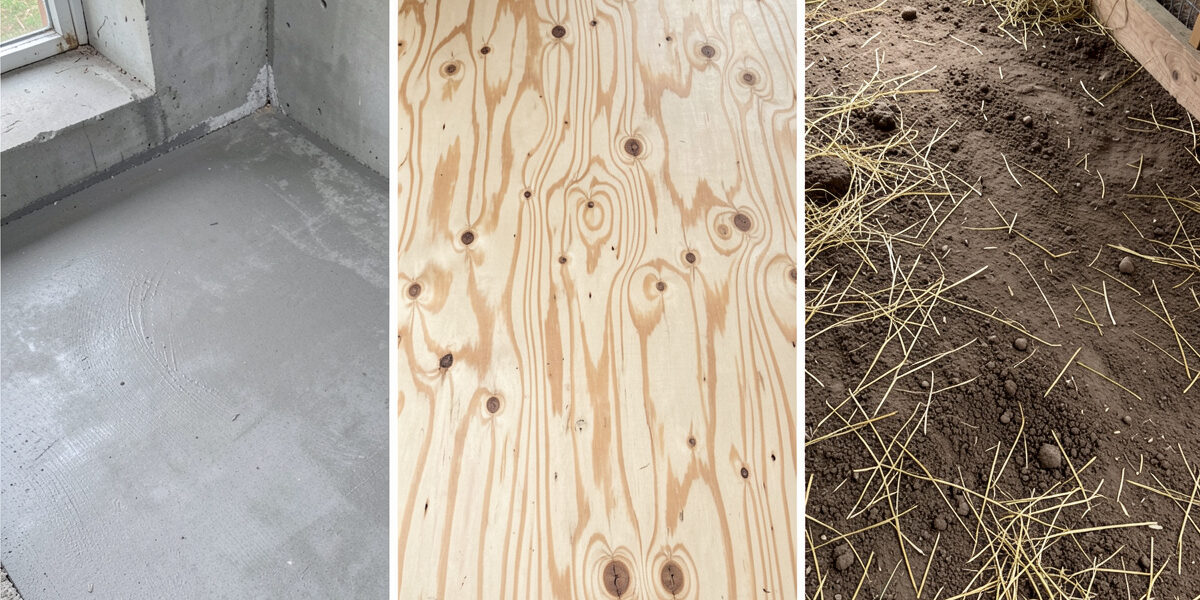
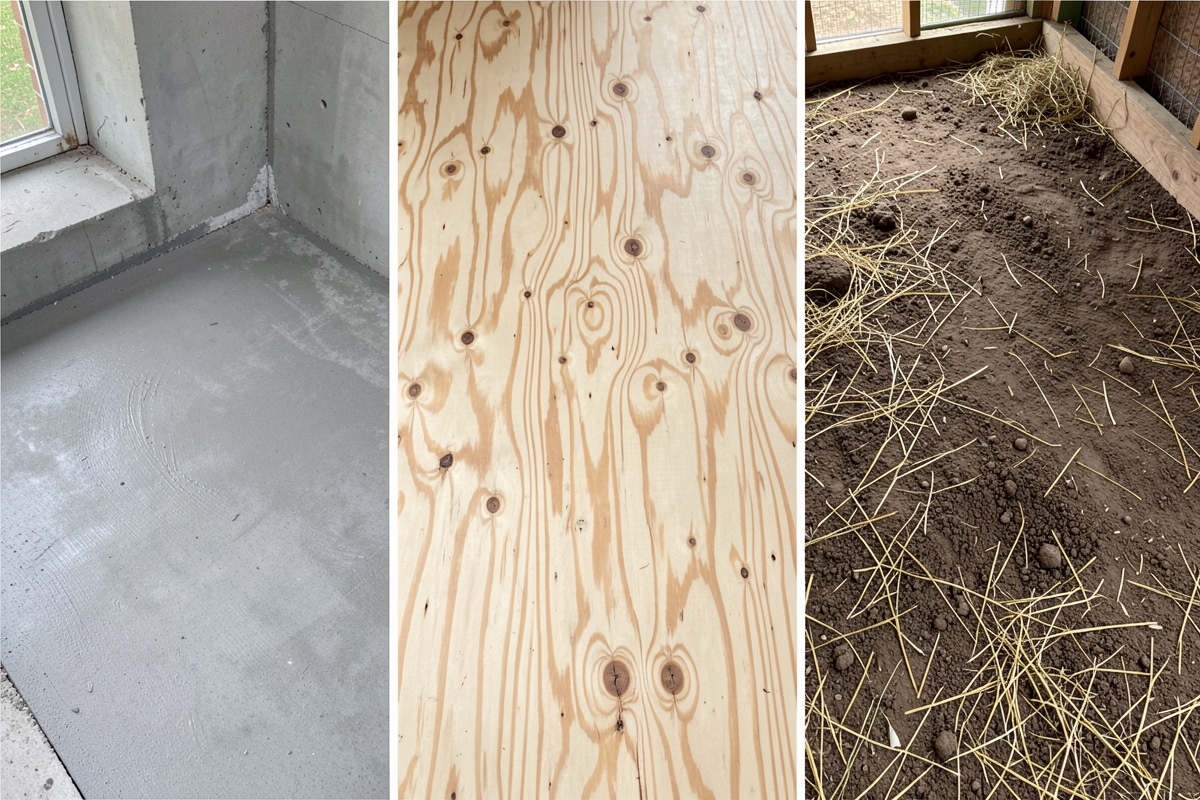
Concrete, plywood, and dirt aren’t three flavors of the same choice — they sit at different points on a triangle of cost, predator resistance, and warmth, and you can’t max all three. Concrete is bomb-proof against diggers but cold and permanent. Plywood is cheap, warm, and movable but rots and can be gnawed. Dirt is free and warm but drains poorly and lets predators tunnel. Pick the weakness you can manage, not the strength you want.
I’ve built coop floors out of all three, and the deciding factor was never the material’s headline virtue — it was which failure mode I could live with in a Swedish winter. My first plywood floor rotted because I ignored moisture. When I later poured a slab for a permanent build, I cursed the cost and the cold every cleaning day until deep litter fixed the warmth. Dirt I’ve only ever trusted where the ground genuinely drains. Here’s the honest head-to-head, with the numbers that actually move the decision.
This is a spoke off my main chicken coop flooring options guide — start there if you’re still mapping the whole territory. If you’ve already narrowed it to these three, read on.
What’s the Fastest Way to Decide Between Concrete, Plywood, and Dirt?
Answer two questions and the choice mostly makes itself: is the coop permanent or might you move it, and how hard does your ground freeze and drain? Permanent plus high predator pressure points to concrete. Movable or budget-driven points to sealed plywood. Free, warm, and well-draining ground can support dirt — but only if it genuinely drains.
The reason those two questions dominate is that they map straight onto the two failure modes that actually kill coop floors: moisture and predators. A movable coop can’t sit on a slab. A wet site rots plywood and turns dirt to mud. High predator pressure punishes anything a fox can dig under or a rat can chew through. Once you know your site and your permanence, the material with the tolerable weakness is usually obvious. Everything below is just filling in what “tolerable” means for each.
How Do Concrete, Plywood, and Dirt Compare Side by Side?
Concrete leads on durability and predator resistance and trails on cost and warmth; plywood is the cheapest warm option but needs sealing and a wire skirt; dirt is free and warmest but the weakest on drainage and diggers. The table is the whole argument in one screen.
| Factor | Concrete (4 in slab) | Sealed plywood (¾ in) | Dirt floor |
|---|---|---|---|
| Up-front cost | Highest | Low–medium | Free |
| Predator resistance | Excellent — undiggable | Fair — needs wire skirt | Poor — must bury apron |
| Winter warmth | Cold without deep bedding | Warm | Warmest |
| Cleanability | Excellent — scrape/hose | Good once sealed | Poor — dig out yearly |
| Movable? | No — permanent | Yes | No |
| Rot / rodent risk | None | Rots unsealed; gnawable | Damp risk; tunnelable |
| Lifespan | Decades | 8–15 yrs sealed | Indefinite if it drains |
Notice there’s no column that wins outright. Concrete’s clean row of strengths carries two heavy costs — money and cold — and dirt’s freedom carries two real risks. That’s why I won’t tell you one is “best.” I’ll tell you what each is genuinely good at and where it will bite you.
When Is Concrete the Right Coop Floor?
Concrete is the right floor for a permanent coop under real predator pressure, where you want to pour it once and never think about the floor again. A 4-inch slab with a thickened edge is the only floor nothing digs through — but it’s cold and clammy bare, so it only works paired with deep bedding.
The strength is absolute: a rat can’t gnaw it, a fox can’t excavate under a properly edged slab, and it hoses down to nothing. When I set the welded steel posts of my run frame into concrete footings, it was for exactly this reason — a hard stop a digger simply can’t beat. But concrete is a thermal sink. Bare, it pulls heat out of a bird’s feet and sweats with condensation in a cold snap, so a concrete coop lives on its bedding: I run 4–6 inches of pine shavings building to 8–12 over winter as a composting deep litter layer that insulates and warms. Get the sub-slab moisture barrier right when you pour, because you can’t add one later — a slab poured straight on wet ground wicks damp up forever. Concrete is the “do it once, do it right, never touch it again” option, and if predators are your main worry, pair it with the apron detailing in my underground predator barrier guide.
When Is Plywood the Better Choice?
Plywood wins whenever you want a warm floor you can build fast, modify, or eventually move — which covers most DIY coops. Sealed exterior ¾-inch plywood lasts 8–15 years and stays warmer underfoot than concrete. Its two weaknesses, rot and rodent-gnawing, are both solvable with sealing and a wire underlay.
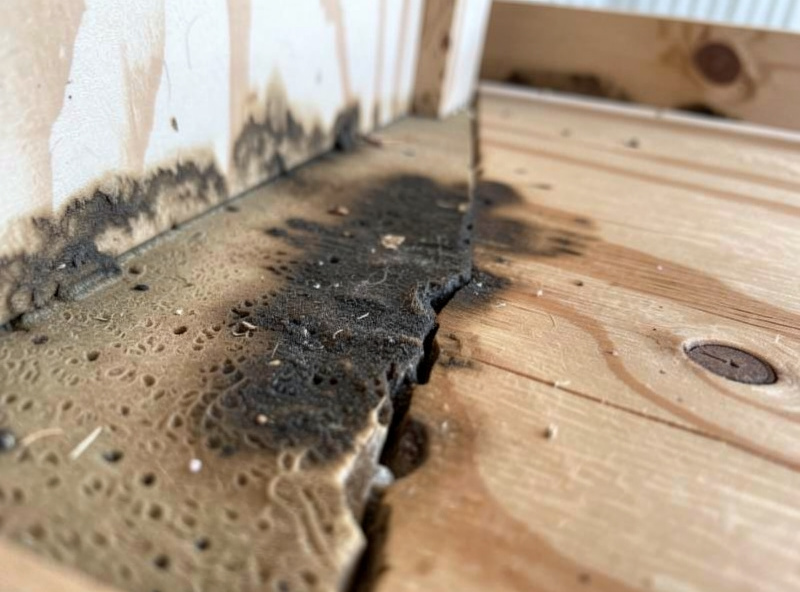
This is the floor I’d hand most first-time builders, with one non-negotiable: seal it, edges and all. My rotted first floor was bare plywood that wicked water into its end-grain until the panel flexed underfoot. Use a proper exterior or better exposure grade — the glue-line durability ratings from APA – The Engineered Wood Association are what separate a floor that shrugs off repeated wetting from one that delaminates. Then seal it and cove the wall joint so cleaning takes seconds. The other plywood weakness is teeth: a rat will chew through unprotected ¾-inch ply given a food motive, so I lay ½-inch hardware cloth under the floor — the same hardware cloth, not chicken wire, logic that governs every opening in my coop. Do both and plywood’s disadvantages mostly disappear, leaving you a warm, cheap, workable floor.
When Does a Dirt Floor Actually Work?
A dirt floor works where the ground drains well and you’ve buried wire against diggers — nowhere else. On free-draining sandy or sloped ground it’s the warmest, cheapest floor there is and lets birds dust-bathe naturally. On clay or a high water table it becomes stinking mud, which is why dirt gets a bad name it doesn’t always deserve.
The whole thing hinges on water. Raise the coop pad a few inches above the surrounding grade so runoff sheds away instead of pooling in, and the dirt stays workable; skip that and the first wet week turns the floor sour. Dig-proofing is the other half: chicken wire won’t stop a fox, so you bury a hardware-cloth apron or footer around the perimeter — the designs I use are in the underground predator barrier post. Over well-drained dirt, deep litter is at its best, composting droppings in place and letting you fork the finished material into the garden once a year. I won’t run a dirt floor in my main winter coop because my ground holds water, but on the right site it’s a legitimately excellent, nearly-free choice. If you’re going this route, get the drainage right first.
What About Warmth and Frostbite in a Cold Climate?
In a hard-freezing climate, floor material matters less than you’d think — because frostbite is caused by humidity, not by cold feet. A cold concrete floor doesn’t frostbite combs; damp, poorly ventilated air does. The floor’s job in winter is to stay dry and let deep bedding do the insulating, whatever the material.
This is the point cold-climate keepers get wrong most often. They obsess over the floor’s warmth and ignore the moisture the floor is holding. What actually protects a comb at −20 °C is dry air moving overhead — the ventilation-versus-draft balance — sitting above deep, dry litter. Concrete under 8 inches of composting shavings is plenty warm; bare plywood over a wet crawlspace is not. So don’t let “warmth” decide this for you in isolation. Pick the floor that stays driest on your site and insulate with bedding. Poultry housing guidance from land-grant programs like Penn State Extension makes the same point — ventilation and litter moisture drive frostbite risk more than raw air temperature. The one place cold does bite the floor choice directly is sand and standing water, which is its own separate discussion in the flooring hub.
Which One Would I Build Today?
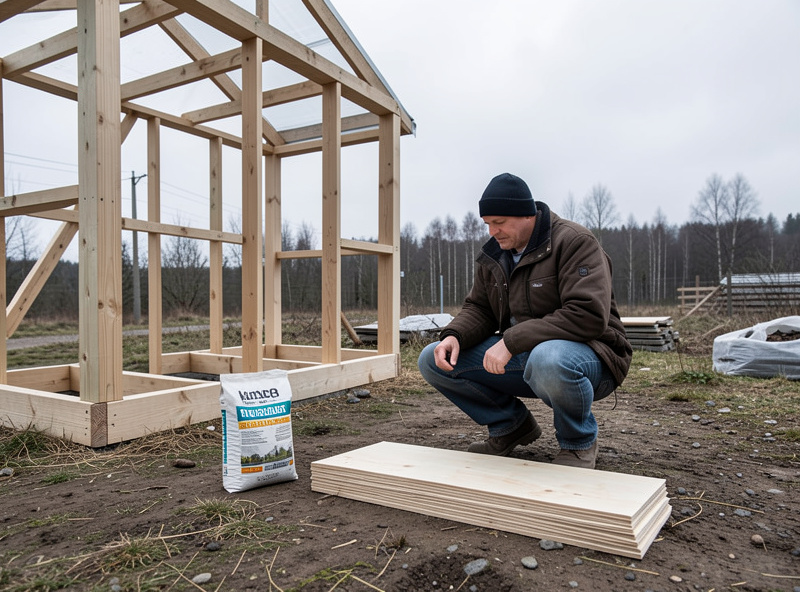
For a permanent coop where I keep birds year-round under fox and rat pressure, I’d pour concrete and run deep litter over it. For anything I might move, or a first build on a budget, I’d lay sealed ¾-inch plywood over a hardware-cloth underlay on a raised frame. I’d only choose dirt on genuinely free-draining ground.
If I had to give one default, it’s the sealed-plywood-plus-wire build: it’s forgiving, warm, cheap, and fixable, and it fails slowly and visibly rather than trapping a problem in a slab you can’t undo. Concrete is the right splurge for permanence and predator peace of mind. Dirt is the right frugal choice only when the site earns it. Whatever you pick, the through-line is the same one that runs through every floor decision: control the moisture first, block the diggers second, and let the bedding carry the warmth. Match your material to your site and your permanence, and you’ll build a floor you’re not tearing out in two springs like I did with my first.
Related Guides
- Chicken Coop Flooring Options: What Actually Works
- Underground Predator Barriers: Apron & Footer Designs
- Hardware Cloth vs Chicken Wire: Why It Matters
- The Deep Litter Method: A Complete Guide
- Best Chicken Coop Bedding: Complete Material Guide
Is concrete or plywood better for a chicken coop floor?
It depends on whether the coop is permanent. Concrete is more durable and completely predator-proof but cold and permanent, so it suits a fixed coop under heavy predator pressure. Sealed plywood is cheaper, warmer, and movable, making it the better choice for most DIY and portable coops as long as you seal it and add a hardware-cloth underlay.
Do I need to seal a plywood coop floor?
Yes. Unsealed plywood wicks moisture into its edges and screw holes and rots from the seams outward within a couple of wet seasons. Use exterior-grade plywood, seal the whole surface including the edges, and cove the wall joint so the floor cleans quickly and stays dry.
Can predators dig through a dirt coop floor?
Yes, a fox or dog will excavate under the wall of a dirt-floor coop unless you bury a hardware-cloth apron or footer around the perimeter. Chicken wire is not strong enough. Combine buried wire with a coop pad raised above the surrounding grade for drainage.
Is a concrete coop floor too cold for chickens?
Bare concrete is cold, but frostbite in chickens is caused by humid air, not cold feet. A concrete floor topped with 4 to 8 inches of deep-litter bedding stays plenty warm. Good ventilation to remove moisture matters far more for comb health than the floor material.
Related Guides
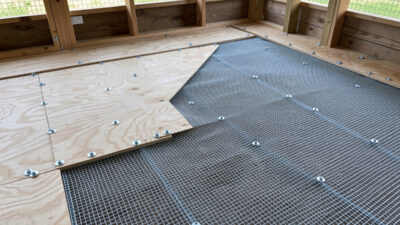
Rat-Proof Coop Floor: Stop Diggers Coming Up Through It
Rats don’t come over the coop wall — they come up through the floor, gnawing through plywood or tunneling under…
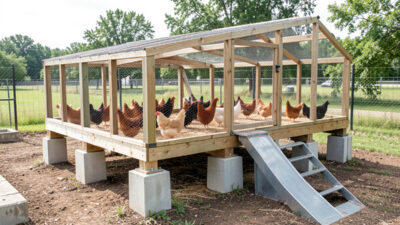
Raising a Coop Off the Ground: Footings & Skids
Every coop with a wooden floor should sit off the ground — a few inches at minimum, ideally enough to…
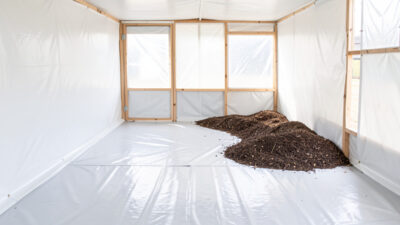
Vinyl & Linoleum Coop Floor: The Easy-Clean Upgrade
Sheet vinyl or linoleum over a plywood subfloor is the single best-value upgrade you can make to a coop floor:…