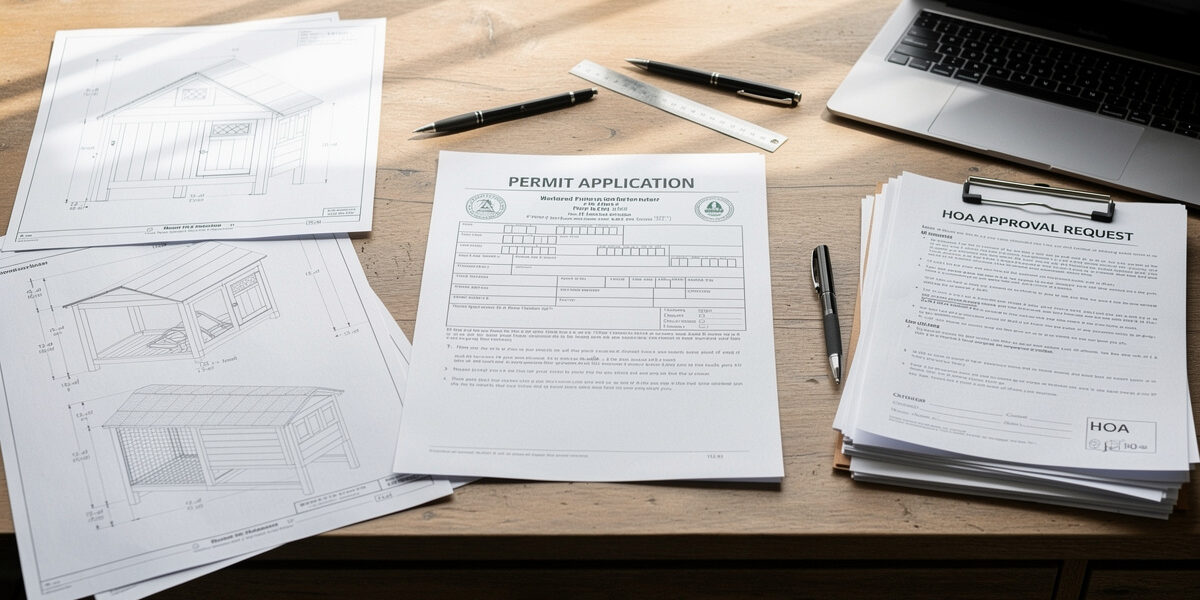
Most US backyard smart chicken coop permits fall into three categories: a backyard chicken/livestock ordinance check (free or under $50), a structural building permit if your coop exceeds local size limits ($40–$200), and an electrical permit for any new branch circuit pulled from your house panel ($40–$120). Requirements vary heavily by city and county — some places require none of the three, others require all of them — so treat every threshold below as “typical,” not universal, and verify locally before you build. HOAs add a fourth layer that often matters more than city code.
This guide walks through what to check, where to find the answers, and how to handle HOAs and neighbors without delaying your build. Sweden’s rules on outbuildings and livestock are different from the US layers below, but the underlying instinct is the same one I apply to every automation project — check before you build, not after a neighbor complains. For overall planning context, see our smart chicken coop planning guide.
The Four Permission Layers
| Layer | What It Controls | Typical Cost | Timeline |
|---|---|---|---|
| Zoning / chicken ordinance | Whether you can keep chickens at all, flock size, rooster rules | $0–$50 | Same day to verify |
| Building permit | Coop structure size, setbacks, foundation | $40–$200 | 1–4 weeks for approval |
| Electrical permit | New branch circuit pulled to coop | $40–$120 | 1–3 weeks plus inspection |
| HOA approval | Whether your HOA allows chicken coops, structure aesthetics | $0 (typically) | 2–8 weeks for review |
The HOA layer is the most variable and often the most restrictive. A city that allows chickens generally does not override an HOA covenant that bans them — HOA CC&Rs commonly prohibit “livestock” or “poultry” outright regardless of what city code says (The HOA Handbook’s coverage of backyard-farming restrictions walks through why). Always check HOA rules first if you live in one — every other layer is downstream of that.
Layer 1: Backyard Chicken Ordinances
Most US cities and counties have specific rules for backyard chickens. The variables you need to confirm:
- Are chickens allowed at all? Most suburban cities now allow them; some still ban.
- Maximum flock size. Common limits: 4, 6, or 8 hens. Some allow more by lot size.
- Roosters? Most prohibit them, or limit to specific zoning. If you want a rooster, this matters.
- Coop setback from property line. Typically 10–25 feet.
- Coop setback from neighbor’s dwelling. Sometimes 50+ feet.
- Permit/registration. Some cities require an annual registration ($10–$30).
Where to find the answer: search “[your city] backyard chickens ordinance” or check your municipal code directly. The city clerk’s office or planning department will confirm. The local Cooperative Extension office often has a current summary.
If chickens are not allowed: petitioning the city to change the ordinance is possible (and has succeeded in many places) but takes 6–18 months. Not a fast path.

Layer 2: Building Permits
Building permits for coops trigger at different size thresholds depending on jurisdiction:
| Coop Size | Permit Requirement Pattern |
|---|---|
| Under 100 sq ft (e.g., 4×8) | Often exempt as an accessory structure, but plenty of jurisdictions still require a permit — never assume |
| 100–200 sq ft (e.g., 8×12, 8×14) | A common threshold where permits start being required |
| Over 200 sq ft | Permits required in nearly every jurisdiction |
The thresholds matter for smart coops because the automation footprint adder (covered in our smart chicken coop size guide) often pushes the build into the 100–200 sq ft range where permits are common.
If a permit is required, the typical process:
- Submit plans (floor plan, elevation, site plan with setbacks) — sometimes a simple sketch, sometimes stamped drawings
- Pay fee ($40–$200)
- Wait 1–4 weeks for plan review
- Build to approved plan
- Schedule rough-in inspection (foundation, framing) before sheathing
- Schedule final inspection after build complete
The good news: most building departments are friendly to backyard chicken coops if the paperwork is in order. The bad news: skipping the permit can force you to tear down a non-permitted structure if a neighbor complains.
Layer 3: Electrical Permits
Any new branch circuit pulled from your house panel typically requires an electrical permit. This is true even if you do the work yourself in most jurisdictions.
The process:
- Submit a simple one-line diagram showing the new circuit (circuit breaker, wire size, run length, outlet)
- Pay fee ($40–$120)
- Pull the wire and rough-in
- Schedule rough inspection before burying or covering wiring
- Complete the install
- Schedule final inspection
Build the inspection timeline into your schedule. Inspections take 1–3 weeks to schedule in most jurisdictions. Coordinate with your build sequence so the inspector arrives when the wiring is exposed but the rest of the coop is ready to move forward. Wiring details in our smart chicken coop wiring guide.
What you can usually do without an electrical permit:
- Plug a 12V power supply into an existing outlet
- Run 12V/24V low-voltage wiring inside the coop
- Install fused distribution blocks
- Connect smart devices to the 12V loop
If you can stay on the 12V side of an existing outlet, you can often build a complete smart coop with no electrical permit at all.
Layer 4: HOA Rules
HOAs are governed by their own covenants, conditions, and restrictions (CC&Rs). They can:
- Ban chickens entirely
- Allow chickens but require coop design approval
- Require specific setbacks tighter than city code
- Mandate fencing or screening
- Require coop structure aesthetics matching the home
The HOA approval process typically:
- Read your CC&Rs (look for “livestock,” “fowl,” “outbuildings,” “structures”)
- Submit an application to the architectural review committee with photos, dimensions, and materials
- Wait 2–8 weeks for response (most HOAs have a 30-day response requirement)
- Build only after written approval
If your HOA bans chickens: getting the rule changed requires a vote of the homeowner association membership, typically 50%+. This works in some HOAs and is impossible in others. Honest assessment of your HOA’s culture matters before investing time here.

State-by-State Patterns
Common patterns by region:
| Region | Typical Stance |
|---|---|
| West Coast (CA, OR, WA) | Generally chicken-friendly; HOA restrictions vary widely |
| Mountain West (CO, UT, ID, MT) | Very chicken-friendly; few HOA bans |
| Mid-Atlantic (NY, NJ, PA, MD, VA) | City ordinances vary; HOAs commonly restrictive |
| Northeast (MA, CT, RI, ME, NH, VT) | Generally permissive; older suburbs sometimes restrictive |
| South (FL, GA, NC, SC, TX) | Mixed; HOAs commonly restrictive |
| Midwest (OH, MI, IL, IN, MN, WI) | Generally permissive in suburbs; varies in cities |
This is descriptive, not prescriptive — you still need to check your specific city and HOA. Patterns identify what to expect; the actual rules are local.
Talking to Neighbors
Even when permits are not required, talking to neighbors before building heads off most complaint-driven enforcement actions — in my experience it’s the single cheapest insurance you can buy for the project:
- Tell adjacent neighbors before building, not after
- Show them the proposed location and dimensions
- Explain the smart automation and how it eliminates noise/smell concerns
- Offer eggs as a peace offering (works surprisingly well)
- Address any specific concerns up front (smell, noise, rodents, predators)
Most neighbor objections trace to two concerns: smell and noise. Smart coops with good ventilation and no roosters address both. A 5-minute conversation upfront beats a city complaint that triggers an inspection 6 months later — and in my experience an egg carton left on a doorstep before the first shovel of dirt is turned does more to keep the peace than any amount of paperwork.
What to Bring to the Permit Office
For a smooth permit application:
- Site plan showing property lines, house, coop location, all setbacks measured
- Floor plan with dimensions, door locations, window/vent placement
- Wall elevation showing exterior appearance, materials, height
- Materials list with construction approach (framing, sheathing, roofing)
- Electrical one-line if pulling a new circuit (wire size, breaker, outlet)
- Photos of similar coops can help if the building official is unfamiliar with chicken coops
Most applications are approved without changes if these documents are clear and the design respects setbacks. Where applications get bounced is missing setback measurements or unclear electrical details.
If You Build Without Permits
The risks of building without required permits:
- Code-enforcement complaint. A neighbor calls the city. You receive a notice. Two outcomes: pull a retroactive permit (if compliant) or tear down the structure (if not).
- Insurance issues. If a non-permitted structure damages someone or burns down, your homeowner insurance may deny coverage — most standard policies carry a faulty-workmanship exclusion that insurers point to specifically when uninspected wiring or construction causes the loss (LegalClarity’s explainer on unpermitted-work coverage).
- Resale issues. Selling your house with non-permitted structures triggers disclosure obligations and sometimes mandatory removal.
- HOA enforcement. HOAs can fine, place liens, or sue homeowners for unauthorized structures.
For most readers, the modest permit fees ($80–$320 total) are dramatically cheaper than the risks. Pull the permits.
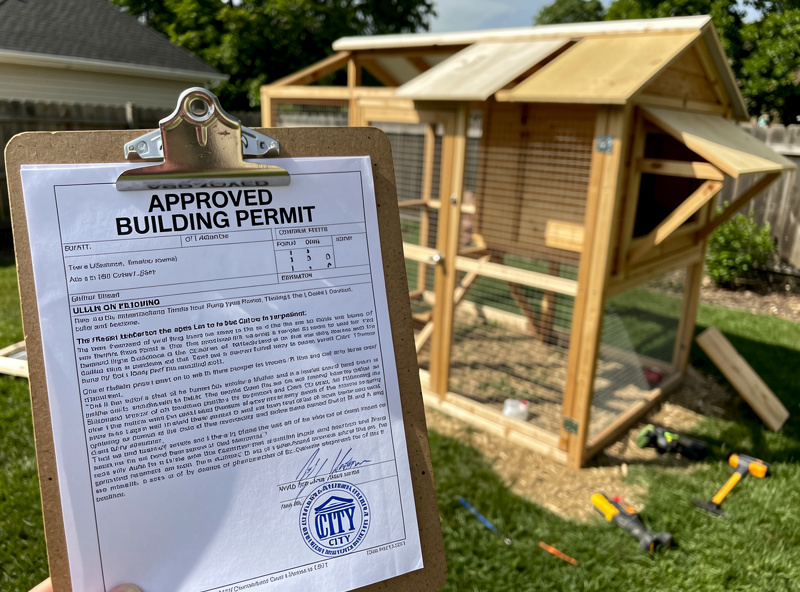
Permit Timeline Built Into Your Build Schedule
| Week | Activity |
|---|---|
| -8 to -4 | Read HOA CC&Rs, submit HOA application |
| -6 to -2 | Confirm city ordinance, submit building permit if needed, submit electrical permit if needed |
| -4 to -2 | Permit reviews complete, approval received |
| -2 to 0 | Materials ordered, site prepped |
| 0 to +4 | Construction phase |
| +1 to +3 | Rough-in inspection (after framing, before sheathing) |
| +4 to +6 | Final inspection (after build complete) |
Plan 4–8 weeks of permit lead time before you swing the first hammer. Most builders treat this as part of the planning phase covered in our smart chicken coop planning guide.
Frequently Asked Questions
Do I need a permit to build a chicken coop in my backyard?
It depends on your jurisdiction. Small coops are sometimes exempt as accessory structures, coops in the 100-200 sq ft range commonly cross into permit-required territory, and larger structures need a permit almost everywhere. Electrical permits are required for any new house-panel circuit. Check your local building department for the exact threshold.
How much do chicken coop permits cost?
Building permits typically run $40–$200, electrical permits run $40–$120, and any city chicken-keeping registration runs $10–$30. Total cost for a smart coop with new electrical and a building permit usually lands at $80–$320 — small compared to enforcement risks.
Can my HOA prevent me from building a chicken coop?
Yes. HOA covenants can ban chickens entirely, restrict coop sizes and locations, or require architectural review. HOA rules generally override more permissive city ordinances. Read your CC&Rs and submit an architectural review application before building, regardless of city permission.
Do I need an electrical permit for a smart chicken coop?
You need an electrical permit if you pull a new branch circuit from your house panel ($40–$120 in most jurisdictions). Low-voltage 12V wiring downstream of a UL-listed power supply typically does not need a permit. Plugging a 12V power supply into an existing outlet avoids electrical permits entirely.
What happens if I build a chicken coop without a permit?
You risk a code-enforcement complaint forcing you to retroactively permit or tear down the structure, potential homeowner insurance gaps, disclosure issues at resale, and HOA fines or liens. The $80–$320 in permit fees is dramatically cheaper than these risks.
Should I tell my neighbors before building a chicken coop?
Yes. A 5-minute conversation before construction heads off most complaint-driven enforcement actions. Show them the proposed location, address smell and noise concerns directly, and offer eggs as a peace offering. Smart coops with good ventilation and no roosters address most neighbor concerns.
Related Articles
Related Guides
Water-Level and Flow Sensors: Knowing the Waterer Is Empty Before They Do
A coop water-level sensor tells you the drinker is going dry — or freezing solid — before the flock does,…
Ammonia Sensors for the Coop: Catching Air Problems Before You Smell Them
An ammonia sensor belongs at the birds’ breathing height, close to the litter where the gas is generated, because that…

Node-RED vs Home Assistant Automations for the Coop: When to Use Which
Use native Home Assistant automations for the coop’s simple, safety-critical rules — the sunrise door, the freeze-watch waterer — and…