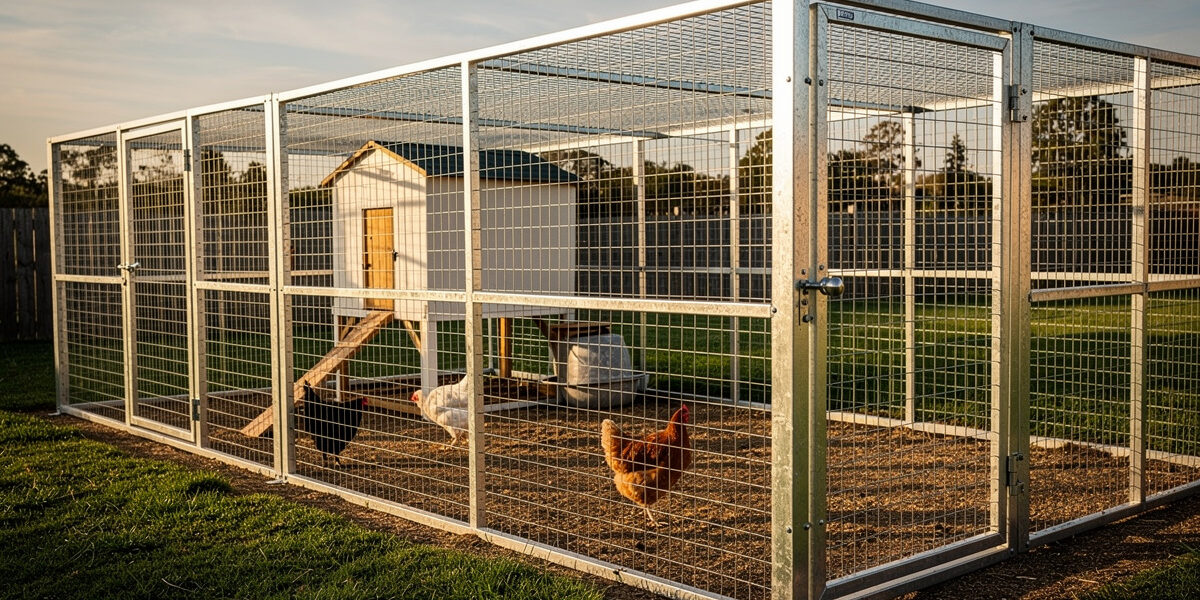
A metal chicken run built from galvanized steel framing and welded-wire panels typically lasts 15–25 years in temperate climates — three to five times longer than wood-frame equivalents — at $450–$900 for an 8×12 size. The trade-off is higher upfront cost, less aesthetic flexibility, and corner rust risk in coastal or salt-heavy environments. For most backyard keepers prioritizing durability, metal is the right answer.
This guide compares the top metal run brands, covers galvanized vs powder-coated finishes, and explains where metal beats wood and PVC. My own run frame is welded steel — I built it myself instead of buying a kit — precisely because I wanted the lifespan and dig-barrier shape this guide makes the case for. For overall material decisions, see our chicken run guide.
What “Metal Chicken Run” Actually Means
Two distinct construction styles fall under the metal-run label:
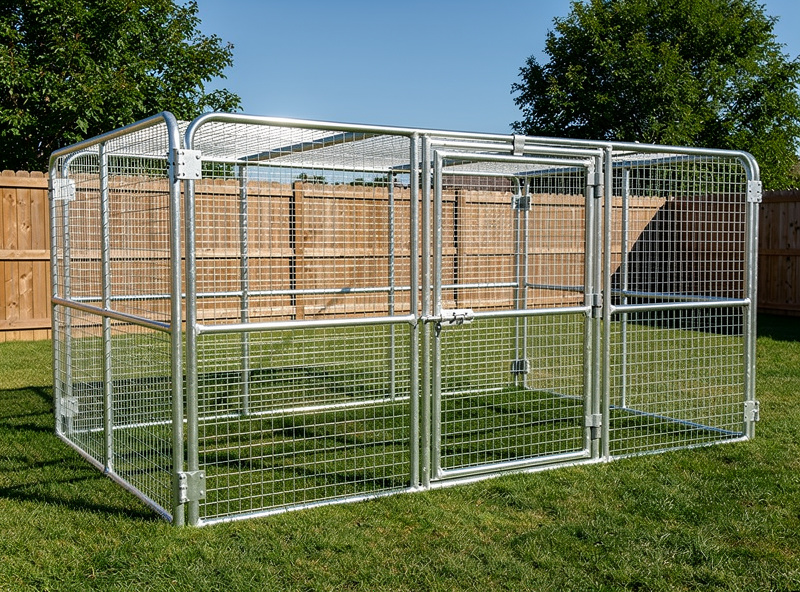
- Steel-tube frame + welded-wire panels. Most prefab brands. Hot-dip galvanized or powder-coated tubing forms the structural frame; welded wire panels (usually 1/2″ or 1″) form the walls. Bolts together. The standard commercial metal run.
- Chain-link converted to chicken use. A repurposed dog-pen or chain-link enclosure with hardware-cloth lining on the lower 24″. Cheap if you find used material, but requires lining work to be predator-tight.
The difference matters. Welded-wire panels at 1/2″ mesh ARE predator-tight as shipped. Chain-link is decorative containment for chickens but lets weasels and rats through, so the lower section needs hardware-cloth lining before deployment.
Galvanized vs Powder-Coated vs Plain Steel
| Finish | Lifespan | Cost Premium | Best For |
|---|---|---|---|
| Hot-dip galvanized | 20–30 yrs | Baseline | Most backyard runs, all climates |
| Powder-coated over galvanized | 20–30 yrs + better aesthetics | +10–20% | Visible suburban yards |
| Plain steel (paint only) | 5–10 yrs | -15–25% | Avoid — rusts at every cut and weld point |
| Aluminum frame | 25+ yrs | +30–50% | Coastal/salt environments |
For 90% of backyards, hot-dip galvanized steel is the right choice. Powder-coating adds aesthetics without lifespan benefit; aluminum costs more but is essentially overkill outside coastal areas. The mechanism behind these numbers is well documented — the American Galvanizers Association puts heavy structural hot-dip coatings at 50-plus maintenance-free years in most atmospheric environments, though the thinner tubing and wire gauge used in consumer coop kits won’t reach those structural-steel numbers — which is exactly why the cut and weld points (thin coating, more exposed steel) are where the real-world rust shows up first, not the flat panel faces.
Top Metal Chicken Run Brands (2026)
| Brand | Sizes | Frame | Wire | Price (8×10) |
|---|---|---|---|---|
| OverEZ | 10×10 to 10×20 | Hot-dip galv. steel tube | 1/2″ welded wire | $650–$1,200 |
| Producer’s Pride | 6×10, 8×10, 10×10 | Powder-coated steel | 1/2″ welded wire | $340–$680 |
| Pawhut Walk-In Cage | 6×10 to 12×10 | Galv. steel tube | 1″ welded wire (line bottom 24″ with HC) | $280–$520 |
| Tractor Supply Steel Run | 8×10 | Galv. steel | 1/2″ welded wire | $450–$680 |
| Omlet Walk-In Run | 3m × 3m to 4m × 6m | Powder-coated steel | Heavy-duty steel mesh | $700–$1,400 |
| VEVOR Walk-In | 6.5×10 | Galv. steel | Hexagonal galvanized mesh (relining recommended) | $230–$400 |
As an Amazon Associate I earn from qualifying purchases.
OverEZ and Producer’s Pride’s Low-Profile run sit at the sweet spot for most readers — 1/2″ welded wire out of the box, durable galvanized framing, walk-in heights, and reasonable pricing. (Note: Producer’s Pride doesn’t sell a separately-branded “Sentinel Run” — the Sentinel is a small coop; its matching run is the Low-Profile line above.) Many of these brands appear in our best chicken coop brands roundup.
Where Metal Beats Wood
- Lifespan. Wood frames need restaining every 2–3 years and replacement at 10–15 years. Galvanized steel goes 20+ years untouched.
- Predator strength. A determined raccoon can chew through softwood corners. Steel does not chew.
- Pest resistance. Carpenter ants and termites destroy wood-frame runs in some regions. Steel is immune.
- Rapid assembly. Bolt-together steel kits assemble in 3–6 hours. Equivalent wood DIY takes 8–14 hours.
- Weight + relocation. Steel runs can be partially disassembled and moved more easily than nailed wood frames.
Where Wood Beats Metal
- Aesthetic flexibility. Wood can match the surrounding architecture, be stained any color, and integrate naturally with garden landscaping. Metal looks utilitarian.
- Hot climates. Steel framing in direct sun can get genuinely hot — 120°F+ in midsummer. Birds avoid the metal-frame areas.
- Custom dimensions. Wood DIY can be any size. Metal is constrained to manufactured kit sizes.
- Coastal or salt environments. Even galvanized steel rusts faster in coastal air. Cedar or treated wood often outlasts steel within 2–5 miles of saltwater.
Predator-Proofing Metal Runs
Even welded-wire metal runs need three additions:
- Buried apron extension. Hot-dip galvanized hardware cloth extending 12–18 inches outward, buried 4–6 inches deep. Stops digging predators that the run’s above-ground walls do not.
- Door latch upgrade. Most metal runs ship with single slide-bolt latches. Add a carabiner or padlock — raccoons defeat single bolts.
- Wire-size verification. If the kit ships with 1″ mesh, line the lower 24 inches with 1/4″ hardware cloth for weasel/rat protection. 1/2″ mesh out of the box does not need this.
Total upgrade cost: $40–$120 depending on size. The 2 hours of work prevents the predator-loss scenarios that no marketing brochure mentions. The buried apron was the first thing I added to my own run, before the birds ever moved in — it’s the one upgrade I’d never skip regardless of brand or budget.
Common Metal Run Issues
| Issue | Cause | Fix |
|---|---|---|
| Corner rust spots | Galvanizing damage at cut/weld points | Touch up with cold-galvanizing spray annually |
| Wire panel sag | Tension lost over time | Add a horizontal mid-rail; re-tension panels |
| Frame flex in high wind | Lightweight tube + tall walls | Add corner braces and ground anchors |
| Hot-to-touch in summer | Steel conducts heat | Shade cloth on west/south walls; light-color paint |
| Cold transmission in winter | Steel conducts cold to attached coop | Insulate the coop-side joint; gap weatherstripping |
| Snow load collapse | Flat or low-pitch metal roof | Use 6:12+ pitch in snow regions; clear snow above 6″ |
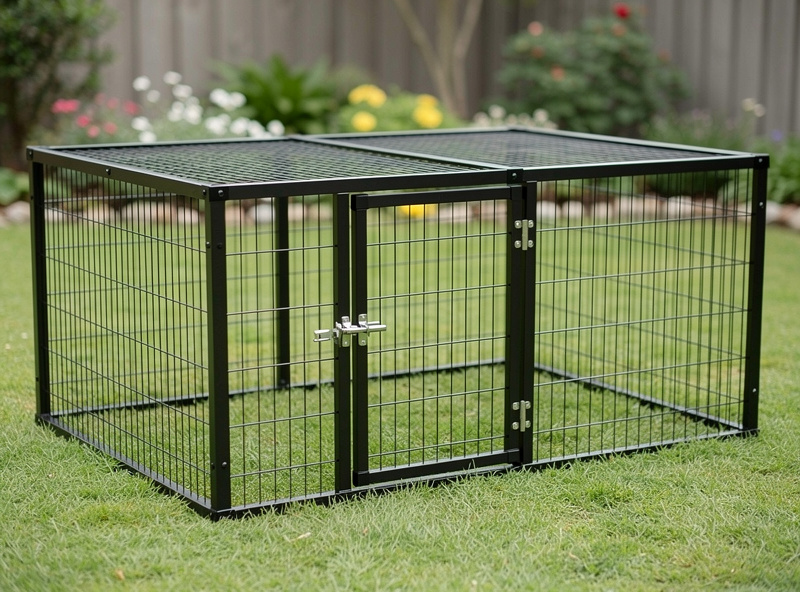
Cost Comparison: Metal vs Wood vs PVC (8×12 Run)
| Material | Build Cost | 10-Year TCO | 20-Year TCO |
|---|---|---|---|
| PVC + hardware cloth | $140–$240 | $280–$420 (1 replacement) | $560–$840 (2 replacements) |
| Wood + hardware cloth (DIY) | $340–$520 | $440–$640 (incl. stain refresh) | $800–$1,200 (1 replacement) |
| Steel-frame welded wire (prefab) | $450–$900 | $500–$960 (touch-ups only) | $550–$1,020 (still going) |
| Aluminum-frame welded wire | $700–$1,400 | $700–$1,400 (no maintenance) | $700–$1,400 (still going) |
At the 20-year horizon, metal becomes the cheapest option per year. At the 10-year horizon, wood and metal are roughly equivalent. PVC is the cheapest entry but costs more long-term because it gets replaced every 5–8 years.
Sizing a Metal Run by Flock
The same 8–10 sq ft per bird guideline applies to metal runs as any other run material. Metal kits typically come in fixed sizes:
| Kit Size | Square Footage | Comfortable Capacity |
|---|---|---|
| 6×10 (60 sq ft) | 60 | 4–6 birds |
| 8×10 (80 sq ft) | 80 | 6–8 birds |
| 10×10 (100 sq ft) | 100 | 8–10 birds |
| 10×20 (200 sq ft) | 200 | 16–20 birds |
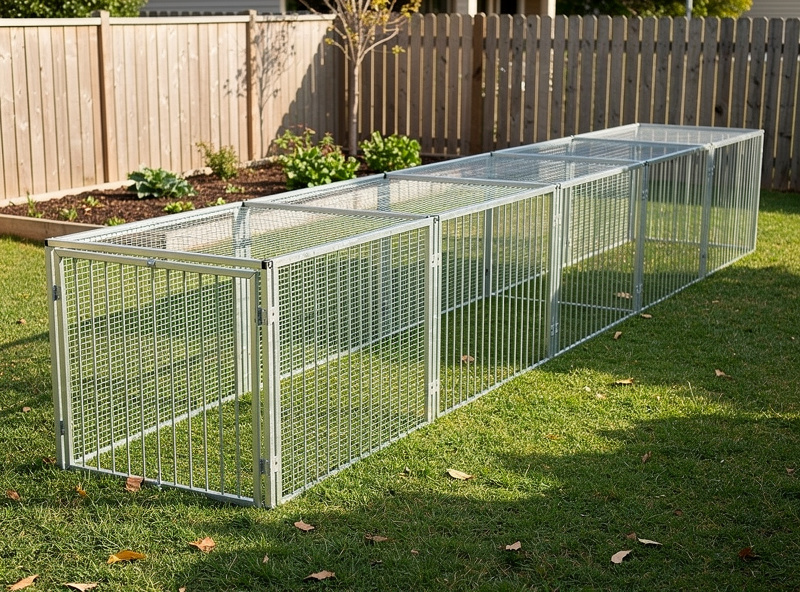
For larger flocks, several metal runs can be bolted together in modular fashion. OverEZ and Producer’s Pride support this directly with extension kits. Our large chicken coop guide covers setups for 25+ bird flocks.
Smart Coop Integration with Metal Runs
Metal runs work well with smart-coop automation, with three caveats:
- WiFi signal attenuation. Steel framing acts as a Faraday cage. Cameras inside metal runs may need a closer mesh node — see our chicken coop WiFi guide for placement. I run PoE cameras off my own steel-clad run into a Home Assistant NVR, and the attenuation is real — I ended up moving my nearest access point closer to the run wall rather than fighting the signal loss through the wire and framing.
- Cable runs. Drilling steel tubing for cable pass-through is harder than wood. Plan cable entry points before assembly.
- Outdoor camera mounting. Steel framing is excellent for camera mounts — strong, won’t rot or warp. Use stainless mounting hardware for galvanic compatibility.
For the broader smart-coop integration plan, see our best smart chicken coop devices guide.
Common Metal Run Mistakes
- Buying 1″ mesh and not relining. Many cheap metal runs ship with 1″ wire that lets weasels and rats through. Always reline the lower 24 inches with 1/4″ hardware cloth in any region with these predators.
- Skipping the buried apron. Metal walls above ground are predator-tight. Without a buried apron, foxes and dogs dig under within months.
- Ignoring corner rust. Galvanizing breaks at cut points and welds. Untreated, these become rust starting points. Annual cold-galvanizing spray prevents it.
- No anchoring. Lightweight steel runs can be lifted by determined predators or shifted by high winds. Use ground anchors at every corner.
- Wrong roof pitch in snow regions. Flat metal roofs collect snow. Northern climates need 6:12+ pitch with metal roofing that sheds.
Is Metal the Right Choice for You?
Metal wins when you want:
- Maximum lifespan (15–25 years)
- Minimal ongoing maintenance
- Fast assembly (3–6 hours vs 8–14 hours wood)
- Predator-proofing without the corner-chewing risk
Wood wins when you want:
- Aesthetic integration with garden or home
- Custom dimensions
- Cooler temperatures in hot climates
- Simpler in coastal or salt environments
For the hybrid path — metal frame + DIY-flexible attachment to existing coop — see our chicken coop with run guide.
Frequently Asked Questions
How long does a metal chicken run last?
Hot-dip galvanized steel runs last 20–30 years in temperate climates with minimal maintenance. Powder-coated runs match this lifespan. Plain steel (painted only) lasts just 5–10 years before rust at cut points becomes structural. Aluminum framing reaches 25+ years even in coastal environments.
Is a metal chicken run better than wood?
For lifespan and maintenance, yes — metal lasts 15–25 years vs 10–15 for wood, with no restaining required. Wood wins for aesthetic flexibility, custom dimensions, hot-climate temperature, and coastal environments where even galvanized steel corrodes faster than treated cedar.
What size mesh should a metal chicken run have?
1/2 inch welded wire is the predator-tight standard, blocking weasels, rats, and snakes. 1 inch mesh is borderline and requires lining the lower 24 inches with 1/4 inch hardware cloth in most regions. Avoid larger mesh sizes that fail to keep small predators out.
Do metal chicken runs get hot in summer?
Steel framing can reach 120°F+ in direct summer sun, and birds avoid the heated metal areas. Three fixes work: shade cloth on west and south walls, light-colored powder coat to reflect heat, and ensuring at least 50% of the run has natural shade from trees or roof overhang.
Can I attach a metal run to my existing wood coop?
Yes — most metal run kits include adapter brackets or universal mounting hardware. The key detail is sealing the joint between the metal run wall and the wood coop wall with hardware-cloth flashing and silicone caulk to prevent the gap that predators exploit.
Are metal chicken runs predator-proof out of the box?
Mostly. 1/2 inch welded wire on the walls and roof is predator-tight, but most kits skip the buried apron and ship with single-latch gates. Add a 12-inch buried hardware-cloth apron and a carabiner or padlock to the gate to make any metal run truly predator-tight.
Related Articles
Related Guides
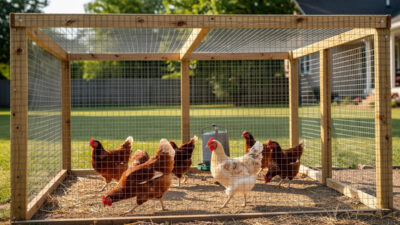
Chicken Enclosure Types: Open vs Covered Runs
A backyard chicken enclosure falls into one of four basic types — fully covered run, partially covered run, open-top run,…
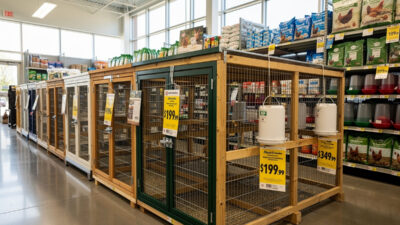
Chicken Runs For Sale: Best Online Sources 2026
The best places to find quality chicken runs for sale in 2026 are direct from manufacturers (OverEZ, Omlet, YardCraft), big-box…
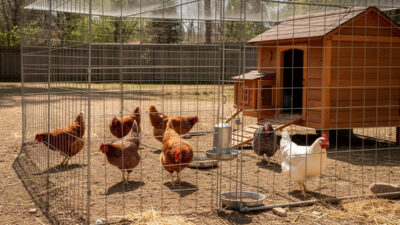
Large Chicken Run: Sizing for 12+ Birds
A large chicken run for 12+ birds needs at least 120 sq ft of secure outdoor space, walk-in height (6+…