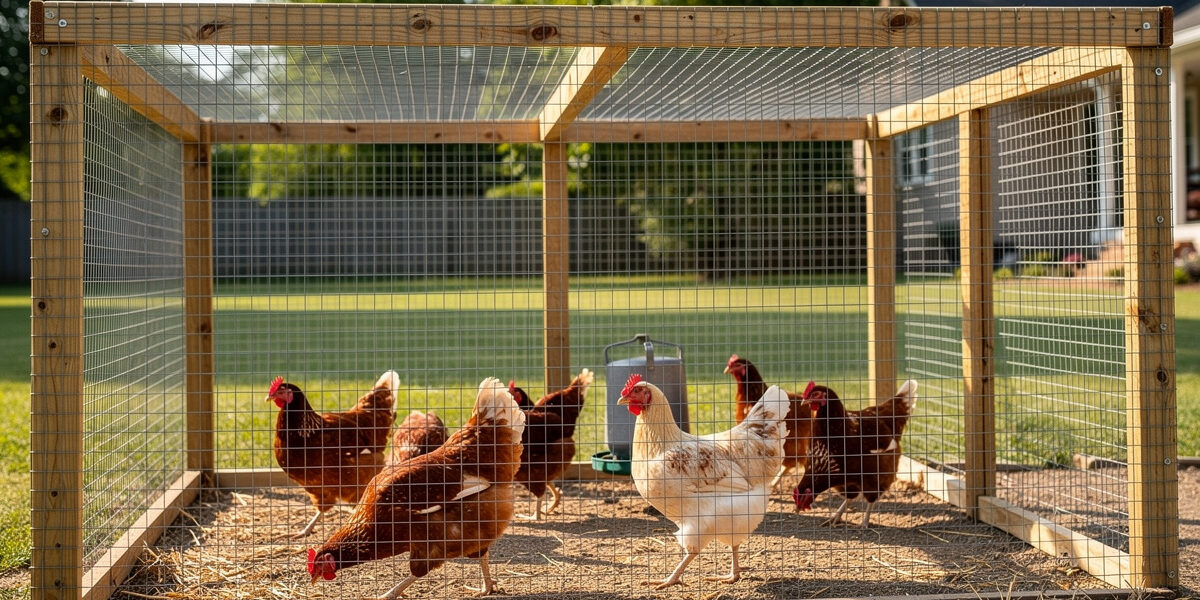
A backyard chicken enclosure falls into one of four basic types — fully covered run, partially covered run, open-top run, and free-range with electric fence. Each handles predator pressure, climate, and behavioral needs differently. The right choice depends on your local hawks, weather, lot shape, and how comfortable you are with periodic losses. For most US backyards, a fully covered run with hardware cloth on every surface is the safest default; open-top runs only make sense in fenced suburban yards with no aerial predators.
This guide compares the four enclosure types directly with cost, predator outcomes, and maintenance loads. My own run is fully covered — I switched from a partial-cover design after a hawk found the gap, and I haven’t lost a bird to an aerial predator since. For run material specifics, see our chicken run guide.
As an Amazon Associate I earn from qualifying purchases.
The Four Enclosure Types
| Type | Predator Protection | Climate Performance | Cost (8×12) | Best For |
|---|---|---|---|---|
| Fully Covered Run | Excellent (all directions) | Excellent (shade + dry ground) | $340–$780 | Default for most US backyards |
| Partially Covered Run | Good (covered zone safe; open zone vulnerable) | Good (mixed sun + shade) | $260–$540 | Yards with limited tree shade |
| Open-Top Run | Poor (aerial predators access) | Variable (full sun + rain) | $180–$420 | Fully fenced suburban yards, no hawks |
| Free-Range + Electric Fence | Moderate (deters most ground predators, no aerial) | Excellent (full pasture) | $280–$680 (electric) | Properties of 1+ acre, daytime supervision |
The covered run path is the right call for most typical backyard situations. Open-top makes sense in narrow circumstances; free-range works on larger properties with active oversight.
Type 1: Fully Covered Run (Default Choice)
A fully covered run encloses chickens on all six surfaces — four walls, a roof, and a floor (either bare ground with a buried apron or a permanent floor). Every opening uses hardware cloth or welded wire at 1/2 inch or smaller mesh.
Strengths:
- Eliminates aerial predator losses (hawks, owls)
- Provides shade in summer (lowers heat-stress risk)
- Provides dry ground in rain (less mud, less parasite buildup)
- Reduces snow load on the run floor (in northern climates)
- Allows confident overnight access (chickens can range freely under the cover)
Weaknesses:
- Higher build cost than open-top
- Roof framing complexity (especially in snow regions)
- Slightly less sunlight reaches birds (matters for vitamin D and laying)
The vast majority of well-built backyard chicken setups use this type. Build details and material picks are covered in our chicken run guide.
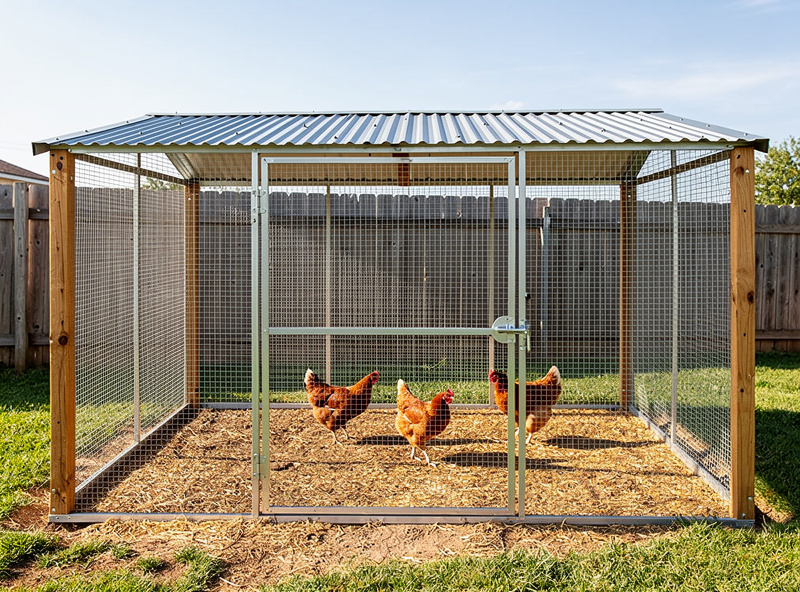
Type 2: Partially Covered Run
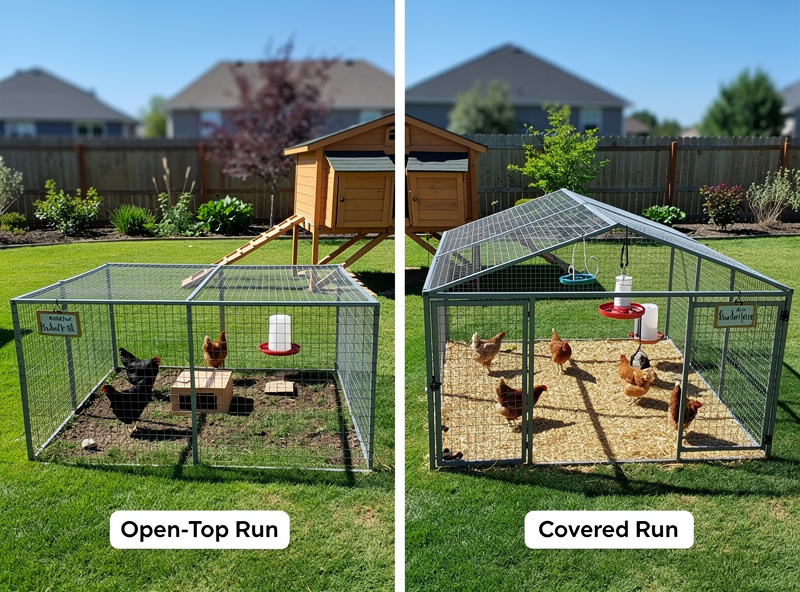
A partially covered run has a roof over part of the run (often the half closest to the coop) with the remainder open-top. This compromises gives birds access to direct sun while preserving aerial protection in the covered zone.
When this works: Yards with low aerial predator pressure where birds spend most of their time near the coop. The covered zone protects them when they retreat to it; the open zone gives sun and natural foraging.
When this fails: Areas with active hawks. Once a hawk learns chickens are accessible in the open zone, it will keep coming back to that same spot even if the rest of the run is covered — I’ve watched this happen on my own coop’s camera feed before I extended the cover. Most keepers in hawk country eventually end up extending the cover to the entire run, usually after the first near-miss.
Cost note: The partial cover saves only $80–$120 compared to fully covered, while introducing predator risk in the open section. The math rarely justifies the trade-off. Just build fully covered.
Type 3: Open-Top Run
The traditional run design: walls on all four sides, no roof. Cheapest to build and gives chickens full access to sun and rain. But aerial predators can take birds at any time.
When open-top works:
- Fenced suburban backyards with established human activity (deters hawks)
- Yards with significant tree cover that breaks up hawk approach paths
- Areas where local raptor populations are low (verify with bird-watching neighbors)
- Daytime-only chicken keeping (chickens locked in coop during dawn/dusk hawk hours)
When open-top fails:
- Open suburban or rural yards with sky visibility from any corner
- Properties near woods or open fields where raptors hunt
- Any yard where you have personally seen a hawk or owl
- 24/7 free-range setups
There’s no clean nationwide loss-rate number for open-top runs in hawk country — flock outcomes vary too much by region and raptor density to make a single figure honest. What Extension predator-management guidance consistently says is that a fully covered run with 1/2 inch hardware cloth stops aerial predators outright, while an open-top design leaves the door open indefinitely. For some keepers, occasional losses are an acceptable trade-off for a cheaper build; for most, they are not.
Type 4: Free-Range with Electric Fence
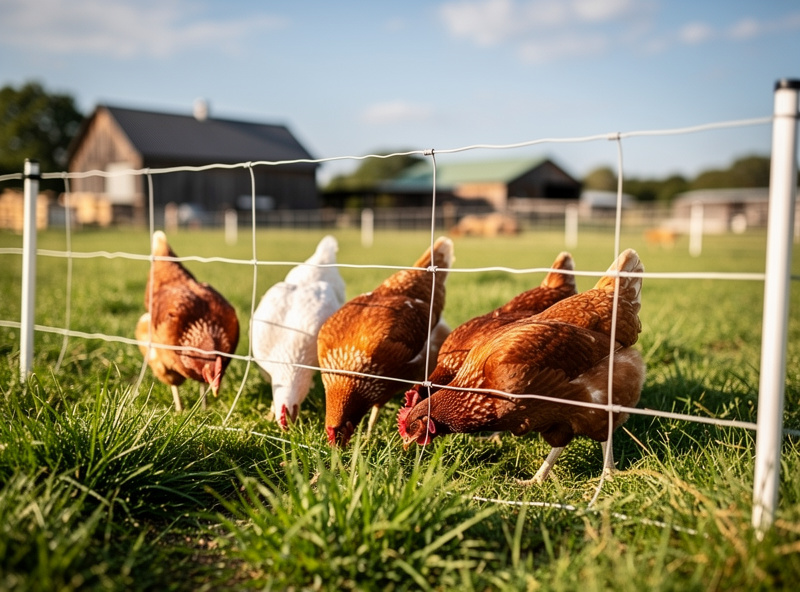
For properties of 1+ acre, a moveable electric poultry netting fence (Premier 1, Gallagher) gives chickens far more range than any fixed run while deterring most ground predators. The fence is 2–4 feet tall, polywire-strand, powered by a small fence energizer. I run electric netting around my rotational run in the warmer months and it’s the single easiest upgrade for forage diversity — the trade-off is it does nothing about the sky.
Strengths:
- Maximum range and pasture access
- Lowest stress and best forage diversity
- Eliminates parasite-load buildup (continuous rotation)
- Strongest ground-predator deterrent (pulse shock)
Weaknesses:
- Aerial predators still take birds (no roof)
- Requires daytime supervision (chickens close at dusk in a permanent coop)
- Fence energizer needs power (solar or grid)
- Setup time scales with property size
Free-range works best for larger flocks (10+ birds) on rural or semi-rural properties where active management replaces fixed enclosure. Most backyard suburban setups don’t have the space.
Cost Breakdown by Type (8×12 Equivalent)
| Type | Materials | Roof | Total |
|---|---|---|---|
| Fully Covered Run | Wood frame, 1/2″ hardware cloth, buried apron | Asphalt or metal panels | $340–$780 |
| Partially Covered Run | Same frame, mixed cover | Half-coverage | $260–$540 |
| Open-Top Run | Wood frame, 1/2″ hardware cloth, buried apron | None | $180–$420 |
| Free-Range + Electric | Coop only + portable electric net | N/A (range area) | $280–$680 for fence |
Prices reflect mid-tier DIY builds. Premium builds with hardware cloth on every surface, double-latched gates, and metal roofing run 30–50% higher.
Roof Materials for Covered Runs
| Roof Material | Cost (8×12) | Pros | Cons |
|---|---|---|---|
| Hardware cloth only (mesh roof) | $40–$80 | Lightest, lets through full sun and rain | No rain shelter, no sun shade |
| Shade cloth (woven) | $30–$80 | Sun shade, breathable, cheap | No rain protection, replace every 3–5 yrs |
| Corrugated metal panels | $120–$240 | Rain proof, durable, sheds snow | Hot in direct sun, no light through |
| Asphalt shingle (matched to coop) | $140–$220 | Aesthetic match, solid weatherproofing | Heavier framing required |
| Polycarbonate panels (clear or tinted) | $180–$360 | Lets sunlight through + rain proof | Highest cost, can yellow at 8–10 yrs |
| Hybrid (metal main + clear panels) | $200–$340 | Best of both | Slightly complex install |
For most backyard runs, corrugated metal or shingle roofing handles the workload. Polycarbonate is the premium choice when you want sunlight to reach the chickens through the roof — useful in cloudy regions.
How Predator Pressure Drives the Decision
Match enclosure type to your specific predator pressure:
| Your Threat Level | Recommended Enclosure |
|---|---|
| Very high (rural, predator-rich) | Fully covered + buried apron + electric perimeter |
| High (suburban with woods nearby) | Fully covered + buried apron |
| Moderate (typical suburban) | Fully covered (default) |
| Low (dense urban, fenced yard) | Open-top + buried apron acceptable |
| Daytime free-range, secure overnight coop | Open-top day pen + electric fence + locked coop at dusk |
If you do not know your threat level, talk to neighbors, check local Cooperative Extension data, and look at any fence camera or doorbell footage for hawk and predator sightings. The default safe choice when uncertain: fully covered.
Roof Considerations by Region
| Region | Roof Recommendation |
|---|---|
| Northeast / Midwest (heavy snow) | Metal panels at 6:12 pitch — sheds snow |
| Southeast (heat, humidity) | Hybrid — metal for rain, shade cloth or polycarbonate for cooling |
| Pacific Northwest (rain, low sun) | Polycarbonate — lets winter sunlight through while shedding rain |
| Mountain West (intense UV, cold winters) | Metal panels — durable in extreme conditions |
| Desert Southwest (extreme heat) | Shade cloth + light-color metal — minimize heat absorption |
Climate dictates roof material more than predator concerns. The base structure (covered vs open-top) follows from predator pressure; the specific roof material follows from regional climate.
Sun and Vitamin D for Chickens
Chickens synthesize vitamin D from UV exposure on bare skin, which feeds into eggshell strength and bone health. Research on UV-supplemented hens found that after three weeks of six hours of daily UV exposure, egg yolk vitamin D content ran three to four times higher than unsupplemented hens. Roof material makes a real difference here:
- Hardware cloth only (mesh roof): full UV transmission — no shade or rain protection either
- Polycarbonate panels: partial UV transmission, varies significantly by tint and grade
- Asphalt shingle: blocks essentially all UV
- Metal panels: blocks essentially all UV
If your covered run uses opaque roofing (shingle or metal), keep calcium available free-choice (oyster shell) and give the flock some direct-sun time when you can — even an hour or two of supervised free-range in clear weather helps, though it won’t replicate the controlled dose in the research above. On my own coop the run stays mostly shaded under metal panels, so the flock gets its sun during supervised range time near the garden instead.
Common Enclosure Mistakes
- Open-top run in hawk country. Most common predator-loss scenario. Cover the roof.
- Ignoring the buried apron. Even covered runs lose birds if foxes can dig under walls.
- Using chicken wire instead of hardware cloth. Universal mistake. Hardware cloth on every surface, period.
- Single-latch gate on a covered run. The cover only protects from above; gates remain the human-and-raccoon access point.
- No ventilation in covered runs. Sealed covered runs trap ammonia. Add high vents on the gable end.
- Mismatched roof to climate. Flat polycarbonate in heavy-snow regions collapses. Steep pitch is mandatory in snow country.
- Forgetting the coop-run joint. Even the best enclosure fails at the seam where the coop meets the run if framing leaves gaps.
Combining Enclosure Types
Some setups use multiple enclosure types together:
- Covered run + occasional supervised free-range. Standard for backyards where you can watch the flock during 1–2 hours per day. Maximum benefit at low risk.
- Covered run + electric fence around it. Adds ground-predator deterrent on top of physical predator-proofing. Useful in high-pressure rural areas.
- Day pen (open-top) + locked covered coop. Birds free-range in a day pen during human-supervised hours, locked into a fully predator-proof coop overnight.
The “covered run + occasional supervised free-range” approach captures most of the benefit of free-range without the predator risk. It works well for typical suburban backyards.
Frequently Asked Questions
What types of chicken enclosures are there?
Four main types: fully covered runs (walls plus roof, predator-tight), partially covered runs (compromise design), open-top runs (no roof, vulnerable to hawks), and free-range with electric fence (large properties only). For most US backyards, fully covered with hardware cloth is the default safe choice.
Should a chicken enclosure be covered?
Yes, in any area with hawks, owls, or visible sky access from the run. Extension predator-management guidance is consistent that a fully covered run with 1/2 inch hardware cloth stops aerial predators outright, while open-top designs stay vulnerable indefinitely. A covered roof typically adds well under $200 in materials on a standard 8×12 run.
What is the difference between a chicken run and a chicken enclosure?
A run is the specific outdoor enclosed space attached to a coop where chickens spend daylight hours. An enclosure is the broader category that includes runs, pens (smaller temporary cages), tractors (movable coop+run combos), and electric-fence pasture areas. All runs are enclosures; not all enclosures are runs.
How big should a chicken enclosure be?
Minimum 8-10 sq ft per bird in any enclosed daytime space. For 6 birds, plan 50-60 sq ft minimum or 72-96 sq ft comfortable. Larger is always better for behavior, parasite resistance, and laying. Vertical space (6+ ft walk-in height) matters as much as floor area.
Can chickens be free-ranged without a fence?
Not safely in most settings. Without a fence or electric perimeter, chickens can wander well beyond your property line and become easy targets for dogs, foxes, hawks, and stray cats. Free-ranging is workable only with active human supervision or with portable electric fencing on properties of 1+ acre.
What is the cheapest chicken enclosure to build?
Open-top wood-frame run with 1/2 inch hardware cloth costs $180-$420 for an 8×12 — the cheapest functional enclosure. The trade-off is aerial predator vulnerability. For a roughly $80-$200 premium, a fully covered run delivers far better predator outcomes and longer chicken life expectancy.
Related Articles
Related Guides
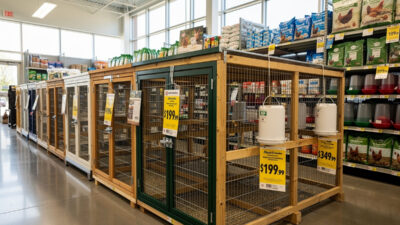
Chicken Runs For Sale: Best Online Sources 2026
The best places to find quality chicken runs for sale in 2026 are direct from manufacturers (OverEZ, Omlet, YardCraft), big-box…
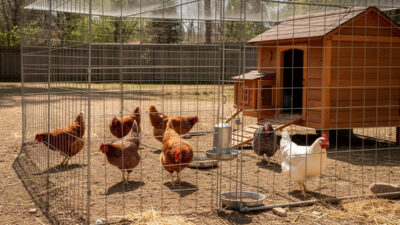
Large Chicken Run: Sizing for 12+ Birds
A large chicken run for 12+ birds needs at least 120 sq ft of secure outdoor space, walk-in height (6+…
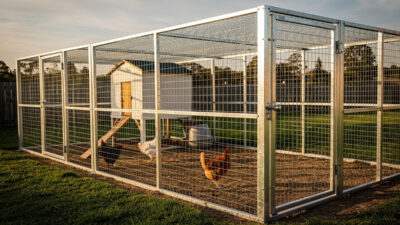
Metal Chicken Runs: Pros, Cons & Top Brands
A metal chicken run built from galvanized steel framing and welded-wire panels typically lasts 15–25 years in temperate climates —…