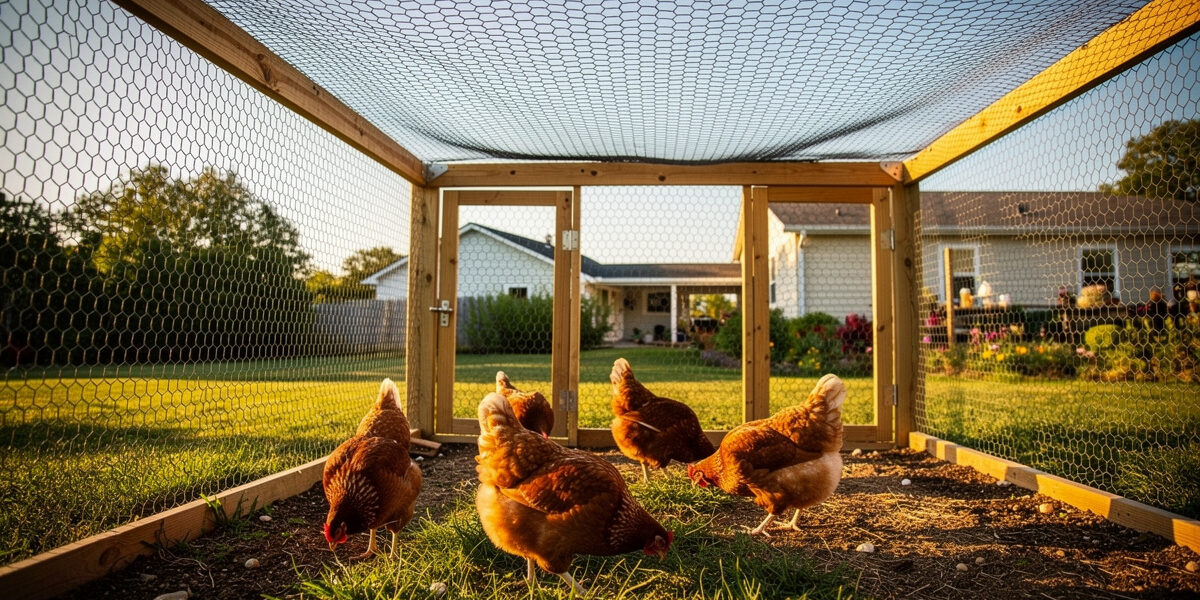
The only complete defense against hawks is a solid run roof or 1-inch agricultural netting overhead. Every other technique — roosters, mock predator silhouettes, brush cover, color choice — reduces losses by 30–50% but does not eliminate them. Free-ranging birds without overhead protection lose 1–3 hens per month once a hawk moves into the area. This guide covers the species, the math, and the layered defenses that actually keep your flock alive in daylight.
For the broader predator-defense system covering ground predators too, see our Predator-Proof Chicken Coop Defense Guide.
Which Hawks Actually Hunt Chickens
Three raptor species account for nearly all backyard chicken losses in the US:
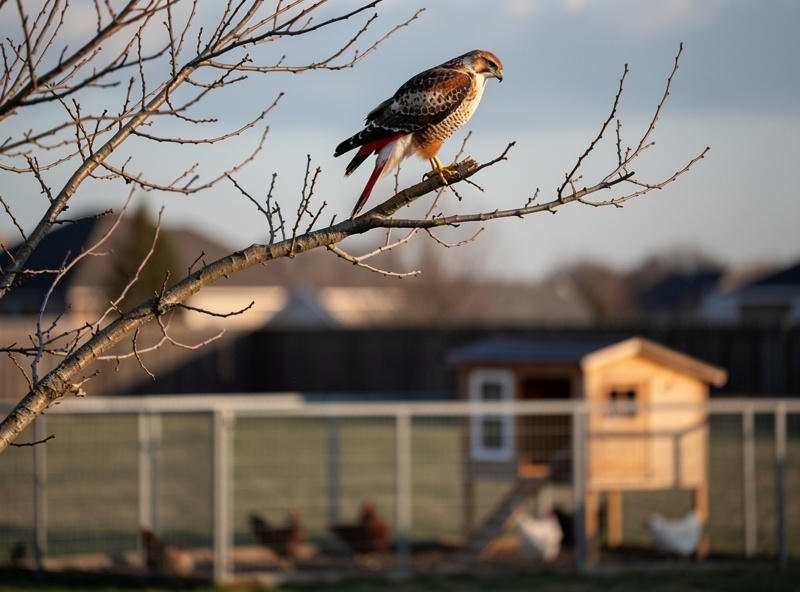
Red-tailed hawk (Buteo jamaicensis): the most common backyard predator in North America, weighing roughly 1.5–3.5 lb with a wingspan up to about 4.5 feet (females run heavier than males). Hunts open ground from a perch. Strong enough to kill and carry off a full-size standard-breed hen, not just chicks. Active during daylight, year-round.
Cooper's hawk (Accipiter cooperii): smaller (roughly 0.5–1 lb, females noticeably bigger than males) but far more agile. Hunts through trees and around structures, taking chicks and bantams. Common in suburban and woodland-edge backyards. Less likely to take adult standard hens.
Sharp-shinned hawk (Accipiter striatus): smallest of the three, takes chicks and small bantams only. Hunts at low altitude through dense cover.
Owls are the corresponding nighttime threat — great-horned owls in particular take adult hens overnight if the run is uncovered. The defenses below cover both daytime hawks and nighttime owls because the physical mechanism (overhead cover) is the same. My own run has been fully netted for years now — a hawk worked the fence line for the better part of a week before it found the one gap in my early, half-hearted cover, and the camera caught it circling back to the same corner three mornings running before it connected. That’s when the netting went up properly, and it hasn’t found a way in since.
Realistic Loss Math
No agency tracks backyard hawk predation with this kind of precision, so treat any exact percentage you read as a rough estimate rather than hard data. What follows is the pattern extension guidance and keepers consistently report — myself included, from the years before I netted my run — for free-ranging backyard flocks once a hawk moves into the area:
- No overhead defense, suburban woodland edge: 1–3 hens lost per month during peak hawk season (October–March in most regions).
- No overhead defense, open rural: 0.5–2 hens per month, depending on alternate prey availability.
- Roosters + brush cover only: 0.3–1 hen per month — a real reduction but not elimination.
- Run with 1" agricultural netting: 0–0.1 hens per month (rare incidents only when birds escape the netted area).
- Solid run roof: effectively zero losses to aerial predators.
Translating to dollars: at $20 per hen, monthly losses range from $20–$60 with no defense, $0–$5 with proper overhead defense. Over a year that is $240–$720 saved by installing the netting once.
The mechanism lines up with official guidance too: the eXtension predator-management guide for small and backyard flocks lists a covered run as the most reliable fix once a hawk or owl has zeroed in on your property, and recommends eliminating perch sites within 100 yards of the coop — isolated trees, poles, anything a raptor can stage a hunt from.
Solid Run Roof: The Complete Defense
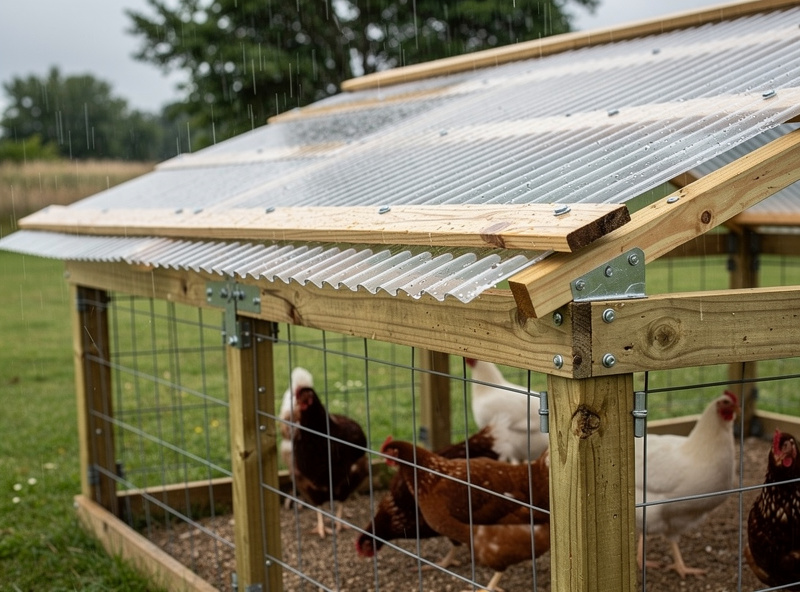
A solid run roof — polycarbonate panels, metal roofing, or heavy-duty tarp on a frame — is the only defense that approaches 100% effectiveness. Hawks cannot strike through solid material; the entire vertical attack vector closes.
Material options:
- Polycarbonate corrugated panels: $50–$100 for a typical run. Lets light through (run plants grow), shed rain. Lifespan 10+ years.
- Galvanized metal roofing: $80–$150 per run. Lasts 25+ years. Loud in rain. Best for regions with snow load.
- Heavy-duty tarp: $30–$60 per run. Cheapest option. Replace every 3–5 years from UV degradation.
- Wood + shingle roof: built-in like a porch roof. Most expensive but best aesthetic match for premium coops.
Run roofs also solve adjacent problems: rain shelter for the flock, summer shade reducing run temperatures by 10–15°F, and snow weight on netting (which collapses uncovered netting in any region with regular snow).
Aerial Netting: The Cost-Effective Defense
If a solid roof is not feasible (rented property, very large run, aesthetic preference), 1" agricultural netting is the next-best option. It blocks hawks at 95%+ effectiveness, lets rain through, and costs $0.10–$0.20 per square foot of run area.
Specifications that matter:
- Mesh size: 1" or smaller. 2" mesh lets sharp-shinned hawks through. 1.5" is debatable.
- Twine weight: at least 36-lb test. Lighter twine breaks under snow, fallen branches, or determined raccoons (climbing).
- UV stabilization: non-UV-stabilized netting fails in 1–2 years. Pay extra for UV-stabilized.
- Tension: netting must stay tight. Sagging netting allows hawks to land, walk, and find weak spots. Use ridge poles or center support.
Installation: anchor the netting at all corners, use ridge poles every 8–10 feet to prevent sagging, and sew or zip-tie all seams (gaps in seams are the most common breach point).
Remove the Perches Near the Run
A hawk hunts from a stationary perch, scanning open ground below for movement, then stoops in a fast, low glide. Take away the perch and you take away a big chunk of the threat even before netting goes up. A dead tree, a leaning fence post, a utility pole, the peak of an unused shed — anything that gives a raptor a clear sightline to your run within about 100 yards is a staging platform, and it will get used.
I lost a corner of my run’s cover to sagging netting one winter, and the hawk that had been sitting on a dead pine about 40 yards out was back within the hour of the gap opening — cutting that tree down afterward did more for the run’s safety than another roll of netting would have. Trimming or removing isolated perch trees, capping fence posts with anti-perch spikes, or simply running a string line above open perch points are all cheap, permanent fixes that work alongside — not instead of — netting or a solid roof.
Partial Defenses (When Full Cover Is Not Possible)
If your birds free-range during the day and you cannot cover the entire foraging area, these partial defenses reduce losses but do not eliminate them:
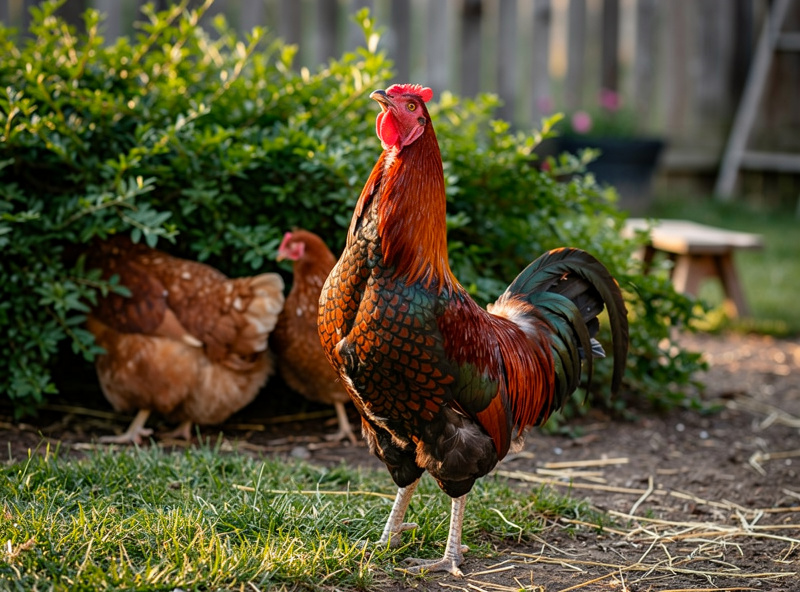
Roosters. A vigilant rooster cuts hawk losses noticeably by alarm-calling when he sees a raptor — the flock dives for cover on the call, not after the strike. Most keepers who run one report it as the single biggest free-range improvement short of overhead cover. Trade-offs: noise, sometimes-aggressive temperament, zoning rules in many suburbs prohibit roosters.
Mock predator silhouettes. Plastic owls or rubber snakes deter hawks for 1–3 weeks before habituation. Effective only if you move them every 3–4 days. Diminishing returns past one month.
Reflective tape or CDs hanging in trees. Visual disturbance discourages stooping in some species (particularly red-tailed hawks). Effectiveness fades quickly; replace or relocate weekly.
Dense brush and shrubs. Plant or relocate brush so birds always have 2-second cover within 5 feet. Hawks abort attacks on birds that can dive into cover before the strike, and it’s a meaningful reduction in practice — though nowhere near a substitute for netting or a roof.
Color choice. Black and dark-feathered hens (Australorps, Black Sex Links) draw fewer strikes than white birds by most keepers’ accounts — white feathers stand out against grass and dirt at a distance in a way dark plumage doesn’t. There’s no rigorous study putting a firm number on the effect, so treat it as a minor tiebreaker rather than a defense plan, but it costs nothing to weigh when picking breeds.
Guard animals. Geese, large dogs (Maremma, Great Pyrenees), and llamas all deter hawks effectively but require their own management. Worth considering for flocks of 20+ birds where a guardian animal is justified.
Combining Defenses for Free-Range Flocks
If you must free-range without overhead cover, the combination that minimizes losses:
- Rooster. Single most effective free-range defense.
- Dense brush layout. Plant cover every 10 feet of foraging area; birds learn to use it.
- Time-restricted free-ranging. Confine birds to covered run during peak hawk hours (mid-morning and late afternoon). Hawks hunt opportunistically; cutting exposure time during those windows meaningfully cuts losses.
- Guard dog if practical. Effective but requires commitment.
- Replace lost birds with darker-feathered breeds. Marginal but free.
This combination reliably cuts free-range hawk losses well below the no-defense baseline above — much better than doing nothing, but still meaningfully worse than a properly netted or roofed run. If you can get any overhead cover up, even over just the core run, do that first and treat the rest of this list as damage control for the acreage you can’t cover.
Reading the Kill Site, and What to Do After a Strike
Hawk and owl kills leave different signatures, and telling them apart tells you whether you’re dealing with a daytime or nighttime problem — which changes what you check first. A hawk kill typically shows deep, stab-like wounds across the back and breast (talons puncture rather than crush), feathers plucked cleanly near the body, and a simple white streak of droppings nearby. An owl kill more often takes the head and neck first — sometimes over two nights — with chalkier, clumpier droppings at the site; a good predator-evidence identification guide walks through the differences in more detail than I can here. If you find a dead hen with the breast consumed but legs and wings intact and the attack happened in daylight, that’s almost always a hawk.
Once a hawk or owl has taken a bird from your flock, expect it to come back — raptors that find an easy meal return to the same territory repeatedly, not just once, a pattern general predation guidance backs up and one I’ve seen firsthand with the bird that worked my own fence line. The response window is short and the fix is the same regardless of which raptor it was:
Within 24 hours: confine the flock to covered run. Do not let them out unsupervised until netting is up.
Within 7 days: install agricultural netting or solid roof on the run, and check for perch sites — dead trees, poles, fence posts — within about 100 yards that may be giving the bird a staging platform. Even temporary 1" netting on poles is better than nothing.
Document and report. Photograph evidence; raptors are federally protected and you cannot trap or harm them, but state wildlife services track losses for management purposes.
Frequently Asked Questions
How do I protect my chickens from hawks?
A solid run roof or 1-inch agricultural netting overhead is the only complete defense against hawks. Other techniques (roosters, brush cover, mock owls) reduce losses noticeably but do not eliminate them. Free-ranging without overhead protection loses roughly 1-3 hens per month in active hawk areas, based on extension guidance and keeper-reported patterns.
Will a rooster protect chickens from hawks?
Partially — a vigilant rooster cuts hawk losses noticeably by alarm-calling when he sees a raptor. The flock dives for cover on the call, not after the strike. Roosters are not a complete defense and do not work in the absence of cover for the flock to dive into.
What size netting keeps hawks out?
1-inch mesh or smaller is required. 2-inch mesh lets sharp-shinned hawks through. The netting twine should be at least 36-pound test and UV-stabilized; cheaper netting fails within 1-2 years. Ridge poles every 8-10 feet prevent sagging.
Can hawks pick up chickens through wire?
Hawks cannot grab through hardware cloth or 1-inch wire mesh. They can grab through chicken wire (1-inch hexagonal) when birds press against it. The lower 4 feet of any run wall should be 1/2-inch hardware cloth, not chicken wire.
Do fake owls deter hawks from chickens?
For 1-3 weeks, yes — then hawks habituate and ignore them. To extend effectiveness, move the fake owl every 3-4 days to a different location. After about a month, switch to a different deterrent. Mock owls work as a temporary supplement, not a permanent defense.
What time of day are hawks most likely to attack chickens?
Mid-morning (after the air warms enough for thermals) and late afternoon (last hunting opportunity before sunset) are peak attack times. Confining the flock to covered run during these windows meaningfully cuts losses even without other defenses.
Related Articles
- Predator-Proof Chicken Coop Defense Guide
- Hardware Cloth vs Chicken Wire
- Electric Fence for Chickens
- Chicken Run Guide: Sizing & Materials
- Best Automatic Chicken Coop Doors: 7 Models Compared
Related Guides
Smart Coop Cameras: Network Setup for Reliable Predator Alerts
A reliable smart coop camera setup needs three things your default home Wi-Fi rarely provides: stable signal at the coop…
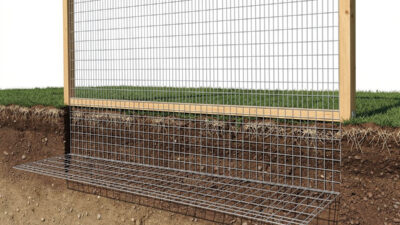
Underground Predator Barriers: Apron & Footer Designs
Foxes and coyotes can dig under an unprotected chicken run wall in well under an hour once they commit to…
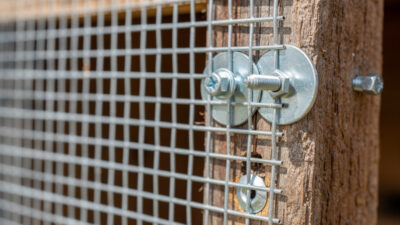
Hardware Cloth vs Chicken Wire: Why It Matters
Chicken wire keeps chickens IN. Hardware cloth keeps predators OUT. 1/2-inch galvanized hardware cloth is the only mesh that reliably…