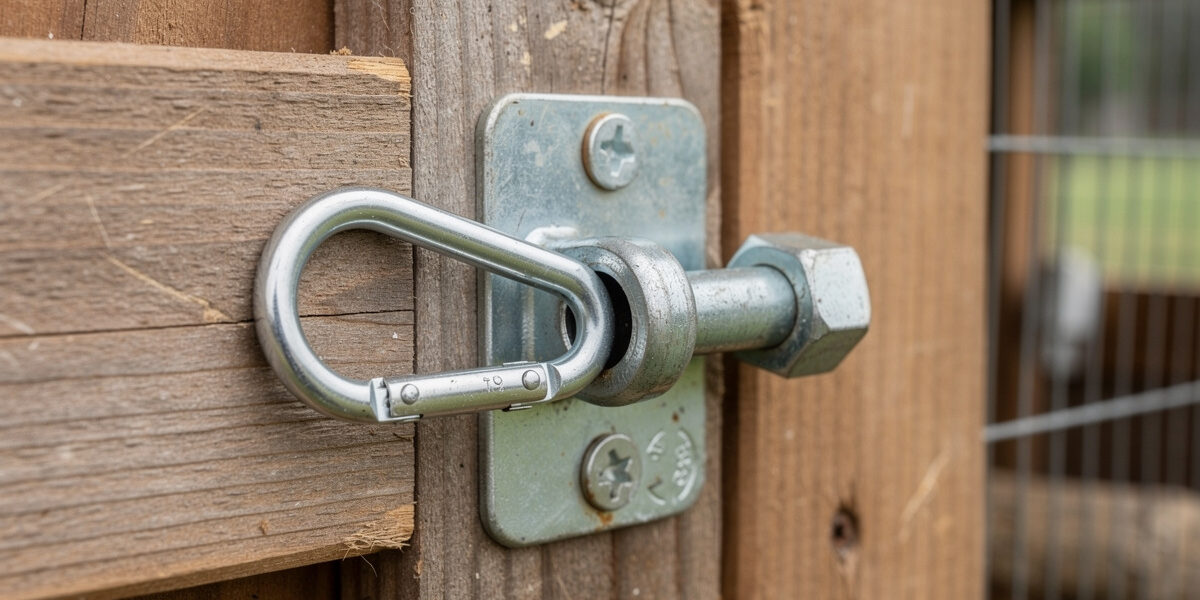
Standard barrel bolts and turn-buttons take a raccoon under three minutes to open. The fix: two-step latches that require human dexterity, carabiner-locked latches, or padlocks. This guide covers the four latch designs that actually stop raccoons, the two cheap fixes that make existing budget coops predator-grade, and which $5 hardware swap saves more flocks than $200 of motion sensors.
Latches are one piece of the predator-defense system — for the full layered approach, see Predator-Proof Chicken Coop Defense Guide.
Why Standard Latches Fail
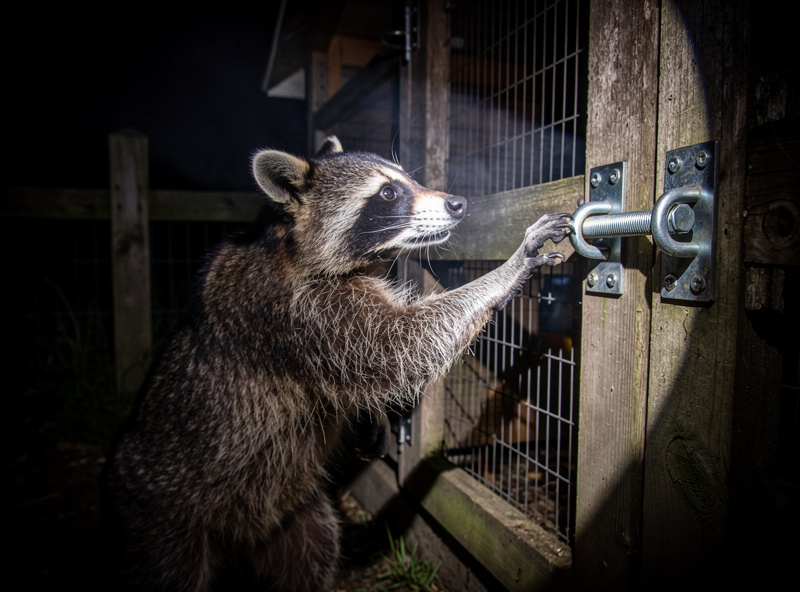
Raccoons have hands. Their dexterity is roughly equivalent to a 4-year-old child, and they have unlimited time to work on a problem overnight. Any latch that a child can open with one hand, a raccoon can open with one paw.
The latches that ship on most budget chicken coops fail this test:
- Barrel bolts: raccoon slides the bolt sideways within 1–2 minutes.
- Turn-buttons: raccoon rotates the button to vertical and the door swings open.
- Hook-and-eye latches: raccoon lifts the hook off the eye in seconds.
- Magnetic catches: not predator hardware at all; raccoon pulls the door open with normal force.
- Spring-loaded gate latches (single-action): raccoon presses the lever and the door opens. These are designed to keep gates from blowing open, not to keep predators out.
The pattern: any latch that opens with a single motion fails. Predator-grade latches require two distinct actions in sequence — a lift-and-pull, a press-and-twist, or a key-and-turn. Raccoons can perform single actions; they cannot reliably chain two.
Four Latches That Actually Work
| Latch Type | Cost | Two-Step? | Owner Hassle | Notes |
|---|---|---|---|---|
| Carabiner-locked spring latch | $8–$15 | Yes (clip + slide) | Low | Best balance; clip a carabiner through the latch hole |
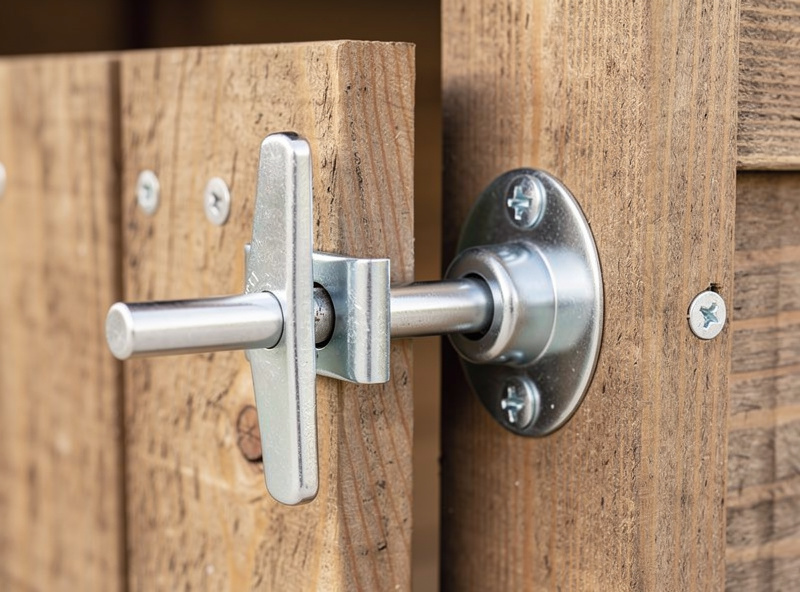
| T-handle latch with locking bar | $20–$35 | Yes (rotate + pull) | Low | Used on RV doors; raccoon-proof and weatherproof |
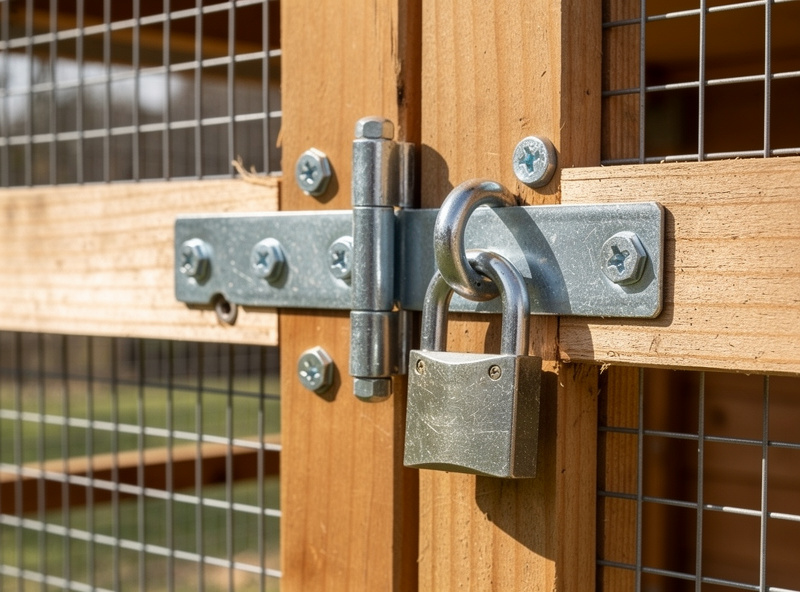
| Padlock + hasp | $10–$25 | Yes (key + open) | Medium (lose keys) | Highest security; combination padlock removes key issue |
| Eye-bolt + cotter pin | $3–$5 | Yes (pull pin + slide) | Low | Cheapest fix; pin attaches with chain so it cannot be lost |
| Single-action barrel bolt (FAIL) | $3–$8 | No | Very low | What ships on budget coops; do not rely on this |
The honest recommendation: swap every barrel bolt on every door for a barrel bolt + carabiner combination. The carabiner clipped through the latch hole turns it into a two-step latch. Total cost for an 8-bird coop with 3 doors (main, pop, nest box lift-top) is under $15. This single upgrade is the highest-leverage predator defense you can make.
The Carabiner Trick (Cheapest Effective Fix)
If your coop has standard barrel bolts and you cannot replace them, the carabiner trick converts each bolt to two-step:
- Buy a small carabiner ($1–$2 each at any hardware store) for each latch on the coop.
- Most barrel bolts have a small hole at the end of the slide for a padlock. Clip the carabiner through this hole.
- Once clipped, the bolt cannot slide because the carabiner blocks it. To open: unclip the carabiner (action 1), slide the bolt (action 2).
- For weatherproofing, buy stainless-steel or zinc-plated carabiners; aluminum corrodes outdoors within 1–2 years.
This $1–$2 fix per latch is what experienced keepers use on every door, regardless of latch quality. Even premium latches benefit from a carabiner backup — if a critical screw works loose, the carabiner provides a second line of defense.
T-Handle and RV-Style Latches
RV and trailer manufacturers solved the "raccoon problem" decades ago because boats and campers face similar predator pressure (bears, raccoons). The T-handle latch they developed:
- Outer T-shaped handle that you must pull outward (against spring tension) to engage the unlock mechanism.
- Inner locking bar that engages the door frame at multiple points.
- Optional keyed lock for additional security.
To open: pull the T-handle out, rotate 90 degrees, pull the door open. Three actions in sequence. Raccoons cannot perform this combination reliably.
RV T-handle latches cost $20–$35 from RV supply stores or Amazon. Installation requires drilling a 2"-square hole in the door, mounting the latch with 4 screws, and attaching the locking bar to the door frame. Total install time about 30 minutes per door.
Padlocks: Highest Security, Owner Hassle
A padlock through a hasp is the most secure latch — raccoons cannot open padlocks, period. Two trade-offs:
Key management. Lost keys mean a locked-out flock. Solution: keyed-alike padlocks (all use the same key) and stash a spare in a magnetic key holder mounted under the coop where you can reach it.
Combination locks. Combination padlocks remove the key problem but add the dial-spinning hassle every visit. For coops with 2–3 daily visits, this gets old. For coops accessed once per day or less, combination locks are excellent.
Use a padlock on the main coop door at minimum. Pop doors and nest-box lift-tops can use lighter latches if they are inside a perimeter-secured run.
Eye-Bolt and Cotter Pin: Cheapest Two-Step
For DIY coops or budget retrofits, an eye-bolt and cotter pin combination is the cheapest reliable two-step latch:
- Drill a hole through the door frame and door at the latch point.
- Insert an eye-bolt through both holes; secure with a washer and nut on the back side.
- To lock: drop a hairpin cotter pin through the eye.
- To open: pull the cotter pin out (action 1), pull the eye-bolt out (action 2), open the door.
Total cost: $3–$5 per door. Attach the cotter pin to the door frame with a 6" piece of chain so it cannot be lost. Raccoons cannot grasp and pull cotter pins; even if they could, the second step (pulling the eye-bolt) requires holding the door against gravity.
Where to Place Latches
Predator-grade latches matter most on:
Main coop access door: the door humans use to enter. Highest priority — this is the most vulnerable single point.
Pop door (chicken access): if you do not have an automatic pop door, the manual pop door needs a latch too. Standard barrel bolts on pop doors fail at exactly the time predators are active (overnight).
Nest box lift-top: external lift-tops for egg collection are easy access for raccoons. Latch them.
Run gate: the human-access gate to the run. Match the security level to the coop door — a perimeter-secured run with a weak gate is no longer perimeter-secured.
Feed storage door: if your feed storage is attached to the coop, latch it the same way. Rats and raccoons learn to open feed storage and use it as a daily food source.
Installation Best Practices
Even the best latch fails if it is mounted poorly:
Use long screws (1.5"+). Short screws pull out under predator force. The latch fails not because the mechanism gives way but because the entire latch tears off the door.
Use wood screws into solid wood. Mounting into 1/4" trim or cosmetic plywood is useless. The latch must mount through to a structural 2×4 or door framing.
Pre-drill pilot holes. Splitting the wood at the screw point reduces holding strength by 50%+.
Add a backing plate on the inside. A 3"×3" piece of metal or plywood on the inside of the door, behind the latch screws, distributes load and prevents the screws from pulling through.
Test by yanking. After installation, pull the latch hard enough to simulate raccoon force. If it gives, fix it before depending on it.
Frequently Asked Questions
Can raccoons open chicken coop latches?
Yes — standard barrel bolts, turn-buttons, and hook-and-eye latches all open in 1-3 minutes by a raccoon. Use two-step latches that require sequential actions: carabiner-locked spring latches, T-handle RV latches, padlocks, or eye-bolt with cotter pin.
What is the best raccoon-proof latch for a chicken coop?
Carabiner-locked spring latches are the best balance of cost and effectiveness — under 15 dollars per door, two-step opening, low owner hassle. T-handle RV latches are the premium pick at 20-35 dollars. Padlocks are most secure but add key-management hassle.
Will a padlock work on a chicken coop?
Yes — padlocks are the most secure latch option since raccoons cannot open them. Use keyed-alike padlocks (same key opens all) or combination padlocks to avoid the key-management problem. Stash a spare key in a magnetic holder under the coop for emergencies.
How can I make my existing chicken coop latches predator-proof?
The cheapest fix: clip a small carabiner through the padlock hole at the end of any standard barrel bolt. The bolt cannot slide while the carabiner is in place, converting any single-action latch into a two-step latch. Total cost: 1-2 dollars per latch.
Where should I install predator-proof latches on a coop?
Main coop door (highest priority), pop door if manually operated, nest box lift-top, run gate, and feed storage door. Match the latch quality across all access points — a perimeter-secured coop with one weak latch is not perimeter-secured.
Are spring-loaded gate latches predator-proof?
No — spring-loaded gate latches open with a single press of the lever and are designed to keep gates from blowing open, not to keep predators out. Replace with carabiner-locked, T-handle, or padlock latches for any predator-facing access point.
Related Articles
Related Guides
Smart Coop Cameras: Network Setup for Reliable Predator Alerts
A reliable smart coop camera setup needs three things your default home Wi-Fi rarely provides: stable signal at the coop…
Underground Predator Barriers: Apron & Footer Designs
Foxes and coyotes can dig under a chicken run wall in under 20 minutes. The defense: a buried apron skirt…
Hardware Cloth vs Chicken Wire: Why It Matters
Chicken wire keeps chickens IN. Hardware cloth keeps predators OUT. 1/2-inch galvanized hardware cloth is the only mesh that reliably…