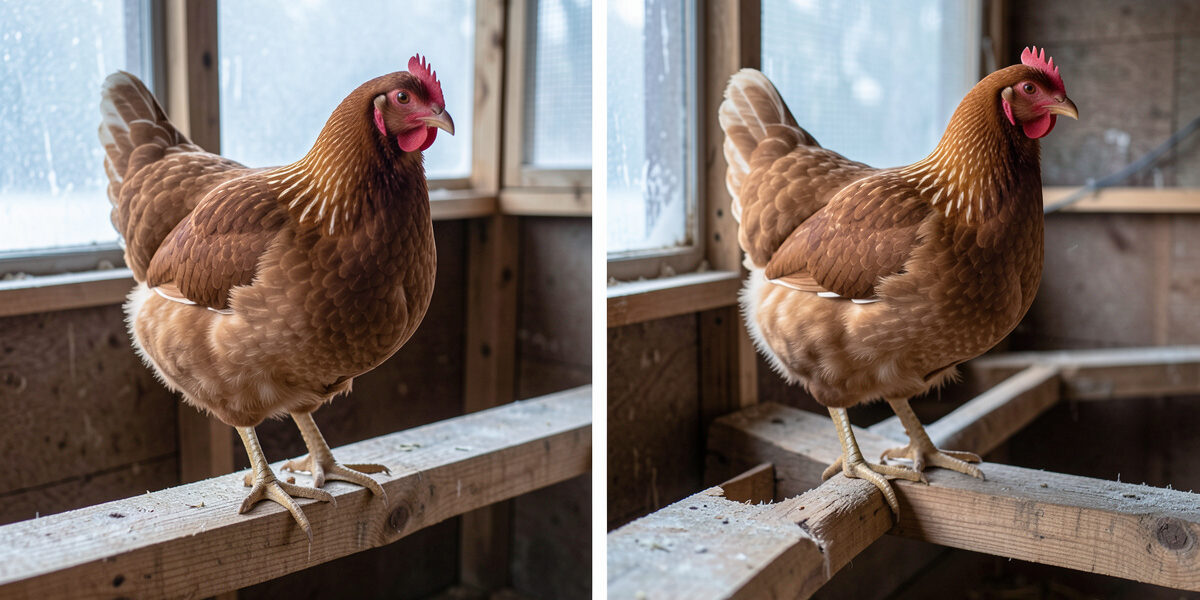
A flat 2×4 laid on its wide face beats a round dowel roost in cold weather for one reason: it lets a chicken sit flat-footed so her own belly feathers blanket her toes overnight. A round bar forces the toes to wrap and stay exposed to the freezing air, and exposed toes on a −18 °C night are toes you can lose to frostbite.
I ran a round closet rod in my first coop because a starter-kit article told me chickens “grip like wild birds.” They don’t — a chicken is a heavy ground bird that rests on a perch, not a songbird that locks onto a twig. That single wrong assumption cost me a run of frostbitten toes my first Swedish winter. When I tore out the round bar and put in a flat 2×4, the frostbite stopped. This is the whole case for the flat profile, the physics behind it, and the one situation where shape matters a little less — pulled straight from my roost design system.
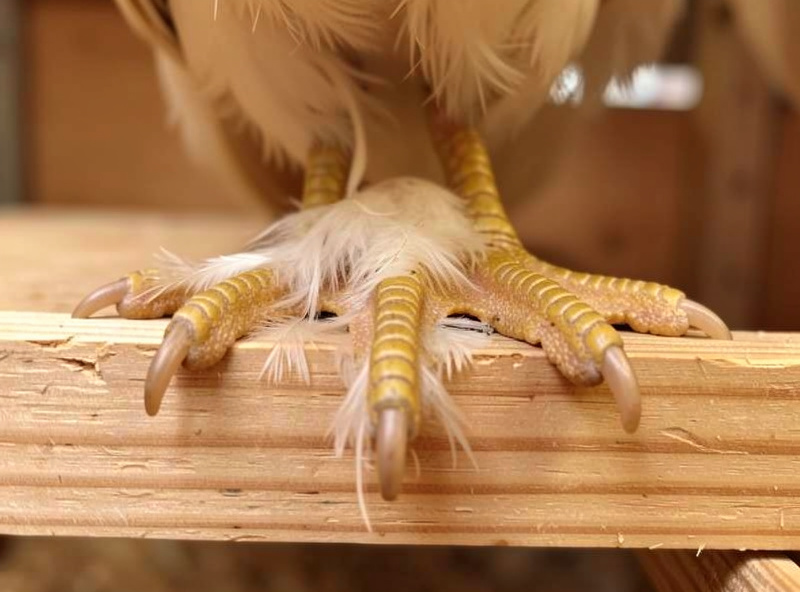
Why Does Roost Shape Matter for Frostbite?
Roost shape decides whether a chicken’s toes are covered or exposed while she sleeps, and exposure is what drives toe frostbite. On a flat, wide bar a hen settles down onto her feet and her belly feathers drape over her toes like a duvet. On a narrow round bar the toes have to grip and curl around the underside, where nothing covers them and the cold air circulates freely.
Frostbite in a coop is driven far more by moisture and exposure than by raw temperature — the same mechanism the Merck Veterinary Manual describes for extremities, where damp tissue freezes at higher temperatures than dry tissue. A chicken’s foot has very little insulating flesh and a lot of surface area; it relies entirely on being tucked under warm feathers to survive a hard freeze. Take that coverage away and you’re asking bare, sometimes-damp skin to sit in sub-zero air for eight hours. That’s why I treat roost shape as a cold-climate safety spec, not an aesthetic choice. If you keep birds anywhere that dips below freezing, this is the detail that quietly protects their feet — or fails to. (If a bird does get frostbite, that’s a vet conversation, not a DIY one; keepers report the flat roost as prevention, but treatment is for your avian vet.)
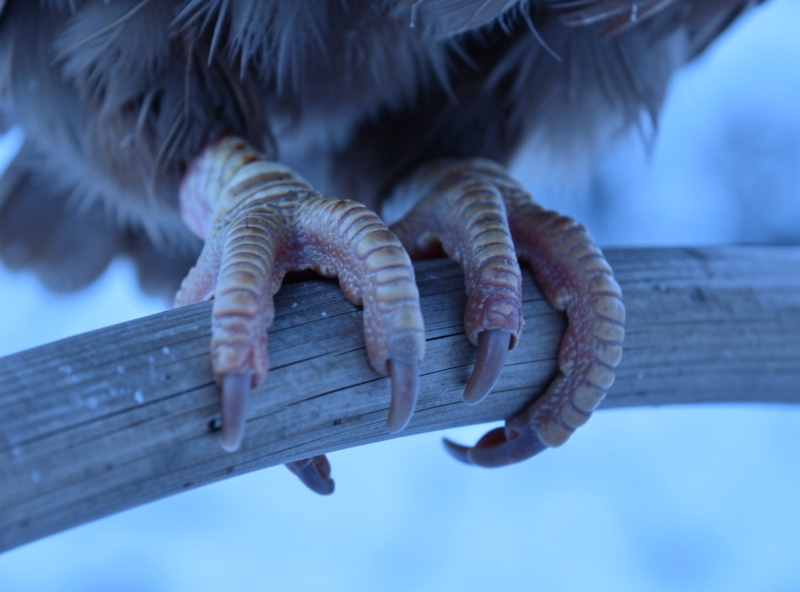
What’s Wrong With a Round Roost in the Cold?
A round roost forces a chicken to grip, which curls her toes around the bar and leaves them hanging in open air all night. There’s no way for her belly feathers to reach and cover wrapped toes on a 1- or 2-inch pole. The narrower and rounder the bar, the more the toes are exposed — the exact opposite of what you want in a freeze.
There’s a persistent myth that chickens “need to grip” a round perch the way wild birds do, and it’s simply wrong biology. Wild perching birds have a tendon mechanism that locks their toes around a thin branch automatically; domestic fowl are heavy-bodied ground birds descended from jungle fowl that roosted on branches but sleep by settling their weight onto the keel, not by gripping. Watch a hen on a flat bar — she sinks down, feet flat, and goes still. Watch one on a round dowel and she’s actively balancing, toes clenched, all night. The clenching keeps the feet exposed and adds fatigue. On my first coop’s round rod I found the frostbite showed up on exactly the toe tips that hung lowest off the bar, which told me everything about the mechanism before I’d read a word about it.
How Wide Should the Flat Roost Be?
Make the flat top 3.5 inches wide — a nominal 2×4 laid on its wide face — with the top edges eased to a gentle radius, not left square and not rounded into a dowel. That width is broad enough for a standard hen to rest flat-footed with full feather coverage, and the eased edges keep a sharp corner from digging into the foot.
A nominal 2×4 measures a true 1.5 by 3.5 inches, a dressed-lumber standard the American Wood Council documents, so flat-face-up you get that ideal 3.5-inch surface. Stood on edge it’s only 1.5 inches — too narrow, and the toes start to wrap again — so always run it flat. I knock the two top corners down with 80-grit on a sanding block until there’s no hard edge, then stop; over-round it and you’ve reinvented the dowel. Bantams and very small breeds can use a slightly narrower 2- to 3-inch flat bar, but for anything standard-size or larger, 3.5 inches flat is the number. The full set of roost measurements — height, wall setback, spacing — lives in the height and spacing guide, and how much linear length each bird needs is in roost space per chicken.
| Roost profile | Toe coverage in cold | Grip effort | Cold-climate verdict |
|---|---|---|---|
| 2×4 flat (3.5 in), eased edges | Full — feathers cover toes | None — rests flat | Best; what I run |
| 2×3 flat (2.5 in) | Good for smaller birds | Minimal | Fine for bantams / light breeds |
| 2-inch round dowel / branch | Partial — toes wrap | Moderate | Risky below freezing |
| 1–1.5 in round closet rod | Poor — toes fully exposed | High — constant clench | Avoid in any cold coop |
| Metal pipe / rebar | Poor + wicks foot heat | High — slick | Never in cold weather |
Does the Flat 2×4 Have Any Downsides?
The main knock on a flat roost is that droppings can accumulate on the wide top surface instead of falling off a round bar, and the flat top can hold a little more moisture. Both are real but minor, and both are solved by a removable bar and a poop board underneath — which you want anyway for mite checks.
Because the 2×4 presents a flat top, a bird standing on it can leave droppings there rather than shedding them down the sides of a pole. In practice this is trivial: I lift the bar out, give the top a quick scrape when I clear the poop board, and it’s done in the same motion. The moisture point matters more in a damp coop, which is really an argument for fixing your ventilation so the whole interior stays dry — a wet coop frostbites birds regardless of roost shape. Make the bar drop-in removable (I run mine in open saddle brackets) and the cleaning downside evaporates. I’ll take a two-second scrape over a winter of exposed toes every single time.
Does Roost Shape Still Matter in a Warm Climate?
In a climate that never freezes, roost shape matters far less for frostbite — but the flat 2×4 still wins on comfort and stability. Even in heat, a bird rests more soundly flat-footed than clenched, and a wide flat bar lets her lie forward to dump heat through her legs on a hot night. Shape stops being a safety issue and becomes a comfort one.
If you keep chickens somewhere that stays reliably above freezing, you have more latitude — a sturdy debarked branch or a round bar won’t cost your birds their toes. But I’d still choose flat, because the ergonomics don’t change with the thermometer: chickens are built to settle onto a surface, not grip a pole, and the flat bar respects that in July as much as January. Where I’d never compromise is any coop that sees a hard freeze even occasionally. A single unexpected cold snap on a round roost can do the damage a whole winter of flat roosting would have prevented.
Do Chickens Actually Prefer a Flat Roost?
Given a genuine choice, most chickens settle onto a flat bar over a round one, especially heavier birds. Offer both in the same coop and you’ll see the big dual-purpose hens claim the flat bar first while lighter, more acrobatic birds are less fussy. The preference tracks body weight — the heavier the bird, the more she wants a stable, flat surface to rest her keel on.
I tested this without meaning to during a rebuild, when I temporarily had one flat 2×4 and one leftover round bar mounted at the same height. Within two nights the pecking order had sorted it out: my Orpingtons and the big Wyandotte owned the flat bar, and only the flightiest Easter Egger regularly chose the round one, seemingly because she liked the height it happened to sit at. Preference isn’t proof of welfare on its own, but it lines up with the biomechanics — a bird that isn’t fighting to balance sleeps more soundly and burns less energy overnight, which matters in a cold climate where every calorie is going toward staying warm. When the birds and the physics agree, I stop arguing.
What About Natural Tree Branch Roosts?
A natural branch sits somewhere between flat and round, and it can work if it’s thick enough — at least 2 inches in diameter — and debarked or well-checked for mites and rot. A gnarly branch actually offers varied grip surfaces and slight flat spots where a bird can settle, so it’s better than a smooth round dowel, but it’s still not as reliably toe-covering as a flat 2×4 in a hard freeze.
I like branches aesthetically and my birds enjoy the varied texture, but I treat them with more caution in winter. Bark hides red mite and holds moisture, so any branch roost gets debarked, sanded smooth on top, and inspected yearly for rot and cracks. Even then, on the coldest nights the irregular surface means toe coverage is less consistent than on a flat bar. My rule: branches are fine as a supplementary or fair-weather roost, but the main sleeping bar in my cold coop is always a flat 2×4. The material trade-offs — lumber versus branch versus the things you should never use — get their own breakdown in the roost material showdown, but for pure cold-weather toe protection, flat and wide wins.
How I Switched My Whole Coop to Flat Bars
Swapping my coop from that first round rod to flat 2x4s took an afternoon and cost the price of a couple of studs. I cut the 2x4s to length, sanded the top edges, set them into open saddle brackets at 30 inches, and lifted each bird onto the new bars after dark for four nights until the habit locked in. By the following winter — a genuinely brutal one — I had zero frostbitten toes for the first time.
The sensory difference the first night was obvious: on the round rod the coop had a low, restless shuffling as birds constantly rebalanced; on the flat bars it went quiet within minutes, just the soft settling sound of a flock sinking onto its feet. That quiet is the tell that the roost is right. If you’re running anything round in a cold climate, this is the cheapest, highest-impact upgrade you can make to a coop — a few dollars of lumber standing between your flock and a preventable injury. Cut the 2×4, sand the edges, and don’t look back.
Can I Convert a Round Roost Without a Full Rebuild?
Yes — in most coops you can swap a round bar for a flat 2×4 in under an hour without touching the supports. If the round roost sits in brackets, just cut a 2×4 to the same length, sand the top edges, and drop it into the existing mounts. If the old bar was screwed down, unscrew it and fasten the 2×4 in its place, flat-face-up.
The only real adjustment is height: a flat 2×4 sits a little differently in a bracket than a round rod, so re-check that it still clears the nest boxes and leaves 18 inches of headroom. I keep a couple of pre-cut, pre-sanded 2×4 bars in the shop specifically so a roost problem is a five-minute fix, not a project. There’s no reason to run a round roost through another winter when the flat alternative is this cheap and this fast to install.
Further Reading
Related Guides
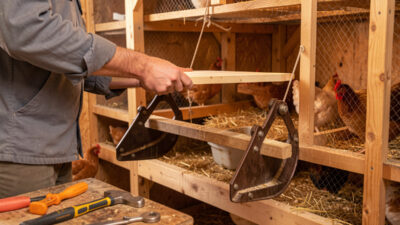
DIY Removable Roost Bars for Fast Cleaning and Mite Checks
The best roost you can build is one you can lift out in ten seconds without a tool. Removable roost…
Ladder Roost vs Single-Level: Which Suits a Mixed Flock
For most mixed-size backyard flocks, a single-level roost wins. Putting every bird on one horizontal bar at the same height…
Roost Above the Nesting Box: The Height Rule for Floor Eggs
The rule is simple: the roost must sit higher than the top of your highest nesting box — ideally 6…