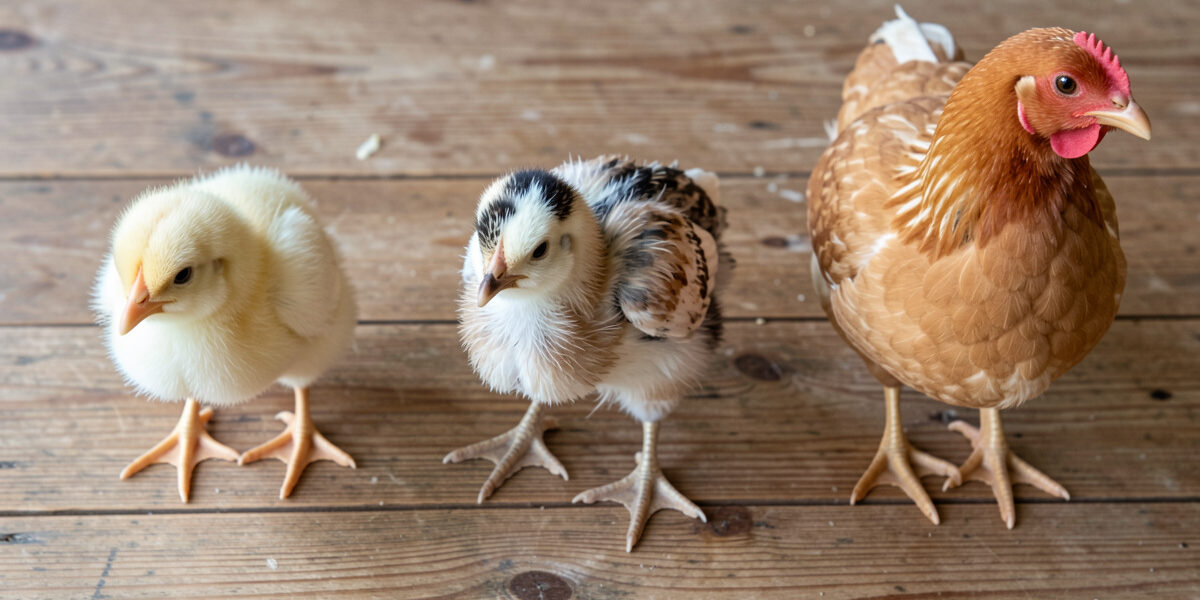
A chick goes from a fragile day-old fluffball to a laying hen in roughly five months, passing through four recognizable stages: the brooder weeks, the awkward feathering juvenile, the grow-out pullet, and point of lay at about eighteen to twenty-two weeks. Knowing what’s normal at each stage is genuinely useful — it tells you when to step heat down, when to change feed, when to move birds outside, and when to start watching for that first egg. After raising many broods through to lay, here’s the timeline as it actually plays out, with the caveat that breed and conditions shift every number.
Treat the weeks below as the shape of the curve, not a schedule to enforce. Bantams, heavy breeds, and slow-maturing heritage birds all run their own pace, and a cold winter grow-out lands later than a warm spring one. What stays constant is the order of milestones and the signals the bird gives you at each.
Weeks 1–3: The Brooder Fluffball
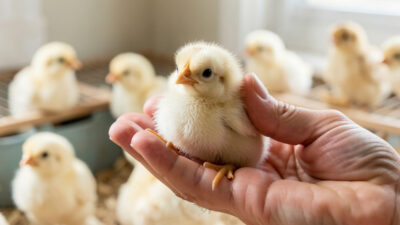
The chick arrives covered in down, unable to regulate its own temperature, and almost entirely dependent on the brooder. Week one is the highest-risk period: chicks sleep in heaps, eat and drink constantly, and need a warm zone around 95 °F (35 °C) with the rest of the brooder cooler so they can choose. This is when you check vents daily for pasty butt and watch that every bird is active and drinking.
By weeks two and three the first real changes appear. Wing and tail feathers start pushing through the down, the chicks begin short test-flights and try to perch on anything, and personalities emerge. The brooder that looked roomy on day one suddenly looks small — they grow startlingly fast. Step the heat down by roughly 5 °F each week as they begin to feather. They’re still firmly brooder birds, but the transformation has started.
Weeks 4–6: The Awkward Feathering Stage
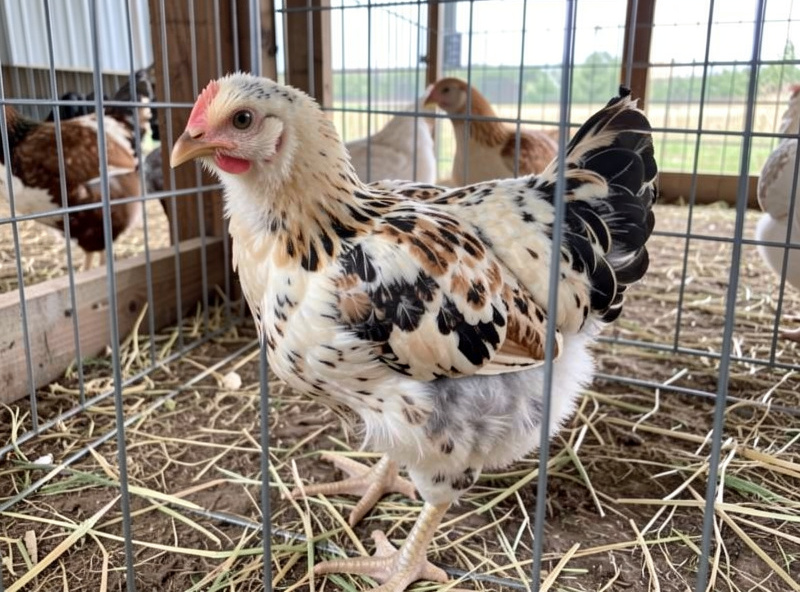
This is the gangly teenager phase, and it’s not the brood’s most photogenic. Down gives way to real feathers in patches, leaving birds looking half-finished and a bit ridiculous. They’re voraciously hungry, growing fast, and increasingly active and flighty — a brooder lid becomes essential if it wasn’t already. Heat steps down to room temperature over these weeks and comes off entirely once the birds are fully feathered, which is the real signal that they can hold their own body heat.
Full feathering, usually somewhere around five to six weeks, is the gate to moving outdoors. Earlier in warm weather, later if your nights are still cold. The moment a chick is fully feathered and the brooder heat has stepped down to match the room, it’s ready for unheated housing — and it stops being a chick and becomes a pullet. This is also the window for the feed transition from starter toward grower.
Weeks 6–16: Growing Out as a Pullet
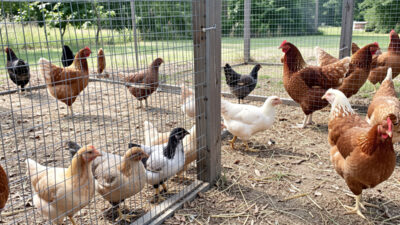
Now the birds are pullets — young females not yet laying — living in unheated housing and growing toward maturity on grower feed. This is the long, quiet stretch where not much dramatic happens week to week, but the bird is steadily filling out. Combs and wattles slowly redden and enlarge, and over these weeks the difference between any cockerels and the pullets becomes obvious: cockerels grow larger, develop redder combs earlier, and start showing pointed saddle and hackle feathers. Any miss-sexed roosters usually announce themselves with a first scratchy crow somewhere in this range.
If you’re integrating these birds into an existing flock, this is when it happens — once they’re well-feathered and close to adult size, using the gradual see-but-don’t-touch method rather than a sudden introduction. It’s also when you make sure the coop they’ll mature in is ready: enough space, predator-proof construction, and the nesting boxes they’ll need soon.
Weeks 16–22: Point of Lay
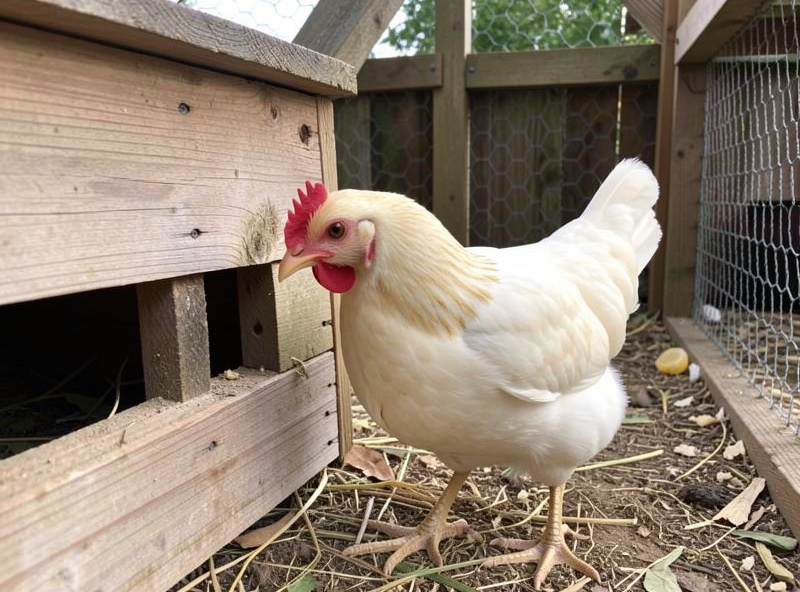
The finish line. Point of lay arrives for most standard laying breeds somewhere around eighteen to twenty-two weeks, though some hybrids start earlier and many heritage breeds later. The signs are unmistakable once you know them: combs and wattles deepen to a rich red, the pullets start investigating the nesting boxes, and they begin doing the submissive squat when you approach — a crouch that signals they’re coming into lay. Then the first egg appears, often small and sometimes oddly shaped, and the bird is officially a hen.
This is when feed switches to a calcium-rich layer feed, and when the rest of the laying system — nesting boxes, a settled flock, good husbandry — earns its keep. The early eggs can be irregular for a few weeks before the bird hits a steady rhythm, which is completely normal.
The submissive squat is worth knowing about because it’s the most reliable behavioral tell that lay is days to a couple of weeks away. A pullet coming into lay will crouch low and spread her wings slightly when you reach toward her — it’s a hormonal response, the same posture she’ll hold for a rooster, and it appears before the first egg. When the squat shows up, get the nesting boxes appealing: clean bedding, maybe a fake or “nest” egg to suggest the spot, and a dim, private location. First eggs are often a comedy of errors — tiny “fairy eggs” with no yolk, soft or shell-less eggs, double-yolkers, or eggs laid from the roost before the bird works out where they’re supposed to go. All of it is normal teething trouble as the laying machinery calibrates, and it sorts itself out within a few weeks.
The Timeline at a Glance
| Stage | Age (typical) | What you see | Key actions |
|---|---|---|---|
| Brooder chick | Weeks 1–3 | Down, heaped sleeping, first feathers by wk 2–3 | Heat ~95 °F dropping weekly; check vents |
| Awkward juvenile | Weeks 4–6 | Patchy feathering, flighty, voracious | Heat off when fully feathered; move outside |
| Grow-out pullet | Weeks 6–16 | Filling out; combs redden; sexes diverge | Grower feed; integrate into flock |
| Point of lay | Weeks 16–22 | Red comb, squat, nest interest, first egg | Switch to layer feed; offer oyster shell |
Reading Feathering as Your Real Clock
If you take one thing from this timeline, make it this: feathering, not age, is the signal that actually matters for management decisions. A chick’s down is useless for thermoregulation — it traps no heat once the bird leaves the warmth of the brooder — so the transition out of supplemental heat and out of the brooder is gated entirely on the bird growing real feathers. Two broods of the same age can feather at noticeably different rates, and the slower one needs heat longer. Watch the bird, not the calendar.
The feathering sequence itself is fairly consistent: wing feathers come first (you’ll see them by the end of week one), then tail, then the body fills in from there, with the head and neck often the last to finish. A “fully feathered” bird has replaced essentially all its down with real feathers and looks sleek rather than fuzzy. That’s your green light for unheated housing. It’s also why the awkward weeks four to six look so scruffy — the bird is mid-swap, neither fluffy nor sleek, just patchy and gangly.
What Changes at Each Transition
Each stage boundary is really a set of management changes, and lining them up makes the whole thing manageable. Leaving the brooder means heat off, a move to unheated housing, and the start of the starter-to-grower feed switch. Entering the grow-out phase means more space, possibly flock integration, and getting the destination coop predator-ready. Reaching point of lay means the switch to layer feed, free-choice oyster shell, and nesting boxes the birds will actually use.
Getting the coop infrastructure right before each transition is what keeps the timeline smooth. The birds you’re growing out need to land in a coop sized with honest square-footage math, clad in predator-proof hardware cloth, with the right number of nesting boxes ready for the first eggs. None of these are last-minute jobs — they’re things to have sorted while the birds are still growing into them, so the transition is a non-event rather than a scramble.
Why the Numbers Vary
If your birds don’t match these weeks exactly, that’s expected. Breed is the biggest variable: production hybrids are bred to mature and lay early, sometimes from sixteen weeks, while many heritage and heavy breeds take their time and may not lay until twenty-six weeks or beyond. Season and daylight matter too — pullets coming of age as days shorten into autumn often hold off laying until the light returns in late winter, which surprises a lot of first-timers. Nutrition and health through the grow-out also shift the timing; a steadily fed, unstressed bird hits her milestones more predictably than one that had a rough start.
The brooder-to-coop move itself deserves a little planning rather than a sudden eviction. If your nights are cool when the birds are ready, ease the transition: move them on a mild day, let them spend daytimes outside before sleeping out, and make sure the coop is genuinely draft-free even if it’s unheated, because a feathered bird handles cold fine but not a cold draft. Birds raised together move as a group without much fuss; the stress comes from doing too much at once — new space, new flock, and cold all on the same day. Spread those changes out and the move is uneventful, which is exactly what you want.
The practical upshot: use the timeline to anticipate the next stage and prepare for it — step the heat down, change the feed, ready the coop, watch for the squat — but read the individual bird rather than the calendar. The full day-old-to-laying-hen journey, with the brooder, feed, sexing, and integration detail behind each stage, is in the complete chick and pullet care guide. Once the eggs start, the egg production guide picks up where this one ends, and chick feed stages covers the nutrition that carries a bird through every phase above.
Related Guides
Common Chick Problems: Signs, Prevention, and When to Get Help
Almost every common chick problem is an environment problem first — chilling, damp bedding, crowding, or dehydration — which is…
Integrating Chicks Into the Flock Without Bloodshed
You never just tip young birds into an established flock — chickens enforce a strict pecking order and a sudden…
How to Sex Chicks: What Actually Works (and What Does Not)
For a backyard keeper, the only reliable way to know a chick’s sex at hatch is to buy auto-sexing or…