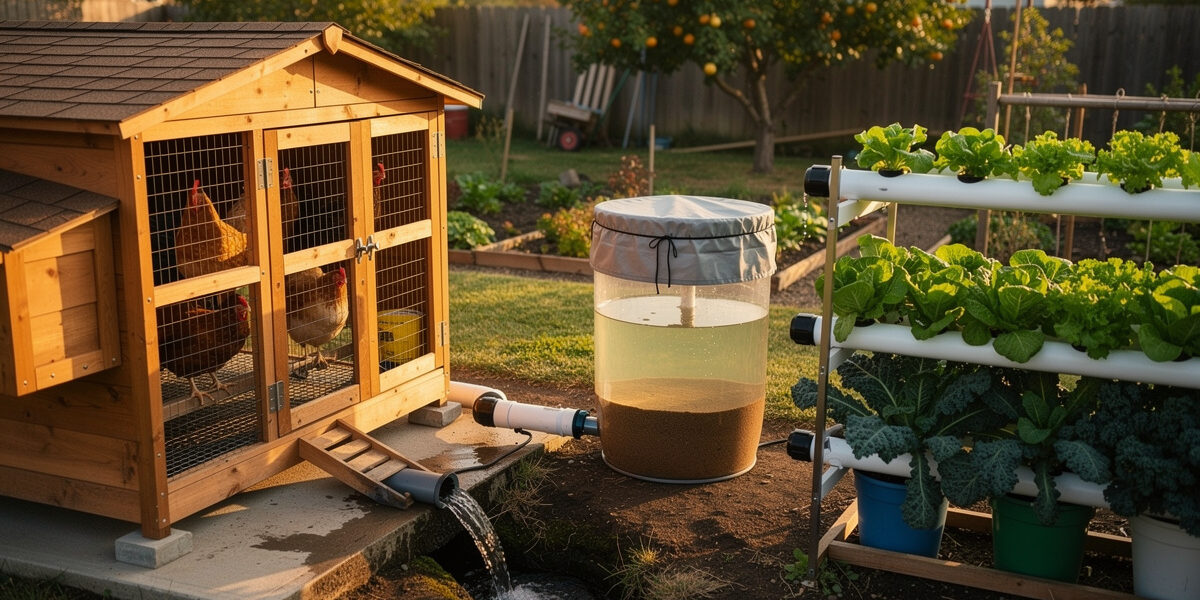
Chicken coop runoff contains dissolved nitrogen, phosphorus, and potassium at concentrations that make it a viable nutrient input for hydroponic systems — if you filter and dilute it correctly. A typical 4-hen coop produces roughly 8–12 pounds of manure per week, and the water that runs through bedding during cleaning carries 200–400 PPM of dissolved nitrogen compounds that hydroponic plants can absorb directly, cutting into what would otherwise be a recurring synthetic-nutrient purchase.
I have been running DWC buckets in the spare room for about 18 months — pH adjustments twice a week with General Hydroponics pH Down, EC checked every other day with a Bluelab Truncheon, full reservoir change once a month. That part of the loop is dialed in. The coop side is the established half of my setup too — the flock, the deep litter, the welded run frame are all running — but routing the runoff into the DWC buckets instead of straight to the compost pile is the newer piece of the build, and it is the part I am still finishing. The numbers below come from the same EC and PPM thinking I already use every week on the hydro side, cross-checked against what I am actually measuring coming off my own coop floor. What follows is the design logic — how the waste stream from one system becomes the nutrient input for another, where the filtering, dilution, and safety steps sit between them, and which hydroponic-side mistakes I have already made that translate directly to the coop-side filter I am plumbing in now.
The nutrient chemistry side — how to mix and manage hydroponic nutrient concentrations — lives on smarthydrolab.com, where the EC meter readings, pH adjustments, and reservoir maintenance are covered in detail. I am linking to the complete hydroponic nutrient guide for the full chemistry breakdown. What this article focuses on is the coop end: what comes out of the run, what the water picks up, and how to turn that waste into something a DWC bucket can use.
What Is in Coop Runoff Water
Every time you hose down a coop floor or rinse a soiled coop bedding tray, the water picks up a dissolved load of chicken manure. Fresh chicken manure is roughly 1.5% nitrogen, 1.0% phosphorus, and 0.5% potassium by dry weight — the NPK ratio equivalent of a 1.5-1.0-0.5 fertilizer. The water that runs off during cleaning dissolves the water-soluble fraction of that manure: ammonia nitrogen (NH₃/NH₄⁺), phosphate ions, and potassium salts. The total dissolved solids (TDS) in coop runoff typically measures 400–800 PPM, with ammonia nitrogen making up 30–50% of that reading.
The problem with using that runoff directly is ammonia toxicity. Hydroponic plants absorb nitrogen as nitrate (NO₃⁻), not ammonia (NH₄⁺). High ammonia concentrations in a reservoir — anything above 10–20 PPM — stress root systems and invite root rot because ammonia raises pH locally at the root surface and inhibits oxygen uptake. Fresh coop runoff at 400–800 PPM with 30–50% ammonia nitrogen means the raw runoff is 120–400 PPM ammonia, which is 6–20× higher than what a hydroponic system can tolerate. The fix is a two-step process: filter the solids out, then let aerobic bacteria convert the ammonia to nitrate before the water enters the hydro reservoir.
The Filtration and Nitrification Loop
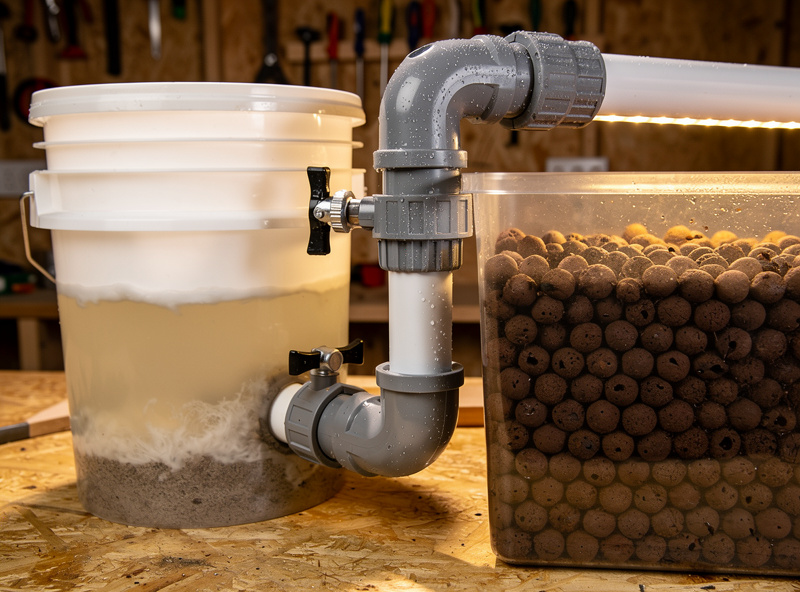
Between the coop and the hydroponic reservoir, you need a settling tank and a biofilter. The settling tank is a simple 20–30 gallon (75–110 L) container — a plastic drum or an IBC tote — where coop runoff sits for 24–48 hours. Solids settle to the bottom. The clearer water from the top is then pumped through a biofilter: a container filled with Hydroton expanded clay pellets, lava rock, or Marineland bio-balls that hosts nitrifying bacteria (Nitrosomonas and Nitrobacter). These bacteria do the same job they do in an aquarium filter — they convert ammonia to nitrite, then nitrite to nitrate — and colonizing the biofilter media to a stable, fully cycled state typically takes 3-6 weeks of the system running, not the 2-week best case some kits advertise. The two-stage settling-tank-then-biofilter layout is the same design pattern Clemson University Extension’s aquaponics system design guide lays out for solids removal followed by biological filtration in small-scale systems.
The biofilter output is water with TDS in the 200–500 PPM range, now primarily nitrate nitrogen with trace phosphorus and potassium. This is the input that a smart chicken coop setup can route to a hydroponic reservoir. The nutrient balance is not perfect — chicken manure is nitrogen-heavy relative to phosphorus — but it covers 70–80% of the macronutrient needs for leafy greens like lettuce, kale, and Swiss chard, which are the plants most commonly grown in beginner DWC systems. A small supplemental dose of a phosphorus-potassium bloom formula every other week fills the gap.
Dilution Ratios That Work
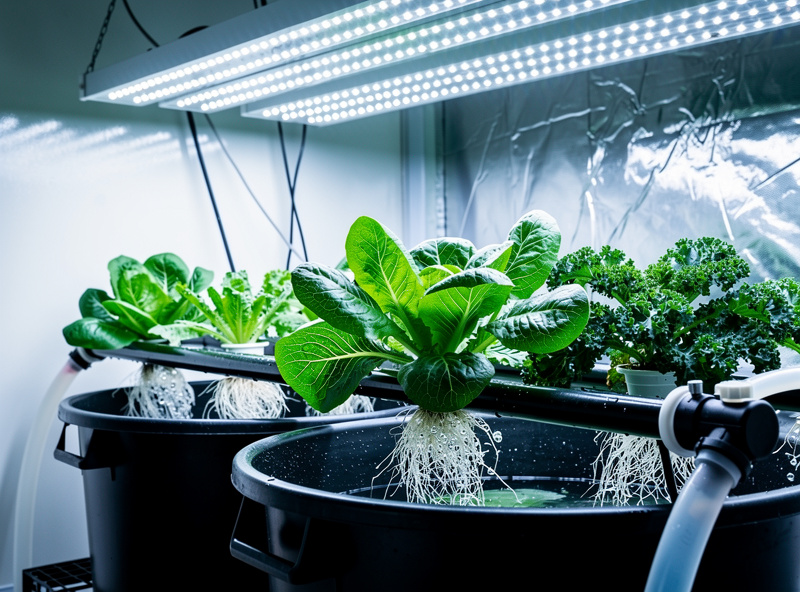
The rule that keeps the reservoir safe is dilution: the biofilter output runs at 200–500 PPM, and most leafy-green hydroponic reservoirs run at 800–1,200 PPM total. The biofilter output provides the nitrogen backbone, and you top up with clean water plus a PK supplement to hit the target EC. Here is the practical math for the coop sizes most backyard keepers actually run:
| Flock Size | Weekly Runoff (gal) | Biofilter Output TDS | Dilution Ratio (Runoff:Clean) |
|---|---|---|---|
| 4 hens | 8–12 | 250–400 PPM | 1:2 |
| 8 hens | 16–24 | 300–500 PPM | 1:3 |
| 12 hens | 24–36 | 350–550 PPM | 1:4 |
| 20 hens | 40–60 | 400–600 PPM | 1:5 |
The dilution ratio increases with flock size because larger flocks produce more concentrated runoff. At the 1:2 ratio for a 4-hen flock, each gallon of biofilter output is mixed with 2 gallons of clean water to bring the reservoir to 800–1,200 PPM. A 10-gallon DWC reservoir running lettuce consumes about 2–3 gallons per week through plant uptake and evaporation, which means a 4-hen flock’s weekly runoff of 8–12 gallons can supply 3–4 DWC buckets continuously. The nutrient loop closes: the coop produces the waste, the filter converts it, the plants consume it, and the coop gets cleaned again next week.
What Breaks and How to Prevent It
The most common failure in a coop-to-hydro nutrient loop is ammonia spike in the reservoir. It happens when the biofilter has not fully colonized (the first several weeks) or when a heavy rain floods the coop run and delivers a slug of undiluted manure water straight into the settling tank, overwhelming the bacterial capacity. I have already lived the smaller version of this failure on the hydroponic side: first time I added fresh Hydroton to a running DWC bucket without rinsing the new pellets, the new clay leached enough salts into the reservoir that EC drifted from 1.4 to 1.9 mS/cm over three days and the lettuce roots browned at the tips before I caught it. Same physics on the coop side — a clean filter media bed dumped into a running reservoir overwhelms it. The fix is a bypass valve: during heavy rain, divert runoff away from the settling tank for 24 hours while the filter catches up. A secondary fix — and the one I have designed into the plan — is an HM Digital TDS-EZ ($15 meter) in the settling tank wired to a Shelly H&T sensor that triggers a phone alert if the reading jumps above 1,000 PPM, meaning the water is too concentrated to send to the biofilter and needs dilution first.
The other failure point is pathogen risk. Chicken manure carries Salmonella, Campylobacter, and E. coli, which is why raw manure should never touch edible plant leaves. The pathogen profile and the safe-handling timing rules are laid out in Penn State Extension’s guidance on reducing risks from animals and manure, which identifies poultry droppings specifically as a Salmonella source and sets the composting-temperature and pre-harvest-interval standards produce growers work to. The biofilter and the dilution step reduce pathogen load significantly — nitrifying bacteria outcompete many pathogens, and the 24–48 hour settling time starves oxygen-dependent pathogens — but the rule is absolute: this nutrient loop is for root-feeding hydroponic systems only (DWC, NFT), never for foliar feeding or soil-surface application where edible leaves or fruits could contact the water. The roots are in a closed reservoir that never touches the edible portion of the plant.
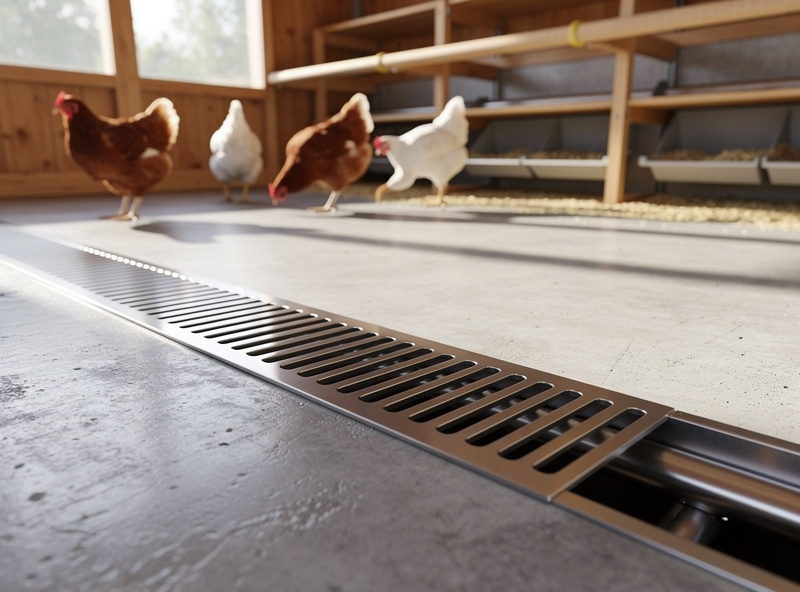
The line between waste and resource is a filter and a few weeks of bacterial patience. The drain retrofit I am cutting into my existing coop floor — see the smart coop build notes for the base layout it is going into — slopes toward the settling tank: a 2% grade in the concrete slab, a stainless-steel grate over the channel, and a PVC pipe that runs underground to the tank. The coop-to-hydro loop is not an afterthought bolted onto a finished coop. Once it is in, it is the reason that section of floor drains at all.
Frequently Asked Questions
Can I use chicken coop runoff directly in a hydroponic system?
No. Raw coop runoff contains ammonia at 120-400 PPM, which is toxic to plant roots above 10-20 PPM. The runoff must pass through a settling tank and biofilter to convert ammonia to nitrate before it can be used, and the biofilter needs roughly 3-6 weeks of bacterial colonization to stabilize before it is reliable.
Is chicken manure safe to use for plants I will eat?
Yes, with proper processing. The biofilter and dilution steps reduce pathogen load, but the water should only feed root-zone hydroponic systems (DWC, NFT) where the nutrient solution never touches edible plant parts. Never use coop runoff for foliar feeding or on soil where leaves or fruits contact the water.
How much does a coop-to-hydro filtration system cost?
A basic setup runs $80-150: a 30-gallon settling tank ($25-40), a submersible pump ($20-30), biofilter media like expanded clay pellets ($15-25), PVC plumbing ($15-25), and a TDS meter ($15). It offsets a meaningful share of a leafy-green DWC system’s ongoing synthetic-nutrient cost, though how quickly that adds up depends on how many buckets you’re feeding and what nutrient brand you’d otherwise be buying.
What plants grow best with chicken-manure-based nutrients?
Leafy greens work best: lettuce, kale, Swiss chard, bok choy, and herbs like basil and mint. These plants are nitrogen-hungry and tolerate the nitrogen-heavy profile of chicken manure. Fruiting plants like tomatoes and peppers need supplemental phosphorus and potassium beyond what the coop runoff provides.
Does the water smell bad in a coop-to-hydro system?
The settling tank smells like a compost bin — earthy, not foul — if it is aerated adequately. Adding an air stone to the settling tank keeps the water aerobic and prevents the anaerobic decomposition that produces hydrogen sulfide (rotten-egg smell). A lid on the tank contains any odor.
Can I use deep litter bedding runoff in this system?
Deep litter runoff is lower in dissolved nutrients than fresh manure runoff because the carbon in the bedding (straw, wood shavings) binds nitrogen during decomposition. It can still be used, but expect 30–50% lower TDS readings. Compost the spent deep litter separately and use it as garden soil amendment instead.
Related Articles
Related Guides

Egg Handling and Storage: Nest Box to Kitchen
My eggs sit unwashed in a bowl on the kitchen counter, not the fridge, and that’s not neglect — it’s…

Backyard Egg Quality: Feed, Forage, and Handling
Crack a carton of my own eggs next to a supermarket dozen and the difference is obvious before you even…
Automatic Chicken Feeder: Types, Setup & Guide
Complete guide to automatic chicken feeders. Compare gravity, treadle, timer, and smart WiFi feeders with capacity planning, training tips, and…