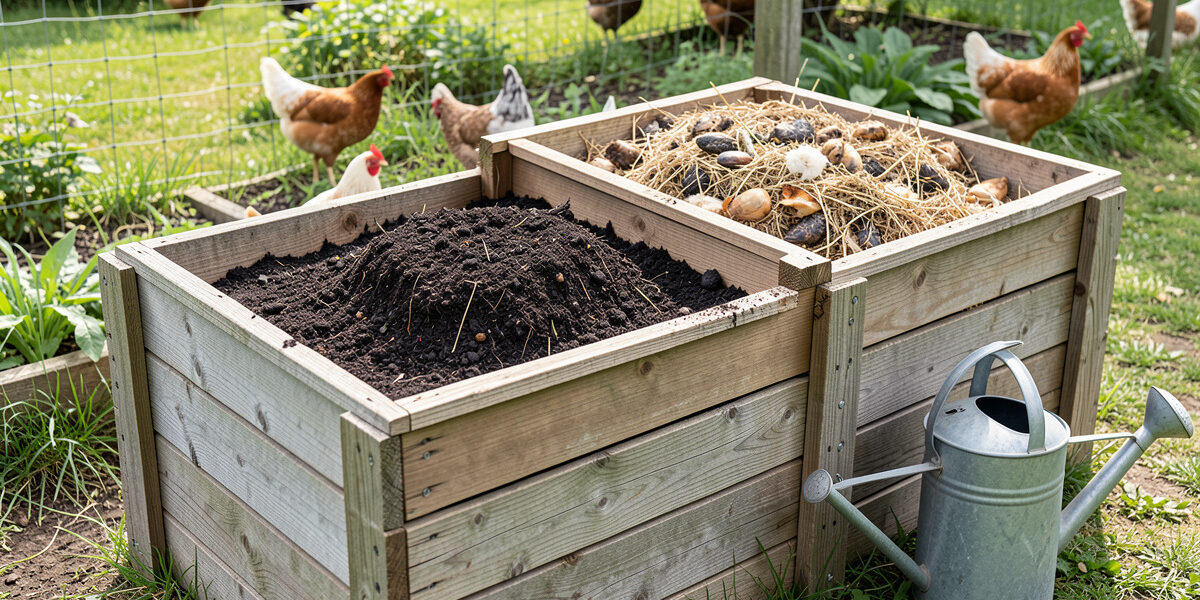
Fresh chicken manure is the richest free fertilizer you’ll ever produce — its nitrogen runs roughly 1.1–1.5%, hotter than cow or horse manure — and the fastest way to burn your plants and spread pathogens if you use it raw. The whole job of composting it is converting that “hot,” high-nitrogen waste into a safe, balanced, dark soil amendment — and it comes down to three things: mix it with carbon, let it heat, and cure it for months. On my flock the coop bedding and manure come out half-composted already, which makes the rest easy. Here’s exactly how to compost chicken manure for the garden.
This is the back half of the coop-to-garden loop. Everything you scrape and strip out during normal coop cleaning and maintenance — the poop-board scrapings, the spent deep litter, the nest material — isn’t waste, it’s feedstock. Composted properly it becomes the best amendment in the garden. The broader chicken-powered garden cycle, including how it feeds my raised beds, lives in my chicken-powered garden writeup; this guide is the composting mechanics themselves.
Why You Can’t Use Fresh Chicken Manure
Fresh chicken manure is “hot” — very high in nitrogen, with an NPK roughly in the range of 1.1–1.5% nitrogen, far stronger than cow or horse manure. Put it straight on plants and that concentrated nitrogen, along with its salts and ammonia, chemically burns roots and foliage. It’s the gardening equivalent of pouring undiluted fertilizer on a seedling.
The second problem is pathogens. Raw poultry manure can carry E. coli, Salmonella, and other organisms you do not want near edible crops — the CDC’s backyard poultry guidance documents these risks directly. Composting solves both at once: it dilutes and stabilizes the nitrogen as the carbon balances it, and a properly hot, well-managed pile reaches temperatures that kill the pathogens. Raw manure is a liability; composted manure is an asset. The conversion between them is the entire point of this process.
The Carbon-to-Nitrogen Ratio: The One Number That Matters
Composting runs best at roughly 25–30 parts carbon to 1 part nitrogen (C:N). Chicken manure alone sits far on the nitrogen-heavy side, around 7:1, which is why a pile of pure manure goes slimy, anaerobic, and reeks of ammonia instead of composting cleanly. You fix that by mixing in carbon-rich “browns” — and if you run a deep-litter coop, you’ve already done most of it, because the bedding the manure is mixed into is the carbon.
| Material | Role | Approx. C:N |
|---|---|---|
| Fresh chicken manure | Nitrogen (green) | ~7:1 |
| Pine shavings / coop bedding | Carbon (brown) | ~300–500:1 |
| Dry leaves | Carbon (brown) | ~50–60:1 |
| Straw | Carbon (brown) | ~80:1 |
| Target compost mix | Balanced | ~25–30:1 |
The practical rule beats the math: aim for two to three parts bedding/browns to one part manure by volume, and let your nose calibrate. A balanced pile smells earthy; an ammonia smell means too much nitrogen (add browns), and a pile that just sits cold and wet usually needs more browns and more air too. Deep-litter keepers start ahead because the harvested litter is already close to balanced — my deep litter guide covers getting it to that state in the coop.
Building a Hot Pile
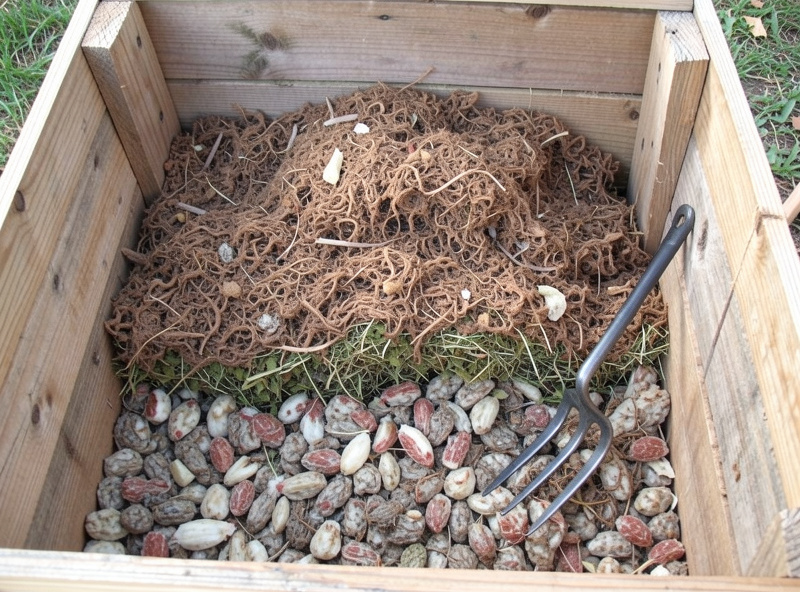
To kill pathogens and break the manure down fast, you want a hot, aerobic pile. Build it with enough mass to insulate itself — a cubic meter (about a 1m × 1m × 1m heap) is the practical minimum to hold heat. Layer your balanced mix of coop bedding and manure with the occasional thin layer of green material, moisten it to the dampness of a wrung-out sponge (not soaking), and let the microbes go to work. Within days a well-built pile heats up as the bacteria multiply.
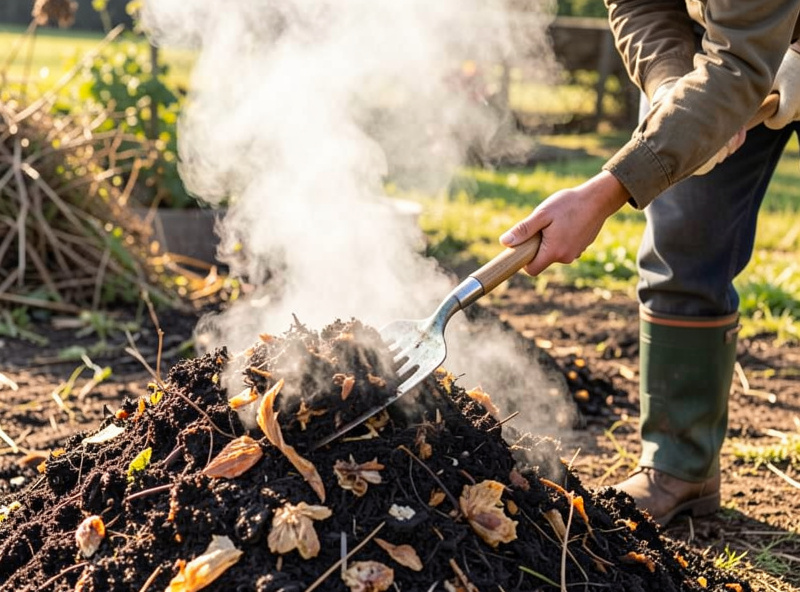
A hot composting pile reaches roughly 55–65 °C in the active core, and that heat is what sanitizes the manure — sustained temperatures in that range kill the pathogens and most weed seeds. A cheap compost thermometer takes the guesswork out; you’re aiming to hold that hot zone, not just touch it once. If the pile never heats, it’s usually too dry, too small, too carbon-heavy, or too compacted — all fixable.
Turning and Moisture
Hot composting is aerobic, so it needs oxygen, and that means turning. Every week or two, fork the pile so the cooler outer material moves to the hot center and fresh air gets in. Turning is what keeps it aerobic (preventing the slimy, stinking anaerobic failure mode) and what ensures every part of the pile passes through the hot, pathogen-killing core rather than just the middle. More turning means faster compost; less turning means slower but still works.
Moisture is the other lever: too dry and the microbes stall, too wet and it goes anaerobic and sour. Wrung-out-sponge dampness is the target — squeeze a handful and you want a drop or two, not a trickle. In a rainy climate, cover the pile so it doesn’t waterlog; in a dry one, water it as you turn. This is the same aerobic-vs-anaerobic balance you manage in the coop litter itself, which is why deep-litter keepers find composting intuitive.
Curing: The Step People Skip
After the pile stops heating (it cools as the easy material is consumed), it’s not finished — it needs to cure. Curing is a slower, cooler maturation phase where the compost stabilizes, the last of the harsh compounds break down, and it becomes safe and gentle enough for plants. Skipping the cure is the most common mistake: a pile that’s stopped steaming can still be too raw to use.
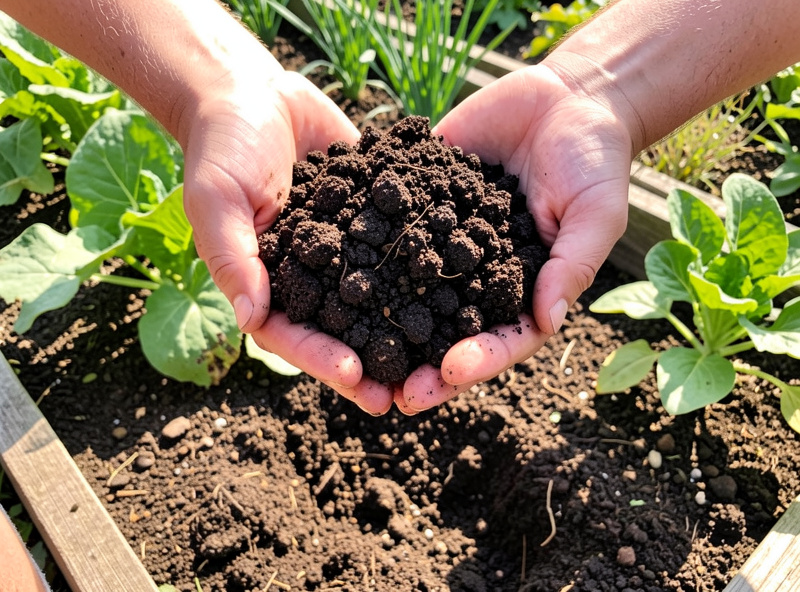
For chicken manure compost destined for an edible garden, give it time. A well-managed hot pile that’s been turned regularly can be ready in a few months; a cooler, passive pile takes longer — commonly six months to a year from fresh manure to finished, cured compost. Finished compost is dark, crumbly, sweet-smelling, and you can no longer recognize the original bedding or manure. If you still see identifiable droppings or smell ammonia, it needs more time. Patience here is what separates a soil amendment from a plant-killer.
Food Safety: When Is It Safe to Use?
This is the part to take seriously on an edible garden. Even after composting, common food-safety guidance for raw or incompletely composted manure recommends a long interval between application and harvest — widely cited guidelines suggest waiting 90 to 120 days before harvesting crops whose edible parts contact the soil. Fully finished, properly hot-composted and cured manure is far safer, but the conservative approach for anything you eat raw (salad greens, root crops) is to apply it well ahead of planting, not mid-season.
For ornamental beds, lawns, and non-edible plantings the bar is lower — finished compost can go down freely. The safest practice overall: compost hot, cure long, and time edible-crop application generously. When in doubt, use it on the flowers and give the vegetable beds the most thoroughly finished batch. For the urban-garden composting angle and small-space methods, the folks over at CityRooted cover composting in tighter setups well.
Using the Finished Compost
Once it’s truly finished and cured, chicken manure compost is premium stuff — rich, balanced, and a genuine soil-builder. Work a couple of centimeters into the top of garden beds before planting, side-dress established plants, or blend it into potting mixes at a modest fraction (it’s strong, so you don’t need much). Because it’s already balanced and stabilized, it feeds without the burn risk of the raw material.
This closes the loop that makes a flock pay for itself in the garden: the same coop maintenance that keeps the air dry produces, as a byproduct, the best amendment your beds will get. Scrape the poop board, run the deep litter, harvest it twice a year, compost it hot, cure it long — and the waste problem becomes a fertility supply. It’s the most satisfying part of the whole system.
Frequently Asked Questions
How long does it take to compost chicken manure?
A well-managed hot pile that is turned regularly can produce usable compost in a few months, while a cooler passive pile takes longer. From fresh manure to fully finished, cured compost is commonly six months to a year. Finished compost is dark, crumbly, and earthy-smelling with no recognizable droppings or ammonia odor.
Can you put fresh chicken manure straight on the garden?
No. Fresh chicken manure is too high in nitrogen and will chemically burn plant roots and foliage, and it can carry pathogens like E. coli and Salmonella. It must be composted with carbon-rich material and cured first. Deep-litter bedding comes out already partly composted, which speeds the process.
What is the right carbon-to-nitrogen ratio for composting chicken manure?
Aim for a finished mix around 25 to 30 parts carbon to 1 part nitrogen. Chicken manure alone sits near 7 to 1, far too nitrogen-heavy, so mix in two to three parts carbon browns like coop bedding, dry leaves, or straw per part manure. An ammonia smell means add more browns.
How hot does a chicken manure compost pile need to get?
The active core of a hot pile reaches roughly 55 to 65 degrees Celsius, and that sustained heat is what kills pathogens and weed seeds. Build the pile at least a cubic meter to hold heat, keep it as damp as a wrung-out sponge, and turn it so every part passes through the hot center.
Is composted chicken manure safe for vegetables?
Fully hot-composted and cured manure is much safer than raw, but for edible crops the conservative approach follows food-safety guidance of waiting 90 to 120 days between applying manure-based compost and harvesting, especially for crops eaten raw. Apply it well ahead of planting rather than mid-season, and use the most finished batch on vegetables.
Why does my chicken manure compost smell like ammonia?
An ammonia smell means the pile is too nitrogen-heavy or has gone anaerobic. Add carbon-rich browns like coop bedding or dry leaves and turn the pile to reintroduce oxygen. A balanced, aerobic compost pile smells earthy, not sharp. The same carbon and oxygen balance applies in the coop litter itself.
Further Reading
- Coop Cleaning, Bedding & Maintenance: The Complete System
- The Deep Litter Method: A Complete Guide
- The Chicken-Powered Garden Cycle
- Chicken Bedding Types Compared
- Chicken Coop Odor Control
Related Guides
The Chicken Coop Cleaning Schedule That Actually Works
A chicken coop cleaning schedule should take about five minutes a day, fifteen minutes a week, under an hour a…
The Deep Litter Method: A Complete Guide for Chicken Coops
The deep litter method is a system where you let the bedding and droppings compost in place on the coop…
Chicken Coop Odor Control: A Diagnostic Approach
A chicken coop should smell faintly of earth and warm birds — never of ammonia. That sharp, eye-watering note isn’t…