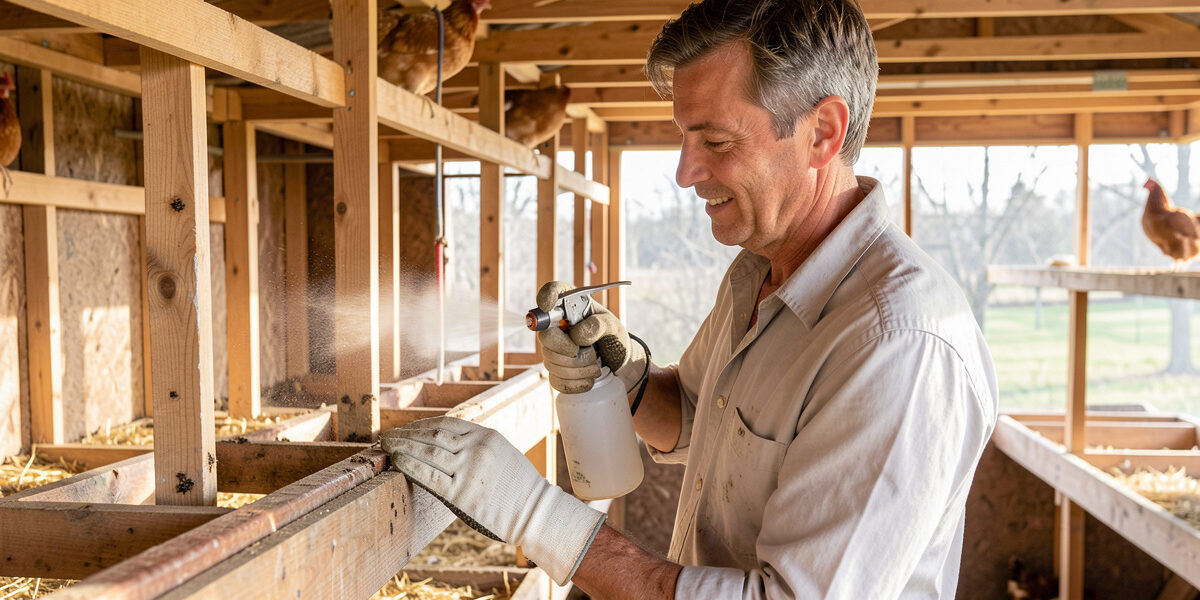
The reason mite treatments fail is that keepers treat the bird and ignore the coop. Red mites — the worst pest most flocks face — don’t live on the chicken. They live in the cracks of the coop structure and only crawl onto the birds at night to feed, and in warm weather a red mite can complete its whole life cycle in about 7 days, so a population explodes fast. Dust every hen you own and you’ll still lose the war if you don’t treat the roost joints, the perch brackets, and the seams where they hide. The coop is the battlefield. Here’s how to win it.
I run a self-built walk-in coop and treat it as the front line, because that’s where these pests actually are. This guide is about coop-side pest control — the structure, the roosts, the feed storage, the exclusion. For signs and treatment on the bird, I keep that separate in my mites and lice on chickens writeup, and anything that looks like illness rather than parasites goes to an avian vet, not a blog post. What follows keeps the environment hostile to pests so the birds stay clear.
Know Your Enemy: Where Each Pest Actually Lives
Effective control starts with knowing where the pest spends its day, because that’s where you treat. The big distinction is between parasites that live in the coop and ones that live on the bird — it changes the entire strategy.
| Pest | Where it lives | Coop-side control |
|---|---|---|
| Red mite (Dermanyssus) | Cracks in roosts, perch ends, structure seams — feeds on birds at night | Treat the structure: permethrin in every crack, smooth sealable roosts, seasonal blitz |
| Northern fowl mite | Mostly on the bird, around the vent | Treat the bird; clean coop reduces spread — route to vet/bird guide |
| Lice | On the bird, at skin/feather base | On-bird treatment; dust baths help — route to bird guide |
| Rodents (rats/mice) | Burrows near feed; enter through gaps | Lock down feed, seal gaps, treadle feeder, hardware cloth |
| Wild birds | Drawn to spilled feed; disease & mite vector | Exclude from run and feed, cover feed, mesh openings |
| Flies | Wet, anaerobic litter pockets | Keep litter dry and turned; remove moisture source |
Red Mites: Treat the Structure, Not Just the Bird
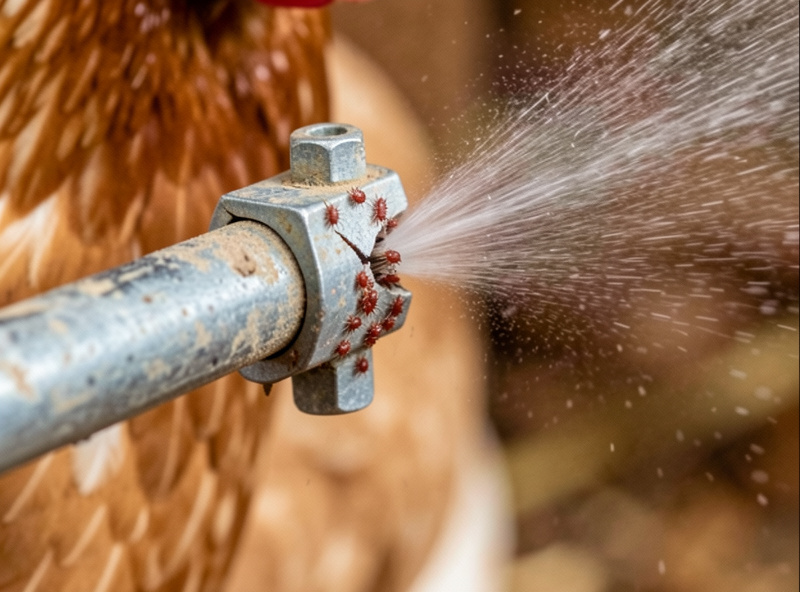
Red mites are the nightmare because they’re nocturnal and they hide. By day they retreat into the cracks at the ends of the roost bars, the joints where perches meet brackets, and any seam or gap in the coop structure, clustering in grey-white or red-brown masses that look like ash or, after a feed, like dried blood. At night they emerge, crawl onto the roosting flock, drain blood, and retreat before dawn. A heavy load drops laying, causes anemia, makes birds reluctant to roost, and in severe cases kills (the biology is well documented in poultry extension resources on external parasites).
Because they live in the coop, you treat the coop. The roost bars and their brackets are ground zero — that’s where they congregate, so that’s where the treatment goes. Smooth, sealable, removable roosts you can lift out and scrub are a massive advantage over rough timber full of hiding cracks; it’s one reason I print smooth-faced roost-end caps on the 3D printer rather than leaving raw cut ends. Catching them early at the monthly roost inspection in your coop cleaning schedule is far easier than fighting an established infestation.
The Treatment Arsenal: Permethrin, DE, and Heat
Three tools cover coop-side mite control. Permethrin-based coop sprays are the workhorse for an active infestation — you drive the spray into every crack, joint, and roost end where the mites shelter, following the product label exactly for poultry use and re-treating on schedule to catch newly hatched mites the first pass missed. A permethrin coop spray is what I keep on hand for a flare-up. As an Amazon Associate I earn from qualifying purchases.
Diatomaceous earth (food-grade) is the preventive layer — a fine dust that mechanically damages mite exoskeletons. Worked into roost cracks, the poop board, and dust-bath areas it suppresses populations, but it only works bone-dry (it’s useless once damp) and you must avoid creating clouds of it, since the dust is a respiratory irritant for both birds and keeper — apply it low and gentle, not in a haze. Heat and sunlight are the free tools: a stripped, scrubbed, sun-dried coop on a hot day is hostile to mites, which is why the seasonal deep clean is your biggest single blow against them.
The Seasonal Blitz: Your Biggest Weapon
The twice-yearly deep clean is where you land the hardest hit. Strip the coop completely, remove all bedding (it goes to compost), and scrub every surface. With the structure bare, you can finally reach the roost joints, the bracket seams, and the wall cracks — treat all of them, let everything dry fully in sun if you can, and re-treat the high-risk zones before fresh bedding goes back in. A spring blitz is the most important one, because it knocks the population down before the warm season lets it explode (mites breed far faster in heat).
Between blitzes, the routine clean-coop habits do the maintenance work. Mites thrive in deep, undisturbed, dirty conditions and struggle in a dry, turned, well-managed coop — so the whole coop maintenance system is itself a form of pest control. A neglected coop is a mite incubator; a managed one fights them for you between treatments.
Rodents: It’s Always About the Feed
Rats and mice aren’t after your birds — they’re after the feed, and where there’s accessible feed there will be rodents. They also gnaw entry points, foul feed with droppings, spread disease, and a bold rat will take eggs and even young chicks. The entire control strategy is denying them food and entry, because poison and traps are downstream patches on an open buffet.
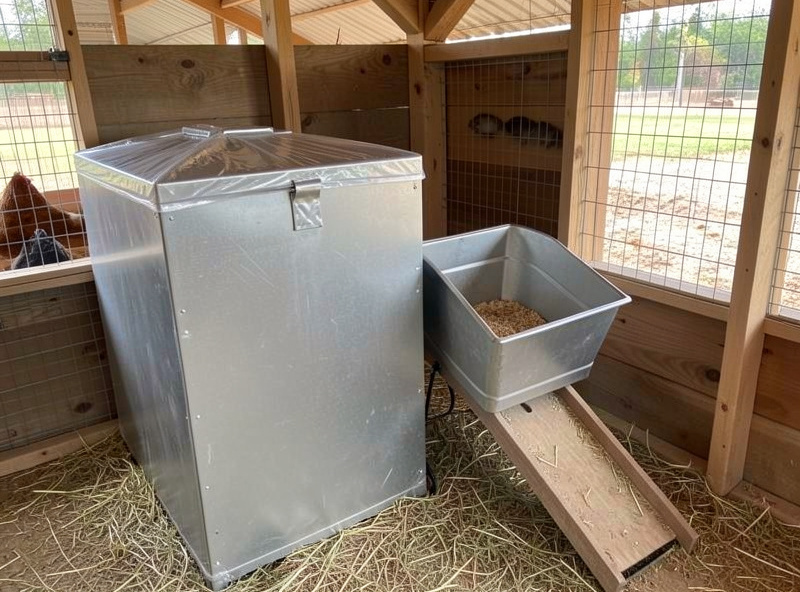
Lock the feed in metal (not plastic) bins they can’t gnaw, never leave feed out overnight in an open trough, and switch to a treadle feeder that closes under a bird’s weight but not a rat’s. Seal gaps in the coop and skirt the base and any dig-prone openings with ½-inch hardware cloth — the same mesh that keeps predators out keeps rodents from tunneling in. A treadle feeder is one of the highest-return anti-rodent upgrades there is. As an Amazon Associate I earn from qualifying purchases. Remove the food source and the rodents leave on their own.
Wild Birds and Flies: The Overlooked Vectors
Wild birds are drawn to spilled feed and are a genuine disease and mite vector — they can introduce red mites and pathogens to a clean flock. The control is the same feed discipline that handles rodents, plus mesh on the run and coop openings to keep them out of the feeding area. Covering feeders and cleaning up spillage removes the magnet.
Flies are a symptom, not a primary pest: a fly problem almost always means a wet, anaerobic pocket in the litter or a manure build-up that’s gone damp. You don’t fight flies with spray — you fix the moisture. Find the wet patch (a leaking waterer, a dead-air corner, a saturated zone under the roost), dry it, turn the litter, and add carbon. The same moisture discipline that controls odor controls flies, which is why I treat them together with coop odor control.
When It’s Not a Pest: Route to the Vet
One important boundary: coop pest control is about the environment, not bird medicine. If a bird shows signs of illness rather than external parasites — respiratory symptoms, lethargy, weight loss, anything systemic — that’s a veterinary question, not a coop-spray question. I keep husbandry awareness here and route diagnosis and treatment to an avian vet, because guessing at flock health from a blog is how small problems become outbreaks. Treat the coop hard; let a professional treat the sick bird.
Frequently Asked Questions
Where do red mites hide in a chicken coop?
Red mites hide in cracks and seams during the day, especially at the ends of roost bars, in the joints where perches meet their brackets, and in gaps in the coop structure. They cluster in grey-white or red-brown masses and only crawl onto the birds at night to feed, which is why you must treat the coop, not just the chicken.
Why does dusting my chickens not get rid of mites?
Because red mites do not live on the bird. They live in the coop structure and feed on the flock only at night. Treating the chickens alone leaves the breeding population untouched in the roost cracks, so the infestation returns. Effective control means treating the roosts, joints, and seams of the coop itself.
Does diatomaceous earth work against coop mites?
Food-grade diatomaceous earth works as a preventive, mechanically damaging mite exoskeletons when worked into roost cracks and the poop board. It only works when completely dry and is useless once damp. Apply it gently and low, because the dust is a respiratory irritant to both birds and keeper if it clouds the air.
How do I keep rats out of the chicken coop?
Deny them food and entry. Store feed in metal bins, never leave feed out overnight, and use a treadle feeder that closes under a rat’s weight. Seal structural gaps and skirt dig-prone openings with half-inch hardware cloth. Rodents come for the feed, so removing the food source is what makes them leave.
How often should I treat my coop for mites?
Inspect the roost ends and joints monthly to catch infestations early, and run a full treatment blitz during each seasonal deep clean, twice a year. The spring blitz matters most because it knocks the population down before warm weather lets mites breed rapidly. Active infestations need repeat treatment to catch newly hatched mites.
Related Guides
- Coop Cleaning, Bedding & Maintenance: The Complete System
- The Chicken Coop Cleaning Schedule
- Chicken Mites and Lice: Signs and Treatment
- Chicken Coop Odor Control
- The Deep Litter Method
Related Guides
How to Compost Chicken Manure for the Garden
Fresh chicken manure is the richest free fertilizer you’ll ever produce — its nitrogen runs roughly 1.1–1.5%, hotter than cow…
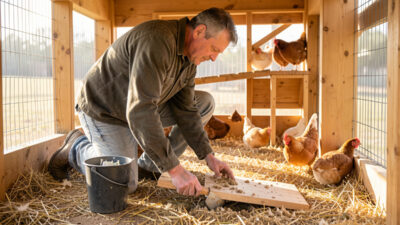
The Chicken Coop Cleaning Schedule That Actually Works
A chicken coop cleaning schedule should take about five minutes a day, fifteen minutes a week, under an hour a…
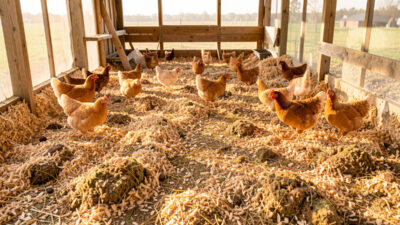
The Deep Litter Method: A Complete Guide for Chicken Coops
The deep litter method is a system where you let the bedding and droppings compost in place on the coop…