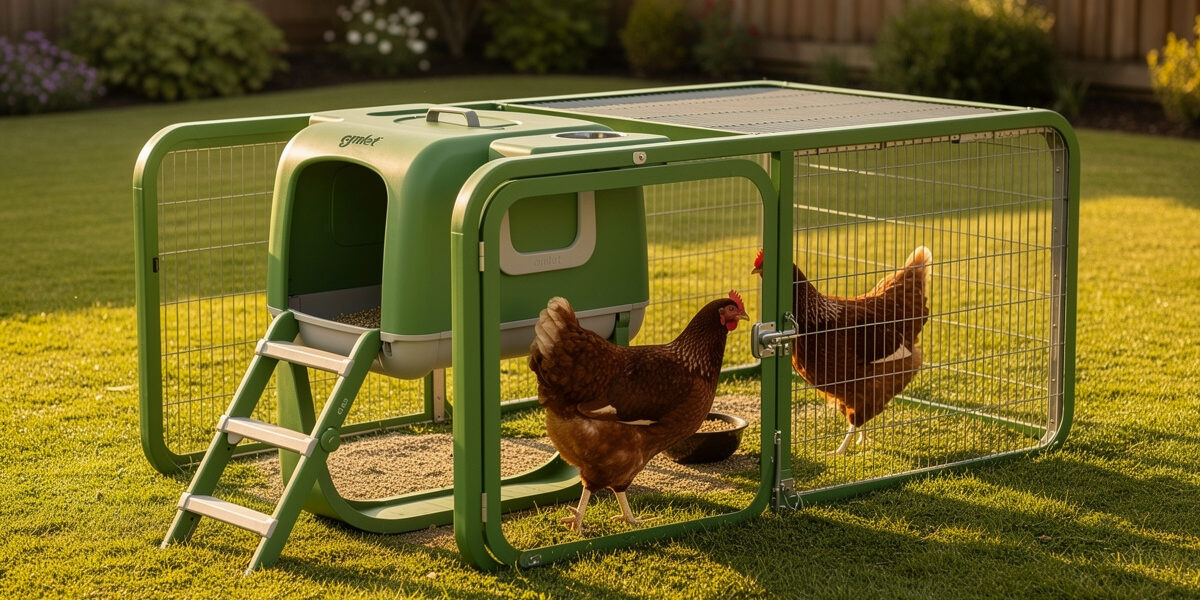
The Omlet Eglu chicken coop is the strongest premium-tier coop on the US market in 2026, built from twin-wall HDPE plastic with a 10-year worry-free warranty and the cleanest out-of-the-box smart automation integration available. Pricing runs $700 for the Eglu Go (2-4 hens) up to $1,800 for a fully kitted Eglu Cube setup with run extension (6-10 hens). The trade-off is the molded-plastic aesthetic and the longer-than-budget price tag.
Omlet has been making the Eglu line since 2004 from a UK design house, and the product has been refined steadily across two decades of real backyard use. Unlike most premium coops that compete on cedar craftsmanship and weight, the Eglu competes on engineering — the HDPE shell does not rot, the insulation is twin-walled, the cleaning routine takes 5 minutes with a pressure washer, and the matching smart-door integrates without any DIY framing work. My own coop is a self-built, insulated wood walk-in, not an Eglu — but the Omlet Autodoor is one of the automatic doors I run and have watched cycle through a full year of light on my own build, so the smart-integration half of this review is hands-on. The HDPE coop body itself is evaluated from specs, long-term owner reports, and the same engineering lens I apply to my own build. This guide covers the full Eglu lineup, the long-term ownership picture as reported by owners, the smart-coop pathway, and an honest look at where the Eglu falls short. For broader context on how Eglu stacks against other premium and mid-range brands, see our complete chicken coop brands comparison.
As an Amazon Associate I earn from qualifying purchases.
The Eglu Lineup in 2026
Omlet sells the Eglu in three main configurations for the US market. Each fits a different flock size and price point, but they all share the same HDPE construction philosophy and warranty.
Eglu Go ($700-900). The smallest model, sized for 2-4 standard hens. Footprint is compact enough for a small suburban yard, with an attached 2-meter run included. Best for first-time chicken keepers committing to a tiny flock and limited yard space. Easy to move (the whole coop weighs about 35 pounds with no chickens). Check current price on Amazon →
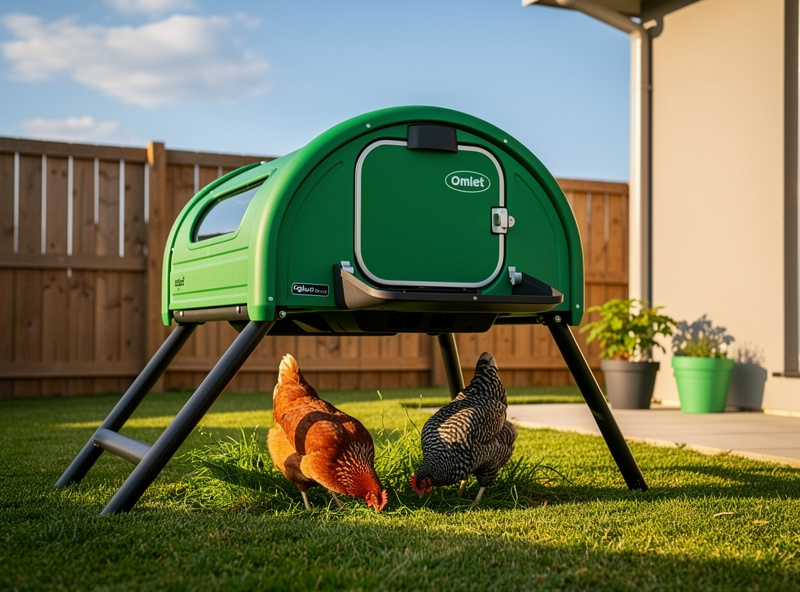
Eglu Go Up ($900-1,100). The mid-size model, raised on a metal frame so the run sits underneath the elevated coop body. Same 2-4 hen capacity as the Go but takes up about 35% less ground footprint thanks to the elevation. The vertical layout is the right pick for buyers tight on yard space. The metal frame is powder-coated steel and carries the same 10-year worry-free warranty as the rest of the coop. Check current price on Amazon →
Eglu Cube ($1,200-1,800). The flagship product. Capacity is 6-10 standard hens or up to 12 bantams. Includes a walk-in 3-meter run that you can extend with additional 1-meter or 2-meter sections. The Cube body is the most refined Eglu — the cleaning trays slide out from outside the run, the perches lift cleanly for cleaning, and the egg port lets you collect eggs without entering the coop. The 1.8-meter walk-in run height is a real comfort upgrade over crawling-into a smaller setup. Check current price on Amazon →
All three models can be ordered with the matching Omlet Autodoor pre-installed for an extra $200, which is the cleanest smart-door integration available on any consumer coop in 2026. The Autodoor closes on light sensor, timer, or app trigger, and runs off either the standard power adapter or 4 AA batteries — expect roughly 2-3 months per set of batteries on typical use (per Omlet’s own product page), so wiring in the power adapter is worth doing if the run has power nearby. Check current price on Amazon →
Why HDPE Construction Wins Long-Term
The single biggest argument for paying premium for an Eglu is what happens at year three. By month 36, a typical pine-construction coop (Producer’s Pride, Pawhut, even mid-tier Tractor Supply partners) shows wood-rot at the floor edges, asphalt-shingle wear on the roof, and pop-door warping that fights any retrofit you bolted on at year one. The Eglu shows essentially no aging.
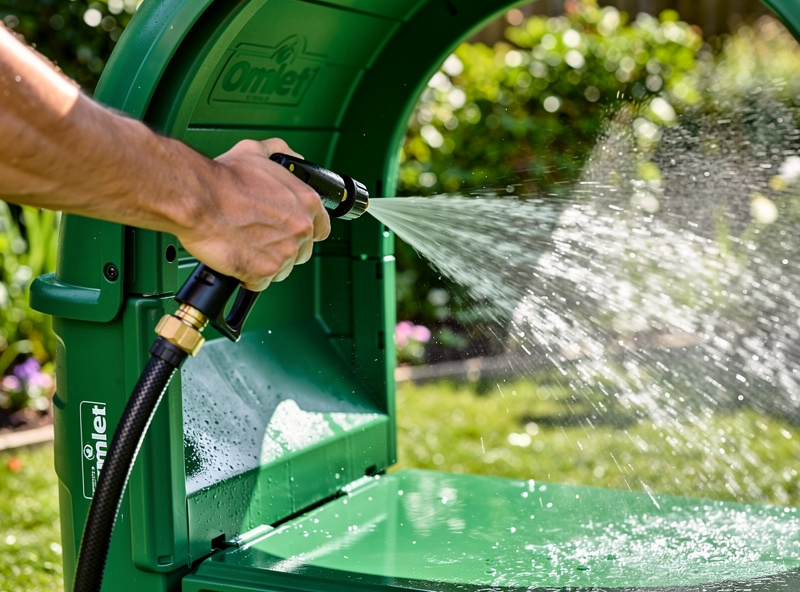
HDPE is the same plastic used in kayaks, outdoor playground equipment, and commercial trash bins. It does not rot, does not crack at 0°F or 100°F, does not absorb water, and shrugs off pressure washing. The twin-wall design (a hollow gap between two HDPE skins) provides moderate thermal insulation — interior temperatures stay 5-10°F warmer in winter and cooler in summer than single-wall pine equivalents.
The cleaning advantage compounds the longevity story. Pine coops accumulate biofilm and red mites in the wood grain, requiring twice-yearly deep cleans with diatomaceous earth or chemical treatments. The Eglu’s smooth HDPE surfaces have no grain for mites to hide in, and a 10-minute pressure wash returns it to nearly-new condition. Over years of ownership that adds up to real saved weekend time, and it meaningfully lowers the odds of the kind of mite infestation that can cost a pine-coop owner an entire flock if it goes unnoticed.
Smart-Coop Readiness — The Strongest in the Industry
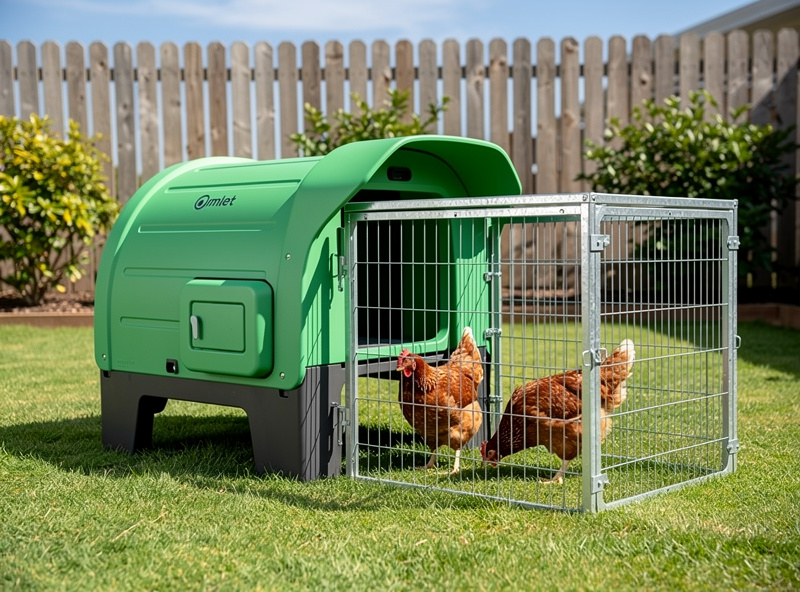
The Eglu is the only consumer coop in 2026 that ships with a fully integrated smart-door pathway from the manufacturer. The Omlet Autodoor mounts directly to the Eglu’s pop-door frame using purpose-designed brackets — no drilling, no cutting, no warranty voiding. The Autodoor is also sold separately for non-Omlet coops, but the integration on Eglu is genuinely seamless.
Beyond the door, the Eglu accommodates third-party smart accessories cleanly. The walk-in Cube run has structural elements that mount cameras and motion lights without compromising the run mesh. The flat-roofed coop body provides clean wire runs for sensor cabling. And unlike a metal-roofed coop, the Eglu’s all-plastic construction is not going to shield or bounce a wireless signal — a Wyze or Eufy camera mounted inside the run mesh gets a cleaner line to your router than it would off a metal-clad coop.
Omlet also sells the Connect app that pairs with the Autodoor and provides door-status monitoring, scheduled triggers, and remote override. The app is functional but limited compared to a Home Assistant or SmartThings setup. Power users typically add a Shelly relay or similar smart switch upstream of the Autodoor to get full home-automation integration. For the broader ecosystem of cameras, sensors, and feeders that work with Eglu coops, see our best smart chicken coop devices for 2026 roundup. For door choices including the Omlet Autodoor specifically, see our automatic chicken coop door buyer’s guide.
Omlet Eglu Models at a Glance
| Model | Capacity | Footprint | Price (Coop + Run) | Warranty | Best For |
|---|---|---|---|---|---|
| Eglu Go | 2-4 hens | Compact ground-level | $700-900 | 10 yr worry-free | First-time keepers, limited yard |
| Eglu Go Up | 2-4 hens | Elevated, smaller footprint | $900-1,100 | 10 yr worry-free | Tight yards, pest-prone areas |
| Eglu Cube | 6-10 hens (12 bantams) | Walk-in run, larger footprint | $1,200-1,800 | 10 yr worry-free | Mid-size flocks, buyers committing 10+ years |
| Cube + Autodoor | Same as Cube | Same | +$200 add-on | 2 yr on Autodoor | Full smart-coop pathway |
Pricing varies by retailer and seasonal promotions. Direct from Omlet’s US site is usually the most reliable in-stock source, with occasional Amazon listings and the rare US specialty retailer carrying the Cube.
Real-World Pros and Cons After 12+ Months
Tracking long-term owner reports across forums, reviews, and the Autodoor’s own duty cycle on my own coop, the Eglu’s strengths and weaknesses crystallize as follows.
What works very well. The cleaning routine is genuinely 5-10 minutes (not 45 minutes for a pine coop). The egg port lets you collect eggs without entering the run. The interior temperatures stay moderate through cold-climate winters without supplemental heating for most keepers — though anyone running genuinely Nordic-cold winters, mine included, still wants a thermostatic heated waterer regardless of coop material, since moisture and frozen water are the real cold-weather killers, not the shell. The Autodoor reliability is excellent — door failures are rare and Omlet honors warranty replacements quickly.
What works adequately. Predator resistance from raccoons and small predators is solid via the run mesh. The plastic shell is too smooth for raccoons to grip, and the Autodoor’s tight closing tolerance prevents reach-in attacks at the pop door. Bears and large dogs are still a structural concern — the Cube’s run mesh would not stop a determined bear, but no consumer coop will.
What disappoints. The molded-plastic aesthetic does not appeal to all backyards. Buyers who want a “country chicken coop” look will be happier with cedar or pine. Replacement parts are expensive — a cracked roosting bar costs $35 plus shipping versus $5 for raw lumber to fix a pine coop. And the integrated nesting box layout limits flexibility for buyers who want to expand to roll-away nesting boxes or non-standard configurations.
Eglu vs Mid-Range Pine Coops
The decision most buyers face is whether to spend $1,500 on an Eglu Cube or $700 on a mid-range pine coop like the Producer’s Pride Defender. The math depends almost entirely on how long you plan to keep chickens.
For owners committing 5+ years, the Eglu wins on total cost of ownership. The pine coop will need a major rebuild or replacement around year 4-5 ($300-500 in repairs or full replacement), the Eglu will not. Add the time saved on cleaning and the lower mite-infestation risk, and the Eglu pays for itself by year 5.
For owners committing 1-2 years (often first-time keepers testing whether they enjoy the hobby), the mid-range pine coop is the financially correct choice. Resale on a used Eglu holds up reasonably well on the secondhand market given how visibly non-deteriorated the plastic shell stays, but you are still losing a meaningful chunk of the purchase price in the first year like any used coop. Resale on a used pine coop loses a similar share proportionally, just on smaller absolute dollars. For our broader breakdown of mid-range options that compete with the Eglu Cube, see our Tractor Supply chicken coops review.
For owners with very small yards (under 800 sq ft of yard space available for chickens), the Eglu Go Up’s elevated design is uniquely valuable — no other premium coop fits a 4-bird flock into the equivalent footprint. The pine alternatives at this size are all larger or all worse on smart compatibility.
Next Steps
The Eglu is the right call for buyers who plan to keep chickens for 5+ years, value time savings on weekly maintenance, and want the cleanest path to a smart-managed coop. The Eglu Cube with the Autodoor add-on is the strongest single-purchase you can make in the consumer chicken coop market in 2026.
Before committing, cross-reference the broader landscape with our complete chicken coop brands guide to understand where Eglu sits in the premium tier, and our best chicken coops 2026 buyer’s guide for direct model-versus-model comparisons. For first-time keepers considering whether to start with the Eglu or a mid-range pine coop, our backyard chickens for beginners guide walks through the broader timing and equipment decisions. And to plan the full smart automation pathway from day one, see the complete smart chicken coop build guide.
Frequently Asked Questions
Are Omlet Eglu chicken coops worth the price?
For buyers committing 5 or more years, yes — the HDPE construction outlasts pine coops by 5 to 10 years, weekly cleaning is 30 minutes shorter, and the smart-door integration is the cleanest in the industry. For commitments under 2 years, a mid-range pine coop usually wins on dollars-out vs months-of-use math.
How many chickens can fit in an Omlet Eglu Cube?
The Eglu Cube houses 6 to 10 standard hens comfortably, or up to 12 bantams. Like all coops, the listed capacity is at the optimistic end — for first-time keepers we recommend planning for 6 to 8 standard hens to leave room for natural pecking-order space.
Does the Omlet Eglu come with an automatic door?
Not by default. Omlet sells the Autodoor as a $200 add-on that integrates seamlessly with all Eglu models — no drilling or framing modifications needed. The Autodoor is also sold separately and works with non-Eglu coops, but the integration on Eglu is the cleanest available.
How long does an Omlet Eglu last?
The HDPE shell is rated for 25+ years of exterior use without significant degradation. Real-world owner reports show essentially no aging at the 10-year mark beyond minor color fading from UV exposure. The 10-year structural warranty backs this longevity claim.
Can you clean an Omlet Eglu with a pressure washer?
Yes. The HDPE construction is fully waterproof and pressure-washing is the recommended cleaning method. Most owners do a 10-minute weekly hose-down plus a deeper monthly pressure wash. Compare this to 30-45 minutes per cleaning session on a pine coop.
What is the warranty on an Omlet Eglu?
All Eglu models, including the Go Up’s metal frame, carry Omlet’s 10-year worry-free warranty covering free repairs and replacement parts. The Autodoor add-on carries its own separate 2-year warranty.
Related Articles
Related Guides
Rural King Chicken Coops Compared
Rural King is a farm supply chain historically rooted in the Midwest — roughly 150 stores, with Ohio, Indiana, and…
Amazon Chicken Coops: 7 Best & 3 to Avoid
Amazon lists hundreds of different chicken coop SKUs in 2026, ranging from $99 generic listings up to $2,200 walk-in premium…
Lowes Chicken Coops: What’s Actually In Stock
Lowes carries a smaller and more curated chicken coop selection than Tractor Supply, with about 15-20 chicken coop SKUs across…